Data Processing Agreement (DPA) Review Checklist Template

A supplier’s standard DPA can look complete and still let it use your data for its own purposes, add sub-processors without telling you or take a week to report a breach. The time to find out is before you sign.

Last reviewed: October 2026

This free DPA review checklist takes one data processing agreement from a supplier, the processor, through a review by you, the controller, before anyone signs it. It is for privacy teams, in-house lawyers, DPOs and procurement. The business owner describes the data and the people it is about, the privacy reviewer confirms the roles, then checks the processing description and each term Article 28(3) requires, from documented instructions to audits. The security reviewer checks the Article 32 measures. Breach notice timing, sub-processors and the right to object, transfers outside the UK or EEA, and liability follow. Terms that fail go back to the supplier as redlines and come back for a re-review. The DPO or privacy lead signs off before the DPA is signed and added to your records of processing with a review date. Choose UK GDPR, EU GDPR or both on the first task and the matching notes appear. Review the main agreement with the Contract Review & Approval Checklist and the supplier itself with the Vendor Risk Assessment Checklist.

A DPA Review, Not a Whole Contract Review

A data processing agreement is the contract the law requires when a supplier processes personal data on your behalf. Article 28(3) of the UK GDPR and the EU GDPR lists what it must say: a description of the processing and eight terms, from documented instructions to audits. Suppliers usually send their own DPA, and most of the work is checking it says what the law needs and nothing that lets the supplier use your data for itself.

This checklist reviews one DPA, as the controller, before you sign it. It does not review the whole commercial contract or decide whether the supplier is safe to use at all; other checklists do that. It is a working checklist, not legal advice: your privacy team and your own advisers decide what your DPA needs.

This checklist

One supplier’s DPA, before signing

Covers: the roles, the Article 28(3) description and terms, security, breach notice, sub-processors, transfers, liability, redlines and the DPO’s sign-off.

When: each time a supplier that will handle personal data sends a DPA, and again at renewal.

Output: a signed DPA in your records with a review date.
The whole contract

The Contract Review & Approval Checklist

Covers: intake, risk triage, legal and commercial review, negotiation, approval, signature and filing for any contract.

Use it: for the main agreement the DPA attaches to. Contract Review & Approval Checklist.

The supplier itself

The Vendor Risk Assessment Checklist

Covers: tiering the supplier, inherent risk, security questionnaires and assurance reports, and reassessment.

Use it: before the DPA review, to show the supplier gives sufficient guarantees. Vendor Risk Assessment Checklist.

What the DPA Review Checklist Covers

Nine phases take one DPA from the day it arrives to a signed agreement in your records. The law you choose on the first task (UK GDPR, EU GDPR or both) shows the matching notes on the breach and transfer tasks. The supplier’s own DPA, sensitive data, a supplier that is not a processor, sub-processors, transfers outside the UK or EEA and terms that fail review each add their own tasks. The sign-off is the gate: the signature and the records wait until it is done.

  1. Phase 1

    Phase 1: Intake & Scope

    6 tasks

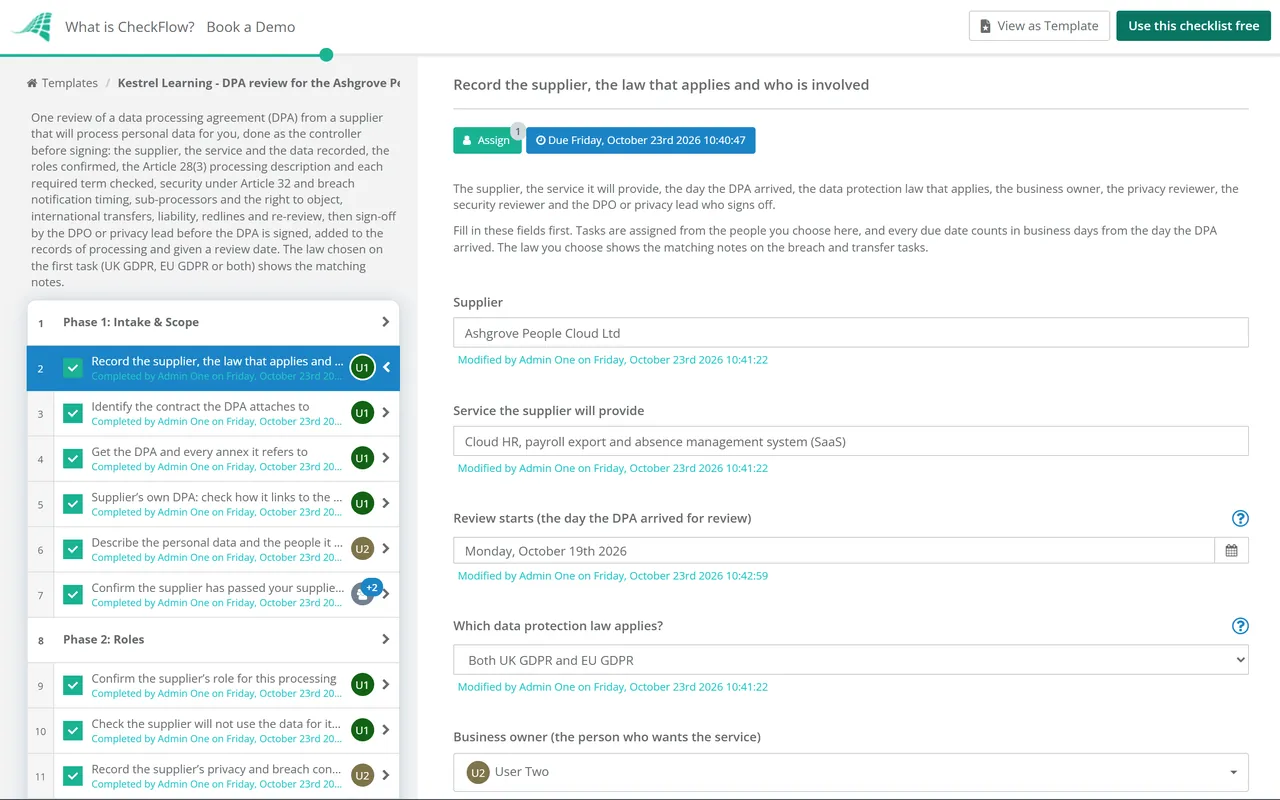
    The privacy reviewer starts the run when a supplier’s DPA arrives. Task 1 names the people and the law that applies. Every due date counts in business days from the day the DPA arrived for review.

    • Record the supplier, the law that applies and who is involved — the supplier, the service it will provide, the day the DPA arrived, the data protection law that applies, the business owner, the privacy reviewer, the security reviewer and the DPO or privacy lead who signs off
    • Identify the contract the DPA attaches to — the main agreement or order form, its term and renewal date, and who will sign for each side
    • Get the DPA and every annex it refers to — the DPA itself, the description of the processing, the security measures annex, the sub-processor list and any transfer clauses, all in the version you are being asked to sign
    • Supplier’s own DPA: check how it links to the contract and whether it can change — which document wins if the DPA and the main terms conflict, whether any part is only a link to a web page the supplier can update, and how you are told of changes
    • Describe the personal data and the people it is about — what the supplier will receive or be able to access, whose data it is (staff, customers, patients, children), roughly how many people, and where the data comes from
    • Confirm the supplier has passed your supplier checks — a completed vendor risk or security assessment, because Article 28(1) lets you use only processors that give sufficient guarantees of appropriate technical and organisational measures
  2. Phase 2

    Phase 2: Roles

    4 tasks

    Article 28 terms are for a processor that acts on your behalf. A supplier that decides why and how the data is used is a controller for that use and needs different terms, so confirm the roles before checking any clause.

    • Confirm the supplier’s role for this processing — who decides the purposes and the means: you alone (the supplier is your processor), you and the supplier together (joint controllers), or the supplier for its own purposes (a separate controller)
    • Not a processor: agree joint controller or data sharing terms instead — for joint controllers, an arrangement under Article 26 that sets out each party’s responsibilities, bearing in mind that people can exercise their rights against either of you; for a separate controller, data sharing terms. Mark the Article 28 tasks below Not applicable where they do not fit
    • Check the supplier will not use the data for its own purposes — no use for product improvement, analytics, benchmarking or training AI models unless you instruct it; under Article 28(10) a processor that decides the purposes and means of processing is treated as a controller for that processing
    • Record the supplier’s privacy and breach contacts — the supplier’s data protection officer or privacy contact, the address breach notices come from and the person who takes your instructions
  3. Phase 3

    Phase 3: The Processing Description

    4 tasks

    Article 28(3) says the contract must set out the subject matter and duration, the nature and purpose, the type of personal data and categories of data subjects, and your obligations and rights. Check each one against what the business owner described in Phase 1.

    • Check the subject matter and duration of the processing — what the service is and how long the processing lasts, tied to the term of the main contract and ending when the data is deleted or returned
    • Check the nature and purpose of the processing — what the supplier does with the data (storing, hosting, analysing, sending messages) and for which of your purposes, with nothing wider than the service needs
    • Check the types of personal data and categories of data subjects — the lists in the DPA match Phase 1, include any special category data, and are not so broad that they cover data the supplier will never receive
    • Check your obligations and rights as controller are set out — your rights to give instructions, to audit, to be told of sub-processor changes and breaches, and to choose deletion or return, written into the DPA
  4. Phase 4

    Phase 4: The Article 28(3) Terms

    7 tasks

    One task per term the law requires. Record what each clause says and whether it passes. Security and sub-processors have phases of their own.

    • Check the supplier processes the data only on your documented instructions — the Article 28(3)(a) term, including for transfers to another country, and a duty to tell you before processing if the law requires something else, unless that law forbids telling you
    • Check everyone who handles the data is bound to confidentiality — the Article 28(3)(b) term, covering staff, contractors and temporary workers who can reach the data
    • Check the supplier must tell you if an instruction breaks the law — the term at the end of Article 28(3): the processor informs you immediately if, in its opinion, an instruction infringes data protection law
    • Check the supplier will help you answer data subject requests — the Article 28(3)(e) term: appropriate technical and organisational measures to help you respond to requests such as access, rectification and erasure, with a response time short enough for your own deadline
    • Check the supplier will help with security, breaches and DPIAs — the Article 28(3)(f) term: help with your obligations under Articles 32 to 36, which cover security, notifying breaches to the regulator and to the people affected, DPIAs and prior consultation
    • Check the data is deleted or returned at the end — the Article 28(3)(g) term: deletion or return at your choice when the service ends, existing copies deleted unless the law requires them to be kept, and how backups are put beyond use until they are deleted
    • Check your audit and information rights — the Article 28(3)(h) term: all the information needed to show compliance, and audits and inspections by you or an auditor you appoint; note any limits on notice, frequency or cost
  5. Phase 5

    Phase 5: Security & Breach Notification

    4 tasks

    The supplier must take all the measures Article 32 requires. The security reviewer checks the measures annex and the privacy reviewer checks how fast you hear about a breach. Sensitive data adds a task.

    • Check the security measures annex against Article 32 — measures appropriate to the risk, as Article 32(1) lists them: pseudonymisation and encryption, ongoing confidentiality, integrity, availability and resilience, restoring access after an incident, and regular testing of the measures
    • Check access is limited to people acting on your instructions — who at the supplier can reach the data, how access is granted and removed, and that nobody processes it except on your instructions (Article 32(4))
    • Sensitive data: check the extra safeguards and whether a DPIA is needed — stronger access controls, encryption and logging for special category, criminal offence or children’s data, and whether your DPIA covers this supplier or one must be done before you sign
    • Check the breach notification terms — a fixed number of hours for the supplier to tell you, what the notice contains, who it goes to and the help you get afterwards; the law says only “without undue delay”, so agree a time that leaves room for your own deadline
  6. Phase 6

    Phase 6: Sub-Processors

    4 tasks

    Article 28(2) says the supplier may not engage another processor without your prior specific or general written authorisation. If it uses sub-processors, three tasks check the list, your right to object and the terms that flow down.

    • Find out whether the supplier uses sub-processors — hosting providers, support centres, email or analytics services and group companies that will process your data for the supplier
    • Sub-processors: get the current list and check each one — each sub-processor’s name, what it does and where it processes the data, checked against the transfer phase
    • Sub-processors: check the authorisation and your right to object — whether you give specific or general written authorisation; under a general authorisation, notice of any intended addition or replacement and a real chance to object, with what happens if you do
    • Sub-processors: check the same terms flow down and the supplier stays liable — the same data protection obligations imposed on each sub-processor by contract, and the supplier fully liable to you if a sub-processor fails to meet them (Article 28(4))
  7. Phase 7

    Phase 7: International Transfers

    4 tasks

    A transfer can happen through hosting, support access or a sub-processor abroad. If the data leaves the UK or EEA, three tasks check each destination, the transfer mechanism and the assessment behind it. The notes follow the law chosen on task 1.

    • Find out where the data is stored and accessed from — the countries where the data is hosted, backed up and supported, including remote access by support staff and by sub-processors
    • Transfers: list each destination and recipient — every country the data goes to or is reached from, who receives it there and why
    • Transfers: check the transfer mechanism for each destination — adequacy for the country, or a safeguard such as the IDTA, the UK Addendum or the EU standard contractual clauses, completed and attached to the DPA
    • Transfers: check the transfer risk assessment — where you rely on a safeguard rather than adequacy, a written assessment of the protection in the destination and any extra measures it needs, kept with the DPA
  8. Phase 8

    Phase 8: Liability, Redlines & Negotiation

    6 tasks

    Liability caps and indemnities are commercial terms, not legal requirements. Then decide whether the DPA passes. Changes needed adds the redline round and a re-review before the sign-off.

    • Check liability and indemnity for data protection breaches — whether data protection claims sit inside or outside the main liability cap, any indemnity for the supplier’s breach of the DPA, and insurance, agreed with the business owner
    • Check what happens when the contract changes or ends — the DPA lasts as long as the processing, survives termination until the data is deleted or returned, and lets you end the service if the supplier breaches it
    • Decide whether the DPA passes review — every failed term from Phases 2 to 7 in one list, each marked must change or nice to have
    • Changes needed: send the redlines to the supplier — a marked-up DPA or an issues list with the reason for each change and the wording you need, sent to the supplier’s contact
    • Changes needed: negotiate and record what was agreed — each point agreed, conceded or escalated, with the business owner deciding any commercial trade-off and the privacy reviewer any data protection one
    • Changes needed: re-review the revised DPA — every changed clause checked against the earlier tasks, and no other change slipped in elsewhere in the document
  9. Phase 9

    Phase 9: Sign-Off, Signature & Records

    6 tasks

    The DPO or privacy lead signs off before anyone signs the DPA. The sign-off is the gate: the signature, the records and the review date wait until it is done.

    • Prepare the review summary for sign-off — the supplier, the data, the roles, any sub-processors and transfers, the terms that changed and any risk accepted, with the final DPA attached
    • DPO or privacy lead signs off the DPA — the summary read, any open risk accepted or sent back, and the decision recorded; if the DPA is not ready, record what must change and leave this task open, because nothing after it can be completed until it is done
    • Sign the DPA with the right signatories — signed by someone authorised for each side, in the version that was signed off, with every annex and transfer agreement attached
    • Add the supplier and any transfers to your records of processing — the supplier among the recipients, and any countries the data goes to, as Article 30(1) asks of a controller’s record of processing activities; keep the safeguard used with the transfer documents
    • Store the signed DPA, the sub-processor list and the transfer documents — kept where your contract and privacy teams can find them, with the sub-processor list saved so later changes can be compared with it
    • Set the date to review the DPA again — a review at renewal or at a set interval, and sooner if the supplier changes its sub-processors, its locations or the service

Article 28 Terms, and the UK and EU Rules at a Glance

What Article 28 requires, and what to look for

The middle column is the law, the same in the UK GDPR and the EU GDPR. The right-hand column is common practice when reviewing a supplier’s wording, not a legal requirement.

Term What the law requires What to look for in the DPA
Description (28(3))Subject matter, duration, nature and purpose, types of personal data, categories of data subjects, your obligations and rightsLists that match the data the supplier will really receive
Instructions (28(3)(a))Process only on your documented instructions, including for transfers, unless the law requires otherwiseNo clause letting the supplier use the data for its own purposes
Confidentiality (28(3)(b))Everyone authorised to process the data is bound to confidentialityCovers contractors and temporary staff
Security (28(3)(c))All measures Article 32 requiresA measures annex specific enough to check
Sub-processors (28(2), 28(3)(d), 28(4))Your prior specific or general written authorisation; notice of changes and a chance to object; the same obligations flowed down; the supplier stays fully liableA notice period and a remedy if you object
Data subject rights (28(3)(e))Help you respond to requests, as far as possibleA response time that fits your own deadline
Your obligations (28(3)(f))Help with Articles 32 to 36: security, breach notification, DPIAs, prior consultationWho pays, and how fast
End of contract (28(3)(g))Delete or return the data at your choice, and delete copies unless the law requires storageHow backups are handled and a deletion confirmation
Audits (28(3)(h))All information needed to show compliance; allow and contribute to audits and inspectionsLimits on notice, frequency and cost
Unlawful instructionsTell you immediately if, in its opinion, an instruction infringes data protection lawA named contact for the warning

UK GDPR and EU GDPR: where the review differs

Article 28 reads the same in both. The differences show up in breach reporting and international transfers, and the notes on those tasks follow the law you choose on the first task.

Point UK GDPR EU GDPR
Processor tells you of a breachWithout undue delay after becoming aware (Article 33(2))Without undue delay after becoming aware (Article 33(2))
You tell the regulatorThe Information Commission (the ICO), without undue delay and where feasible within 72 hours (Article 33(1))The competent supervisory authority, without undue delay and where feasible within 72 hours (Article 33(1))
Countries approved for transfersUK regulations approving transfers (Article 45A), which the ICO calls adequacy regulationsEuropean Commission adequacy decisions
Standard clausesThe ICO’s IDTA, or its Addendum to the EU SCCs; the EU SCCs alone are not valid for UK transfersThe Commission’s standard contractual clauses of 4 June 2021
Assessment with a safeguardThe data protection test: protection not materially lower than under UK law (Article 46(1A) and (6))Enforceable data subject rights and effective legal remedies available (Article 46(1))

Sources. UK GDPR Article 28, Article 33 and Article 46 on legislation.gov.uk (latest revised version, including the Data (Use and Access) Act 2025 changes), and the EU GDPR as adopted. The ICO’s guidance on contracts between controllers and processors (which it says is under review after the Data (Use and Access) Act) and on international transfers, and the European Commission’s page on standard contractual clauses. ICO guidance is guidance, not law.

Why Run DPA Reviews in CheckFlow?

1

Every term checked by the right person

Choose the business owner, the privacy reviewer, the security reviewer and the DPO or privacy lead on the first task, and each task is assigned to the person who should do it. Every due date counts in business days from the day the DPA arrived, and overdue alerts go to the people assigned.

2

Only the tasks this supplier needs

The supplier’s own DPA, sensitive data, a supplier that is not your processor, sub-processors, transfers outside the UK or EEA and terms that fail review each add the tasks that deal with them. A simple DPA with none of these stays short.

3

Signed off before anyone signs

The DPO’s sign-off is a gate: the signature and the records cannot be ticked off until it is done. The DPA, the sub-processor list and the transfer documents are uploaded to the tasks they belong to, and the Reports Grid lists each review with its answers, with filters and export. See how approval steps work.

CheckFlow does not draft or redline the DPA; your documents and your lawyers do that. CheckFlow runs the review around it: who checks which term by when, what evidence is attached, what failed and who signed off. See analytics and reporting for open and overdue reviews, and how recurring checklists start the next review on time.

Assess the supplier first with the Vendor Risk Assessment Checklist, or the SaaS Procurement Security Review Checklist for a software tool, and review the main agreement with the Contract Review & Approval Checklist. If the data is sensitive, run the Data Protection Impact Assessment (DPIA) Checklist, and test your processor contracts as a whole each year with the GDPR Compliance Audit Checklist.

AI generator

Didn’t find what you need? Describe it.

Describe the process in a sentence and the AI checklist generator drafts the phases and tasks for you.

Frequently Asked Questions

What is a data processing agreement (DPA)?

It is the contract between a controller and a processor that the UK GDPR and the EU GDPR require when a supplier processes personal data on the controller’s behalf. Article 28(3) says it must be binding on the processor, describe the processing and include a set of required terms. Article 28(9) says it must be in writing, which includes electronic form. Many suppliers call theirs a DPA or a data processing addendum.

What must a DPA include under Article 28?

The subject matter and duration, the nature and purpose, the types of personal data and categories of data subjects, and your obligations and rights. Then terms that the processor acts only on your documented instructions, binds its people to confidentiality, takes the Article 32 security measures, follows the sub-processor rules, helps with data subject requests and with Articles 32 to 36, deletes or returns the data at the end, and allows audits. It must also tell you if an instruction infringes data protection law.

Do we need a DPA if the supplier is a joint controller or a separate controller?

Article 28 terms are for processors. Joint controllers need an arrangement under Article 26 that sets out each party’s responsibilities, and people can exercise their rights against either of them. A supplier that uses the data for its own purposes is a separate controller for that use, which usually calls for data sharing terms instead. The checklist adds a task for this when the roles step says the supplier is not your processor.

How quickly must a processor tell us about a data breach?

Article 33(2) says without undue delay after it becomes aware of the breach. It sets no number of hours. Your own duty is to tell the regulator without undue delay and, where feasible, within 72 hours of becoming aware, so many controllers agree a fixed number of hours in the DPA that leaves room for that. The figure is a commercial choice, not a legal one.

What should we check about sub-processors?

That the supplier cannot use one without your prior specific or general written authorisation, and that under a general authorisation it tells you of any intended addition or replacement so you can object (Article 28(2)). Also that it puts the same data protection obligations on each sub-processor by contract and stays fully liable to you for them (Article 28(4)). Get the current list and check where each one processes the data.

Do we need the IDTA or the SCCs as well as a DPA?

Only if the data is transferred to, or accessed from, a country outside the UK or EEA that is not covered by adequacy. For UK transfers the ICO’s IDTA or its Addendum to the EU standard contractual clauses are the usual safeguards; the ICO says the EU SCCs alone are not valid for UK transfers. For EU transfers, the Commission’s 2021 standard contractual clauses. With a safeguard you also need an assessment of the destination: in the UK, the data protection test.

Who should sign off a DPA?

The law does not say who signs off inside your organisation. This checklist makes the DPO or privacy lead the gate, because they can judge the data protection risk, and leaves the signature to someone authorised to sign contracts for you. The business owner decides commercial points such as liability caps, and the privacy reviewer the data protection ones.

Should the supplier go in our records of processing?

Yes, if you keep a record under Article 30. A controller’s record includes the categories of recipients and any transfers to other countries, naming each country. Under the UK GDPR, Article 30(5) exempts organisations with fewer than 250 employees unless the processing is likely to result in a risk, is not occasional, or includes special category or criminal offence data.

Is CheckFlow free for this template?

14-day free trial, no card required. The Business plan is $10 per user per month after the trial. Full details at checkflow.io/pricing.

Review Every DPA Before You Sign

Free trial — no credit card required.

14-day free trial, no credit cardFull refund in your first 30 daysUS hosting, EU on request