
LP Investor Onboarding Checklist Template

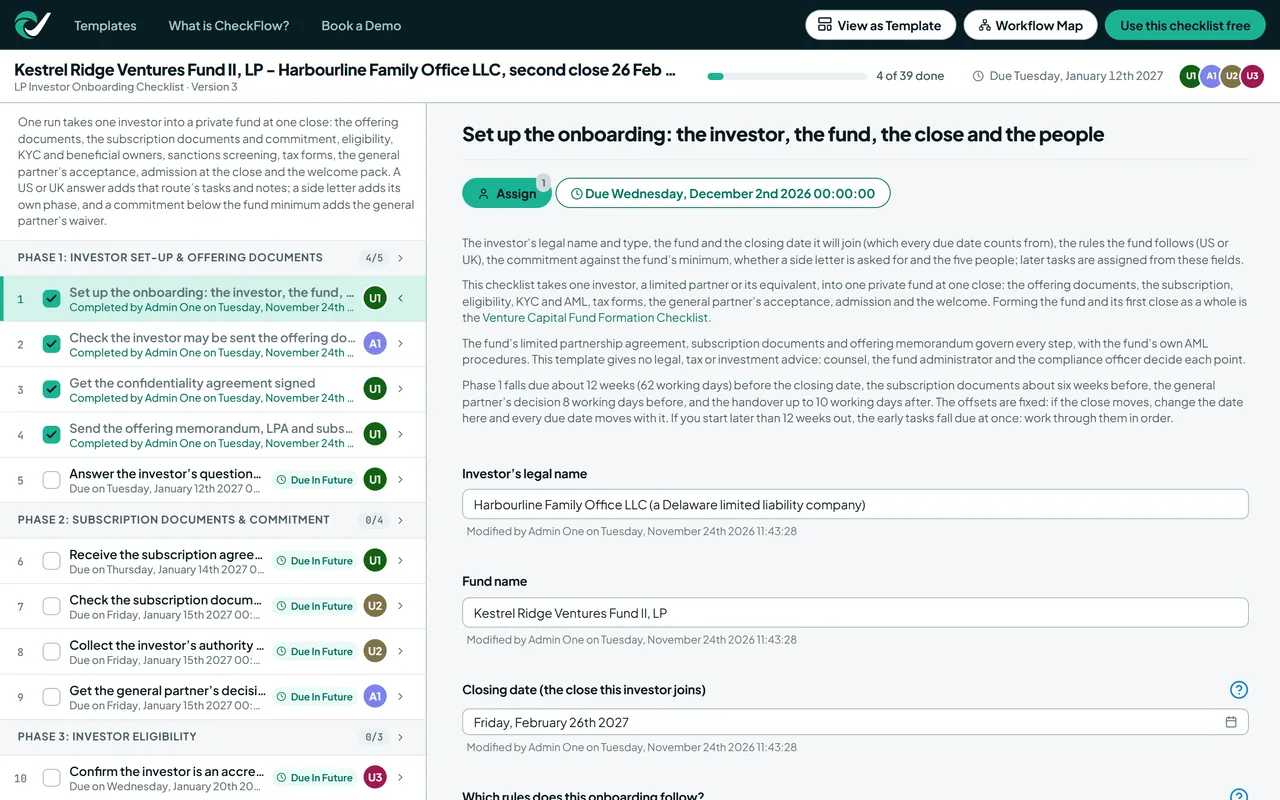
Take one investor into your fund at a close: the offering and subscription documents, eligibility, KYC and beneficial owners, tax forms, any side letter, the general partner’s acceptance and admission, on the US or UK route.

Last reviewed: November 2026

Printed from checkflow.io/templates/investor-relations/lp-investor-onboarding-checklist

This free LP investor onboarding checklist is for investor relations teams, fund administrators and fund counsel at private equity, venture capital and other private funds. One run covers one investor joining one fund at one close, with every due date counted from the closing date. It checks the investor may be sent the offering documents, receives and checks the subscription agreement and questionnaire, and confirms eligibility: accredited investor and qualified purchaser status in the US, or the client category in the UK. It identifies and verifies the investor and the people who own or control it, screens them, collects the IRS form and the FATCA and CRS self-certification, and negotiates any side letter. The general partner decides whether to accept, and the checklist halts there until the decision is made. Admission, the capital account and the welcome pack follow. It reflects the SEC, FinCEN, IRS, FCA and HMRC sources and the MLR 2017 as read on 24 November 2026, including the FCA’s new client categorisation rules from 1 December 2026.

One Investor, Not the Whole Fundraise

Each investor joining a private fund goes through the same steps: documents out, subscription back, eligibility, KYC, tax forms, the general partner’s acceptance and admission at a close. This checklist runs those steps for one investor, so each one has its own file, owner and dates, and a later investor can start while an earlier one is still in KYC.

Forming the fund, appointing its service providers and running the fundraise and first close as a whole is the Venture Capital Fund Formation Checklist; that checklist’s last phase is the fundraise, and this one is what happens for each investor inside it. A bank’s or firm’s due diligence on its own customers is the Customer Due Diligence Checklist, and the scheduled refresh of an existing customer’s file is the KYC Periodic Review Checklist. A company raising money from investors prepares the Investor Data Room Checklist; here the fund is the one checking the investor.

This checklist

LP investor onboarding

Covers: the offering and subscription documents, eligibility, KYC and beneficial owners, screening, tax forms, any side letter, the general partner’s acceptance, admission and the welcome pack, on the US or UK route.

Planned around: the closing date the investor joins, about 12 weeks ahead.

Output: an investor admitted on a complete file, or a recorded decline.

The whole fund

Venture capital fund formation

Covers: the thesis, the entities, the legal documents, registration, service providers and the fundraise to first close, in the Venture Capital Fund Formation Checklist.

Ends: with the fund formed and its first close held.

What the LP Investor Onboarding Checklist Covers

Nine phases take one investor from the offering documents, about 12 weeks before the close, to the welcome pack after it. The first task’s answers add the US tasks (accredited investor and qualified purchaser) or the UK task (client category) and each route’s notes, the ownership tasks for an entity or trust, the side letter phase, the later-close catch-up and the waiver for a commitment below the minimum. An owner at or above 25% adds its own verification, a screening result can add enhanced due diligence or a sanctions stop, and the checklist halts at the general partner’s acceptance in Phase 7.

  1. Phase 1

    Phase 1: Investor Set-Up & Offering Documents

    5 tasks

    Owned by investor relations. Start about 12 weeks before the close the investor will join. Enter the closing date on the first task: every due date counts back from it in working days, and the admission and handover tasks count forward. The first task’s answers add the US or UK tasks and notes, the beneficial ownership tasks for an entity or trust, the side letter phase, the later-close catch-up and the minimum commitment waiver.

    • Set up the onboarding: the investor, the fund, the close and the people — the investor’s legal name and type, the fund and the closing date it will join (which every due date counts from), the rules the fund follows (US or UK), the commitment against the fund’s minimum, whether a side letter is asked for and the five people; later tasks are assigned from these fields
    • Check the investor may be sent the offering documents — how the fund came to offer to this investor and the basis it relies on to send the offering memorandum, recorded before anything is sent: on the US route the Rule 506(b) or 506(c) offering, on the UK route the client category or financial promotion exemption
    • Get the confidentiality agreement signed — the confidentiality agreement or undertaking the fund asks for before it shares the offering memorandum and the data room, signed by the investor
    • Send the offering memorandum, LPA and subscription documents — the private placement memorandum or offering memorandum, the limited partnership agreement, the subscription agreement and investor questionnaire, and data room access, with the versions and the date sent recorded
    • Answer the investor’s questions and keep a log — each question from the investor or its advisers, the answer given and who gave it, with any answer that changes or adds to the offering documents checked with counsel first
  2. Phase 2

    Phase 2: Subscription Documents & Commitment

    5 tasks

    The investor returns the signed subscription agreement and questionnaire about six weeks before the close. The fund administrator checks them for gaps, and a commitment below the fund’s minimum goes to the general partner for a waiver now, before the eligibility and KYC work.

    • Receive the subscription agreement and investor questionnaire — the signed subscription agreement, the investor questionnaire, the signature pages to the LPA (or the power of attorney the subscription agreement gives) and any other forms the fund asks for, logged on the day they arrive
    • Check the subscription documents are complete — every page signed and dated by an authorised signatory, the commitment amount matching the first task, the questionnaire answered in full, the notice and bank details given, and any gaps sent back to the investor in one list
    • Collect the investor’s authority and signatory documents — for an entity or trust, the resolution or other authority to invest, the authorised signatory list and the constitutional documents; for an individual, nothing more is needed here (mark the task not applicable)
    • Get the general partner’s decision on a commitment below the minimum — the general partner decides whether to accept a commitment below the fund’s minimum, as the LPA or offering memorandum allows, before more work is done on the subscription
    • Ask the investor to raise its commitment or stop the onboarding — the investor told that the waiver was refused, and either a commitment at or above the minimum agreed (with amended subscription documents) or the onboarding stopped and the investor told in writing
  3. Phase 3

    Phase 3: Investor Eligibility

    4 tasks

    Counsel and the compliance officer confirm the investor may invest, from the questionnaire and the evidence behind it. The US route checks accredited investor and qualified purchaser status; the UK route confirms the client category. Counsel records the result.

    • Confirm the investor is an accredited investor — the paragraph of Rule 501(a) the investor relies on, the evidence for it and, in a Rule 506(c) offering, the reasonable steps taken to verify it
    • Confirm qualified purchaser status or the investor count — for a fund relying on section 3(c)(7) of the Investment Company Act, that the investor is a qualified purchaser; for a fund relying on section 3(c)(1), that admitting it keeps the fund within its limit on beneficial owners and, where its SEC-registered adviser takes a performance fee or carried interest, that the investor is a qualified client (Advisers Act rule 205-3)
    • Confirm the investor’s client category — the investor categorised as a per se professional client, an elective professional client (with its informed consent signed) or a retail client the fund may accept under an exemption, with the evidence and the date
    • Record counsel’s view on the investor’s eligibility — counsel’s conclusion that the investor may be admitted on the basis recorded above, or the reason it may not
  4. Phase 4

    Phase 4: KYC, Beneficial Owners & Screening

    9 tasks

    The fund administrator identifies and verifies the investor and, for an entity or trust, the people who own or control it, and screens them all. A sanctions match or a higher-risk result adds its own task. The compliance officer records the AML decision before the general partner decides.

    • Identify and verify the investor — the investor’s identity verified from documents or reliable sources: an individual’s name, date of birth and address; an entity’s name, registration number, registered office, governing law and constitution
    • Map the investor’s ownership and control — the ownership and control structure understood and recorded, down to the individuals who own or control the investor, with each one’s share
    • Verify each owner at or above 25% — each individual who owns or controls 25% or more of the investor identified and verified, with the evidence kept, and screened in the next task
    • Identify and verify the controllers, and a trust’s settlor and beneficiaries — for a company, partnership or LLC, its directors or managers, at least one individual with significant responsibility to control or manage it, and any individual who otherwise controls it, for example through the right to appoint or remove most of its board; for a trust or foundation, the settlor, the trustees, each named beneficiary (or the class of beneficiaries) and anyone else with control
    • Screen the investor, owners and controllers — everyone recorded so far screened against the sanctions lists, for politically exposed persons and for adverse media, with any possible match resolved and the result recorded
    • Stop and escalate a confirmed sanctions match — no money accepted and nothing signed, the match escalated to the compliance officer, and the fund’s sanctions procedure followed with counsel, including any report it must make
    • Record where the commitment money will come from — the source of the funds for the commitment and the account the investor will pay from, consistent with what is known about the investor
    • Apply enhanced due diligence — for a higher-risk investor, more information on the investor, its owners and the source of its wealth and funds, senior management approval where the rules or the fund’s procedures need it, and a plan for closer monitoring
    • Record the AML risk rating and decision — the compliance officer’s risk rating for the investor and the decision that it is cleared, cleared after enhanced due diligence or not cleared
  5. Phase 5

    Phase 5: Tax Forms & Self-Certification

    3 tasks

    The fund administrator collects the IRS form and the FATCA and CRS self-certification, and checks them against the KYC file so the investor can be classified for withholding and reporting.

    • Collect the IRS form — Form W-9 from a US person, Form W-8BEN-E (or the W-8 form the instructions require) from a foreign entity or Form W-8BEN from a foreign individual, signed and complete; mark the task not applicable if the fund’s tax adviser says none is needed
    • Collect the FATCA and CRS self-certification — the investor’s self-certification of its tax residence and, for an entity, its classification and its controlling persons, collected before admission
    • Check the self-certification against the KYC file — the tax residence, address and classification compared with the KYC documents, anything inconsistent queried and a new self-certification obtained if it fails, and the investor’s reporting status recorded
  6. Phase 6

    Phase 6: Side Letter & MFN

    4 tasks

    Applies only when the investor has asked for a side letter (first task). Counsel negotiates the terms, checks them against the LPA and the other investors’ side letters, and records any most-favoured-nation rights before the general partner decides.

    • Log the side letter requests — each term the investor asks for (fees, reporting, transfers, advisory committee seat, co-investment, tax or regulatory points, most-favoured-nation rights) logged with the reason given
    • Negotiate the side letter terms with counsel — each request agreed, changed or refused, checked against the LPA and the side letters already given to other investors, and any term the general partner must approve flagged
    • Record any most-favoured-nation rights — whether the investor has most-favoured-nation rights, which other side letter terms they let it elect, and when the election process runs under the LPA or side letter
    • Agree the final side letter for signature — the final side letter agreed with the investor and ready for signature with the subscription agreement, and added to the side letter register
  7. Phase 7

    Phase 7: General Partner Review & Acceptance

    5 tasks

    Investor relations puts the file together and, at a later close, works out the catch-up amount. The general partner signatory decides whether to accept the subscription, and nothing after that decision can be completed until it is made.

    • Work out the later-close catch-up amount — the investor’s share of the capital already drawn from earlier investors and any interest or other amount the LPA adds for joining late, agreed with the fund administrator for the closing notice
    • Put together the acceptance pack for the general partner — one summary of the commitment and any waiver, eligibility, the AML decision, the tax forms, the side letter terms and any open points, with the subscription documents attached
    • Fill the gaps the general partner named — each missing item obtained or fixed, the acceptance pack updated, and the general partner asked to decide again
    • Tell the investor and close the file — the investor told in writing that the subscription is declined, any money received returned to the account it came from, access to the data room removed and the records kept
    • General partner decides whether to accept the subscription — the general partner signatory accepts the subscription in full or for a lower commitment, or declines it, and records the reasons; complete this task with the decision
  8. Phase 8

    Phase 8: Admission at the Close

    6 tasks

    Applies only when the general partner accepts the subscription in Phase 7. The closing notice goes out with the amount due, the payment details are confirmed by phone, the documents are countersigned and the investor is admitted on the closing date.

    • Send the closing notice with the amount due — the closing notice sent to the investor with the closing date, the amount due at admission (any first drawdown and catch-up) and the fund’s payment details
    • Confirm payment details by phone — the fund’s payment details confirmed to the investor, and the investor’s own bank details for distributions confirmed, by a call to a number already on file, never one given in the same email
    • Countersign the subscription agreement and any side letter — the general partner countersigns the subscription agreement, and the side letter where there is one, for release at the close
    • Confirm the money due at admission has arrived — the amount received matched to the closing notice and to the account recorded in Phase 4, with any shortfall chased
    • Admit the investor and update the register of partners — the investor admitted at the close, the register or schedule of partners the LPA requires updated, and any filing counsel says the fund’s structure needs made
    • Set up the investor’s capital account — the investor’s commitment, the amount paid in at admission and the unfunded commitment recorded in the fund’s accounts and the administrator’s system
  9. Phase 9

    Phase 9: Welcome Pack & Handover

    5 tasks

    Applies only when the general partner accepts the subscription in Phase 7. Investor relations confirms the admission and sends the welcome pack, then hands the investor on to the capital call, reporting and KYC refresh routines.

    • Confirm admission and send the welcome pack — the investor told it has been admitted, with copies of the countersigned documents, the contacts, the reporting calendar and how capital calls and distributions will reach it
    • Give the investor access to the investor portal — the people the investor named given access to the portal or reporting service, with the notice and contact details checked
    • Hand the investor to the capital call and reporting routines — the investor added to the capital call and distribution lists and the reporting distribution list, with its commitment and payment details
    • Diary the KYC refresh and tax form renewal — the next KYC review date set by the risk rating, the W-8 renewal date where one applies, and the side letter reporting duties added to the fund’s calendar
    • Close the onboarding file — every document and decision kept in the investor file, the retention period recorded, and the onboarding marked complete

The US and UK Routes Side by Side

The investor relations work is the same in both countries. These are the rules that differ, as the official sources put them on 24 November 2026. The first task’s answer shows one column’s tasks and notes.

Topic United States United Kingdom Source
Who may investAn accredited investor under Rule 501(a); a fund relying on section 3(c)(7) also needs qualified purchasers, and one relying on section 3(c)(1) stays within 100 beneficial owners (250 for a qualifying venture capital fund); a performance fee needs qualified clients (rule 205-3).A professional client, or a retail client only where a promotion exemption and the fund allow it.17 CFR 230.501, 275.205-3; 15 U.S.C. 80a-2(a)(51), 80a-3(c); COBS 3, COBS 3A
Sending the offering documentsRule 506(b) limits the manner of offering; Rule 506(c) does not, but every purchaser must be accredited and verified.COBS 4.12B restricts promoting non-mass market investments to retail clients; units in unregulated collective investment schemes fall under section 238 of FSMA.17 CFR 230.506; COBS 4.12B.6R and 4.12B.7R
Changes nowSEC notices (October 2026) on more credentials for accredited investor status; comments due 4 December 2026. Not yet rules. The SEC also proposed on 6 October 2026 to let accredited investors count as qualified clients for performance fees; comments due 7 December 2026. Not yet a rule.New client categorisation rules in COBS 3A from 1 December 2026; old or new rules may be used until 31 May 2028.SEC Release 33-11446; Federal Register 2026-20474; FCA PS26/23
AML rules for the fundFinCEN’s AML rule for investment advisers is postponed to 1 January 2028; until then identity and beneficial owner checks follow the fund’s own procedures. OFAC sanctions apply now to every US person.Customer due diligence when a business relationship is established, for relevant persons under the MLR 2017.FinCEN, 31 December 2025; MLR 2017 regs 8, 27, 28
Beneficial ownersOwners of 25 percent or more and one individual with control (the CDD rule, used here as practice).Owners or controllers of more than 25% of a body corporate, and any individual who otherwise controls it; for a trust, the settlor, trustees, beneficiaries and anyone with control.31 CFR 1010.230(d); MLR 2017 regs 5, 6, 28
Sanctions and PEPsOFAC’s sanctions lists, which every US person must comply with.The UK Sanctions List; UK financial sanctions apply to everyone in the UK and to UK persons abroad. Enhanced due diligence for a politically exposed person or a FATF call for action country.OFAC FAQ 11; OFSI general guidance; MLR 2017 regs 33, 35
Tax formsForm W-9 from a US person; Form W-8BEN-E or W-8BEN from a foreign investor.A FATCA and CRS self-certification on account opening, checked for reasonableness.IRS; HMRC IEIM403140, IEIM403440
RecordsAs the fund’s policy and regulators require.Five years after the business relationship ends.MLR 2017 reg 40

Sources read on 24 November 2026: Regulation D on eCFR and Cornell LII; the Investment Company Act and 31 CFR 1010.230 on Cornell LII; FinCEN’s postponement notice; the IRS pages for Forms W-9 and W-8BEN-E; the FCA’s PS26/23 and COBS as published in September 2026; HMRC’s International Exchange of Information Manual; GOV.UK on the UK Sanctions List and OFSI’s general guidance; OFAC’s FAQ 11; the SEC’s 6 October 2026 proposal in the Federal Register; and the Money Laundering Regulations 2017 on legislation.gov.uk, as amended in 2026. The fund’s LPA, offering documents and AML procedures govern each step. Take legal and tax advice on your own fund.

Why Onboard Fund Investors in CheckFlow?

1

No admission before the general partner decides

The general partner signatory named on the first task is the only person who can complete the acceptance decision, and the checklist halts there: the closing notice, countersignature and admission cannot be completed until it does. Not accepted yet adds a rework task and Declined adds the task to close the file, and both hide the admission phases. See how approvals that halt a checklist work.

2

The investor sets the checklist

The US or UK answer adds that route’s eligibility task and notes. An entity or trust adds the ownership and control tasks, an owner at or above 25% adds its verification, a side letter adds its phase, a later close adds the catch-up and a commitment below the minimum adds the general partner’s waiver. Conditional logic keeps the rest out of the way.

3

Timed from the close, owned by name

Enter the closing date and every task falls due a set number of working days before or after it. Tasks go to investor relations, the fund administrator, counsel, the compliance officer and the general partner named on the first task, and each sees their work in the Tasks Grid. Every investor in progress sits in the Reports Grid, and the commitment and amounts are recorded as numbers.

CheckFlow runs the onboarding: who does what and by when, the evidence kept and the decisions made. It does not verify identities, screen names, decide eligibility or give legal, tax or investment advice. Your administrator, compliance officer and counsel do that, and the checklist records what they found and decided.

Screen names across all investors with the Sanctions Screening Checklist, refresh files with the KYC Periodic Review Checklist, and report to investors once they are in with the Investor Communication & Reporting Framework Checklist.

AI generator

Didn’t find what you need? Describe it.

Describe the process in a sentence and the AI checklist generator drafts the phases and tasks for you.

Frequently Asked Questions

What should an LP investor onboarding checklist include?

The offering documents sent on a recorded basis, the subscription agreement and questionnaire checked, eligibility confirmed, the investor and the people who own or control it identified, verified and screened, the tax forms and self-certification, any side letter, the general partner’s acceptance, admission at the close with the capital account set up, and the welcome pack. This template covers those steps for one investor on the US or UK route, timed from the closing date.

What documents does an investor sign to join a private fund?

The fund’s own documents set the list. It typically includes a subscription agreement with an investor questionnaire, signature pages to the limited partnership agreement or a power of attorney to sign it, tax forms and a self-certification, and sometimes a side letter. The investor also gives KYC documents for itself and the people behind it. This template’s subscription tasks check each one has arrived, signed and complete.

Who can invest in a private fund in the US?

Under Rule 506(c) every purchaser must be an accredited investor (Rule 501(a)): for example an individual with net worth over $1,000,000 excluding their home, or income over $200,000 in each of the last two years and expected this year, or a company, partnership or LLC with total assets, or a family office with assets under management, over $5,000,000, not formed to buy the securities. Rule 506(b) also allows up to 35 non-accredited purchasers in any 90 days, each able to evaluate the risks. A section 3(c)(7) fund needs qualified purchasers.

How does a fund verify accredited investor status under Rule 506(c)?

Rule 506(c) requires the fund to take reasonable steps to verify that every purchaser is accredited. The rule lists optional methods for individuals: reviewing IRS forms for income, recent statements and a credit report for net worth, or a written confirmation from a broker-dealer, registered adviser, attorney or CPA. In March 2025 SEC staff also said a high minimum investment is a relevant factor, with written representations. Counsel decides what is enough.

How are fund investors categorised in the UK?

A firm treats each client as retail, professional or an eligible counterparty under the FCA’s rules. From 1 December 2026 those rules move to COBS 3A: elective professional status uses an expertise route or a £10 million wealth route, and the client’s informed consent must be signed. Firms may use the old or new rules until 31 May 2028. Promotions of non-mass market investments to retail clients are restricted to set exemptions.

Do private funds have to run AML checks on their investors?

In the UK, a fund manager or administrator that is a relevant person under the Money Laundering Regulations 2017 must apply customer due diligence when the relationship starts. In the US, FinCEN’s rule for investment advisers was postponed to 1 January 2028, so identity and beneficial owner checks follow the fund’s own procedures. Sanctions are different: every US person, including a US fund, must comply with OFAC sanctions now, and UK financial sanctions bind everyone in the UK.

Which tax forms does a fund investor provide?

A US person usually gives Form W-9 with its taxpayer identification number. A foreign entity usually gives Form W-8BEN-E (a foreign partnership or other flow-through entity often gives Form W-8IMY instead), which generally stays valid until the end of the third calendar year after it is signed, and a foreign individual Form W-8BEN. Funds that report under FATCA and the CRS also need a self-certification of tax residence, checked against the KYC file. The fund’s tax adviser confirms what is needed.

What is a side letter, and what is a most-favoured-nation clause?

A side letter is a separate agreement between the fund and one investor that adds to or changes how the LPA applies to it, for example on reporting, fees or transfers. A most-favoured-nation clause lets an investor elect terms given to other investors in their side letters, within limits the clause sets. This template logs each request, has counsel check it against the LPA and other side letters, and records any such rights.

What happens when an investor joins a fund at a later close?

An LPA can require a later investor to pay its share of the capital already drawn from earlier investors, sometimes with an extra amount for joining late, so that all investors end up in the same position. The LPA says whether and how it is worked out. In this template, choosing a later close on the first task adds a task to record the catch-up figures before the closing notice goes out.

Is CheckFlow free for this template?

14-day free trial, no card required. The Business plan is $10 per user per month after the trial. Full details at checkflow.io/pricing.

Admit Every Investor on a Complete File

Free trial — no credit card required.

14-day free trial, no credit cardFull refund in your first 30 daysUS hosting, EU on request