
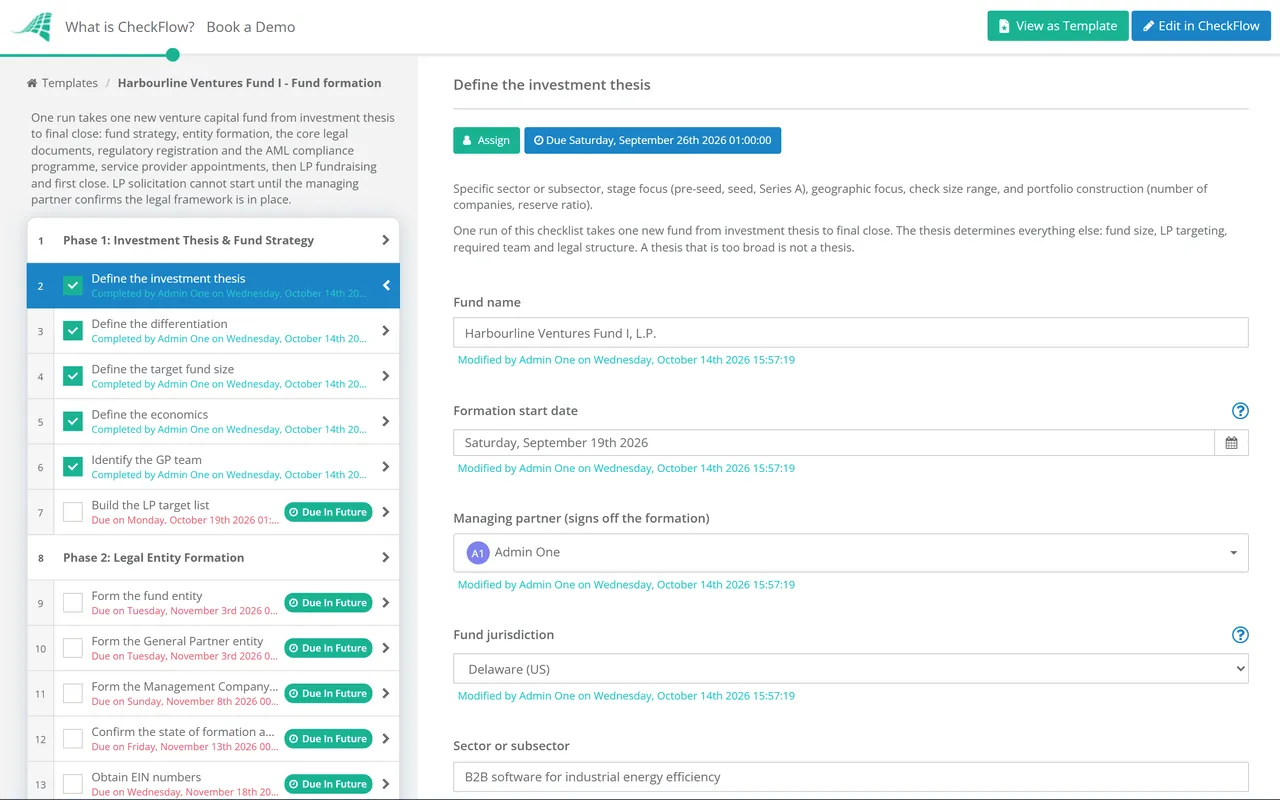
Fund formation takes 6–18 months, costs $200K–$400K in legal fees, and requires your legal framework to exist before your LP conversations do. A structured process is not optional — it is the difference between a compliant fund launch and a regulatory failure.
Most first-time GPs approach fund formation backwards. They spend months refining the investment thesis, build an LP target list, and then discover they have no idea how to structure the fund, what regulatory requirements apply, or how to draft the legal documents that govern the fund’s entire lifecycle. The legal framework must exist before LP conversations begin — not as a formality, but because any solicitation of LP capital before proper legal structure is in place creates regulatory exposure under federal and state securities laws. As of January 2026, new FinCEN AML rules add a formal anti-money laundering programme requirement to the compliance obligations of SEC-registered investment advisers and Exempt Reporting Advisers — including written policies and procedures, a designated compliance officer, and ongoing employee training. A structured fund formation checklist sequences every decision — from investment thesis through entity formation, legal documentation, regulatory registration, service provider selection, LP fundraising, and first close — in the correct order, with the correct advisers, on the correct timeline. This free checklist gives first-time GPs and emerging managers a structured framework for the full fund formation process.
Disclaimer: This checklist describes the fund formation process framework. VC fund formation involves complex legal, regulatory, tax, and securities law considerations that vary significantly by jurisdiction, fund size, and structure. Always engage qualified legal counsel specialising in investment fund formation before making any legal or regulatory decisions. This checklist does not constitute legal, financial, or regulatory advice.
The investment thesis — the specific sector, stage, geography, and differentiated approach that defines the fund’s strategy — determines everything else: fund size, LP targeting, required team, and legal structure. A thesis that is too broad is not a thesis; a thesis that cannot be differentiated from existing funds will not attract institutional LPs.
Legal Framework Before LP Conversations
The legal and compliance infrastructure (fund entity, GP entity, regulatory filings, compliance policies) must be established before LP solicitation begins. Soliciting capital commitments without proper legal structure creates regulatory exposure under federal securities laws, including the Investment Advisers Act and applicable state laws.
The Regulatory Tier Determines the Framework
Sub-$150M funds typically qualify for Exempt Reporting Adviser (ERA) status — simpler compliance than full SEC registration. Funds targeting $150M+ require full SEC registration under the Investment Advisers Act. The regulatory tier determines compliance costs, reporting requirements, and examination risk.
What the VC Fund Formation Checklist Covers
Six phases covering the full fund formation lifecycle — from investment thesis through entity formation, legal documentation, regulatory registration and AML compliance, service provider selection, and LP fundraising to first close.
Phase 1
Investment Thesis & Fund Strategy
The investment thesis is the product the LP is buying. It must be specific, differentiated, and credible — backed by a track record or a demonstrable edge that explains why this GP, this sector, at this stage, is better positioned than existing funds.
Define the investment thesis — specific sector or subsector, stage focus (pre-seed, seed, Series A), geographic focus, check size range, and portfolio construction (number of companies, reserve ratio)
Define the differentiation — what does this fund offer that the 500+ existing VC funds does not? Sourcing edge, sector expertise, network access, or operator experience?
Define the target fund size — a realistic target based on the LP network, track record, and deployment strategy; first funds are typically $10M–$50M for emerging GPs
Define the economics — management fee (typically 2%), carried interest (typically 20%), preferred return (hurdle rate), and any GP commitment (typically 1–3%)
Identify the GP team — founding partners, complementary skills, track record (deal history and outcomes); GP economics allocation agreed in writing before fund formation begins
Build the LP target list — family offices, endowments, HNWIs, fund of funds, institutional LPs, and strategic LPs; mapped to relationship strength
Phase 2
Legal Entity Formation
Delaware remains the preferred jurisdiction for US VC fund formation — its legal infrastructure for investment vehicles is mature, well-tested, and familiar to institutional LPs. Engage jurisdiction-specific counsel for UK and European fund structures.
Form the fund entity — typically a Delaware Limited Partnership (the fund); GP counsel engaged before this step
Form the General Partner entity — typically a Delaware LLC; this is the GP that manages the fund and carries the management fee and carried interest
Form the Management Company entity — separate from the GP in many structures; employs the team and receives the management fee
Confirm the state of formation and any additional state qualifications — required in states where the fund will be doing business or where GPs reside
Obtain EIN numbers — for each entity formed; required for banking and regulatory filings
Phase 3
Core Legal Document Drafting
Draft the Limited Partnership Agreement (LPA) — the governing document of the fund; covers LP rights, GP obligations, investment restrictions, fee structure, distribution waterfall, fund term, and GP removal provisions; negotiate key terms carefully
Draft the Private Placement Memorandum (PPM) — disclosure document provided to prospective LPs; covers the investment strategy, team, terms, risks, and legal information; required for securities law compliance
Draft subscription documents — the documents LPs sign to commit capital; accredited investor certification, KYC/AML information, and LP representations
Draft side letter framework — template for LP-specific terms (most-favoured-nation provisions, reporting requirements, excuse rights); manage carefully to avoid contradicting the LPA
Draft management agreement and GP agreement — documenting the GP entity’s relationship to the fund and management company
Confirm all documents are reviewed by qualified fund formation counsel — do not use templates without specialist legal review
Phase 4
Regulatory Registration & Compliance Framework
2026 AML Update: As of January 1, 2026, formal AML programme requirements apply to both SEC-registered RIAs and Exempt Reporting Advisers. Written policies, a designated compliance officer, and employee training are now mandatory. This is the most urgent compliance item for new fund managers.
Determine the regulatory registration tier — Sub-$150M AUM: Exempt Reporting Adviser (ERA) filing on Form ADV Part 1A; Over $150M: full SEC registration as a Registered Investment Adviser (RIA)
File Form ADV — through IARD system; Part 1A (required) and Part 2A brochure (required for RIAs and recommended for ERAs); with qualified compliance counsel
Confirm Investment Company Act exemption — Rule 3(c)(1) (no more than 100 beneficial owners; not a public offering) or Rule 3(c)(7) (qualified purchasers only; unlimited investors); confirm with counsel
Implement the AML compliance programme — REQUIRED as of January 2026: written AML policies and procedures; designated compliance officer; ongoing employee training; KYC protocols for all LPs
Register with applicable state regulators — state notice filings where required; confirm with counsel for each state where LPs are located
Establish compliance calendar — Form ADV annual amendment (within 90 days of fiscal year end); any ongoing regulatory filing requirements
Phase 5
Service Provider Appointment
Appoint fund formation counsel — specialising in investment fund formation; the most important service provider appointment
Appoint the fund administrator — manages LP capital accounts, capital calls, distributions, NAV calculations, and LP reporting; institutional LPs typically require independent fund administration
Appoint an independent auditor — registered with PCAOB where required; annual audit of the fund financial statements
Appoint a tax adviser — fund and GP tax structuring, K-1 preparation, UBTI analysis for tax-exempt LPs
Confirm banking arrangements — fund and management company bank accounts; some banks are experienced with VC fund structures; confirm AML/KYC requirements for account opening
Consider technology infrastructure — LP portal for reporting, CRM for deal pipeline, cap table management, and compliance management tools
Phase 6
LP Fundraising & First Close
Confirm legal framework is in place — before beginning LP solicitation; formation entity, initial legal documents, and regulatory filing must exist first
Prepare the pitch materials — pitch deck, data room, and supporting materials; consistent with the PPM; reviewed by legal counsel for compliance
Engage anchor LPs first — the first LP commitment creates social proof; anchor LP terms may include fee discounts or advisory board seats
Manage the LP pipeline — tracking interest, meetings, due diligence requests, and commitment status; a detailed pipeline is essential for managing close timing
Execute LP KYC/AML process — before accepting any LP commitment; collect all required information; verify accredited investor or qualified purchaser status; required under AML programme
Target the first close — sufficient capital to begin deployment (typically 50–60% of target fund size); announce first close and begin deployment
Continue fundraising to final close — the LPA will define the fundraising period (typically 12–18 months from first close); equalisation provisions for late-closing LPs
The Core Fund Formation Documents — What Each One Does
Document
Purpose
Who It Protects
Limited Partnership Agreement (LPA)
Governing document of the fund; defines GP/LP rights, economics, investment restrictions
Both GP and LP
Private Placement Memorandum (PPM)
Disclosure document for prospective LPs; investment strategy, team, risks
LP (informed consent); GP (disclosure defence)
Subscription Documents
LP commitment and KYC/AML information
GP (LP representations)
Management Agreement
GP entity’s authority to manage the fund
Fund (structured delegation)
Side Letters
LP-specific terms; MFN, reporting, excuse rights
Specific LP protections
Form ADV
SEC/regulatory disclosure; part of investment adviser registration
Regulators and LPs
Why Run Fund Formation in CheckFlow?
1
A sequenced formation process that follows the correct order
Fund formation has a specific dependency sequence — entity formation must precede regulatory filing; legal documents must precede LP solicitation; AML programme must be implemented before accepting LP commitments. CheckFlow’s fund formation checklist enforces this sequence structurally — each phase cannot begin until the preceding phase’s required tasks are complete.

2
Track all service providers and deliverables in one place
A fund formation process involves six or more specialist service providers (counsel, administrator, auditor, tax adviser, bank) all working in parallel with interdependent deliverables. CheckFlow assigns tasks across all parties, tracks outstanding items, and sends reminders — giving the managing partner a single view of where the formation process stands across every workstream.
3
A compliance record from day one
SEC examination findings frequently relate to inadequate documentation of compliance procedures — particularly AML programmes and Form ADV accuracy. Every formation task completed through CheckFlow is timestamped and attributed, creating a documented compliance record from the first day of fund operation. The record of when the AML programme was implemented, when training was conducted, and when LP KYC was completed exists as a byproduct of running the formation process.
After fund formation, the LP reporting and communication programme begins. CheckFlow’s Investor Communication & Reporting Framework covers the structured process for managing LP updates, quarterly reports, and investor query management. See the Investor Communication & Reporting Checklist →
LP due diligence on GPs often focuses on governance and compliance frameworks. CheckFlow’s compliance template series covers related regulatory compliance checklists. See the Compliance Templates →
What does the venture capital fund formation process involve?
+
VC fund formation involves six phases: investment thesis and fund strategy (defining the specific investment focus, differentiation, target size, and economics), entity formation (creating the Delaware LP fund entity, GP entity, and management company), legal documentation (drafting the LPA, PPM, subscription documents, and side letter framework with specialised fund formation counsel), regulatory registration and compliance (Form ADV filing, investment company act exemption confirmation, and AML programme implementation), service provider selection (fund administrator, auditor, tax adviser, bank), and LP fundraising and first close (pitching to LPs, managing the pipeline, executing KYC/AML, and achieving first close). The process typically takes 6–18 months and requires significant legal investment — $200K–$400K in legal fees is not unusual for a first fund.
What is the difference between an SEC-registered RIA and an Exempt Reporting Adviser?
+
Investment advisers with AUM below $150 million typically qualify as Exempt Reporting Advisers (ERAs) — required to file Part 1A of Form ADV but exempt from full SEC registration. This significantly reduces compliance burden and examination exposure. Advisers with AUM at or above $150 million must register as full Registered Investment Advisers (RIAs) — subject to a broader set of requirements including the full Form ADV (Parts 1 and 2), code of ethics, compliance programme, and periodic SEC examination. As of January 2026, both ERAs and RIAs are now subject to the same AML programme requirements under updated FinCEN rules.
What is the AML requirement for VC funds effective January 2026?
+
As of January 1, 2026, SEC-registered investment advisers (both registered RIAs and Exempt Reporting Advisers) are subject to formal anti-money laundering programme requirements under updated FinCEN rules. The requirements include three core components: written AML policies and procedures tailored to the specific risks of the firm, a designated AML compliance officer responsible for implementing and overseeing the programme, and ongoing employee training on AML obligations. The rules also require KYC (Know Your Customer) protocols for all investors and suspicious activity reporting. For new fund managers in 2026, establishing the AML programme at formation is now a mandatory first step.
What is carried interest and how is it structured?
+
Carried interest is the GP’s share of profits from the fund — typically 20% of returns above the invested capital (and above any hurdle rate or preferred return, often 8%). It is the primary performance-based compensation for VC fund managers. The distribution waterfall — the sequence in which capital is returned and profits are distributed — is one of the most heavily negotiated provisions in the LPA. American waterfall (deal-by-deal carry) favours the GP; European waterfall (whole-fund carry) favours the LP. Most institutional LPs negotiate for European-style waterfall. Carry is taxed as long-term capital gains in the US, subject to a 3-year holding period requirement. Specific tax advice is essential.
Is CheckFlow free for this template?
+
14-day free trial, no card required. The Business plan is $10 per user per month after the trial. Full details at checkflow.io/pricing.
Build Your Fund’s Infrastructure Before You Build Your LP Relationships
Free trial — no credit card required.
Do you like cookies? 🍪 We use cookies to ensure you get the best experience on our website. Learn more