
Investor Queries & Communication Management Checklist Template

An investor who asks a question and receives a slow, inconsistent, or substantively different answer from the one another investor received is an investor whose confidence is declining. Regulation FD does not allow the alternative — and good IR practice would not permit it anyway.

Investor query management sits at the intersection of investor relations, compliance, and reputation management. A query from a major shareholder about a strategic decision, fielded by a junior IR executive who provides a speculative answer, can move markets and create regulatory exposure. A query from a prospective LP about fund performance, answered with information not provided to existing LPs, can breach the terms of the LPA. A query from a retail shareholder about business strategy, answered with different information than was provided to an institutional investor in a private meeting, may violate Regulation FD (US) or MAR (UK/EU). The structures that prevent all three failures are the same: a single point of contact for investor queries; an approved response framework that defines which questions are answered, by whom, and with what pre-cleared content; a screening step that identifies MNPI risk before responses go out; and a complete query log that makes every interaction auditable. This free checklist gives IR teams, CFOs, and fund managers a structured framework for managing investor queries consistently, compliantly, and professionally.

Disclaimer: Investor query management at listed companies is subject to securities disclosure laws. Consult qualified legal and compliance counsel for specific regulatory requirements.
Use This Template Free See Live Example
No Credit Card Required

What Investor Query Management Needs to Get Right — Every Time

Consistency

Every investor who asks the same question receives the same answer — not similar, the same. This requires an approved response framework with pre-cleared content for frequently asked questions, and a review process before any novel response is sent. Inconsistency is a regulatory risk for listed companies and a relationship risk for all.

Speed

An investor who waits five days for a response to a routine question is an investor who is forming a negative view about the organisation’s operational competence. Response time commitments — acknowledging within 24 hours and substantive response within 48–72 hours — should be defined, communicated, and met.

Compliance

At listed companies, any response to an investor query that contains material non-public information must be simultaneously disclosed publicly — or not provided at all. The MNPI screening step must be built into every query response process, not applied retrospectively when a problem has already occurred.

What the Investor Queries Management Checklist Covers

Six phases covering the full investor query management cycle — from framework setup and query receipt through MNPI screening, response drafting and approval, dispatch, and continuous improvement.

Phase 1

Query Management Framework Setup

Query management is only as good as the framework it operates within. An ad hoc query management process — whoever happens to receive the query responds with whatever they think is accurate — is not a process.

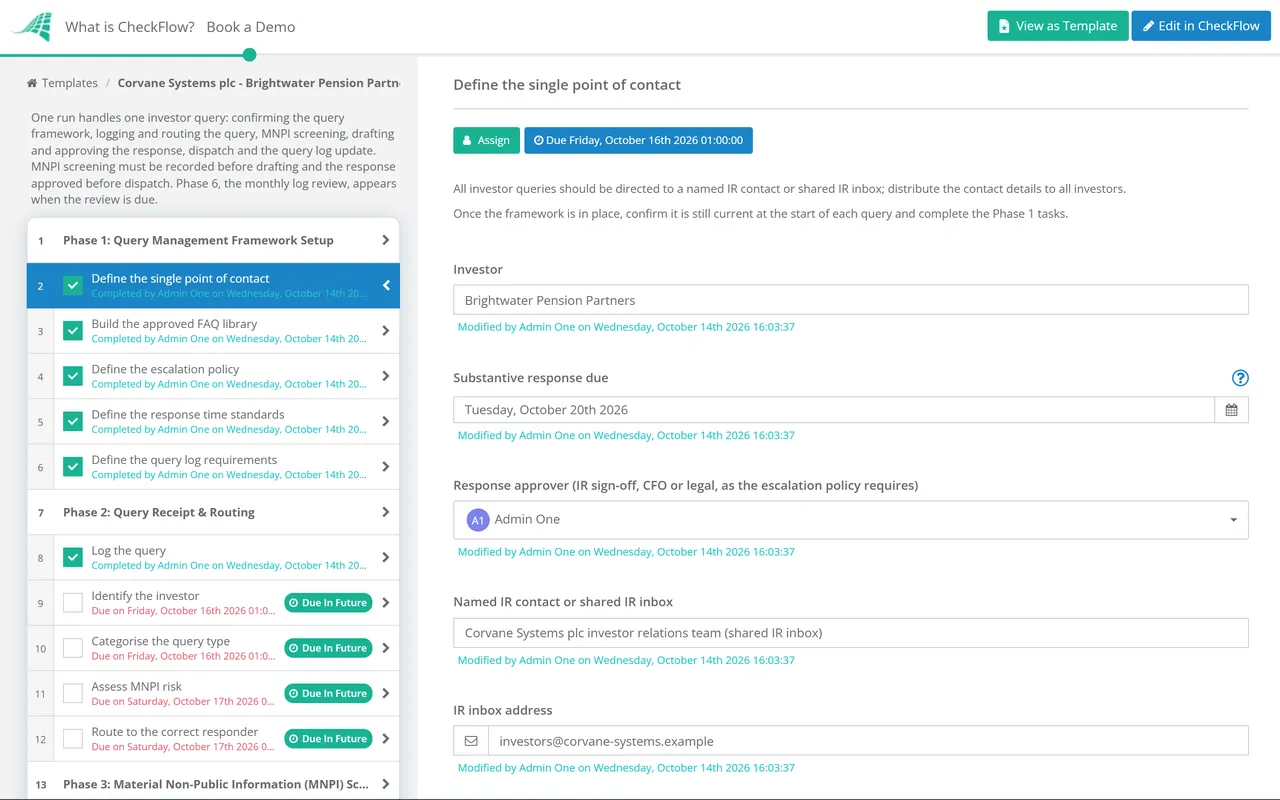
  • Define the single point of contact — all investor queries should be directed to a named IR contact or shared IR inbox; distribute the contact details to all investors
  • Build the approved FAQ library — pre-cleared responses to the questions most commonly received; reviewed by legal and compliance; updated after every results period and material event
  • Define the escalation policy — which queries can be answered directly; which require CFO or legal review before response; which require a call rather than a written response
  • Define the response time standards — acknowledgement within 24 hours; substantive response within 48–72 hours for routine queries; same day for urgent queries from major shareholders
  • Define the query log requirements — every query received is logged: date, investor identity, nature of query, response provided, response date, and MNPI screen result
Phase 2

Query Receipt & Routing

  • Log the query — immediately upon receipt; investor name, date, channel (email, call, meeting), and query topic summary
  • Identify the investor — institutional, retail, LP, analyst, prospective investor, or press; the routing and response approach may differ by category
  • Categorise the query type — financial performance, strategy, governance, ESG, operational, regulatory, or other; determines routing and approved response framework
  • Assess MNPI risk — does answering this query require sharing information that is not yet public? If yes: escalate immediately; do not respond until the MNPI question is resolved
  • Route to the correct responder — based on query category and the escalation policy; confirm the responder is aware and has accepted the task
Phase 3

Material Non-Public Information (MNPI) Screening

MNPI screening is the highest-stakes step in the investor query management process for listed companies. When in doubt, the answer is to consult legal counsel before responding.

  • Assess whether the query topic involves non-public information — financial results not yet filed; merger or acquisition plans; new product or customer announcements; management changes; regulatory investigations
  • If MNPI risk exists — do not respond with the non-public information; consult legal counsel; consider whether public disclosure is required before the query can be answered
  • For ongoing quiet periods — confirm the company is not in a quiet period before responding to financial queries; quiet period policy communicated to investors annually
  • For questions answered in a private meeting or call — document precisely what was disclosed; confirm no MNPI was shared; if MNPI was inadvertently shared, escalate immediately for Reg FD/MAR compliance action
  • Record the MNPI screening outcome — in the query log; “no MNPI risk identified” or “escalated for legal review”; this record is a compliance document
Phase 4

Response Drafting & Approval

  • Check the FAQ library first — is there a pre-approved response for this category of query? Use it; do not rephrase or expand beyond what has been approved
  • For queries not in the FAQ library — draft a response; route for approval before dispatch; never send a novel response without a review step
  • Confirm consistency with prior responses — if the same or similar question has been answered before, confirm the response is consistent with prior communications
  • Obtain the required approval — based on the escalation policy; routine queries from the FAQ library may need only IR sign-off; novel responses need CFO and/or legal review
  • For verbal responses (calls or meetings) — prepare a briefing note in advance; document what was said immediately after; the call record is a compliance document
Phase 5

Response Dispatch & Query Log Update

  • Dispatch the response — via the defined channel; from the IR inbox or named IR contact; not from personal email accounts
  • Confirm the response is factual, specific, and does not contain promotional language — investor communications are not marketing materials
  • Update the query log — response date, response content (or reference to the archived response), approver, and MNPI screening outcome
  • Archive the full correspondence — all query and response communications retained; for listed companies per records retention requirements; for private companies per good practice
  • Flag complex or recurring queries — for FAQ library expansion; if the same question is arriving repeatedly, the reporting or disclosure needs improving
Phase 6

Query Log Management & Continuous Improvement

  • Review the query log monthly — volume, topic distribution, response time performance, and any recurring query themes
  • Identify disclosure gaps — recurring queries on the same topic indicate a gap in investor reporting; the next investor communication should address it
  • Review FAQ library — after every results period; update for new topics; retire outdated responses
  • Confirm response time compliance — are queries being acknowledged within the defined standard? Are substantive responses meeting the committed timeline?
  • Report to senior leadership — key investor query themes and sentiment from the period; major shareholder concerns require escalation, not just logging
  • Produce the query log for any regulatory examination — the complete log with MNPI screening records is immediately accessible

How to Handle an Investor Query That May Touch MNPI

1

Stop before responding

Any query that touches earnings not yet reported, M&A activity, material management changes, regulatory investigations, or major customer wins or losses should not be answered immediately. Pause.

2

Assess whether the information is public

If it has been filed with the SEC, issued via RNS, or otherwise publicly disclosed — it is not MNPI. If it has not been publicly disclosed — it may be MNPI.

3

Consult legal/compliance if unsure

The test is not whether the information feels material — it is whether a reasonable investor would consider it important in making an investment decision. If in doubt, consult qualified counsel before responding.

4

Consider public disclosure as the solution

If investors are asking a question that requires material information to answer, the solution is to disclose it publicly — via press release, 8-K/RNS, or earnings call — and then answer the query citing the public disclosure.

5

Document the decision whatever the outcome

Whether the query was answered, referred, or escalated, document the MNPI assessment and the rationale. This is the compliance record.

Why Run Investor Query Management in CheckFlow?

1

A query management process that prevents inconsistent responses

When investor queries are answered ad hoc by whoever happens to receive them, the risk of inconsistent responses is high. CheckFlow’s query management checklist routes every query through the same triage, MNPI screening, and response approval sequence — ensuring every investor receives a response that has been approved by the correct person using approved language.


2

MNPI screening as a required step, not a hoped-for habit

MNPI screening is a step that is most likely to be skipped under time pressure — exactly the time when market-sensitive queries tend to arrive. CheckFlow makes the MNPI screening task a required step before the response drafting task can begin. No response goes out without the screening step being completed and documented.

3

A complete, searchable query log for regulatory examination

A regulatory examination that asks “what did you tell this investor, on this date, about this topic” requires a complete, accurate query log with response records and MNPI screening documentation. Every query managed through CheckFlow is logged, dated, attributed, and archived — producing the complete query record as a byproduct of running the process.

Investor queries most commonly relate to the content of the last investor report. CheckFlow’s Investor Communication & Reporting Framework covers the structured reporting cycle that reduces query volume by improving disclosure quality. See the Investor Communication & Reporting Checklist →

For the strategic IR programme that determines which investors the company is engaging with and how, CheckFlow’s Strategic IR & Stewardship Checklist covers the investor targeting and relationship management process. See the Strategic IR Checklist →

Frequently Asked Questions

What should an investor query management process cover?

+

An investor query management process covers six areas: framework setup (single point of contact, FAQ library, escalation policy, response time standards, query log requirements), query receipt and routing (logging, investor identification, query categorisation, initial MNPI risk assessment, and routing to the correct responder), MNPI screening (systematic assessment of whether the query requires non-public information to answer, with escalation and documentation), response drafting and approval (FAQ library check, consistency review, required approval before dispatch), response dispatch and logging (dispatch through defined channels, log update, and archive), and query log management (monthly review, disclosure gap identification, FAQ library maintenance, and regulatory examination readiness).

What is Regulation FD and how does it apply to investor queries?

+

Regulation FD (Full Disclosure), an SEC rule applying to US-listed companies, prohibits the selective disclosure of material non-public information to certain investors or analysts without simultaneous public disclosure. In the context of investor query management, this means that a listed company cannot answer a material question from one investor — in a private meeting, call, or email — that it would not simultaneously answer for all investors. If a query requires material information to answer, the options are: decline to answer the query in private, or make the information publicly available (via filing, press release, or a publicly accessible call) and then answer the query citing the public disclosure. Reg FD applies to intentional disclosures and requires prompt public disclosure if unintentional disclosure occurs.

How quickly should investor queries be acknowledged?

+

Best practice is acknowledgement within 24 hours and a substantive response within 48–72 hours for routine queries. Major shareholders and institutional investors with active, large positions may reasonably expect faster responses — and slower responses are disproportionately noticed and negatively weighted by those investors. Urgent queries relating to material developments should be responded to on the day of receipt. During quiet periods (pre-results blackout windows), response times may extend because many financial queries cannot be answered — communicating the quiet period status promptly avoids investor frustration.

What is an IR quiet period and how should queries be handled during one?

+

An IR quiet period (or blackout period) is a defined period before earnings or results announcements during which IR teams and executives do not discuss the company’s financial performance with investors — to prevent inadvertent selective disclosure of material information before results are public. Quiet periods typically begin 2–4 weeks before results announcements. During a quiet period, investor queries about financial performance, outlook, or any topic touching material information should be acknowledged promptly, with the investor informed that the company is in a quiet period and will be in touch following the results. The quiet period schedule should be communicated to investors at the start of each financial year so expectations are set in advance.

Is CheckFlow free for this template?

+

14-day free trial, no card required. The Business plan is $10 per user per month after the trial. Full details at checkflow.io/pricing.

Manage Every Investor Query Consistently, Compliantly, and on Record

Free trial — no credit card required.