Capital Call Checklist Template

One notice went out with last quarter’s figures, an LP wired to a bank account taken from a spoofed email, and nobody chased the late payer until the investment had closed. A capital call is a short, fixed timetable with money moving on it, and each step needs an owner and a date.

Last reviewed: November 2026

Printed from checkflow.io/templates/investor-relations/capital-call-checklist

This free capital call checklist runs one drawdown from a fund’s limited partners (LPs), for fund CFOs, fund administrators, general partners (GPs) and investor relations teams. The CFO checks the call against the limited partnership agreement (LPA) first: its purpose, the investment period, the uncalled commitments and the notice period. Fees, expenses and any subscription line repayment are worked out next, then each LP’s amount, checked by a second person. The fund’s bank details are confirmed from a trusted source before the notices are drafted, and the GP approves the call before anything goes out. After the notices, the checklist covers call-back checks against wire fraud, a reminder, matching each wire on the due date and paying out. Money still outstanding on the due date adds a late funding and default phase, and the run ends with the ledger, each LP’s capital account and the next LP report. The fund’s LPA governs every step.

One Capital Call, After the Fund Is Formed

A capital call, or drawdown, is the GP asking the LPs for part of the money they committed, on the terms the LPA sets. The Venture Capital Fund Formation Checklist ends at the first close, when the commitments are signed. This checklist starts after that and runs once for each call, and the Investor Communication & Reporting Framework Checklist covers the regular reports in which each call later appears.

This checklist

One drawdown from the LPs

Covers: the purpose and LPA checks, fees and any subscription line, each LP’s amount, the bank details and notices, the GP’s approval, call-back checks, receipts, late funding, capital accounts and the LP report.

Run by: the fund CFO, with the fund administrator, investor relations and the GP.

Output: the money in on time, every LP’s capital account right and a record of each step.

Before the first call

Setting up the fund

Covers: the investment thesis, the fund entities, the legal documents, registration, service providers and LP fundraising to the first close.

Use it: to form the fund. Once the LPs have signed, each call runs on this checklist. Venture Capital Fund Formation Checklist.

After the call

Regular reporting to investors

Covers: the reporting calendar, report content, material events and the compliance review of what goes to investors.

Use it: for the periodic report in which this call appears. Investor Communication & Reporting Framework Checklist.

What the Capital Call Checklist Covers

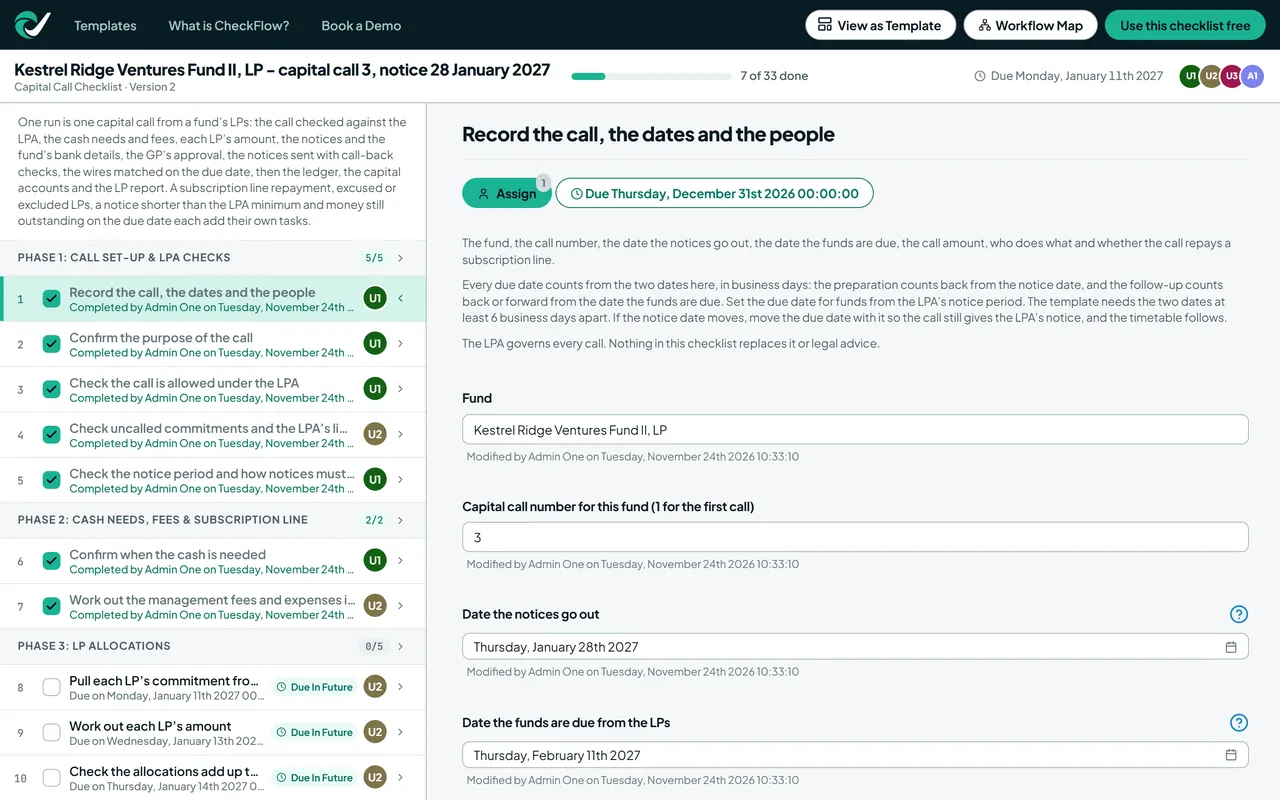
Nine phases take one capital call from set-up about four weeks before the notices go out to the review after the money is in. Two dates on the first task drive the due dates, in business days: the preparation counts back from the date the notices go out, and the follow-up counts from the date the funds are due, which you set from the LPA’s notice period. The two dates must be at least 6 business days apart. The offsets are fixed: a longer notice period leaves a longer gap between the notices and the due date, and if the notice date moves, move the due date with it so the call still gives the LPA’s notice, and the timetable follows. The GP’s approval is the gate: no notice goes out until it is done. A subscription line repayment, excused or excluded LPs, a notice shorter than the LPA minimum and money outstanding on the due date each add their own tasks.

  1. Phase 1

    Phase 1: Call Set-Up & LPA Checks

    6 tasks

    Start about four weeks before the notices go out. The first task sets the two dates the timetable counts from, the call amount and the four people, and asks whether the call repays a subscription line. Then check the purpose, the investment period, the uncalled commitments and the notice period against the LPA. A notice shorter than the LPA minimum adds a task to fix the dates before anything is drafted.

    • Record the call, the dates and the people — the fund, the call number, the date the notices go out, the date the funds are due, the call amount, who does what and whether the call repays a subscription line
    • Confirm the purpose of the call — each investment, management fee and expense the call pays for, with its amount and the date the cash is needed
    • Check the call is allowed under the LPA — the investment period, the follow-on, fee and expense provisions, and the clause each part of the call falls under
    • Check uncalled commitments and the LPA’s limits — total commitments, what has been called so far and what is left after this call, and any cap the LPA sets
    • Check the notice period and how notices must be given — the LPA’s minimum notice, the notice this call gives between the two dates on the first task, and how the LPA says notices are delivered
    • Fix the notice period before any notice goes out — move the date the funds are due so the call gives at least the LPA’s notice, or get any consent or waiver the LPA allows in writing
  2. Phase 2

    Phase 2: Cash Needs, Fees & Subscription Line

    4 tasks

    Work out when the money is needed and what the fees and expenses in the call are. When the call repays a subscription line, get the payoff figure and say so in the notice.

    • Confirm when the cash is needed — the closing date of each investment and the date fees and expenses are paid, with room after the due date for late wires
    • Work out the management fees and expenses in this call — the basis and rate in the LPA, any offsets, reductions or waivers, and whether each counts against commitments
    • Get the payoff amount from the lender — the principal and interest to the planned repayment date, from the lender in writing
    • Show the repayment in the notice — the lender, the facility’s size and outstanding balance, its maturity, the interest and fees in this repayment, and what the drawing was used for, so LPs can see the call repays it
  3. Phase 3

    Phase 3: LP Allocations

    6 tasks

    Each LP’s amount comes from its commitment and the LPA’s terms. Use the current investor register, apply any excused or excluded LPs, check the total against the call amount and have a second person check it.

    • Pull each LP’s commitment from the investor register — the current register, with any transfer, new LP at a later close or change of details since the last call
    • Apply the excused and excluded LPs — remove each excused or excluded LP from that investment and share its part among the others as the LPA says
    • Work out each LP’s amount — each LP’s share of commitments applied to the call amount, rounded the way the LPA or the fund’s policy says
    • Check the allocations add up to the call amount — the total of the LP amounts against the call amount on the first task, with any rounding difference explained
    • Screen every LP against the sanctions lists again — each LP and its known owners and controllers, checked again before money moves
    • Have a second person check the allocations — someone who did not prepare them checks the register, the shares, the amounts and the total
  4. Phase 4

    Phase 4: Notices & Wire Instructions

    5 tasks

    Confirm the fund’s own bank details before they go into a notice, then prepare the cover letter, the description and each LP’s notice, and put the approval pack together for the GP.

    • Confirm the fund’s bank details from a trusted source — from the bank or the fund’s signed account record, never from an email, and confirmed by phone on a number already on file
    • Draft the cover letter and the description — a short cover letter with the net amount due, what it is for and the LPA clause, and a fuller description of each investment, fee and expense
    • Prepare each LP’s notice — the amount due, the due date, its commitment, contributions to date, uncalled commitment before and after, and the wire instructions
    • Check every notice against the allocations — each LP’s name, amount, figures and wire instructions against the checked allocations and the confirmed bank details
    • Send the approval pack to the GP — the purpose and amount, the LPA checks, the allocations, the notices and the bank details confirmation
  5. Phase 5

    Phase 5: GP Approval

    2 tasks

    The GP approves the call before any notice goes out. Not approved adds a rework task. Leave the approval open until the answer is Approved: completing it releases the notices whatever the decision says.

    • Rework the call and return it to the GP — fix what the GP raised, update the tasks it affects, and send the revised pack back
    • Approve the capital call — the GP approves the purpose, the amount, each LP’s amount and the notices before anything goes out
  6. Phase 6

    Phase 6: Notices & Call-Back Checks

    5 tasks

    Send every notice on the notice date by the route the LPA sets, confirm each LP has it, answer questions and call-back checks, and remind LPs before the due date. Any request to change bank details is treated as suspect.

    • Send the notices to every LP — on the notice date, by the route the LPA sets, with the cover letter, the description and each LP’s own figures
    • Confirm every LP has received its notice — bounced emails, unread portal notices and LPs whose contact has changed, followed up the same day
    • Answer LP questions about the call — questions on the purpose, the amounts or the timing, answered consistently and logged
    • Send a reminder before the due date — to LPs that have not confirmed their wire, with the due date and the call-back reminder
    • Handle call-back checks and any request to change bank details — confirm the fund’s wire instructions to LPs who call back, and verify any change to an LP’s own bank details on a number already on file
  7. Phase 7

    Phase 7: Receipts & Matching

    5 tasks

    On the due date, match every wire to its LP and record what is still outstanding. Money outstanding shows the late funding phase. Then pay out what the call was for.

    • Check the fund account for incoming wires — the account statement each day from the reminder to the due date, with each LP’s payment reference
    • Match each wire to its LP — each receipt against the LP’s amount called, and the total received and outstanding at the end of the due date
    • Query or return any wire you cannot match — a payment with no reference, from an unknown account or for the wrong amount is queried before it is accepted
    • Pay out the called capital — fund the investment and pay the fees and expenses as the notice said, using payee details confirmed by call-back
    • Repay the subscription line and get the lender’s confirmation — the payoff amount sent to the lender’s confirmed account, and written confirmation that the drawing is repaid
  8. Phase 8

    Phase 8: Late Funding & Default

    5 tasks

    Applies only when money is still outstanding at the end of the due date. Find out why, follow the LPA’s default terms with fund counsel, and record what was paid late and any interest charged.

    • Contact each LP that has not paid — on the next business day, by phone on a known number, to find out whether the wire is on its way or something is wrong
    • Check the LPA’s default terms with fund counsel — any grace or cure period, interest on late payment, the notice the LPA requires and what the GP may do
    • Send the default notice the LPA requires — only where the LPA’s conditions are met and counsel agrees, by the route and with the content the LPA sets
    • Record late payments and any default interest — what each late LP paid and when, and any interest charged under the LPA
    • Decide on any remedy with the GP and counsel — where an LP has still not paid, the GP decides with counsel which of the LPA’s remedies to use
  9. Phase 9

    Phase 9: Reconciliation & LP Reporting

    6 tasks

    Reconcile the call in the fund’s books, update each LP’s capital account and the uncalled commitments, record the call for the next LP report, file the record and note what to change next time.

    • Reconcile the call in the fund’s books — receipts and payments in the ledger against the bank statement and the notices
    • Update each LP’s capital account — contributions, fees and expenses for each LP, matching its notice
    • Update the uncalled commitments and the call log — the fund’s and each LP’s uncalled commitment after this call, and the call added to the log of calls
    • Record the call for the next LP report — the call, its purpose and each LP’s contribution, ready for the next quarterly report
    • File the call record — the LPA checks, the allocations, the GP’s approval, the notices, the bank confirmation, the receipts and any default papers in one place
    • Review how the call went — late payers, LP questions, corrections and anything to change before the next call

What to Check in the LPA, and What Goes in a Capital Call Notice

What to check in the LPA

The first three phases check each of these before the notices are drafted.

LPA term What to check before each call Where in this checklist
Investment periodWhether new investments can still be called, and what may be called after it ends, such as follow-ons, fees and expensesPhase 1
Commitments and limitsUncalled commitments, any cap on one investment, recycling, and whether fees are called inside or outside commitmentsPhase 1
NoticeThe minimum notice, how its days are counted and how notices must be deliveredPhase 1
Management fees and expensesThe fee basis and rate, offsets, reductions and waivers, and which expenses the fund bearsPhase 2
Subscription lineWhether the fund may borrow ahead of a call, and how a call that repays the line is shownPhases 2 and 7
Excused and excluded investorsWhen an LP may be excused, or the GP may exclude one, from an investment, and how its share is called from the othersPhase 3
DefaultAny grace or cure period, interest on late payment, the notices required and the GP’s remediesPhase 8

What goes in a capital call notice

Phase 4 prepares each part.

Part of the notice What ILPA’s 2025 guidance says it contains
Cover letterA brief narrative of the transaction
Description letterA fuller overview. For an investment: the company, its geography and industry, the use of capital, the deal’s main terms and any LPA amendment or waiver needed, with its date. For fees and expenses: the expense covered, how the amount was worked out, offsets, fee waivers and whether it is inside or outside commitments
Every noticeClear references to the relevant sections of the LPA, and detailed payment instructions
ILPA Capital Call & Distribution TemplateThe accounting details in a standard format, including transaction types, amounts and the effect on the LP’s unfunded commitment, as a supplement to the notice, in Excel or another digital format rather than PDF

Nothing on this page is law or legal advice: the fund’s LPA and other governing documents set the rules for every call, and fund counsel interprets them. The notice contents above come from the Institutional Limited Partners Association’s cover letter and description letter best practices and its Capital Call & Distribution Template guidance, both released in September 2025. The updated template replaces ILPA’s 2011 version: the guidance says funds using ILPA’s Performance Template should use it for funds launched from the first quarter of 2026, with the first delivery not required until the first quarter of 2027, and other funds for funds commencing operations from the first quarter of 2027.

The four weeks of preparation and every offset in this template are its own choices, not rules. In First Citizens Bank’s emerging manager guide, the head of Silicon Valley Bank’s Emerging Manager Practice recommends at least 10 and up to 30 days’ notice for all LPs; the period in your LPA is the one that counts.

Why Run Capital Calls in CheckFlow?

1

Two dates set the whole timetable

Enter the date the notices go out and the date the funds are due, and every task falls due a set number of business days from one of them. Tasks are assigned from the four people named on the first task, and overdue alerts go to every assignee.

2

Nothing goes out before the GP approves

The GP’s approval is a gate: the notices cannot be marked sent until it is done. A notice shorter than the LPA minimum hides the send task until the dates are fixed. See how approval steps work.

3

Every call on record

Each call keeps its LPA checks, allocations, approval, call-backs and receipts on one run. Every fund’s calls sit on the Reports Grid with their answers, so an outstanding amount or a late reconciliation stands out, and Analytics shows completion and overdue work by person and by step.

CheckFlow does not move money, hold bank details or calculate allocations: your bank, fund administrator and ledger do that. It runs the work around the call: who checked what against the LPA, who approved it, which LPs confirmed, what came in and what was chased.

Set the fund up with the Venture Capital Fund Formation Checklist, report to investors with the Investor Communication & Reporting Framework Checklist and log investor questions with the Investor Queries & Communication Management Checklist. Check a change to anyone’s bank details with the Vendor Bank Detail Change Verification Checklist, and handle a sanctions match with the Sanctions Screening Checklist.

AI generator

Didn’t find what you need? Describe it.

Describe the process in a sentence and the AI checklist generator drafts the phases and tasks for you.

Frequently Asked Questions

What is a capital call?

A capital call, also called a drawdown, is a request from a fund’s general partner (GP) to its limited partners (LPs) for part of the money they committed, under the fund’s limited partnership agreement (LPA). Each LP pays its share by the due date in its notice. The money pays for investments, management fees and fund expenses, or repays a subscription line the fund drew first. This checklist runs one call from the LPA checks to the LP report.

What should a capital call notice include?

ILPA’s 2025 best practices describe a short cover letter, a fuller description letter and its Capital Call & Distribution Template for the accounting details. The description covers each investment (the company, what the money is for and the deal’s main terms) and each fee or expense (how it was worked out, offsets and whether it is inside or outside commitments). Every notice should refer to the relevant LPA sections and give detailed payment instructions. Phase 4 prepares each part.

How much notice do LPs get for a capital call?

The LPA sets the minimum and how its days are counted, so read it for each fund. A Silicon Valley Bank emerging manager adviser quoted in First Citizens Bank’s guide recommends at least 10 and up to 30 days’ notice. This template checks the notice the call gives against the LPA minimum, and hides the task that sends the notices until a short notice is fixed. The demo uses 10 business days, which is its own choice.

How is each LP’s share of a capital call worked out?

This checklist starts each LP’s share from its commitment as a share of total commitments, applied to the call with the LPA’s rounding, and the LPA decides any exception: an excused or excluded LP does not take part in an investment, and its share is called from the others as the LPA says. Fees can differ where LPs have different fee terms. This checklist has the total checked against the call amount and the allocations checked by a second person.

What happens if an LP misses a capital call?

The LPA’s default clause decides what happens. It may give a grace or cure period, charge interest on the late amount and give the GP remedies, and the terms differ from fund to fund. When money is still outstanding at the end of the due date, this checklist adds a phase: contact each LP that has not paid, check the default terms with fund counsel, send any notice the LPA requires, record what was paid late and let the GP decide any remedy.

How do you protect capital call payments from wire fraud?

Confirm the fund’s own bank details with the bank before they go into a notice, ask LPs to confirm the wire instructions by phone on a number they already hold, and never accept new bank details by email. The FBI’s Internet Crime Complaint Center advises verifying changes to account information through secondary channels or two-factor authentication. If fraud is suspected, call the bank at once and report it: in the US at ic3.gov, and in the UK to Report Fraud or, in Scotland, Police Scotland on 101.

How does a capital call repay a subscription line?

A subscription line is a credit facility a fund can draw on before it calls capital from its LPs. A later call then raises the money to repay the drawing. ILPA’s 2025 guidance says the call type should match what the facility was used for, such as an investment, and the call should be noted as a subscription facility repayment. This checklist adds the payoff figure, the wording in the notice and the repayment with the lender’s confirmation.

Who is involved in a capital call?

The GP decides and approves the call. The fund CFO or finance lead runs it and checks it against the LPA, the fund administrator or accountant works out each LP’s amount, matches the wires and updates the ledger, and investor relations sends the notices and answers LP questions. Fund counsel advises on the LPA and on any default. In this checklist each of those roles is named on the first task and assigned its tasks.

Is CheckFlow free for this template?

14-day free trial, no card required. The Business plan is $10 per user per month after the trial. Full details at checkflow.io/pricing.

Get Every Capital Call Out Right and the Money In on Time

Free trial — no credit card required.

14-day free trial, no credit cardFull refund in your first 30 daysUS hosting, EU on request