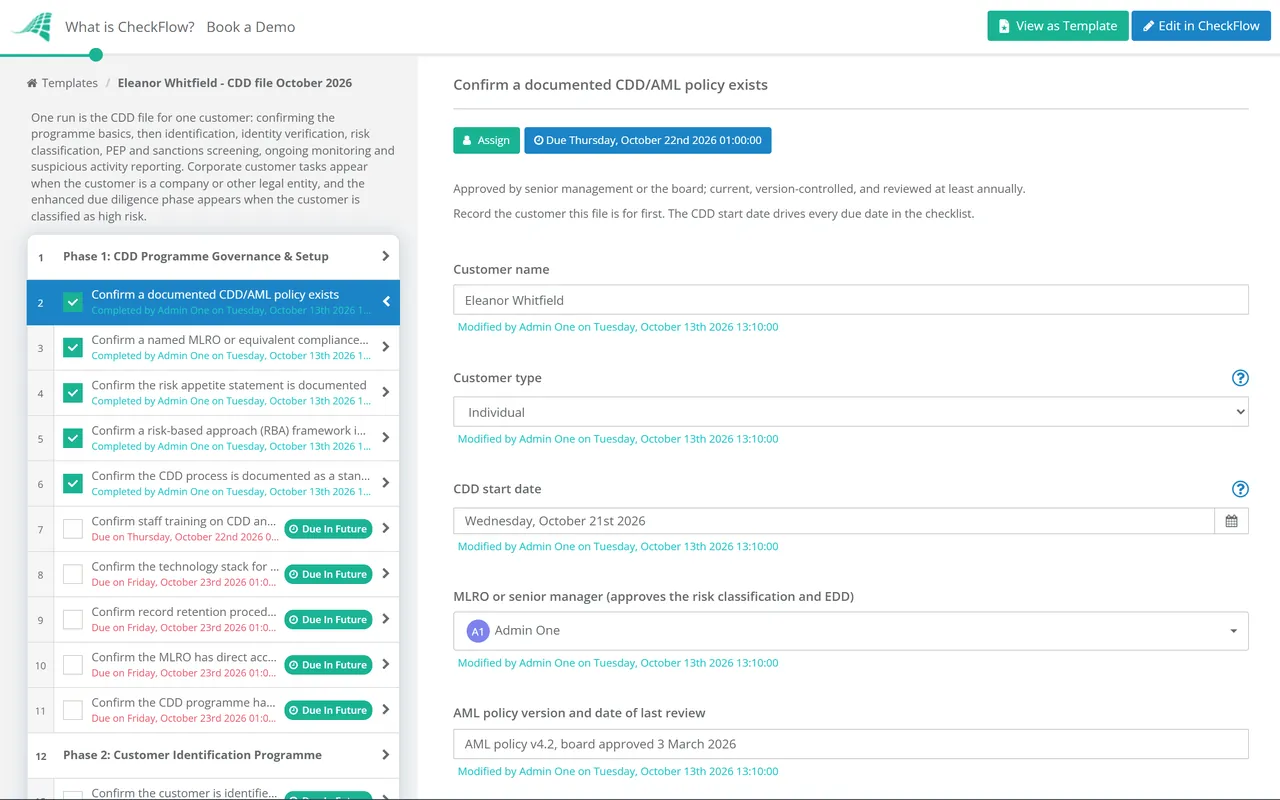
Customer due diligence is not a best practice — it is a legal requirement. Under the Bank Secrecy Act, FATF Recommendations, EU AML Directives, and their national equivalents, regulated businesses must verify who their customers are, assess the risk they represent, apply enhanced scrutiny to high-risk customers, screen against sanctions and politically exposed persons lists, and monitor customer relationships on an ongoing basis. Non-compliance carries severe consequences — regulatory fines, criminal liability, licence revocation, and reputational damage. In 2024, the largest single AML fine issued in the US was $3.09 billion. A structured, documented CDD process is the foundation of any AML compliance programme. This free customer due diligence checklist gives compliance teams, onboarding teams, and regulated businesses a structured framework for the full CDD lifecycle — individual and corporate customers, from initial identification through to enhanced due diligence, risk classification, and ongoing monitoring.
CDD, KYC, EDD, and SDD — What Each Means and How They Relate
Customer due diligence terminology is frequently used inconsistently, which creates compliance risk when teams are not applying the right level of scrutiny to the right customers. KYC (Know Your Customer) is the overarching framework of policies, procedures, and systems that regulated businesses use to verify customer identity, assess risk, and monitor transactions. CDD (Customer Due Diligence) is the core process within that framework — the structured collection and verification of customer information and the assessment of customer risk. EDD (Enhanced Due Diligence) is the deeper process applied to customers who present elevated risk. SDD (Simplified Due Diligence) is the lighter process applicable to customers who meet specific low-risk criteria defined by applicable regulations.
The regulatory foundation is consistent globally: FATF Recommendation 10 requires all member states to implement CDD measures; the US Bank Secrecy Act and FinCEN CDD Rule implement this through the Customer Identification Programme (CIP) requirement and the 2016 beneficial ownership rule; the EU 6th AML Directive extends criminal liability for money laundering to legal persons and imposes stricter CDD requirements across member states; and the UK Money Laundering Regulations implement equivalent requirements. The checklist below applies to all of these frameworks — adapt specific document requirements to the applicable jurisdiction’s regulatory standards.
What the Customer Due Diligence Checklist Covers
This checklist covers eight phases of the CDD lifecycle — from programme governance and customer identification through individual and corporate CDD, enhanced due diligence, risk classification, ongoing monitoring, and suspicious activity reporting.
- 1
Phase 1
CDD Programme Governance & Setup
10 tasksA CDD programme is only as reliable as the governance framework behind it. Regulators assess not just individual customer files but the robustness of the programme that produced them.
- Confirm a documented CDD/AML policy exists — approved by senior management or the board; current, version-controlled, and reviewed at least annually
- Confirm a named Money Laundering Reporting Officer (MLRO) or equivalent compliance officer is appointed — with documented authority and responsibilities
- Confirm the risk appetite statement is documented — which customer types, geographies, and business activities are within and outside the organisation’s risk tolerance
- Confirm a risk-based approach (RBA) framework is in place — defining the criteria for SDD, standard CDD, and EDD for different customer categories
- Confirm the CDD process is documented as a standard operating procedure — all staff involved in onboarding or compliance follow the same defined process
- Confirm staff training on CDD and AML obligations is current — all relevant staff have received training appropriate to their role; training records are maintained
- Confirm the technology stack for CDD is adequate — identity verification, sanctions screening, PEP screening, and adverse media tools are in place and current
- Confirm record retention procedures are in place — CDD records must typically be retained for five years from the end of the business relationship (or longer as required by applicable regulations)
- Confirm the MLRO has direct access to all CDD records — and that the SAR reporting process is documented and understood
- Confirm the CDD programme has been reviewed by internal audit or an independent third party within the required period
- 2
Phase 2
Customer Identification Programme
10 tasks
- Confirm the customer is identified before establishing the business relationship or conducting a transaction — CDD must be completed before or concurrent with customer onboarding
- Collect the required identifying information for individual customers — full legal name, date of birth, address, and taxpayer identification number or national identifier as required by jurisdiction
- Collect the required identifying information for corporate customers — full legal entity name, registered address, company registration number, jurisdiction of incorporation, and nature of business
- Collect the required identifying information for beneficial owners — individuals who own or control 25% or more of a corporate entity (or lower thresholds as required by jurisdiction)
- Identify the authorised signatories or control persons for corporate accounts — individuals with authority to act on behalf of the entity
- Confirm all collected information is accurate and current — do not proceed with onboarding on the basis of incomplete or unverified information
- Confirm the purpose and intended nature of the business relationship is understood and documented
- Document the source of funds and source of wealth where required — applicable to EDD customers and as required by risk assessment
- Confirm all CIP information is recorded and stored securely in the customer file
- Note the date of initial CIP completion — for ongoing monitoring and periodic review purposes
- 3
Phase 3
Identity Verification
10 tasks
- Verify the identity of individual customers — using government-issued photo identification (passport, national ID card, or driving licence); confirm document is current and not expired
- Verify the address of individual customers — utility bill, bank statement, or official government correspondence dated within three months
- Confirm the verification method used — in-person original document review, certified copy, electronic identity verification (eIDV), or other approved method; document the method and outcome
- For corporate customers — verify incorporation documents, certificate of good standing, and registered company information against the relevant companies register
- Verify the identity of all beneficial owners — apply the same identity verification standard as for individual customers
- For complex corporate structures — map the full ownership chain to the ultimate beneficial owner(s); do not accept nominee owners without identifying and verifying the underlying principals
- Document any verification failures — where identity cannot be verified to the required standard, the business relationship must not proceed
- Record verification documents used — document type, issuing authority, document reference, expiry date, and verification method
- Apply enhanced verification where required — remote onboarding, cross-border customers, and high-risk customer categories may require additional verification steps
- Confirm verification is complete and recorded before any services are provided
- 4
Phase 4
Customer Risk Classification
10 tasksRisk classification determines the depth of due diligence required. Misclassification in either direction creates regulatory exposure — classifying a high-risk customer as standard is a compliance failure; over-burdening all customers with EDD is operationally unsustainable.
- Apply the organisation’s risk-based approach framework to the customer — assess risk across all applicable risk factors
- Assess country or geographic risk — customer’s country of residence, country of incorporation, and jurisdictions where business is conducted; reference the FATF grey and black lists, and any internal or regulatory high-risk country list
- Assess customer type and sector risk — certain customer types (cash-intensive businesses, precious metals dealers, crypto businesses, charities) carry elevated inherent risk
- Assess product and service risk — which products or services is the customer using? Higher-risk products (cross-border wire transfers, correspondent banking) increase the overall risk rating
- Assess delivery channel risk — non-face-to-face onboarding carries higher inherent risk than in-person
- Assess PEP status — is the customer or any beneficial owner a Politically Exposed Person? PEPs are automatically classified as high-risk requiring EDD
- Assess transaction risk — expected transaction volumes, values, and patterns; document the expected pattern of activity against which future transactions will be monitored
- Apply the overall risk classification — Low (SDD applicable), Standard (CDD), or High (EDD required); document the rationale for the classification
- Obtain approval for the risk classification at the appropriate level — high-risk classifications typically require senior management or MLRO approval
- Record the risk classification, rationale, approver, and date in the customer file
- 5
Phase 5
PEP, Sanctions & Adverse Media Screening
10 tasks
- Screen the customer against all applicable sanctions lists — OFAC SDN List (US), EU Consolidated List, UN Security Council List, HM Treasury list (UK), and any other applicable lists
- Screen all beneficial owners and authorised signatories against sanctions lists
- Screen the customer and beneficial owners against PEP databases — current and former political office holders and their close associates and family members
- Screen the customer against adverse media sources — negative news coverage indicating involvement in financial crime, fraud, corruption, sanctions violations, or other illicit activity
- Document all screening results — including negative results (clear screens) with the date and lists/databases screened
- Assess any potential matches — a screening match requires careful assessment; not all name matches represent the same individual; document the assessment and rationale
- Escalate confirmed matches immediately — a confirmed sanctions match requires immediate escalation to the MLRO and legal counsel; the business relationship must not proceed
- Apply EDD automatically for confirmed PEPs — regardless of other risk factors; obtain senior management approval before establishing the relationship
- Confirm rescreening frequency is defined — sanctions and PEP lists change; periodic rescreening of the customer base is required
- Document the screening process completion — date, databases used, results, and any assessment decisions
- 6
Phase 6
Enhanced Due Diligence for High-Risk Customers
10 tasksEDD is mandatory — not discretionary — for high-risk customers including PEPs, customers from high-risk jurisdictions, and correspondent banking relationships. The additional scrutiny applied must be proportionate to the risk level identified.
- Confirm EDD trigger — document which risk factor(s) triggered the EDD requirement (PEP status, high-risk country, high-risk sector, large or unusual transaction pattern, etc.)
- Collect additional identification information beyond standard CDD — additional documents, references, or information as required by the risk profile
- Conduct source of wealth verification — how has the customer accumulated their wealth? Obtain documentary evidence where possible
- Conduct source of funds verification — confirm the origin of specific funds in the business relationship; obtain supporting documentation
- Conduct deeper adverse media research — beyond automated screening; review all publicly available information about the customer, their associates, and their business activities
- Obtain senior management approval for the relationship — EDD customers require MLRO or senior management sign-off before onboarding proceeds
- Define enhanced monitoring requirements — what additional monitoring will be applied to this customer on an ongoing basis?
- Define the review frequency — EDD customers require more frequent periodic review than standard CDD customers
- Document all EDD findings, assessments, and decisions — the EDD file must demonstrate the depth of due diligence conducted
- Confirm EDD approval is documented with the approver’s name, date, and rationale
- 7
Phase 7
Ongoing Monitoring & Periodic Review
10 tasks
- Confirm transaction monitoring is in place — transactions are monitored against the expected activity profile established at onboarding
- Define alert thresholds and typologies — what transaction patterns will trigger a review? Confirm these are risk-appropriate and regularly reviewed
- Define the periodic review cycle for each risk tier — high-risk customers typically require annual review; standard CDD every two to three years; SDD less frequently
- Conduct periodic reviews on schedule — re-verify identity information, reassess risk classification, rescreen sanctions and PEP lists, and review actual transaction activity against the expected profile
- Identify trigger events requiring out-of-cycle review — change of control, significant transaction anomaly, adverse media alert, or information suggesting increased risk
- Confirm customer data is kept current — changes to address, directors, beneficial owners, or business activities must be captured and the risk assessment updated
- Review and update the expected activity profile periodically — customer risk profiles evolve; monitoring rules must reflect current reality
- Document all periodic reviews — date, reviewer, findings, any risk reclassification, and approval
- Confirm the review backlog is managed — all reviews are completed within the required schedule; overdue reviews are escalated
- Report the periodic review programme status to the MLRO or compliance committee at defined intervals
- 8
Phase 8
Suspicious Activity Reporting & Escalation
10 tasks
- Confirm all staff know how to recognise and report suspicious activity internally — the internal reporting process is documented and communicated
- Confirm the internal reporting process routes to the MLRO — internal SARs are reviewed by the MLRO promptly and documented
- Confirm the tipping-off prohibition is understood — staff must not alert a customer that they are the subject of a SAR or investigation
- MLRO assessment of internal reports — document the MLRO’s assessment, decision, and rationale for each internal report
- File external SARs with the relevant authority where required — FinCEN (US), NCA (UK), or applicable national FIU; confirm filing is within the required timeframe
- Document all internal and external SAR activity — date, subject, nature of suspicion, and outcome; records must be retained for the required period
- Manage consent requests where required — certain transactions require FIU consent before proceeding; confirm the process is documented
- Review SAR trends periodically — patterns in internal reports may indicate systemic CDD process failures or emerging risk areas
- Confirm the SAR process is tested through training and awareness exercises — staff must know what to do and when
- Report SAR statistics to the board or senior management as part of the regular AML compliance report
This checklist is available as a free, runnable template in CheckFlow — with CDD tasks assigned to onboarding and compliance teams, EDD workflows triggered automatically by risk classification, periodic reviews scheduled as recurring checklists, and a complete audit-ready record for every customer file.
Use this template freeCDD, KYC, EDD, and SDD — The Distinctions That Matter for Compliance
These terms are frequently used interchangeably — but they mean different things, and misapplying them creates compliance risk.
KYC
Know Your Customer
What it is: The overarching framework of policies, procedures, and systems for verifying customer identity, assessing risk, and monitoring transactions.
When it applies: Always — it is the umbrella framework containing all of the below.
CDD
Customer Due Diligence
What it is: The standard process of verifying customer identity, understanding the purpose of the relationship, identifying beneficial owners, and assessing customer risk.
When it applies: All customers not qualifying for SDD; the default process for most business relationships.
EDD
Enhanced Due Diligence
What it is: Deeper due diligence applied to high-risk customers — including additional identity evidence, source of wealth/funds verification, senior management approval, and enhanced ongoing monitoring.
When it applies: PEPs; customers from high-risk jurisdictions; high-value transactions; customers with unusual ownership structures; and any customer where standard CDD is insufficient for the risk.
SDD
Simplified Due Diligence
What it is: A lighter version of CDD applicable to customers where the risk of money laundering or terrorist financing is demonstrably low.
When it applies: Specific low-risk customer categories defined by applicable regulations — typically listed companies, regulated financial institutions, or public bodies in low-risk jurisdictions. SDD is not a unilateral choice — it must be justified against regulatory criteria.
Which Businesses Must Conduct Customer Due Diligence?
CDD obligations extend well beyond banks and financial institutions. Any business designated as a Reporting Entity or Subject Person under applicable AML legislation has mandatory CDD obligations.
Financial services
Banks, building societies, credit unions, payment institutions, e-money institutions, investment firms, insurance companies, mortgage lenders, and other regulated financial institutions.
Professional services
Law firms, accounting firms, auditors, insolvency practitioners, tax advisors, and trust and company service providers — when conducting certain financial or real estate transactions.
Real estate
Estate agents, letting agents, and property developers in transactions above applicable thresholds. AML obligations for real estate have significantly expanded in recent years.
Crypto and digital assets
Crypto exchanges, wallet providers, and virtual asset service providers (VASPs) are now regulated for AML purposes in most major jurisdictions.
High-value goods and art
Dealers in high-value goods (precious metals, gems, luxury goods), art dealers, and auction houses above defined transaction thresholds.
Gambling
Casinos, online gambling operators, and betting firms above defined transaction thresholds or for customers above defined spend levels.
If your business falls within any of these sectors, CDD is a legal obligation — not an operational choice. CheckFlow’s CDD template gives your team a structured, documented process that meets the audit-ready standard regulators require.
Why Run Your CDD Process in CheckFlow?
CheckFlow manages the CDD process — task assignment, workflow sequencing, documentation, and ongoing monitoring schedules. It complements, but does not replace, specialist KYC technology platforms, identity verification tools, or AML screening software.
1Enforce the process regardless of who is handling the case
CDD quality should not depend on which compliance analyst is available. CheckFlow’s structured checklist ensures every customer file follows the same documented process — the same identity verification steps, the same risk classification criteria, the same EDD trigger assessment — regardless of which team member runs the case. Consistency is what regulators look for in a CDD programme audit.
Automate the ongoing monitoring schedule
Periodic CDD review is a permanent, recurring obligation — high-risk customers annually, standard CDD every two to three years. Without an automated schedule, reviews slip. CheckFlow’s recurring checklist feature creates a new review instance for each customer at the required interval, assigns it to the responsible analyst, and ensures no customer falls outside the review cycle. The regulator will ask for evidence that reviews happened on schedule.
An audit-ready record for every customer file
Every CDD task completed is logged with a timestamp and the name of the responsible analyst. The complete CDD file — identification documents, screening results, risk classification rationale, EDD findings, periodic review history, and any SAR-related decisions — builds automatically as the process runs. When a regulator requests the file for a specific customer, the record is complete and immediately accessible.
Customer due diligence for financial planners and wealth management practices involves specific CDD obligations that overlap with client onboarding. CheckFlow’s Financial Planner Client Onboarding Checklist covers the complete onboarding process — with KYC/AML compliance steps embedded as mandatory, non-skippable phases. See the Financial Planner Onboarding Checklist →
HIPAA-regulated businesses in the US that also have AML obligations — healthcare fintech, health insurance — must manage both compliance frameworks simultaneously. CheckFlow’s HIPAA Compliance Audit Checklist covers the healthcare-specific compliance obligations that run alongside CDD requirements. See the HIPAA Compliance Checklist →