Investor Communication & Reporting Framework Checklist Template
Investor confidence is built through consistent, structured, and honest communication — not just when performance is strong, and not only when investors ask.
Disclaimer: This checklist describes investor communication and reporting process frameworks. It does not constitute legal, financial, or regulatory advice. Investor communications at listed companies are subject to securities laws including Regulation FD (US) and MAR (UK/EU). Always engage qualified legal and compliance counsel for specific regulatory requirements.
Printed from checkflow.io/templates/investor-relations/investor-communication-reporting-checklist
Investors who receive consistent, structured, and informative updates provide more than capital — they provide introductions, strategic advice, patience through difficult periods, and confidence in the next round. Investors who receive inconsistent or uninformative updates — or who only hear from the company when something is needed — provide caution, reduced follow-on commitment, and concern during due diligence for future fundraises. The research is consistent: companies that adopt proactive, structured investor communication practices maintain lower cost of capital, stronger LP retention, and better valuation perceptions than those that communicate reactively. A structured investor communication and reporting framework defines what is communicated, to whom, in what format, on what cadence, and through what review process before distribution — ensuring that every investor update is accurate, compliant, consistent with prior communications, and strategically considered. This free checklist gives CFOs, IR managers, fund managers, and startup founders a structured process for the full investor communication cycle.
The Investor Reporting Calendar — What Good Communication Looks Like at Each Frequency
Annual
Annual Report & Strategic Review
Key deliverables: Annual report or letter, audited financial statements, strategic review, year ahead outlook, AGM materials (listed companies).
Primary audience: All investors and shareholders.
Tone: Reflective, strategic, comprehensive. Covers the full year’s performance honestly — including what did not go as planned.
Quarterly
Quarterly Update & LP Letter
Key deliverables: Quarterly update report or LP update letter, unaudited financial summary, KPI dashboard, portfolio update (for funds), key developments, and one specific forward-looking comment.
Primary audience: All investors and LPs.
Tone: Factual, concise, consistent with prior quarters. The goal is evidence of execution against the narrative, not a marketing document.
Monthly
Monthly Management Accounts
Key deliverables: Monthly management accounts or KPI summary for active investors; board pack distribution for board members.
Primary audience: Lead investors, board members, active LPs.
Tone: Operational. The metric that matters this month and its context. Brief.
Ad hoc
Event-Driven Communications
Key deliverables: Material event notifications, fundraising announcements, significant hires or departures, regulatory filings (listed companies), crisis communications.
Primary audience: Varies by event; all investors for material events.
Tone: Prompt, clear, factual. Never delayed on material events.
What the Investor Communication & Reporting Checklist Covers
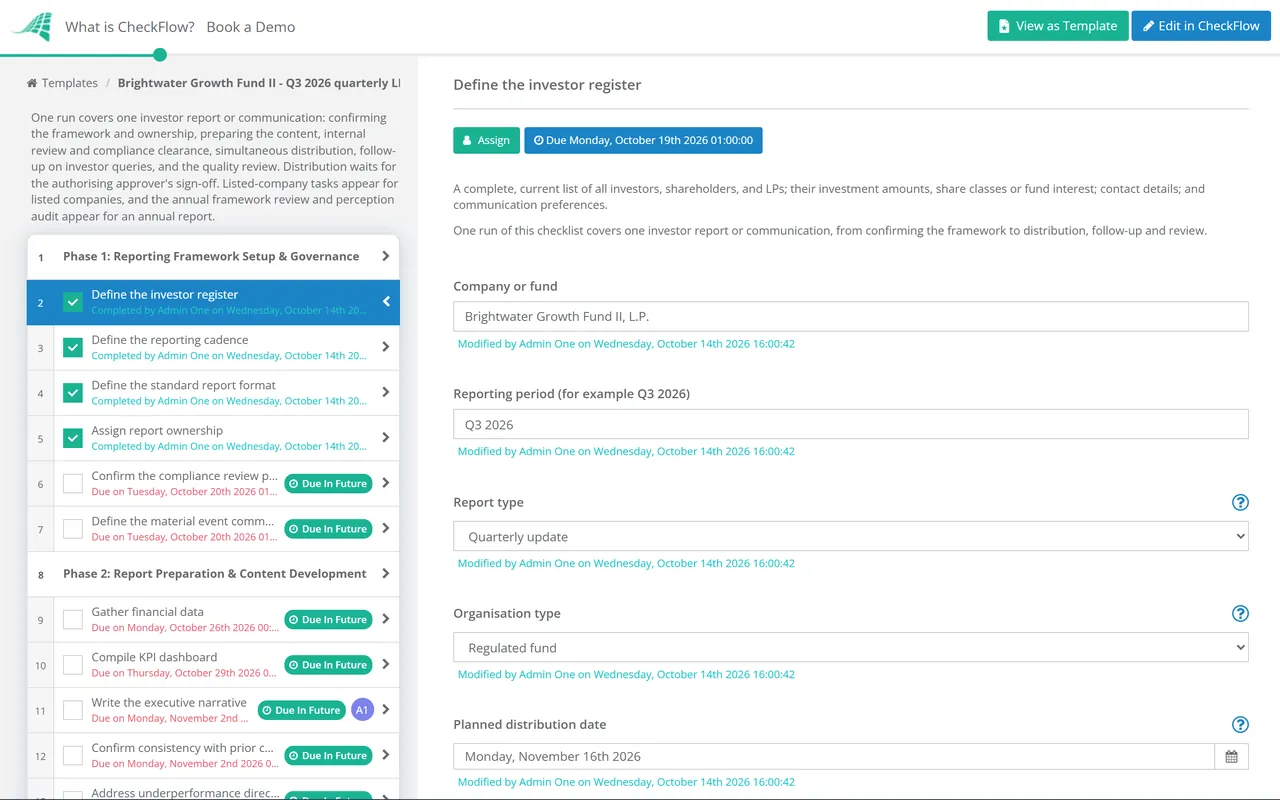
Six phases covering the full investor communication cycle — from framework setup and report preparation through compliance clearance, distribution, post-distribution engagement, and ongoing quality review.
1
Phase 1
Reporting Framework Setup & Governance
6 tasks
The investor communication framework should be established before it is needed — not assembled reactively when an investor asks for an update. The framework defines the rules; the checklist runs the process within those rules.
Define the investor register — a complete, current list of all investors, shareholders, and LPs; their investment amounts, share classes or fund interest; contact details; and communication preferences
Define the reporting cadence — which reports are produced, at what frequency, and for which investor groups; documented and communicated to investors in advance
Define the standard report format — consistent template for each report type; consistency across periods enables investors to spot trends and make comparisons
Assign report ownership — who is responsible for each section of each report; who reviews before distribution; who approves for release
Confirm the compliance review process — for listed companies and regulated funds, confirm the legal and compliance review step before any investor communication is distributed
Define the material event communication policy — what constitutes a material event; who must be notified; within what timeframe; who approves the communication
2
Phase 2
Report Preparation & Content Development
7 tasks
Gather financial data — period financials (P&L, balance sheet, cash position, burn rate where applicable); confirmed accurate and reconciled before inclusion
Compile KPI dashboard — the key operational metrics that define performance for this business or fund; consistent definitions across periods; prior period comparatives included
Write the executive narrative — what happened in the period; why; what it means for the business; honest about both progress and challenges; answers: Where are we now? How did we get here? Where are we going?
Confirm consistency with prior communications — is the narrative consistent with what was communicated last quarter? Any change of direction or material variance requires clear explanation, not omission
Address underperformance directly — metrics or milestones that were not met should be acknowledged with context and the corrective plan; selective omission is a trust-destroying practice
Include forward guidance — what is expected in the next period; key milestones; any risks or uncertainties; realistic, not promotional
Include the “ask” where applicable — for companies approaching fundraising, be specific about what support or introductions would be valuable
3
Phase 3
Internal Review & Compliance Clearance
6 tasks
No investor communication should be distributed without an internal review step — for factual accuracy, consistency with prior communications, legal compliance, and strategic appropriateness. The report that is issued in a hurry is the one that creates the most problems.
Finance review — all financial figures confirmed by the CFO or finance lead against source data; no rounding or approximation without disclosure
Legal and compliance review — for listed companies: confirm no MNPI (material non-public information) is selectively disclosed; Regulation FD (US) or MAR (UK/EU) compliance confirmed by legal counsel
CEO or senior leadership sign-off — a named authorising approver; the buck for investor communications stops here
Disclosure controls review (listed companies) — confirm disclosure controls and procedures are functioning; disclosure committee or equivalent sign-off where required
Check for forward-looking statement disclaimers — any projections, forecasts, or forward-looking statements appropriately caveated per legal requirements
Archive the draft and review record — before and after compliance review; version control; the review record is a compliance document
4
Phase 4
Report Distribution & Tracking
6 tasks
Confirm the distribution list is current — all relevant investors at current contact details; no one added or removed since the last review without documented reason
Distribute simultaneously to all investors in the same class — all investors entitled to the same information receive it at the same time; no preferential early access
Use the defined distribution channel — investor portal, secure email, or data room; consistent with the committed process
Record distribution — date and time sent; recipients confirmed; for regulated communications, this record is a compliance requirement
For listed companies — simultaneous regulatory filing (8-K, RNS, or equivalent) before or concurrent with investor distribution; never after
Confirm receipt for material communications — follow up on bounced or undelivered communications promptly
5
Phase 5
Post-Distribution Investor Engagement
5 tasks
Prepare for investor queries — the report will generate questions; brief the team on expected questions and approved answers before distribution
Respond to investor queries promptly — within 24–48 hours of receipt; see the Investor Queries & Communication Management Checklist for the query management process
Log all post-distribution queries and responses — for consistency checking and as an input to improving future reports
Review investor feedback themes — across the investor base; recurring questions about the same topic indicate a disclosure gap in the report
Update the investor profile notes — record any material concerns, new questions, or changed sentiments expressed by key investors; tracked as relationship intelligence
6
Phase 6
Reporting Quality Review & Continuous Improvement
4 tasks
Conduct an annual review of the reporting framework — is the cadence still appropriate? Is the format giving investors the information they most value?
Conduct a periodic investor perception audit — structured feedback from key investors on the quality and usefulness of communications; identifies improvement priorities
Review KPI consistency — are the metrics being reported consistently defined across periods? Any metric that changes definition should be clearly disclosed
Archive all investor communications — complete archive of every communication sent, to whom, when, and the approval record; retained per legal and regulatory requirements
The Three Questions Every Investor Report Must Answer
Where are we now?
Current financial position: revenue, cash, burn rate, gross margin, key balance sheet items. KPI dashboard against targets. Portfolio performance for funds. An honest current snapshot — not the best possible interpretation.
How did we get here?
The narrative context for the numbers: what drove the period’s performance, what worked as planned, what did not, and why. For underperformance: the analysis of root cause, not just the acknowledgement. Investors reward honest attribution far more than management of bad news.
Where are we going?
Forward guidance: revenue forecasts, key milestones, product roadmap, hiring plan, projected runway. Realistic and specific — overpromising consistently destroys the credibility that accurate reporting builds. Any specific ask for the next period.
Why Run Investor Communications in CheckFlow?
1
A consistent, recurring reporting cycle that runs on time
Investor reports that arrive late — or not at all — signal operational disorder as clearly as the numbers themselves. CheckFlow’s recurring checklist feature starts the quarterly reporting cycle automatically at the defined date, assigns data gathering, narrative drafting, compliance review, and distribution tasks to named owners with deadlines. The report that goes out on time, every quarter, is the one that builds confidence.
2
A compliance review step that cannot be bypassed
The approval step — financial verification, legal review, and CEO sign-off — is the most commonly skipped under deadline pressure. CheckFlow makes the distribution task dependent on the completion of the compliance review tasks. No investor communication goes out without passing through the defined approval chain.
3
An archived record of every communication ever sent
Investor communication archives are compliance documents — for regulatory examination, litigation, and future fundraise due diligence (“what did you tell investors in Q3 2024?”). Every communication distributed through CheckFlow is timestamped with the distribution list, the approving officer, and the date sent. The archive is maintained automatically as the process runs.
Managing the queries that investor communications generate is a process in its own right. CheckFlow’s Investor Queries & Communication Management Checklist covers the structured process for receiving, routing, and responding to investor queries. See the Investor Queries Management Checklist →
For the strategic dimensions of investor relations — developing the equity story, targeting the right investors, and managing market perception — CheckFlow’s Strategic IR & Stewardship Checklist covers the directional IR planning process. See the Strategic IR & Stewardship Checklist →
Describe the process in a sentence and the AI checklist generator drafts the phases and tasks for you.
Frequently Asked Questions
What should an investor communication and reporting framework cover?
An investor communication and reporting framework covers six areas: framework setup and governance (defining the investor register, reporting cadence, standard formats, ownership, and compliance review process), report preparation (gathering financial data, compiling the KPI dashboard, writing the executive narrative, confirming consistency with prior communications), internal review and compliance clearance (financial verification, legal review for listed companies, and senior sign-off), distribution (simultaneous distribution to all investors in the same class through defined channels, with full distribution record), post-distribution engagement (preparing for investor queries, responding promptly, and logging investor feedback), and ongoing quality review (annual framework review, perception audits, and KPI consistency checking).
What is Regulation FD and how does it affect investor communications?
Regulation FD (Full Disclosure), adopted by the SEC in 2000, requires listed US companies to make public disclosure simultaneously to all investors whenever material non-public information (MNPI) is selectively disclosed to certain investors or analysts. The practical implication is that a listed company cannot tell a major investor something material about its business in a private meeting or call without simultaneously disclosing the same information publicly. In the UK and EU, the Market Abuse Regulation (MAR) contains similar requirements. Private companies — those whose securities are not publicly traded — are not subject to Regulation FD but should still aim for consistent disclosure across their investor base as a matter of best practice and LP agreement compliance.
How often should investors receive reports?
The appropriate cadence depends on the type of investor and the stage of the company. Quarterly reporting is the standard minimum for companies with institutional investors or VC-backed companies, and for private equity or venture funds reporting to LPs. Monthly reporting is appropriate for companies in a board-level engagement phase or where investors are actively supporting the business. Annual reports are required for most incorporated entities and should be comprehensive, covering the full year’s performance and strategic position. Listed companies have specific regulatory reporting requirements. All cadences should be set at the start of the investor relationship and communicated to investors — surprises in reporting frequency undermine the consistency that builds confidence.
What metrics should investor reports include?
The right metrics depend on the business, but the principle is consistency — reporting the same metrics, with the same definitions, in the same format, every period. For a growth-stage company: revenue, growth rate (MoM or YoY), gross margin, cash position, burn rate, and runway; plus the key operational metrics (ARR, NRR, CAC, LTV, or whatever drives the business model). For a fund: portfolio company update, capital deployed, NAV, TVPI, DPI, and RVPI. For a listed company: the KPIs communicated in the last earnings guidance. The most important discipline is never changing which metrics are reported without clear disclosure — metric changes that coincide with performance weakness are a well-known red flag.
Is CheckFlow free for this template?
14-day free trial, no card required. The Business plan is $10 per user per month after the trial. Full details at checkflow.io/pricing.
Build the Investor Communication Process That Earns the Next Conversation