Parental Leave Checklist

Parental leave rarely goes wrong because of the leave itself. It goes wrong because a notice went unanswered, statutory pay was set up the week it was due, or cover was found after the employee had already gone.

This free parental leave checklist runs the employer’s side of the process, from the day an employee tells you about a pregnancy, adoption or new child to the day you start planning their return. It covers the United States and the United Kingdom side by side. Choose the country and the type of leave (maternity, paternity, adoption, shared parental or other parental leave) and the checklist shows the tasks, notices and deadlines that apply. Due dates run from the expected week of childbirth or the placement date, so nothing waits until someone remembers it. When the return date is close, the Return-to-Work Checklist takes over.

Use This Template Free See Live Example
No Credit Card Required

Last reviewed: October 2026

Two Very Different Starting Points

The UK sets a floor of leave and pay for almost everyone. Maternity and adoption leave are available from the first day of employment, and since 6 April 2026 so are paternity leave and unpaid parental leave. Statutory pay has its own service and earnings tests. The process is driven by formal notices with fixed deadlines, most of them counted back from the expected week of childbirth.

The US has no federal right to paid leave. The Family and Medical Leave Act gives job-protected, unpaid leave to eligible employees of covered employers. Paid leave comes from a state programme, if the employee works in a state that has one, or from your own policy. Most of the employer’s work is checking which layers apply, then sending the right notices on time.

Both countries punish the same mistakes. Treating someone worse because they are pregnant or on leave, leaving them out of a restructure, or forgetting them when a promotion comes up can all lead to a claim. The safest records show what the employee was told, when, and by whom. Rules change often in this area, so take advice from an employment lawyer before any decision about a specific employee’s job or pay.

United States

Federal floor, state top-up

Job protection: FMLA, for eligible employees of employers with 50 or more employees.

Pay: a state paid family leave programme where one exists, plus any employer policy.

During pregnancy: accommodations under the Pregnant Workers Fairness Act.

Key deadline: FMLA notices within five business days.

United Kingdom

Statutory leave and pay for each type

Job protection: leave rights from day one, plus extra redundancy protection.

Pay: statutory pay, which employers pay and largely recover from HMRC, plus any enhanced scheme.

During pregnancy: an individual risk assessment and paid time off for antenatal care.

Key deadline: confirm maternity or adoption dates in writing within 28 days.

What the Parental Leave Checklist Covers

Six phases run from notification to return planning. The country and leave type chosen in Phase 1 decide which tasks and phases appear.

Phase 1

Phase 1: Notification & Set-Up

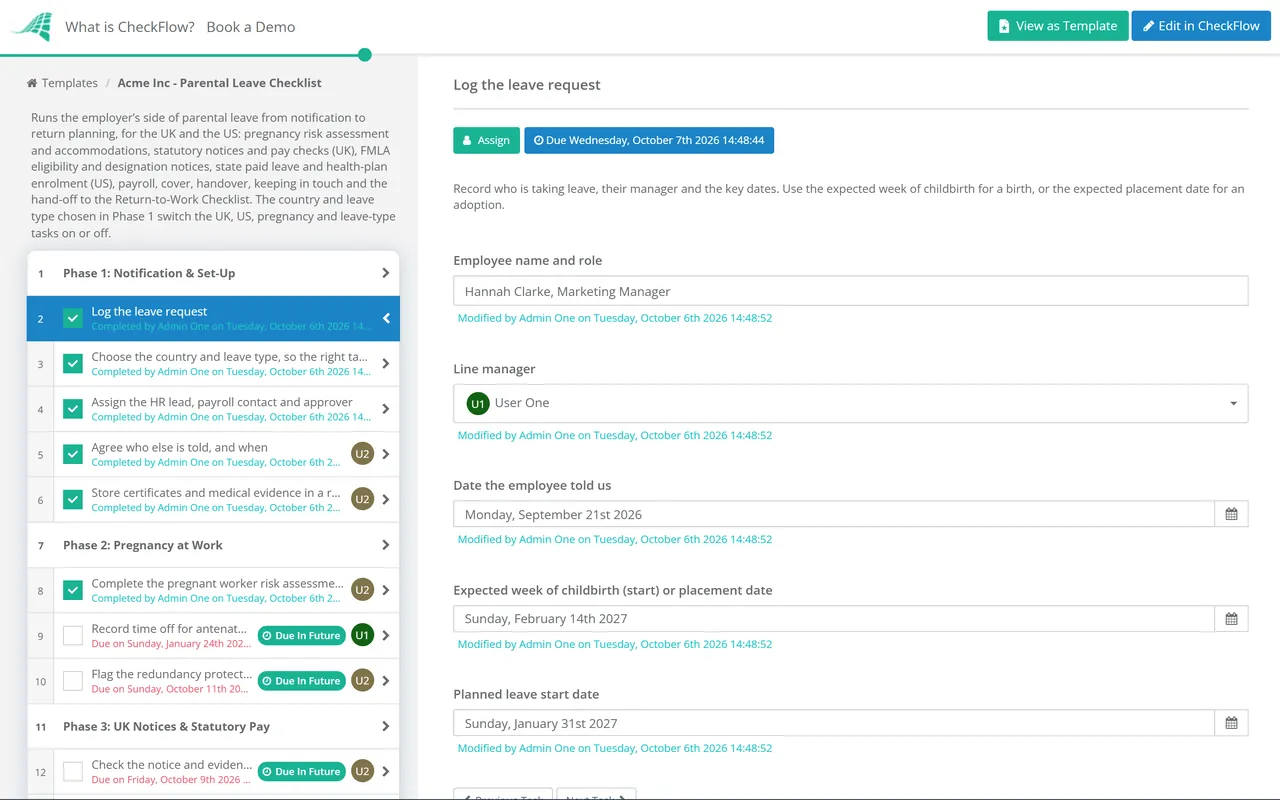
  • Log the leave request — employee, role, manager, expected week of childbirth or placement date
  • Choose the country and leave type, so the right tasks appear
  • Assign the HR lead, payroll contact and approver
  • Agree who else is told, and when
  • Store certificates and medical evidence in a restricted file
Phase 2

Phase 2: Pregnancy at Work

Shown for maternity leave.

  • Complete the pregnant worker risk assessment — UK, once told in writing
  • Agree pregnancy accommodations — US, under the Pregnant Workers Fairness Act
  • Record time off for antenatal appointments
  • Flag the redundancy protected period on the employee’s record — UK
Phase 3 — UK

Phase 3: UK Notices & Statutory Pay

Shown when the employee works in the UK. Leave-type tasks appear only for that type.

  • Check the notice and evidence received — MATB1, matching certificate or paternity notice
  • Confirm the leave dates in writing — within 28 days for maternity and adoption
  • Check eligibility for statutory pay — 26 weeks’ service and the lower earnings limit
  • Process the shared parental leave notices — booking notices need 8 weeks’ notice
  • Agree the unpaid parental leave dates — whole weeks, 21 days’ notice
Phase 4 — US

Phase 4: US Eligibility & Notices

Shown when the employee works in the US.

  • Check FMLA coverage and eligibility — 12 months, 1,250 hours, 50 employees within 75 miles
  • Send the eligibility and rights notice within five business days
  • Check state paid leave and state leave law for the work state
  • Send the FMLA designation notice
  • Confirm health coverage during leave and how premiums are paid
  • Tell the employee about the 30-day window to add the child to the health plan
Phase 5

Phase 5: Pay, Cover & Handover

  • Set up leave pay in payroll — statutory pay, state benefits and any enhanced pay
  • Approve the leave plan and pay arrangements
  • Arrange cover for the role
  • Hand over work, access and open commitments
  • Agree how to keep in touch — how often, by what channel, and about what
Phase 6

Phase 6: During Leave & Return Planning

  • Share vacancies, restructures and pay reviews with the employee
  • Log any keeping-in-touch days worked and pay them
  • Confirm the return date — UK: 8 weeks’ notice to change it
  • Handle any flexible working request
  • Start the Return-to-Work Checklist

Parental Leave and Pay at a Glance

United Kingdom: statutory minimums for 2026/27

The figures below are the statutory floor in England, Scotland and Wales; Northern Ireland has its own employment law. Your contract or policy may pay more. The flat weekly rate of £194.32 (or 90% of average weekly earnings, if lower) applies from April 2026. Statutory pay also needs average earnings of at least the lower earnings limit, £129 a week for 2026/27.

Leave How much Statutory pay Employee notice
MaternityUp to 52 weeks, from day one; at least 2 weeks after the birth are compulsory39 weeks: 6 weeks at 90% of earnings, then 33 weeks at the flat rate. Needs 26 weeks’ service by the 15th week before the due weekBy the 15th week before the due week; you confirm dates within 28 days
Paternity1 or 2 weeks, in one block or two, within 52 weeks of the birth; day one since April 2026Flat rate, but still needs 26 weeks’ serviceDue date 15 weeks ahead; 28 days’ notice of leave dates
AdoptionUp to 52 weeks, from day one39 weeks, paid like maternity. Needs 26 weeks’ service by the week of matchingWithin 7 days of matching; you confirm dates within 28 days
Shared parentalUp to 50 weeks shared between parents in the first year, in up to 3 booked blocksUp to 37 weeks shared, at the flat rate8 weeks’ written notice of each block
Unpaid parental18 weeks per child before their 18th birthday, normally up to 4 weeks a year; day one since April 2026None21 days

Up to 10 keeping-in-touch days can be worked during maternity or adoption leave, and up to 20 during shared parental leave, both by agreement. Neonatal care leave of up to 12 weeks sits on top of the others for babies who spend a week or more in neonatal care. Further Employment Rights Act 2025 changes affecting new parents, including stronger dismissal protection and changes to flexible working, are scheduled for 2027. Check the government’s timeline before relying on any date.

United States: federal and state layers

Each layer has its own eligibility test, so one employee may qualify for state pay but not FMLA protection, or the reverse. State programmes differ in weekly benefit, length, waiting periods and whether the job is protected, so read the rules for the state where the employee works.

Layer What it gives Who it covers Employer task
FMLAUp to 12 workweeks of unpaid, job-protected leave in 12 months; bonding leave must end within 12 months of the birth or placement; health coverage continuesEmployees with 12 months’ service and 1,250 hours, at a site with 50 employees within 75 milesEligibility and designation notices, each within five business days
State paid leavePartial wage replacement, paid by the state fund or an approved private planWorkers in California, Colorado, Connecticut, Delaware, District of Columbia, Maine, Massachusetts, Minnesota, New Jersey, New York, Oregon, Rhode Island and Washington; Maryland’s benefits are not due before 2028Post the state notice, give the employee claim information and coordinate any top-up
PWFAReasonable accommodation for known limitations from pregnancy, childbirth or related conditionsEmployers with 15 or more employeesTalk to the employee, agree an accommodation, and do not force leave if another option works
PUMP ActBreak time and a private space, not a bathroom, to express milk for a year after the birthMost employees covered by the Fair Labor Standards ActArrange the space before the return date
Health planSpecial enrollment for the new childGroup health plan membersEnrollment request within 30 days of the birth, adoption or placement

Spouses who work for the same employer share one 12-week FMLA allowance for the birth and bonding. The authorities to check are the Department of Labor, the EEOC and your state paid leave agency.

Why Run Parental Leave in CheckFlow?

1

Deadlines from the due date

Enter the expected week of childbirth or placement once. Notices, payroll set-up, cover and return planning are given due dates relative to it, and the checklist shows the HR lead what is due this week rather than what they happen to remember.

2

Only the tasks that apply

Conditional logic reads the country and leave type from Phase 1. A UK paternity leave never shows FMLA notices, and a US adoption never asks for a MATB1. One template covers every case without anyone skipping lines.

3

A record of every notice

Letters and certificates are uploaded to the task they belong to, and the audit trail shows who completed what and when. The leave plan goes to a named approver, and the checklist waits until it is signed off.

Parental leave touches HR, payroll and the line manager at once. CheckFlow’s HR checklist software runs it alongside onboarding, reviews and departures, with assignments and approvals between the people involved.

Leave ends with a return, and the first weeks back decide whether the employee stays. The Return-to-Work Checklist picks up where this one stops: access, catch-up, lactation space, flexible working and follow-up reviews.

Frequently Asked Questions

What should a parental leave checklist include?

+

It should cover the whole employer process: logging the request and expected dates, health and safety during pregnancy, checking eligibility for leave and pay, sending the required notices on time, setting up pay in payroll, arranging cover and handover, keeping in touch during the leave and planning the return. The tasks differ by country and by type of leave, which is why this template switches them with two questions at the start.

How much maternity leave and pay do UK employees get?

+

Up to 52 weeks of Statutory Maternity Leave from the first day of employment. Statutory Maternity Pay lasts up to 39 weeks: 90% of average weekly earnings for the first six weeks, then £194.32 a week or 90% of earnings, whichever is lower, for the remaining 33 weeks in 2026/27. Pay needs 26 weeks’ continuous service by the 15th week before the due week and earnings of at least £129 a week. Many employers pay more under their own policy.

Is paternity leave a day-one right in the UK?

+

Yes, since 6 April 2026, under the Employment Rights Act 2025. Unpaid parental leave became a day-one right on the same date. Statutory Paternity Pay has not changed: it still needs 26 weeks’ service by the 15th week before the due week and earnings of at least the lower earnings limit. Paternity leave can be one week or two, taken together or as two separate weeks, at any point in the 52 weeks after the birth, and before or after shared parental leave.

Who qualifies for FMLA leave for a new child?

+

An employee of a covered employer who has worked there for at least 12 months, worked at least 1,250 hours in the last 12 months, and works at a site where the employer has 50 or more employees within 75 miles. They can take up to 12 workweeks of unpaid, job-protected leave for the birth, adoption or foster placement, ending within 12 months of it. Group health coverage continues on the same terms during the leave.

Which US states have paid family leave?

+

Thirteen states and the District of Columbia have paid family and medical leave laws. Twelve of those states and DC pay benefits in 2026, with Delaware and Minnesota starting in January and Maine in May. Maryland has delayed its programme, and benefits are not expected before 2028. Several other states have voluntary insurance schemes. Benefit levels and rules differ widely, so check the agency for the employee’s work state.

Can someone on parental leave be made redundant?

+

In the UK, not because of the leave, and they have extra protection. From the moment an employee says she is pregnant until 18 months after the birth, and during adoption or longer shared parental leave, the employee must be offered any suitable alternative vacancy ahead of other candidates. In the US, FMLA leave does not save a job that would have gone anyway, but the employer has to prove the layoff would have happened if the employee had not taken leave. Use the Redundancy & Layoff Process Checklist if roles are at risk.

Is CheckFlow free for this template?

+

14-day free trial, no card required. The Business plan is $10 per user per month after the trial. Full details at checkflow.io/pricing.

Get Every Notice Out Before the Baby Arrives

Free trial — no credit card required.