Stress Risk Assessment Checklist Template

A stress survey on its own is not a risk assessment. Gather evidence from more than one source, rate the six areas HSE names, agree the changes with the people who do the work, and come back to check they helped.

Last reviewed: November 2026

Printed from checkflow.io/templates/operations-facilities-management/stress-risk-assessment-checklist

Employers in the UK must assess the risk of stress at work as they assess other health and safety risks, and act on what they find. This free stress risk assessment template is for line managers, HR and health and safety leads. One run is one assessment: for a team, using the HSE Management Standards approach, or for one person who has told you work is putting them under pressure. The first task records which, and how you will hear from staff: HSE’s Indicator Tool survey, your own staff survey, or Talking Toolkit conversations. For a team, it gathers evidence from absence, turnover and other records, rates demands, control, support, relationships, role and change, tests the findings with focus groups and agrees an action plan with senior managers and employee representatives. For one person, it covers urgent support, a private conversation about the work, signposting to occupational health, the employee assistance programme and their GP, reasonable adjustments through HR, and a personal action plan. The first actions start before the approver signs off the record, and the last phase checks that the changes helped. It covers Great Britain and Northern Ireland, and keeps health details off the checklist.

A Stress Risk Assessment Looks at the Work, Not at a Diagnosis

HSE says employers have a legal duty to protect workers from stress at work by doing a risk assessment and acting on it, and that you should assess the risk of stress “in the same way as you assess other work-related health and safety risks”. Its Management Standards give the frame: six areas of work design, each with a standard and a list of what should be happening. HSE says that if you follow the approach correctly, you will be adopting an approach that is considered suitable and sufficient.

A general health and safety risk assessment lists stress as one hazard among many; this checklist is the stress assessment itself. Screen and workstation risks have the DSE Workstation Assessment Checklist. One person coming back after sickness has the Return-to-Work Checklist, and a request for adjustments has the Reasonable Accommodation Request Checklist. An employee engagement survey measures engagement, not the six areas, and an ISO 45001 management system runs all your risk assessments as a cycle.

Stress risk assessment

Looks at the work that puts people under pressure

Asks: which demands, controls, support, relationships, roles or changes are causing too much pressure, for whom, and what will change?

When: for a team, when there are signs of stress, after a significant change and at the review date; for one person, when they tell you work is causing them stress.

Output: the findings, an action plan agreed with staff, the approver’s sign-off and a review date.
Health and safety risk assessment

Covers every hazard in a workplace

Asks: what could cause harm here, from machinery and chemicals to manual handling and stress, and what more needs to be done?

When: before new work starts, after a significant change and at the review date.

Output: the significant findings for all hazards, with an action plan.

One person’s return

Brings someone back after sickness

Asks: what does the fit note say, which adjustments or phased return help, and how is the return going?

When: before and after the person’s return date.

Output: a return plan and follow-up reviews for one employee.

What the Stress Risk Assessment Checklist Covers

Eight phases take one assessment from preparation to review, in the order of HSE’s Management Standards steps. The first task records the start date, which sets every due date, and the kind of assessment. A team adds Phases 2, 4, 5 and 6, with the survey tasks or the Talking Toolkit task that fits; one person adds Phase 3 instead. The sign-off in Phase 7 is assigned to the approver, and nothing after it can be completed until they decide. The action plan and any support for one person start before it.

  1. Phase 1

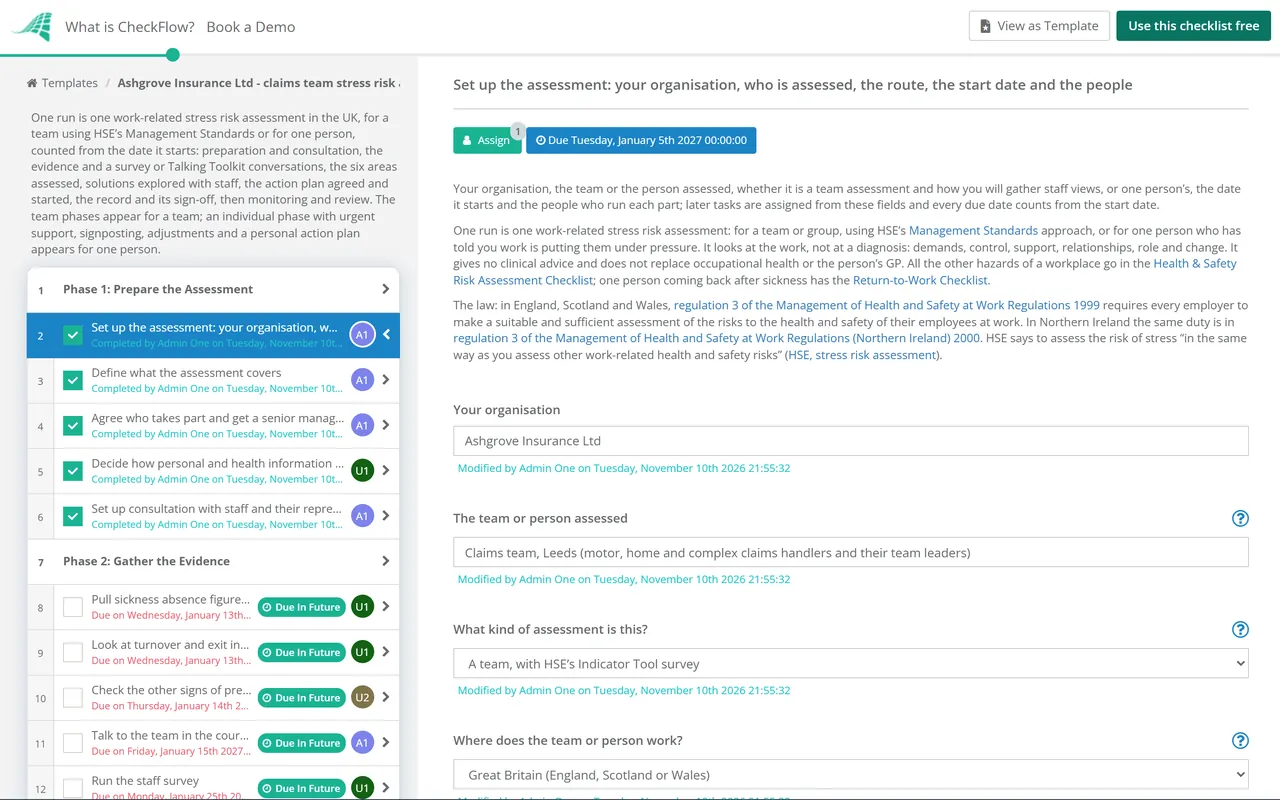
    Phase 1: Prepare the Assessment

    6 tasks

    Owned by the manager, with HR and the health and safety lead. Choose on the first task whether this is a team assessment, and how you will hear from staff, or one person’s: the tasks that fit appear. Decide before anyone is asked a question how answers and health information will be kept.

    • Set up the assessment: your organisation, who is assessed, the route, the start date and the people — your organisation, the team or the person assessed, whether it is a team assessment and how you will gather staff views, or one person’s, the date it starts and the people who run each part; later tasks are assigned from these fields and every due date counts from the start date
    • Check whether the person needs support today — if you are worried about their immediate safety, get help straight away; otherwise agree when you will talk properly, soon and in private
    • Define what the assessment covers — the team, roles, sites and shifts included, people on leave, part-time, home-based and agency workers, the managers themselves, and any recent or planned change; for one person, their role and the work they do
    • Agree who takes part and get a senior manager’s support — a senior manager who backs the assessment and gives staff time to take part, HR, health and safety, occupational health if you have it and, for a team, employee or trade union representatives; a larger organisation may use a steering group or its health and safety committee
    • Decide how personal and health information is handled — survey answers anonymous and reported only for groups large enough that no one can be picked out, health details kept off this checklist and in the confidential HR or occupational health file, and who sees the findings
    • Set up consultation with staff and their representatives — tell the team why the assessment is happening, what will be asked, when and how answers are kept, and involve safety or trade union representatives from the start, in finding the problems and the solutions and in checking the actions later
  2. Phase 2

    Phase 2: Gather the Evidence

    9 tasks

    Applies only when the assessment is for a team. HSE says to use more than one source and look for where they agree. Use figures for the group, never a list of who was off sick and why. The survey or the Talking Toolkit conversations run in the second and third weeks.

    • Map your own survey’s questions to the six areas — which questions cover demands, control, support, relationships, role and change, and what to add, or ask another way, where an area is missing
    • Pull sickness absence figures for the team — levels, patterns and timing against busy periods, compared with other teams, as figures for the group
    • Look at turnover and exit interview reasons — leavers over the last year against what you would expect, and any common reasons people gave for leaving
    • Check the other signs of pressure — grievances and complaints, bullying or harassment cases, accidents and near misses, overtime and hours worked, and any group figures from occupational health or the employee assistance programme
    • Talk to the team in the course of the work — team meetings with an agenda item on workloads, one-to-ones, and walk-throughs or talk-throughs of the busiest tasks
    • Run the staff survey — open to everyone in scope, managers included, for a set period, with reminders through the representatives, and closed on the date you announced
    • Hold Talking Toolkit conversations — one-to-one or small group conversations using HSE’s Talking Toolkit, covering the six areas, with notes of the issues and ideas raised and no names against them
    • Analyse the survey results — the average score for each of the six areas and the lowest-scoring questions, read against the response rate; for HSE’s Indicator Tool, enter the answers in HSE’s Analysis Tool
    • Bring the evidence together and mark the hot spots — where the sources agree, where they differ, and which roles, shifts or areas look most affected
  3. Phase 3

    Phase 3: Talk to the Person & Agree Support

    9 tasks

    Applies only when the assessment is for one person. Talk soon, in private and in working time. The conversation is about the work: the person decides how much they share, and health details stay in the confidential file, not on this checklist.

    • Arrange a private conversation in working time — a quiet place and enough time in the working day, led by someone the person is comfortable with, and a colleague or representative with them if they would like one
    • Explain what the conversation is for and what will be recorded — that it is about the work, what goes on this checklist, what stays in the confidential file and who will see it, and that they need not answer anything they would rather not
    • Go through the six areas with them — demands, control, support, relationships, role and change: what is causing pressure, when it happens and when it does not, using open questions and taking your lead from them
    • Agree what would help, starting with changes to the work — changes at the source first, such as workload, deadlines, priorities, hours or training, then support around them
    • Tell them where else they can get support — occupational health, with a referral if they agree to one, the employee assistance or counselling service, their GP, a trade union or health and safety representative, and any mental health first aider
    • Ask HR whether the duty to make reasonable adjustments applies — where the person has, or may have, a condition that could be a disability, the employer may have a legal duty to make reasonable adjustments; HR decides with occupational health advice, not the line manager alone
    • Agree a written action plan with the person — the problem, the agreed solution, the actions, who does each and by when, and the date to review the plan together
    • Make the first changes and tell only the people who need to know — what changes from when, and what the person agreed others may be told
    • Hold the first review meeting with the person — whether the changes are working, what else is needed, and the next date
  4. Phase 4

    Phase 4: Assess the Six Management Standards

    7 tasks

    Applies only when the assessment is for a team. Rate each area from the evidence, not from the survey alone. HSE says it does not expect an employer to meet all the standards: they are targets to work towards.

    • Assess demands — workload, work patterns and the work environment: what the evidence shows, who it affects, what already helps and the risk that remains
    • Assess control — how much say people have in the way they do their work: what the evidence shows, who it affects, what already helps and the risk that remains
    • Assess support — the encouragement, sponsorship and resources from the organisation, line management and colleagues: what the evidence shows, who it affects, what already helps and the risk that remains
    • Assess relationships — promoting positive working to avoid conflict and dealing with unacceptable behaviour: what the evidence shows, who it affects, what already helps and the risk that remains
    • Assess role — whether people understand their role and do not have conflicting roles: what the evidence shows, who it affects, what already helps and the risk that remains
    • Assess change — how organisational change, large or small, is managed and communicated: what the evidence shows, who it affects, what already helps and the risk that remains
    • Record the groups especially at risk and how — the roles, shifts or people whose work puts them under most pressure, such as new starters, people going through a change or anyone working alone
  5. Phase 5

    Phase 5: Explore Problems & Solutions With Staff

    4 tasks

    Applies only when the assessment is for a team. The data gives a broad picture; the people who do the work say what is behind it and what would work in practice.

    • Share the results with the team and their representatives — the overall picture and the hot spots, before the focus groups, so the figures do not come as a surprise
    • Run focus groups to test the findings and find solutions — small groups who check whether the hot spots are real, raise what the data missed and suggest what would work
    • Look for solutions at the source first — changes that remove or reduce the cause, then help for people to deal with it, then support for anyone already affected, at the level of the organisation, the team or one person
    • Collect each group’s preliminary action plan — the suggestions and recommendations from each group, ready to be combined into one plan
  6. Phase 6

    Phase 6: Agree & Start the Action Plan

    5 tasks

    Applies only when the assessment is for a team. One plan, agreed with senior managers and employee representatives and shared with the team. The first actions start here, before the sign-off.

    • Write one action plan for the team — for each area that needs action: the desired state, the current state, the practical solution, who takes it forward, when, how staff hear about progress, and whether it is done
    • Prioritise each action and give it an owner, resources and a date — the order of priority, whether each action really tackles the issue, the resources it needs and a realistic date
    • Agree the plan with senior managers and employee representatives — who agreed it, when, and any changes made
    • Share the final plan and timetable with the team — what the assessment found, what will change and when, and how people will hear about progress
    • Start the first actions — the quick wins first; the action plan table tracks the rest
  7. Phase 7

    Phase 7: Record & Sign Off the Assessment

    4 tasks

    The record is the significant findings, the groups especially at risk and the actions, with no health details. The approver chosen on the first task signs off; nothing after the sign-off can be completed until they do. For one person, write the record and ask for the sign-off once the plan is agreed and the first changes are made, usually in the second week; the due dates follow the team timetable.

    • Check the policies the findings touch — bullying and harassment, sickness absence, including keeping in touch and return to work interviews, equality and reasonable adjustments, and the first aid needs assessment
    • Write up the record of the assessment — the significant findings, the groups especially at risk and the actions with owners and dates; for one person, the work-related findings and the agreed plan, kept where Phase 1 decided
    • Make the changes the approver asked for — the gaps or changes the approver named; then ask them to change the decision and complete the sign-off
    • Sign off the assessment and the action plan — the approver checks that the evidence covers the six areas, the actions are agreed and started, any individual support is in place and the record keeps health details out, then completes this task with the decision
  8. Phase 8

    Phase 8: Monitor & Review

    4 tasks

    Check the actions are happening, ask whether they have helped, and set the next review. HSE says not to wait for a scheduled review if it becomes obvious the solutions are not working.

    • Check the actions are happening — each action’s progress against the plan, with anything stalled raised with its owner
    • Ask the team, or the person, whether the changes have helped — in team meetings, through the representatives or in a review meeting with the person
    • Compare absence, turnover and survey results with the start — the same figures as in Phase 2, and a repeat survey if the plan includes one
    • Update the record and set the next review date — what changed, what is still open, the date of the next review and what would bring it forward, such as a reorganisation, new targets or more people off sick

The Six Management Standards and Where to Find the Evidence

HSE’s six Management Standards are the frame for Phase 4 and for the conversation with one person in Phase 3. Each standard also says that systems are in place locally to respond to any individual concerns. HSE says it does not expect an employer to meet all the standards: they are goals to work towards through risk assessment and continuous improvement. The first three columns are HSE’s words; the last is this template’s.

Area What it covers (HSE) The standard (HSE) Evidence to look at (this template’s suggestions)
DemandsWorkload, work patterns and the work environmentEmployees indicate that they are able to cope with the demands of their jobsHours and overtime, workload at peaks, absence timed with busy periods
ControlHow much say the person has in the way they do their workEmployees indicate that they are able to have a say about the way they do their workWho sets the pace and the order of work, breaks, consultation on work patterns
SupportThe encouragement, sponsorship and resources provided by the organisation, line management and colleaguesEmployees indicate that they receive adequate information and support from their colleagues and superiorsOne-to-ones and feedback, training, whether people know what support exists
RelationshipsPromoting positive working to avoid conflict and dealing with unacceptable behaviourEmployees indicate that they are not subjected to unacceptable behaviours, eg bullying at workGrievances, bullying and harassment cases, complaints, exit interview reasons
RoleWhether people understand their role and whether the organisation ensures they do not have conflicting rolesEmployees indicate that they understand their role and responsibilitiesJob descriptions, conflicting targets, people reporting to two managers
ChangeHow organisational change (large or small) is managed and communicatedEmployees indicate that the organisation engages them frequently when undergoing an organisational changeRecent or planned restructures, new systems or targets, how and when staff heard

Which law, which regulator. In England, Scotland and Wales, regulation 3 of the Management of Health and Safety at Work Regulations 1999 requires a suitable and sufficient assessment of the risks to employees, and HSE is the regulator. In Northern Ireland the same duty is in the Management of Health and Safety at Work Regulations (Northern Ireland) 2000, and HSENI is the regulator. In both, an employer with five or more employees must record the significant findings and any group especially at risk (regulation 3(6)). Where a disability may be involved, the duty to make reasonable adjustments is in section 20 of the Equality Act 2010 in Great Britain and in the Disability Discrimination Act 1995 in Northern Ireland, where the Equality Act does not apply.

HSG218 or the workbook? HSE’s stress pages now point to its step-by-step workbook, Tackling work-related stress using the Management Standards approach (WBK01, revised edition, March 2019), and we did not find HSG218 on them. HSENI’s resources page for Northern Ireland still links to HSG218 beside the workbook. Both describe the Management Standards approach; this checklist follows HSE’s current pages, read in November 2026.

Why Run Stress Risk Assessments in CheckFlow?

1

One template for a team or for one person

The first task asks what kind of assessment this is. A team gets the evidence, survey or conversation tasks, the six areas, the focus groups and the team action plan. One person gets a private conversation, signposting, adjustments through HR and a personal plan instead. Each task is assigned to the manager, HR or the health and safety lead chosen on that task.

2

Actions and support do not wait for the sign-off

The action plan is agreed, shared and started, and any support for one person arranged, before the approver signs off. The sign-off is assigned to the approver alone, and nothing after the sign-off step can be completed until they decide. If they cannot sign off, a task appears for the manager with the changes to make.

3

The review comes back on time

The last phase checks the actions after about 11 weeks and asks whether they helped after about 15. A yearly recurring schedule starts the next assessment on the same date, and the Reports Grid shows every assessment in progress and the tasks that are overdue.

CheckFlow does not assess anyone’s health. The judgement about the work and the risk is yours, recorded on each task, and health details stay in your confidential HR or occupational health file. The checklist permissions on the template decide who can run and see the checklists started from it. To keep individual assessments to the people running them, change All Users from Run and View to Run and View Assigned To. CheckFlow’s compliance checklist software shows how the same approach handles recurring reviews.

Assess the other hazards of a workplace with the Health & Safety Risk Assessment Checklist, and screen work with the DSE Workstation Assessment Checklist. For one person, use the Return-to-Work Checklist after sickness, the Reasonable Accommodation Request Checklist for adjustments and the Grievance Procedure Checklist for a formal complaint. The Employee Engagement Survey Process Checklist runs an engagement survey, and the ISO 45001 Checklist runs the management system around your assessments.

AI generator

Didn’t find what you need? Describe it.

Describe the process in a sentence and the AI checklist generator drafts the phases and tasks for you.

Frequently Asked Questions

What is a stress risk assessment?

A stress risk assessment looks at the parts of the work that can put people under too much pressure, who is affected and what will be done about it. HSE defines stress as “the adverse reaction people have to excessive pressures or other types of demand placed on them”. Its Management Standards frame the assessment around six areas: demands, control, support, relationships, role and change. The output is a record of the significant findings and an action plan agreed with staff.

Do employers have to carry out a stress risk assessment?

Yes. HSE says employers have a legal duty to protect workers from stress at work by doing a risk assessment and acting on it. The duty to assess is regulation 3 of the Management of Health and Safety at Work Regulations 1999 in England, Scotland and Wales, and of the 2000 Regulations in Northern Ireland. With five or more employees the significant findings must be written down. HSE is the regulator in Great Britain and HSENI in Northern Ireland.

What are the HSE Management Standards?

They are six areas of work design that HSE says, if not properly managed, are associated with poor health, lower productivity and increased accident and sickness absence rates: demands, control, support, relationships, role and change. Each has a standard, such as employees indicating that they are able to cope with the demands of their jobs, and a list of what should be happening. HSE does not expect employers to meet them all; they are targets to work towards.

Do I have to use the HSE Indicator Tool survey?

No. HSE says a survey is not an essential step, and that for smaller organisations it would not be proportionate, particularly where the same information can be gathered in other ways. Its Indicator Tool has 35 questions mapped to the six areas, and you can use your own staff survey if you check it covers all six. HSE developed its Talking Toolkits for smaller organisations. Whichever you use, HSE says not to rely on a survey alone.

When do you need an individual stress risk assessment?

Acas says that if an employee tells their manager they are experiencing work-related stress, the manager should do an individual risk assessment. HSE’s workbook says to speak to the person without undue delay, take the complaint seriously, and ask for expert help, for example from occupational health, where things have gone beyond what the line manager can deal with. Choose One person on the first task and the individual phase appears.

Where should the information from a stress risk assessment be kept?

Keep the work-related findings and actions with the assessment, and keep health details apart. The ICO says information about a person’s physical or mental health is special category data, which needs a lawful basis and a special category condition, and that you should limit how much you collect. This template asks you in Phase 1 where confidential notes are kept, such as the HR case file, and keeps diagnoses and medical details off the checklist.

Is HSG218 still HSE’s guidance on work-related stress?

HSE’s stress pages now point to its step-by-step workbook, Tackling work-related stress using the Management Standards approach (WBK01, revised edition published in March 2019), and we did not find HSG218 on them in November 2026. HSENI’s resources page for Northern Ireland still links to HSG218 beside the workbook. Both describe the same Management Standards approach, and this checklist follows HSE’s current pages.

How often should a stress risk assessment be reviewed?

The regulations set no fixed interval. Regulation 3(3) requires a review when there is reason to suspect the assessment is no longer valid or there has been a significant change in the matters it relates to. HSE adds that the timing depends on the actions, and that if the solutions are clearly not working you should act at once rather than wait. A yearly review, with the survey repeated each year as HSE suggests you may, keeps it current.

Is CheckFlow free for this template?

14-day free trial, no card required. The Business plan is $10 per user per month after the trial. Full details at checkflow.io/pricing.

Assess Stress at Work, Act On It and Check It Helped

Free trial — no credit card required.

14-day free trial, no credit cardFull refund in your first 30 daysUS hosting, EU on request