An employee who complains and hears nothing for three weeks stops trusting the process. A complaint heard by the manager it is about, or answered without a written reason, rarely ends where it started.
This free grievance procedure checklist runs a workplace complaint from the day it arrives to the day the agreed actions are done. It records the complaint, offers an informal route where that fits, invites the employee to a meeting, adds an investigation only when the facts need one, asks HR to approve the response before it is sent, and handles an appeal. A jurisdiction question at the start switches between the UK route under the Acas Code of Practice and the US route. When the complaint is about a colleague’s conduct, the investigation often leads to the Disciplinary Procedure Checklist for that colleague.
A grievance is a concern, problem or complaint an employee raises with their employer. It might be about pay, workload, a change to shifts, a manager’s behaviour or treatment by a colleague. Most are settled with a conversation. The ones that reach a formal process tend to fail in the same few ways: nobody acknowledges the complaint, the person named in it ends up handling it, the meeting turns into a debate rather than a hearing, or the employee gets a decision with no reasons and no route to challenge it.
Answer what was actually raised. A written grievance often contains several separate points. A response that deals with the headline and ignores the rest leaves the employee with a fresh complaint. The template asks the grievance manager to list each point at the start and give a decision on every one of them.
Protect the person who complained. In both countries, an employee who raises a discrimination or harassment complaint in good faith is protected from being treated worse because of it. Brief the managers involved early, and check back with the employee after the outcome to make sure nothing has changed for the worse.
United Kingdom
The Acas Code and the Employment Rights Act 2025
The Code: the employee raises the grievance in writing; the employer holds a meeting without unreasonable delay, decides, replies in writing and offers an appeal. A tribunal can raise an award by up to 25% where an employer’s failure to follow it was unreasonable.
Harassment: since 6 April 2026, reporting sexual harassment can count as whistleblowing. From 30 October 2026, employers are due to take “all reasonable steps” to prevent sexual harassment and must not permit harassment of staff by third parties.
Time limits: for most matters arising on or after 1 October 2026, a tribunal claim must start within six months less one day, not three. An internal grievance does not pause that clock.
United States
A complaint route that works
No set procedure: federal law does not prescribe grievance steps, but the EEOC recommends an effective complaint process. If a supervisor creates a hostile environment, the employer’s defence rests on having tried to prevent and promptly correct it, and on the employee unreasonably not using that route.
Deadlines: an EEOC charge is due within 180 calendar days, or 300 where a state or local agency enforces a similar law. An internal or union grievance generally does not extend it. State deadlines vary.
Guidance: the EEOC rescinded its 2024 harassment guidance in January 2026; the laws against harassment and retaliation are unchanged. Unionised staff follow the grievance steps in their collective agreement.
The checklist sets out process steps and points to the authority behind each one; it does not replace advice on a particular case. If a grievance alleges discrimination or harassment, or arrives alongside a resignation or a disciplinary case, an employment lawyer can help you judge the risk before you reply.
What the Grievance Procedure Checklist Covers
Seven phases, from receiving the complaint to checking the actions were done. The investigation phase appears only when the facts need checking, and the appeal phase once an appeal is received.
Phase 1
Phase 1: Receive & Assess
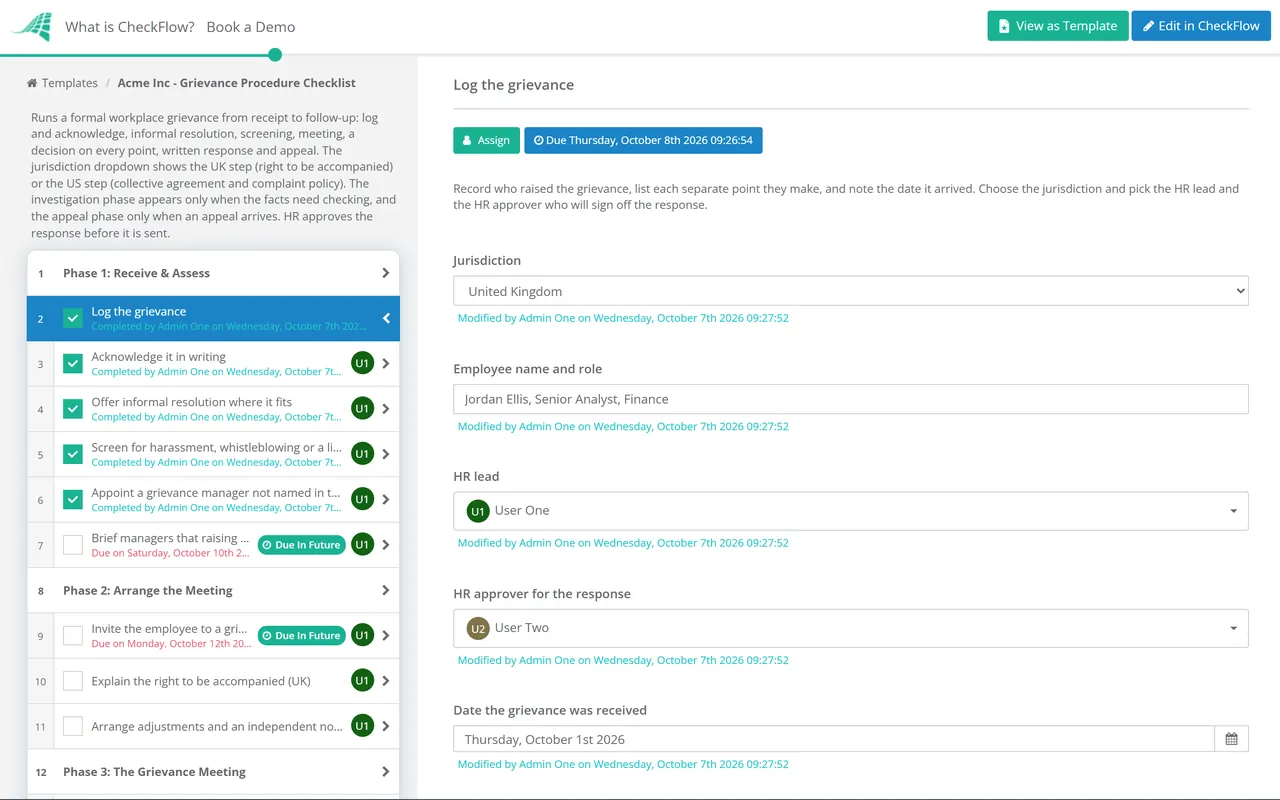
Log the grievance — who raised it, each point they make, the date received and the jurisdiction
Acknowledge it in writing — say who will handle it and what happens next
Offer informal resolution where it fits — a conversation or mediation, only if the employee agrees
Screen for harassment, whistleblowing or a live disciplinary case
Appoint a grievance manager not named in the complaint
Brief managers that raising a grievance must not lead to worse treatment
Phase 2
Phase 2: Arrange the Meeting
Invite the employee to a grievance meeting — without unreasonable delay; Acas suggests ideally within five working days
Explain the right to be accompanied (UK) — and offer another time within five working days if their companion is unavailable
Check the collective agreement and complaint policy (US) — follow any union grievance steps and deadlines
Arrange adjustments and an independent note-taker
Phase 3
Phase 3: The Grievance Meeting
Let the employee explain each point in their own words
Ask what outcome would resolve it for them
Share the meeting notes with the employee — and record any corrections
Decide whether the facts need investigating — adjourn rather than decide on half the picture
Phase 4 — If Needed
Phase 4: Investigation
Shown when the grievance manager decides the facts need checking.
Set the questions the investigation must answer — with an investigator and a target date
Speak to the people named and any witnesses — separately, with agreed notes
Collect the records — messages, rotas, pay data or policies
Report the findings to the grievance manager — what was established and what could not be
Phase 5
Phase 5: Decision & Response
Decide on every point raised — upheld, partly upheld or not upheld, with reasons
HR approves the response and the actions — before the letter goes to the employee
Write to the employee with the decision — the reasons, the actions agreed and how to appeal
Refer any misconduct found to the disciplinary procedure
Note whether an appeal arrives — by the date set in the letter
Phase 6 — If Appealed
Phase 6: Appeal
Shown when the employee appeals against the grievance decision.
Pass the appeal to a manager with no earlier part in the case — senior enough to change the outcome
Arrange the appeal hearing — the grounds, the date and, in the UK, the companion right
Review the grounds of appeal and any new evidence
Confirm the final decision in writing — and that the internal process has ended
Phase 7
Phase 7: Follow Through & Close
Complete the agreed actions — each with an owner and a date
Check in with the employee a few weeks later — has the problem stopped, and has anything changed for the worse?
Tell others directly involved that the process has finished — without sharing the detail
Store the grievance file with restricted access
Look for patterns across grievances — the same team, manager or policy
Which Route a Complaint Takes, and the Clocks That Run Alongside
Not every complaint belongs in the grievance procedure, and some belong in two procedures at once. Sorting this out on day one avoids a late discovery that the complaint was really a whistleblowing report, or that the colleague it names needs their own fair process. Use the table during the screening task in Phase 1.
What is raised
Main route
Watch for
Pay, hours, duties or a change to terms
Grievance procedure
Check the contract and payroll records before the meeting; the answer is often in the paperwork
A colleague’s or manager’s behaviour
Grievance, usually with an investigation
If misconduct is found, the person complained about gets their own disciplinary process, not a verdict reached inside the grievance
Harassment or discrimination
Grievance with an investigation; consider interim separation
Retaliation risk; in the UK, a sexual harassment report can also be a protected disclosure, and the prevention duty applies
Wrongdoing that affects others, such as fraud or a safety risk
A shared complaint raised by a union or employee representative
Collective grievance or disputes procedure
The Acas Code says its grievance provisions do not apply; use your collective agreement
A grievance raised during a disciplinary case
Pause the disciplinary, or run both together if related
The Acas Code allows either; record which you chose and why
Day 1
The written grievance arrives
Log it and acknowledge it. Under the Acas Code, a formal grievance goes to a manager who is not the subject of it. If the employee raised it verbally, ask them to put it in writing, and help them do so if needed.
Week 1
The meeting
The Code says without unreasonable delay, and Acas guidance suggests ideally within five working days. In the UK, if the companion cannot attend, the meeting moves to a time the worker proposes, within five working days after the original date.
Weeks 2–4
Investigation and decision
Only as long as the facts need. Tell the employee if the reply will take longer than expected, and why. The decision goes to them in writing, with the actions and the right of appeal.
Appeal
The window to challenge
Set a deadline in your policy. For employees, Acas suggests five working days from receiving the outcome as a reasonable time to appeal. The appeal is heard impartially, by a manager not involved before where possible.
Outside
The legal clock keeps running
A grievance does not stop the time limit for an external claim. In the UK, the employee must notify Acas for early conciliation before a tribunal claim, which pauses the limit. In the US, the 180- or 300-day EEOC charge deadline runs regardless of internal steps.
Why Handle Grievances in CheckFlow?
1
Only the steps this complaint needs
The jurisdiction dropdown shows the UK companion step or the US collective agreement step. The investigation phase is shown only when the grievance manager says the facts need checking, and the appeal phase only when an appeal arrives.
2
No reply goes out unchecked
The response goes through an approval task: the HR approver chosen when the grievance was logged must sign it off, and nothing moves until they do, so a pay correction or a team move is agreed before it is promised.
3
Dates that keep the case moving
Due dates count from the day the grievance arrived or from the meeting date, so a delay shows as overdue. Notes and letters sit on the task they belong to, and the audit trail records who did what, and when.
Grievances, discipline and investigations share people, letters and deadlines. CheckFlow’s HR checklist software runs them as connected templates, with assignments, approvals and reports that show how long cases take from start to finish.
When a grievance needs a full fact-finding exercise, run the Workplace Investigation Checklist alongside this one: it covers terms of reference, evidence, interviews and the findings report in more depth than Phase 4 here.
It is the route an employee uses to raise a work problem formally and get a considered answer. A typical procedure asks the employee to set out the complaint in writing, then gives them a meeting to explain it, a written decision with reasons and a chance to appeal. Many grievances can be settled informally first, but the formal route should be there, written down, for when that fails.
Is there a right to be accompanied at a grievance meeting?
+
In the UK, yes, when the meeting deals with a complaint about a duty the employer owes the worker, such as a contractual or legal obligation. The worker must make a reasonable request and can choose a fellow worker, a trade union representative or a union official. A tribunal can award up to two weeks’ pay if the right is denied. Many employers allow a companion at every grievance meeting to avoid arguing about which ones qualify. US law gives no general right to a companion.
What if an employee raises a grievance during a disciplinary case?
+
The Acas Code says the disciplinary process may be paused while the grievance is dealt with, or, where the two are related, both may be handled at the same time. A grievance that says the disciplinary manager is biased, or that relevant evidence has been ignored, often justifies a pause or a different manager. Record the choice you make and the reason, so the decision can be explained later.
Does a grievance stop the clock for a tribunal claim or an EEOC charge?
+
No. In the UK, Acas guidance is clear that going through a grievance or appeal does not change the time limit; for most matters arising on or after 1 October 2026 it is six months less one day, and notifying Acas for early conciliation pauses it. In the US, the EEOC says its 180- or 300-day charge deadline is generally not extended by an internal or union grievance. Long internal processes do not protect either side.
How should a collective grievance be handled?
+
When a trade union or other employee representative raises a grievance on behalf of two or more employees, the Acas Code says its grievance provisions do not apply. Use the collective grievance or disputes procedure in your agreement with the union instead. If several employees raise the same complaint individually, you can still hear them separately under this checklist and give a consistent answer.
What changes for harassment complaints in the UK in 2026?
+
Since 6 April 2026, a disclosure that sexual harassment has happened, is happening or is likely can be a qualifying disclosure under whistleblowing law. From 30 October 2026, employers are due to take “all reasonable steps” to prevent sexual harassment, up from “reasonable steps”, and must not permit staff to be harassed by third parties such as customers. A revised Acas Code, consulted on in summer 2026, would ask workers to say in the grievance how they want it resolved; it is not yet in force.
Is CheckFlow free for this template?
+
14-day free trial, no card required. The Business plan is $10 per user per month after the trial. Full details at checkflow.io/pricing.
Give Every Complaint a Fair Hearing and a Written Answer
Free trial — no credit card required.
Do you like cookies? 🍪 We use cookies to ensure you get the best experience on our website. Learn more