Leave of Absence (FMLA) Checklist Template

FMLA leave rarely goes wrong at the start. It goes wrong when the eligibility notice goes out on day nine, nobody writes down the certification due date, or nobody counts the weeks until the employee has already used them up.

Last reviewed: October 2026

This free leave of absence checklist runs one FMLA case for one employee, from the day HR learns of a possibly qualifying reason to the return to work. It follows the federal Family and Medical Leave Act and its regulations; state leave laws and state paid leave programs may add rights, so check the rules in your state. HR records the request, checks coverage and eligibility, sends the eligibility and rights and responsibilities notice within five business days, requests and reviews the certification, and sends the designation notice with the amount of leave counted. Payroll keeps group health coverage going, the manager arranges cover, the leave is tracked against the 12-workweek entitlement, and the employee returns to the same or an equivalent job. The reason for leave shows the matching DOL form, and intermittent leave, an incomplete certification, a second opinion or a fitness-for-duty requirement add their own tasks. For a new child, the Parental Leave Checklist covers the wider process.

One FMLA Case, From the Request to the Return

The Family and Medical Leave Act gives eligible employees of covered employers up to 12 workweeks of unpaid, job-protected leave in a 12-month period, or 26 workweeks to care for a seriously injured or ill servicemember, with group health coverage kept on the same terms. Most of the employer’s work is notices with five-business-day deadlines, a certification with its own clock, and an accurate count of the weeks used.

This checklist runs one FMLA case for one employee, for any of the qualifying reasons. It follows the federal rules only: state family and medical leave laws and state paid leave programs may give the employee more, so check the rules in the state where they work. FMLA leave can also run at the same time as a workers’ compensation claim. Two other checklists cover the steps around it.

This checklist

One FMLA case

Covers: any FMLA reason, from the request to the return: coverage, eligibility, the WH-381 and WH-382 notices, certification, tracking the leave and job restoration.

Where: the United States, federal law.

Output: a designated leave, an accurate count of the weeks used and a complete FMLA record.

A new child

The Parental Leave Checklist

Covers: pregnancy at work, maternity, paternity, adoption and shared parental leave, statutory pay and keeping in touch.

Where: the United States and the United Kingdom side by side.

Use it: when the leave is for a birth or adoption and you want the whole parental process. Parental Leave Checklist.

After any absence

The Return-to-Work Checklist

Covers: the return itself after sickness, injury, parental leave or a career break: fit notes, adjustments, a phased return and follow-up reviews.

Where: the United States and the United Kingdom.

Use it: from a few weeks before the return date. Return-to-Work Checklist.

What the Leave of Absence (FMLA) Checklist Covers

Eight phases follow one FMLA case from the request to the records. The reason for leave shows the matching certification form and the notes on entitlement, second opinions, fitness for duty and recertification. An employee who is not eligible, a key employee, intermittent or reduced schedule leave, an incomplete or missing certification, a second opinion, a fitness-for-duty requirement, leave that is not designated, and an employee who needs more leave or will not return each add their own tasks. HR’s designation notice is the gate: nothing after it can be completed until it has been sent.

  1. Phase 1

    Phase 1: Request & Case Setup

    4 tasks

    HR opens a case as soon as an employee asks for leave or you learn that an absence may be for an FMLA reason. The employee does not have to mention the FMLA. Enter the date HR learned of the need for leave first: every due date in Phases 1 to 3 counts in business days from it.

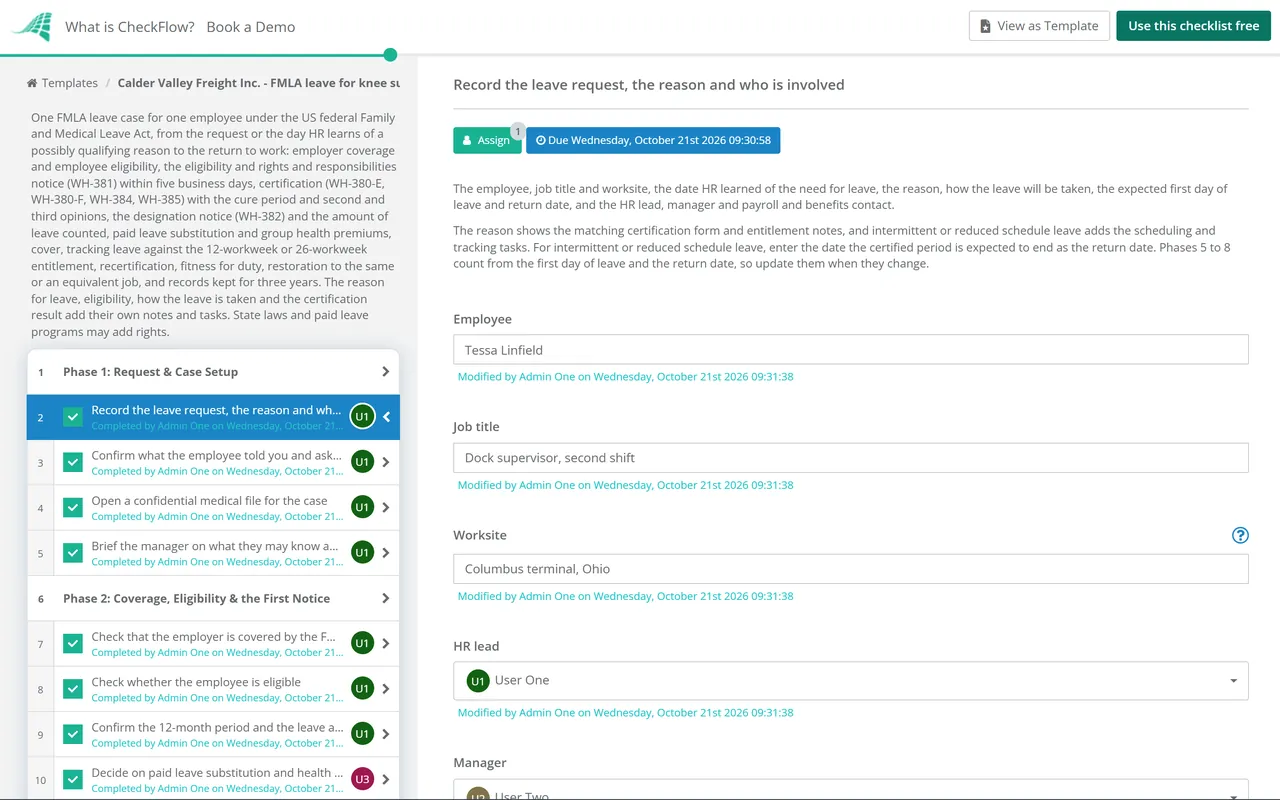
    • Record the leave request, the reason and who is involved — the employee, job title and worksite, the date HR learned of the need for leave, the reason, how the leave will be taken, the expected first day of leave and return date, and the HR lead, manager and payroll and benefits contact
    • Confirm what the employee told you and ask for what is missing — enough to tell whether the FMLA may apply and the expected timing and length of the leave; the employee does not need to name the FMLA, and when the reason is unclear you ask further questions
    • Open a confidential medical file for the case — certifications, recertifications and medical histories created for the FMLA kept as confidential medical records, in a file separate from the usual personnel file
    • Brief the manager on what they may know and do — the expected dates and any work restrictions, not the diagnosis; the manager must not contact the employee’s health care provider, discourage the leave, or count it against the employee in an attendance policy or any other decision
  2. Phase 2

    Phase 2: Coverage, Eligibility & the First Notice

    8 tasks

    The eligibility notice and the rights and responsibilities notice go to the employee within five business days of the request, or of the day you learned the leave may qualify, unless there are extenuating circumstances. DOL’s optional Form WH-381 covers both. A key employee adds a written notice. If the employee is not eligible, the notice gives the reason and two tasks appear: check state law and your own policy, then close the FMLA case.

    • Check that the employer is covered by the FMLA — a private employer with 50 or more employees for each working day in 20 or more calendar workweeks in the current or the preceding calendar year; public agencies and public and private elementary and secondary schools are covered whatever their size
    • Check whether the employee is eligible — at least 12 months with you, which need not be consecutive, at least 1,250 hours worked in the 12 months before the leave starts, and a worksite where you employ 50 or more people within 75 miles
    • Confirm the 12-month period and the leave already used — the method your policy uses for the 12-month period (the calendar year, a fixed leave year, forward from the first FMLA leave, or a rolling period backward) and the FMLA leave the employee has already used in it
    • Decide on paid leave substitution and health premium arrangements — whether the employee chooses, or you require, accrued paid leave to run at the same time as the FMLA leave, the conditions of your paid leave policy, and how the employee will pay their share of group health premiums during any unpaid leave
    • Send the eligibility and rights and responsibilities notice (WH-381) — within five business days, stating whether the employee is eligible and, if not, at least one reason; the rights and responsibilities part covers the 12-month period, any certification needed and what happens without it, paid leave substitution, premium payments, key employee status, benefits and job restoration, and the premiums the employee may owe if they do not return
    • Key employee: give written notice of key employee status — when the employee gives notice, or as soon as practicable, tell them in writing that they are a key employee and what could happen to their job restoration and health benefits if restoring them would cause substantial and grievous economic injury to your operations
    • Not eligible: check state leave law, paid leave programs and company policy — whether a state family and medical leave law, a state paid leave program or your own policy still gives the employee leave, and whether the ADA may also apply
    • Not eligible: record the outcome and close the FMLA case — the reason the employee is not eligible and the leave they are taking instead recorded, the notice filed, and the rest of this checklist marked not applicable; if the eligibility answer was wrong, change it and this task disappears
  3. Phase 3

    Phase 3: Certification

    7 tasks

    Ask for certification when the employee gives notice or within five business days of it (for unforeseen leave, within five business days of the leave starting). The employee has at least 15 calendar days to return it. The reason on the first task shows which DOL form applies. If you do not require certification, mark the rest of this phase not applicable, but still enter a certification due date: the designation tasks count from it.

    • Request certification and set the due date — the matching DOL form, or your own asking for the same information, the date it is due back (at least 15 calendar days after you ask), and in writing what happens if it is not provided
    • Check the certification has come back by the due date — the date it arrived, and a reminder to the employee before the due date if it has not; a certification that is never returned is a failure to provide one, not an incomplete one
    • Review the certification for completeness and sufficiency — every applicable entry completed, and information that is not vague, ambiguous or non-responsive; you contact the health care provider only to clarify or authenticate, after the employee has had a chance to cure, and never through the employee’s direct supervisor
    • Incomplete or insufficient: say in writing what is missing and allow seven days to cure — the additional information needed stated in writing, and seven calendar days for the employee to provide it, or longer if they cannot despite diligent, good faith efforts; if the gaps are not cured, you may deny FMLA leave
    • Not returned: check the reason and decide how the absence is treated — whether the employee made diligent, good faith efforts; for foreseeable leave you may deny FMLA coverage until the certification is provided, for unforeseeable leave from the end of the 15 days until it is, and leave never certified is not FMLA leave
    • Second opinion: arrange it at the employer’s expense — a health care provider you choose who is not employed by you and not one you use regularly, reasonable travel costs reimbursed, and the employee provisionally entitled to FMLA leave and health benefits until the opinions are in
    • Third opinion: agree a provider jointly if the first two differ — a third provider chosen or approved jointly with the employee, in good faith and at your expense; the third opinion is final and binding, and if the first two opinions agree, mark this task not applicable
  4. Phase 4

    Phase 4: Designation & the Leave Plan

    6 tasks

    Once you have enough information, usually the certification, tell the employee in writing within five business days whether the leave is designated as FMLA leave and how much will be counted. The designation notice is the gate: nothing after it can be completed until HR has sent it. Leave that is not designated adds a task to explain why.

    • Intermittent or reduced schedule: agree the schedule and any temporary transfer — a schedule for planned treatment that does not unduly disrupt the work, subject to the health care provider’s approval; bonding leave after a birth or placement is taken this way only if you agree, and for planned treatment you may temporarily transfer the employee to an available alternative position with equivalent pay and benefits
    • Work out the amount of leave to be counted — the hours, days or weeks that will count against the employee’s 12 workweeks, or 26 for military caregiver leave, worked out from their actual workweek; if the amount is not known yet, as with unforeseeable intermittent leave, you give it when the employee asks, up to once every 30 days
    • Decide whether a fitness-for-duty certification is required — only for leave for the employee’s own serious health condition, and only where a uniformly applied policy asks it of every similar employee with the same condition; if it must address the essential functions, the list of them goes with the designation notice
    • Prepare the designation notice (WH-382) — whether the leave is designated as FMLA leave, any requirement to use paid leave at the same time, any fitness-for-duty requirement with the essential functions list, and the amount of leave to be counted if it is known
    • HR sends the designation notice — in writing, within five business days of having enough information, with a copy in the case file; record the decision here, and nothing after this task can be completed until it is done
    • Not designated: tell the employee why and how the absence is treated — a simple written statement of the reason, such as no qualifying reason, no certification or the entitlement used up, and whether your own leave policy or a state law covers the absence; any dispute and the discussion about it are documented, and if no FMLA leave is designated, the rest of this checklist is marked not applicable
  5. Phase 5

    Phase 5: Pay, Benefits & Cover

    4 tasks

    Payroll, benefits and the manager get ready before the first day of leave. These tasks count back from the expected first day of leave on the first task. For leave that has already started, do them now.

    • Set up pay for the leave in payroll — accrued paid leave running at the same time as the FMLA leave where it is substituted, unpaid time where it is not, and any disability plan or workers’ compensation payments
    • Keep group health coverage and collect the employee’s share of premiums — the same group health coverage on the same terms as if the employee were working, family coverage included, with the employee’s share paid as agreed: through payroll for paid leave and, for unpaid leave, on the payroll or COBRA schedule, through a cafeteria plan or by another agreed system
    • Arrange cover for the work and the handover — who covers the work, open tasks and dates handed over, and the access the employee keeps during the leave; replacing the employee or restructuring the role does not remove the right to return
    • Agree how the employee will report on their status and return — how often and how they report their status and intent to return, under a policy that is not discriminatory, and that they tell you within two business days if the expected dates change, where they can foresee it
  6. Phase 6

    Phase 6: During the Leave

    5 tasks

    Track the leave as it is used and keep the employee informed about benefit changes. Recertification is limited, so check the rules before you ask for one. Intermittent or reduced schedule leave adds a task to track each absence in hours.

    • Record the leave taken against the entitlement — the dates of FMLA leave, and the hours where it is taken in less than a full day; a holiday in a full week of leave still counts as a week, and the employee can ask for the amount counted up to once every 30 days
    • Intermittent or reduced schedule: track each absence in hours — each absence recorded in an increment no larger than the smallest you use for other leave and never more than one hour, counting only leave actually taken and required overtime the employee cannot work, never voluntary overtime
    • Tell the employee about benefit changes and enrollment chances — any new or changed plan, premium or benefit that applies to the workforce, and any chance to change plans or add a family member, such as after a birth, offered as if the employee were at work
    • Ask for recertification only when the rules allow — in connection with an absence and no more often than every 30 days, or once the minimum duration certified has passed, or sooner if the employee asks for more leave, circumstances change significantly or you receive information that casts doubt; at least 15 calendar days to provide it, at the employee’s expense, with no second or third opinion
    • Check the entitlement left before the expected return date — the weeks left in the 12-month period against the expected return date; if more time may be needed, your own policy or a state law may give it and the ADA may also apply, but leave beyond the entitlement is not FMLA leave
  7. Phase 7

    Phase 7: Return to Work & Job Restoration

    7 tasks

    Confirm the return a week ahead. More leave or an employee who will not come back each add a task, and a fitness-for-duty requirement in the designation notice adds a task to receive the certification before the first day back.

    • Confirm the return date and the employee’s intent to return — the date the employee will be back, whether they need more leave, or whether they have said clearly that they will not return
    • Needs more leave: check the entitlement left and the certification — the weeks left, a recertification if the extension calls for one, written notice of any change to the designation, and the new return date entered on the first task so the later due dates move
    • Not returning: record the employee’s notice and end the FMLA obligations — the date and words of the employee’s clear notice, the end of the duty to keep health coverage and restore the job (COBRA still applies), and whether you may recover your share of premiums paid during unpaid leave
    • Fitness for duty: receive the certification before the first day back — a certification from the employee’s own health care provider that they can resume work, covering only the condition the leave was for and the essential functions if you listed them; you may delay restoration until it arrives, but not while you seek clarification
    • Restore the employee to the same or an equivalent position — the same job, or one virtually identical in pay, benefits, duties, shift, schedule and a nearby worksite, with any unconditional pay rise given during the leave and a reasonable chance to renew a license or finish a course the leave made them miss
    • Restart benefits and payroll on the first day back — benefits resumed at the same level with no waiting period or requalification, coverage restored even if it lapsed for missed premiums, and any missed employee premiums recovered as agreed
    • Meet the employee on their first day back — a welcome back, the work handed back, and any adjustments agreed; if a condition continues, the ADA may also apply, and a return-to-work plan covers a phased return and follow-up reviews
  8. Phase 8

    Phase 8: Records & Close-Out

    4 tasks

    Keep the FMLA records for at least three years, and keep medical records apart from the personnel file.

    • File the notices and the leave record — the dates and hours of FMLA leave, the employee’s written notices, copies of every notice you sent, premium payments, and any dispute about the designation with the reasons
    • Move the certifications into the confidential medical file — certifications, recertifications and medical histories kept apart from the personnel file; supervisors learn only of work restrictions and accommodations, and first aid and safety staff only when emergency treatment may be needed
    • Set the records to be kept for at least three years — a review date at least three years ahead, and the records ready to show the Department of Labor if it asks
    • Close the case and note anything to change in the leave process — what went well and what was late, and any change needed to the leave policy, the employee handbook or the posted FMLA general notice

FMLA Deadlines, Forms and Entitlements at a Glance

The FMLA deadlines

The deadlines and forms in the checklist, with the section of the regulations each comes from. Business days and calendar days are both used, so read each one carefully.

Step Who Deadline Form Rule
Employee gives notice of the need for leaveEmployee30 days ahead when the leave is foreseeable, otherwise as soon as practicableNone; your usual procedure29 CFR 825.302, 825.303
Eligibility and rights and responsibilities noticeEmployerWithin five business days of the request, or of learning the leave may qualifyWH-381825.300(b), (c)
Request certificationEmployerWhen the employee gives notice or within five business days of itWH-380-E, WH-380-F, WH-384, WH-385, WH-385-V825.305(b)
Return the certificationEmployeeAt least 15 calendar days after the request825.305(b)
Cure an incomplete or insufficient certificationEmployeeSeven calendar days after written notice of what is missing825.305(c)
Copy of a second or third opinionEmployerWithin five business days of the employee’s request825.307(d)
Designation noticeEmployerWithin five business days of having enough informationWH-382825.300(d)
RecertificationEmployer asks, employee providesNo more often than every 30 days unless an exception applies; at least 15 calendar days to provide it825.308
Late health premiumEmployeeCoverage can end once a payment is more than 30 days late, after written notice mailed at least 15 days before825.212
Keep the recordsEmployerAt least three years825.500(b)

The reasons for leave and what each needs

The reason you choose on the first task shows the matching notes in the checklist. The first column matches the choices there.

Reason for leave Entitlement Certification Worth knowing
The employee’s own serious health condition12 workweeks in the 12-month periodWH-380-EA fitness-for-duty certification can be required under a uniformly applied policy
A family member’s serious health condition12 workweeksWH-380-FSpouse, son, daughter or parent; parents-in-law are not covered
Birth or placement of a child, and bonding12 workweeks, ending within 12 months of the birth or placementNo DOL form for bonding; reasonable documentation of the relationshipIntermittent bonding leave only if the employer agrees; spouses at the same employer may share 12 weeks
A qualifying exigency (military family)12 workweeksWH-384, and the active duty orders the first timeCan be taken intermittently; no recertification
Military caregiver leave26 workweeks in a single 12-month period counted forwardWH-385 or WH-385-V; ITOs and ITAs acceptedNo more than 26 workweeks of FMLA leave for all reasons in that period; no recertification

Sources. The FMLA regulations, 29 CFR Part 825 and the Department of Labor’s FMLA pages, where the optional forms are free to download. The forms are optional: your own may be used if it asks for the same information and no more. Special rules apply to airline flight crews and to some school employees, and this table is not legal advice.

Why Run FMLA Leave in CheckFlow?

1

Five business days, counted for you

Enter the date HR learned of the need for leave and the certification due date, and every notice and review gets a due date counted in business days. The return date drives the tasks before and after the employee comes back. Cases still open show on the Reports Grid, and overdue alerts go to the people assigned.

2

The right form for each reason

One answer on the first task shows the matching certification form, from WH-380-E to WH-385-V, and the entitlement notes for bonding and military caregiver leave. Intermittent leave adds the scheduling and hour-by-hour tracking tasks, and an incomplete certification adds the seven-day cure.

3

Nothing moves before the designation

The designation notice is a gate: pay, cover, tracking and the return cannot be ticked off until HR has sent it. Copies of every notice and certification are uploaded to the task they belong to, and the activity log shows who did what and when, which is the record the regulations ask you to keep. See how approval steps work.

CheckFlow does not decide whether leave qualifies, calculate entitlement from your payroll or send the DOL forms for you. HR makes those decisions with the regulations and, where needed, legal advice. CheckFlow makes sure each step happens on time, that every task has an owner and that the case leaves a complete record. HR checklist software shows how leave, reviews and departures run from templates across a team.

For a new child, the Parental Leave Checklist runs the wider parental process in the US and the UK. Plan the first weeks back with the Return-to-Work Checklist, run a workplace injury that also qualifies for FMLA leave with the Workers’ Compensation Claim Checklist, keep the FMLA notice in your handbook with the Employee Handbook Update & Rollout Checklist, and check your leave records once a year with the Human Resources Audit Checklist.

AI generator

Didn’t find what you need? Describe it.

Describe the process in a sentence and the AI checklist generator drafts the phases and tasks for you.

Frequently Asked Questions

What should an FMLA checklist include?

Every step of one leave case: recording the request, checking employer coverage and employee eligibility, the eligibility and rights and responsibilities notice within five business days, requesting and reviewing certification, the designation notice and the amount of leave counted, paid leave and health premiums, cover, tracking the leave against the entitlement, job restoration and the records. This template adds the steps for intermittent leave, an incomplete certification, a second opinion, a key employee and fitness for duty when they apply.

Who is eligible for FMLA leave?

An employee of a covered employer who has worked there for at least 12 months, which need not be consecutive, has worked at least 1,250 hours in the 12 months before the leave starts, and works at a site where the employer has 50 or more employees within 75 miles. Private employers are covered when they have 50 or more employees in 20 or more workweeks in the current or the preceding calendar year; public agencies and schools are covered whatever their size.

How quickly must an employer send the FMLA notices?

The eligibility notice, and the rights and responsibilities notice with it, within five business days of the employee’s request or of the employer learning that the leave may qualify, unless there are extenuating circumstances. The designation notice follows within five business days of the employer having enough information to decide, usually once the certification arrives. DOL’s optional forms are WH-381 for the first and WH-382 for the designation.

How long does an employee have to return a medical certification?

At least 15 calendar days after the employer asks, or longer if that is not practicable despite the employee’s diligent, good faith efforts. If the certification comes back incomplete or insufficient, the employer must say in writing what is missing and allow seven calendar days to fix it. A certification that is never returned can lead to the leave not being FMLA leave.

Can an employer ask for a second opinion?

Yes, if it has reason to doubt that a medical certification is valid. The employer pays, chooses a health care provider it does not employ or use regularly, and reimburses reasonable travel costs. If the two opinions differ, a third provider agreed by both sides gives an opinion that is final and binding. Second opinions are not allowed on recertification, or for military caregiver leave certified by a Defense, Veterans Affairs or TRICARE provider.

Does health insurance continue during FMLA leave?

Yes. The employer keeps the employee’s group health coverage on the same terms as if they were working, and the employee keeps paying their share of the premium. If a payment is more than 30 days late, coverage can end only after written notice mailed at least 15 days before, and the employee must still be restored to the same coverage when they return.

Is FMLA leave paid?

FMLA leave itself is unpaid. The employee may choose, or the employer may require, to use accrued paid leave at the same time, under the employer’s normal leave policy. Some states run paid family and medical leave programs and some have their own leave laws, so check the rules in the state where the employee works.

What FMLA records must an employer keep, and for how long?

At least three years of payroll data, the dates of FMLA leave and the hours of any partial-day leave, copies of the notices given and received, benefit policies, premium payments and any dispute about the designation. Certifications and medical histories go in a confidential file separate from the personnel file.

Is CheckFlow free for this template?

14-day free trial, no card required. The Business plan is $10 per user per month after the trial. Full details at checkflow.io/pricing.

Run Every FMLA Case on Time

Free trial — no credit card required.

14-day free trial, no credit cardFull refund in your first 30 daysUS hosting, EU on request