Restaurant Health Inspection Checklist Template

Most poor ratings come from problems the kitchen could have found itself: an unsigned diary, an unchecked probe, a pest report left open. The officer rarely gives notice, so find them first.

Last reviewed: October 2026

A food hygiene inspection rates what the officer finds on the day, and the day is rarely announced. This free restaurant health inspection checklist is for general managers, head chefs and food safety leads in restaurants, cafes and takeaways. One run is one self-inspection, started when an inspection is due or on a regular schedule, and it carries on through the visit and its result. It checks the records first: food safety plan, diary, temperatures, cleaning, training, pest control, suppliers and allergens. Then it walks every area during service, gives each finding an owner and a date, and ends with the manager confirming the restaurant is ready. On the day it records who hosted the inspector, what they looked at and their feedback. Afterwards it records the rating or result, the improvements and the display rules. A re-rating or re-inspection phase appears only if you ask for a revisit.

Get Ready Before the Inspector Arrives, Not After

A food hygiene inspection is a snapshot. In the UK, a food safety officer from the local authority rates what they find on the day. In the US, a health inspector records what is in and out of compliance with the local food code. Either way the visit usually comes without notice, so the only preparation that counts is the kind that is already done.

This checklist is that preparation, plus the visit and what follows it. It is not the daily routine: the Restaurant Opening & Closing Checklist keeps the day’s temperatures and cleaning. Nor is it the food safety plan itself, which the HACCP Food Safety Checklist builds and reviews. It checks that both are working, the way an officer will.

Self-inspection

Before the officer arrives

Asks: would the records, the kitchen and the team stand up to an inspection today?

Who: the food safety lead, with the general manager signing off.

Output: findings by area, each with an owner and a date, and a manager’s confirmation that the restaurant is ready.
The visit

On the day

Asks: who hosts the inspector, what do they need to see, and what did they find?

Who: the manager on shift, or in the US the person in charge.

Output: a record of what was looked at, what was put right on the spot and the feedback given.

After the visit

The result and what you do next

Asks: what rating or result was given, what must improve and by when?

Who: the general manager or owner.

Output: improvements made and evidenced, the rating displayed where the law requires it, and an appeal, right to reply or revisit request where it helps.

What the Restaurant Health Inspection Checklist Covers

Seven phases run from the self-inspection to the result. A setup question adds the notes for your country: the Food Hygiene Rating Scheme in England, Wales or Northern Ireland, Scotland’s scheme, or a US code based on the FDA Food Code. Phase 7 appears only when you ask for a re-rating or re-inspection, and stops at the manager’s approval.

  1. Phase 1

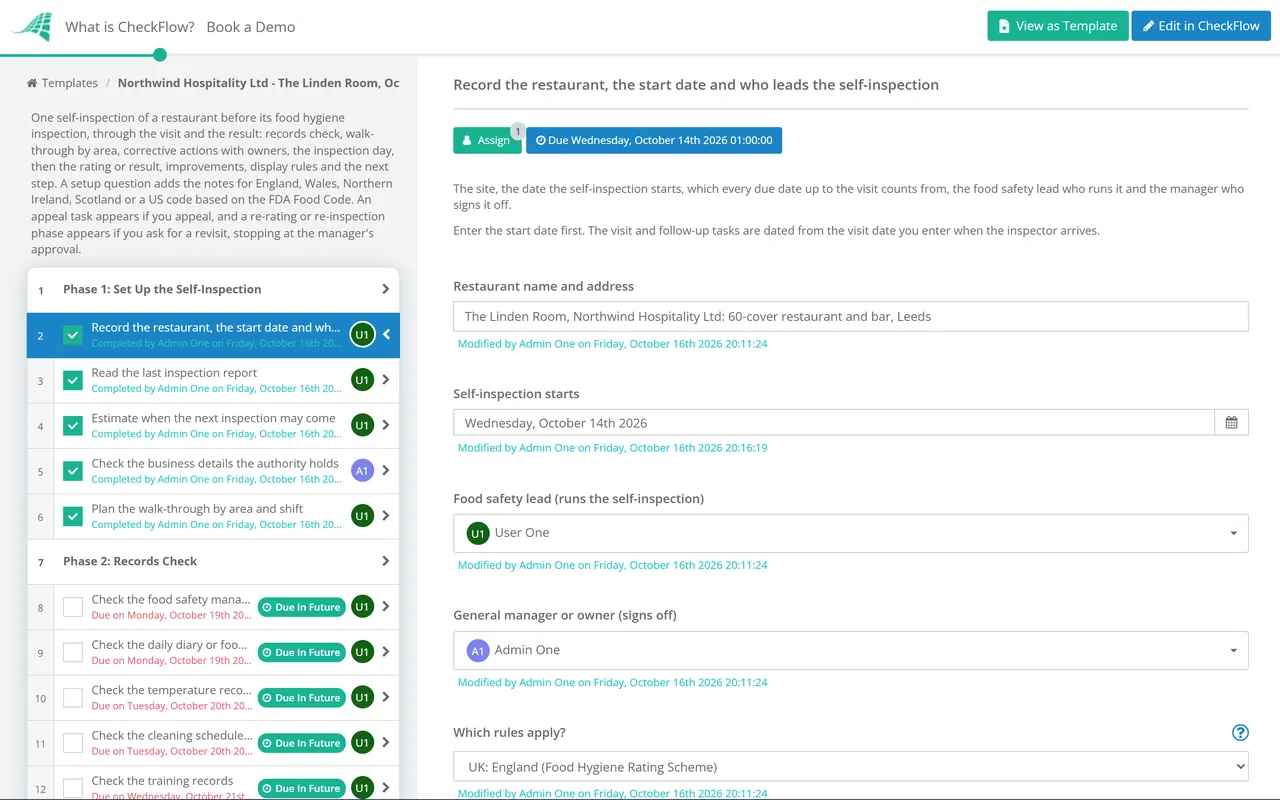
    Phase 1: Set Up the Self-Inspection

    5 tasks

    Answer which rules apply first: it adds the notes for your country to the tasks, the right-to-reply task where the Food Hygiene Rating Scheme applies, and the person-in-charge task for US rules. Every due date up to the visit counts from the self-inspection start date.

    • Record the restaurant, the start date and who leads the self-inspection — the site, the date the self-inspection starts, which every due date up to the visit counts from, the food safety lead who runs it and the manager who signs it off
    • Read the last inspection report — the rating or result, every point the officer raised, and whether each one was put right
    • Estimate when the next inspection may come — officers usually arrive without an appointment, so aim to be ready at any time; how often a business is inspected depends on the risk it poses
    • Check the business details the authority holds — the name, address and type of business on your registration or permit, so the rating or report is issued against the right business
    • Plan the walk-through by area and shift — who checks each area and when, during normal service, so you see the kitchen the way an officer would
  2. Phase 2

    Phase 2: Records Check

    8 tasks

    UK officers judge how food safety is managed: processes, training and systems. In the US the person in charge must keep active managerial control of the foodborne illness risk factors. Records are how both see it. Record one result for each check.

    • Check the food safety management system matches today’s menu — the SFBB pack, Safe Catering pack or HACCP plan covers every dish, supplier, piece of equipment and process you use now
    • Check the daily diary or food safety logs — every day signed for the opening and closing checks, problems and what was done about them written down, and the 4-weekly review completed
    • Check the temperature records — fridge, freezer, cooking, hot holding and cooling readings that are real numbers, the action taken whenever one was out of range, and the probe thermometer checked
    • Check the cleaning schedule and records — every item signed off at its frequency, deep cleans done, and food-contact surfaces sanitised with the right product used the right way
    • Check the training records — every food handler trained for the work they do, with dates, including new starters and anyone who has changed role
    • Check the pest control records — the contractor’s visit reports or your own checks, with every recommendation acted on and none left open
    • Check supplier and traceability records — who supplies each food, with what was delivered, how much and when, and the invoices, so any ingredient can be traced back
    • Check allergen information and the staff illness rule — the allergen information matches every dish on today’s menu, and every food handler knows to report illness before starting work
  3. Phase 3

    Phase 3: Walk-Through by Area

    7 tasks

    Walk each area during normal service, the way an officer would. UK officers look at how hygienically food is handled and the physical condition of the business. The FDA names five risk factors: improper holding temperatures, inadequate cooking, contaminated equipment, food from unsafe sources and poor personal hygiene. Add every problem to the action table in Phase 4.

    • Check deliveries and dry stores — chilled and frozen deliveries cold enough, packaging undamaged, goods what you ordered, and stock stored off the floor, in date and rotated
    • Check fridges, freezers and cold-held food — probe the food, not only the display, and check it is covered, labelled, in date and stored so raw food cannot drip onto ready-to-eat food
    • Check preparation areas — raw and ready-to-eat food kept apart, separate or properly cleaned equipment and boards, and surfaces cleaned and sanitised between tasks
    • Check cooking, hot holding and cooling — probe a cooked dish, food in hot holding and food being cooled, and compare each reading with the limits in your food safety plan
    • Check handwashing, toilets and staff hygiene — basins free to use, with hot water, soap and towels, hands washed at the right times, clean clothing, cuts covered, and toilets clean
    • Check washing up and chemicals — the dishwasher or sink reaching its wash temperature or sanitiser strength, clean items stored clean, and chemicals kept away from food
    • Check the structure, equipment, pest proofing and waste — walls, floors, ceilings and equipment in good repair and easy to clean, lighting and ventilation working, no gaps pests could use, and bins lidded and emptied
  4. Phase 4

    Phase 4: Corrective Actions by Owner

    7 tasks

    Every finding gets an owner and a date. Anything that puts food safety at risk is dealt with the same day; that task appears only when the walk-through found something.

    • List every finding with an owner and a date — in the action table, most serious first, from the records check and the walk-through
    • Deal with anything unsafe the same day — food at the wrong temperature or past its date thrown away, a blocked basin cleared, pest activity reported to the contractor, and what was done written in the diary
    • Book repairs and equipment work — with the contractor, a job reference and a date, for anything that cannot be fixed in-house
    • Brief or retrain staff on what was found — for example handwashing, probe use or answering allergen questions, with who was briefed and when
    • Bring missing or out-of-date records up to date — the food safety plan, diary, cleaning schedule, training records and allergen information
    • Re-check each action on the floor — walk the areas again and mark each action in the table done, with the date
    • General manager confirms the restaurant is inspection-ready — every finding is closed or has a date, and the records would stand up to an officer’s questions
  5. Phase 5

    Phase 5: Inspection Day

    8 tasks

    Officers usually arrive without an appointment, so the first tasks are done in advance. Enter the visit date and time when the inspector arrives: the visit and follow-up tasks are dated from it. The person-in-charge task appears for US rules.

    • Name who hosts the inspector on every shift — the general manager, or the duty manager or person in charge when they are off, and how to reach the food safety lead
    • Keep the inspection file ready on site — the food safety management system, diary or logs, temperature, cleaning, training, pest control and supplier records, and the last report, in one place
    • Brief the team on what happens at an inspection — work as normal, answer from their own practice, and expect the officer to look at records and possibly take samples or photographs
    • US: make sure each person in charge can show food safety knowledge — under 2-102.11 they show it by having no priority item violations, by being a certified food protection manager, or by answering the inspector’s questions correctly
    • Check the inspector’s identification when they arrive — and record their name, the authority and the date and time of the visit, which the rest of the checklist counts from
    • Go round with the inspector and note what they look at — the areas visited, the records asked for, any samples or photographs taken and the questions put to staff
    • Put right what you can during the visit — and make sure each correction is noted on the report
    • Record the feedback at the end of the visit — what the inspector said, what to improve and by when, and any report or notice you were given
  6. Phase 6

    Phase 6: Outcome & Follow-Up

    8 tasks

    Under the Food Hygiene Rating Scheme you are told the rating in writing at the time of the inspection or within 14 days. In the US you get the report at the end of the inspection. The appeal task appears if you decide to appeal, and Phase 7 if you ask for a revisit.

    • Record the rating or result — as written in the letter or report, with the reasons given
    • List each improvement asked for, with its deadline — from the letter or report, with an owner for each; the officer says how quickly each one must be done
    • Make each improvement by its deadline and keep the evidence — photos, receipts and updated records for each item, which a request for a revisit will need
    • Display the rating or tell customers how to see the report — as the rules where you are require, on the premises and online where you choose to
    • Send a right to reply if it helps — a short written comment to the officer on what you have improved, or on unusual circumstances on the day, which is published with the rating
    • Decide the next step — keep standards up until the next planned inspection, ask for a revisit once the improvements are made, or appeal if you think the result is wrong
    • Appeal in writing within the time allowed — after speaking to the officer who gave the rating or result, with your reasons and evidence
    • General manager signs off the inspection record — every improvement has an owner and a date, the rating is displayed where required, and lessons are carried into the next self-inspection
  7. Phase 7 — If you ask for a revisit

    Phase 7: Re-rating or Re-inspection Request

    7 tasks

    Shown only when you decide to ask for a re-rating or re-inspection. Nothing after the manager’s approval can be completed until a decision is recorded.

    • Confirm every improvement is complete — each item in the improvements table done, with photos, receipts or records as evidence
    • Check you can ask for a revisit now — from the rating letter or report and the authority’s rules for revisits
    • Check the fee and how soon the visit may come — from the rating letter, the authority’s website or a call to the food safety team
    • General manager approves the request and any fee — once every improvement is evidenced, since the officer will look at standards across the whole business
    • Send the written request with the evidence — to the officer who inspected, explaining what was done about each issue, with the payment where a fee is charged
    • Keep standards up until the revisit — the officer looks at standards generally, not only the items you fixed, so the rating can go up, down or stay the same, and you will not be told the date
    • Record the new rating or result — given in writing at the time or within 14 days, then displayed, and open to appeal or a right to reply as before

Restaurant Inspections in the UK and US

The inspection itself looks much the same on both sides of the Atlantic: an officer walks the kitchen, reads the records and talks to staff. What differs is how the result is given, published and challenged. Use the table to set up your own run; it is not legal advice, and in the US your health department’s adopted code decides the detail.

Topic England, Wales and Northern Ireland (Food Hygiene Rating Scheme) United States (FDA model Food Code, as adopted locally)
Who inspectsAn authorised officer from the local authority’s food safety team, usually a food safety officer or environmental health officer, not the Food Standards AgencyThe state or local regulatory authority, usually the health department, under the edition of the Food Code it has adopted
NoticeUsually none. Officers may enter and inspect at any reasonable time and must show identification before they startThe inspector presents credentials and states the purpose, then has access during hours of operation and other reasonable times (8-402.11)
What is assessedThree elements: how hygienically food is handled; the physical condition of the business, including cleanliness, layout, lighting, ventilation and pest control; and how food safety is managedFoodborne illness risk factors and public health interventions first, then good retail practices. The person in charge shows knowledge of food safety (2-102.11)
How oftenSet by risk: from six months for the highest risk businesses to two years for lower risk onesAt least once every 6 months in the model code, with longer intervals allowed in set cases (8-401.10)
The resultA rating from 5 (very good) to 0 (urgent improvement necessary), told in writing at the time or within 14 daysAn inspection report given at the end of the visit, with time frames for correction. Any score or grade is the jurisdiction’s own
Putting things rightA reasonable time to make changes unless there is an immediate risk to public health; the officer says how quicklyPriority and priority foundation items at the time of inspection, or up to 72 hours and 10 calendar days if agreed; core items within 90 calendar days (8-405.11, 8-406.11)
Publication and displayPublished on the food hygiene ratings website. Display is legally required in Wales and Northern Ireland and voluntary in EnglandThe report is a public document (8-403.50). The 2026 model code adds a sign telling customers the latest report is available on request (8-304.11(K)); local posting rules vary
Challenging the resultAppeal in writing within 21 days of being told the rating; a right to reply at any time until the next inspectionThrough the appeal or hearing process in the health department’s notice or local code
A revisitA re-rating inspection on request once the rating is accepted and the improvements are made; fees and timing differ by nation and councilThe authority verifies corrections of priority and priority foundation items and records them (8-405.20); ask how follow-up inspections are arranged

Scotland has its own scheme. Food Standards Scotland runs the Food Hygiene Information Scheme, in which a business is rated Pass or Improvement Required after its local authority inspection, and is given a certificate or sticker to display.

No hidden scoring here. This checklist gives the rating scale and the three elements as the Food Standards Agency states them. It does not try to predict your score. To get a 5 you must do well in all three elements, and an officer who gives a lower rating will explain what to improve.

Why Run Restaurant Inspection Readiness in CheckFlow?

1

Every finding has an owner

Records and area checks each record a result, with photos taken in a phone browser. Every problem goes into one action table with an owner and a date, and the general manager confirms the restaurant is ready before the visit. Comments and the history show who did what and when.

2

The rules for your country

One setup answer shows the notes for England, Wales, Northern Ireland, Scotland or the US: display rules, appeal times, revisit fees and the Food Code sections. Due dates count from your start date, then from the visit date you enter when the inspector arrives.

3

No revisit request sent too soon

Asking for a re-rating opens its own phase. The manager approves the request, and nothing after that approval step can be completed until a decision is recorded. Run the self-inspection on a recurring schedule, every quarter for example, so the restaurant is always close to ready.

CheckFlow does not inspect kitchens or predict a rating. That is the officer’s job. It makes sure the self-inspection happens, that each problem reaches someone who will fix it, and that the result and every follow-up step are recorded. Several sites? Each self-inspection shows as an open checklist on the Reports Grid until it is signed off.

Keep the daily checks with the Restaurant Opening & Closing Checklist, build or review the food safety plan with the HACCP Food Safety Checklist, and train new starters with the Restaurant Employee Training Checklist. A problem that keeps coming back belongs in the CAPA (Corrective & Preventive Action) Checklist.

AI generator

Didn’t find what you need? Describe it.

Describe the process in a sentence and the AI checklist generator drafts the phases and tasks for you.

Frequently Asked Questions

What do food hygiene inspectors look for in a restaurant?

In England, Wales and Northern Ireland the officer checks three elements: how hygienically food is handled, including how it is prepared, cooked, reheated, cooled and stored; the physical condition of the business, such as cleanliness, layout, lighting, ventilation and pest control; and how food safety is managed through processes, training and systems. In the US the inspection focuses first on the FDA’s foodborne illness risk factors, such as holding temperatures, cooking, contaminated equipment, unsafe sources and personal hygiene. Food quality, customer service and presentation are not part of the UK rating.

How often are restaurants inspected?

It depends on risk. In England, Wales and Northern Ireland each local authority plans its inspections by the type of food, the customers, the processes and the standards found last time, and the gap ranges from six months for the highest risk businesses to two years for lower risk ones. In the US, the model FDA Food Code says at least once every 6 months, with longer intervals allowed in set cases, but your state or local code decides.

Do food hygiene inspectors give notice before they visit?

Usually not. The Food Standards Agency says authorised officers will usually arrive without an appointment, have the right to enter and inspect at any reasonable time, and must show identification before they start. In the US, the model Food Code has the inspector present credentials and state the purpose of the inspection, after which the person in charge allows access during hours of operation. That is why this checklist names a host for every shift and keeps an inspection file ready.

What do the food hygiene ratings mean?

Under the Food Hygiene Rating Scheme in England, Wales and Northern Ireland: 5 means hygiene standards are very good, 4 good, 3 generally satisfactory, 2 some improvement is necessary, 1 major improvement is necessary and 0 urgent improvement is necessary. The rating is a snapshot of the standards found on the day. Every business should be able to reach a 5, which needs good standards in all three elements. Scotland uses Pass or Improvement Required instead.

Do restaurants have to display their food hygiene rating?

In Wales and Northern Ireland, yes: the sticker must be shown at or near each customer entrance where customers can read it before they enter. In Wales, takeaway menus that let customers order must also carry a bilingual statement pointing to the ratings website, and in Northern Ireland you must tell customers your rating if they ask. In England display is voluntary. In the US, posting rules come from your local code; the 2026 model Food Code adds a sign saying the latest report is available on request.

How do I appeal a food hygiene rating or ask for a re-rating?

Speak to the officer first to understand the rating. If you still think it is wrong, appeal in writing to the local authority within 21 days of being told the rating. To improve a fair rating instead, make every improvement the officer asked for, accept the rating and request a re-rating inspection in writing with evidence such as photos and receipts. Some English councils and all councils in Wales and Northern Ireland charge for it, and the new rating can go up, down or stay the same.

What happens if a US health inspection finds violations?

Under the model FDA Food Code, priority and priority foundation item violations are corrected at the time of inspection, or within up to 72 hours or 10 calendar days if the inspector agrees. Core items are corrected by an agreed date no later than 90 calendar days. The inspector gives you the report and asks you to sign for it, which is not agreement with the findings. Scoring, grading and follow-up visits are set by your state or local health department.

Is CheckFlow free for this template?

14-day free trial, no card required. The Business plan is $10 per user per month after the trial. Full details at checkflow.io/pricing.

Be Ready Before the Inspector Knocks

Free trial — no credit card required.

14-day free trial, no credit cardFull refund in your first 30 daysUS or EU hosting