Restaurant Employee Training Checklist Template

New restaurant staff are often handling food or taking allergy orders within hours of arriving, trained by whoever happens to be on shift. When an inspector or an allergic customer asks what they were taught, there is rarely a written answer.

This free restaurant employee training checklist is for owners, general managers and head chefs bringing on servers, bartenders, cooks, kitchen porters and dishwashers. It puts food safety first: an induction before anyone touches open food, illness reporting rules the starter has signed, allergen training that follows an order from the table to the plate, and station-by-station sign-off. It books the food handler course where local law requires one, adds controls for workers under 18, and ends with shadow shifts and a solo shift the manager approves. Front-of-house and back-of-house starters each see only the stations that apply to them. For a large summer intake or returning staff, the Seasonal Employee Onboarding Checklist is quicker, and contracts and payroll belong in the Employee Onboarding Checklist.

Use This Template Free See Live Example
No Credit Card Required

Last reviewed: October 2026

Food Safety Comes Before the First Cover

Restaurant training usually starts with the menu and where the clean glasses live. The legal duties sit underneath. In the UK, every food business must make sure its food handlers are supervised and instructed or trained in food hygiene in line with the work they do. In the US, the version of the FDA Food Code your state has adopted makes the person in charge responsible for training staff in food safety, including food allergy awareness, and for making sure they know they must report certain illnesses.

The other difference from an office start is that one restaurant hires very different jobs. A server needs to take an allergen order accurately and pass it to the kitchen in writing. A line cook needs to prevent cross-contact, probe food and keep temperature records. A dishwasher needs chemical safety and to know which sink is for hands. One checklist that asks the role on the first task can show each person the right stations and keep the food safety core the same for everyone.

Front of house

Servers, hosts, bartenders and runners

Food safety core: handwashing, illness reporting, handling ice, glassware and ready-to-eat food.

Allergens: asking every table, using the allergen matrix, flagging the order in writing and checking the plate at the pass.

Stations: host stand, section, bar and running food.

Signed off when: they have carried an allergen order through a real service without help.
Back of house

Cooks, prep staff, porters and dishwashers

Food safety core: the same induction, plus raw and ready-to-eat separation and cleaning chemicals.

Allergens: reading recipe specifications, preventing cross-contact and labelling allergen plates.

Stations: prep, line, grill and fryer, dish, and receiving deliveries.

Signed off when: they can probe, record and correct a temperature without being prompted.

What the Restaurant Employee Training Checklist Covers

Seven phases run from before the first shift to an approved solo shift. Role decides which stations appear, and the young-worker phase appears only for starters under 18.

Phase 1

Phase 1: Before the First Shift

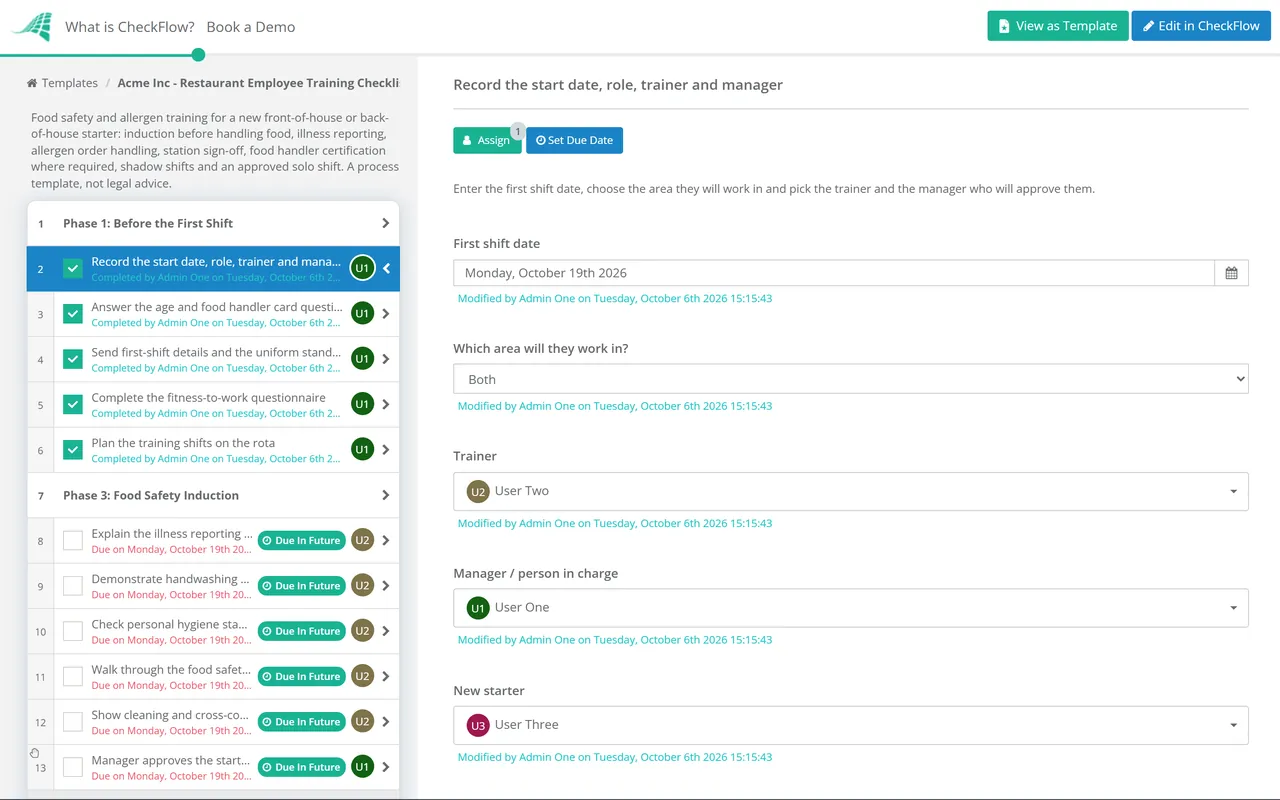
  • Record the start date, role, trainer and manager — role is front of house, back of house or both, and it decides which stations appear later
  • Answer the age and food handler card questions — is the starter under 18, and does local law require a food handler card?
  • Send first-shift details and the uniform standard — arrival time, who to ask for, non-slip shoes and hair restraint
  • Complete the fitness-to-work questionnaire — recent sickness and household illness, before they enter a food area
  • Plan the training shifts on the rota — each shadow shift with its station and trainer
Phase 2 — If Under 18

Phase 2: Young Worker Controls

Shown only for starters under 18, and finished before their first shift. A process step, not legal advice: age rules differ by country, state and local council.

  • Complete the young-worker risk assessment — covering inexperience, the equipment on their stations and the supervision they will get
  • List the equipment they must not use — in the US, meat slicers, power-driven bakery machines and balers or compactors are barred for all under-18s
  • Check permitted hours and tasks for their age — extra cooking and hours limits apply to 14 and 15-year-olds in the US
  • Tell parents or carers of school-age starters about the risks and controls — a UK duty; brief shift leads too
Phase 3

Phase 3: Food Safety Induction

Done on the first shift, before the starter handles open food. The last task is an approval, so the checklist stops there until the manager agrees.

  • Explain the illness reporting rules and get them signed — which symptoms to report, to whom, and when they must stay away from food
  • Demonstrate handwashing and the hand-wash-only sink — when to wash, how long, and drying with disposable towels
  • Check personal hygiene standards — clean uniform, hair tied back and covered, no jewellery except a plain band, cuts covered with a coloured waterproof dressing
  • Walk through the food safety plan and daily records — your HACCP-based plan or Safer Food, Better Business pack
  • Show cleaning and cross-contamination controls — colour-coded boards, raw below ready-to-eat, chemical dilution and contact times
  • Manager approves the starter to handle food
Phase 4

Phase 4: Allergen Awareness & Order Handling

  • Teach the regulated allergens and reaction symptoms — 14 in the UK, nine in the US, and what anaphylaxis looks like
  • Train the allergen matrix and recipe specifications — where the current version is kept and why nobody answers from memory
  • Practise taking an allergen order at the table — ask, check the matrix, never guess, fetch the manager if unsure
  • Follow an allergen order from ticket to pass — written flag on the order, verbal confirmation with the chef, separate preparation, labelled plate, checked before it leaves
  • Show cross-contact controls in prep and cooking — clean equipment, separate oil and utensils, washed hands and fresh gloves
  • Check understanding with a short allergen quiz
Phase 5

Phase 5: Station Training & Sign-Off

The role chosen in Phase 1 shows the front-of-house tasks, the back-of-house tasks, or both.

  • Train the front-of-house stations — host stand, section, bar and food running, including scoops for ice and holding plates and cutlery away from food-contact surfaces
  • Train the kitchen stations — prep, line, grill and fryer, dish
  • Train temperature checks and food safety records — probing, fridge checks, cooking, hot holding and cooling, and what to do when a reading is wrong
  • Train delivery checks and stock rotation — rejecting warm or damaged deliveries, date labels, first in first out
  • Sign off each station on the training record
Phase 6

Phase 6: Certification & Training Records

The card tasks appear only when Phase 1 records that a food handler card is required where you operate.

  • Book the accredited food handler course — due 30 days from the start date, which matches California, Texas and Illinois; shorten it if your rules are stricter
  • Upload the food handler card and record its expiry date
  • Record the in-house hygiene and allergen training completed — topics, dates and trainer, ready for an inspection
  • Confirm a certified or trained supervisor covers their shifts — a Certified Food Protection Manager where your Food Code requires one
Phase 7

Phase 7: Shadow Shifts & Solo Shift

There is no legal number of shadow shifts. The starter moves on when each station is signed off, not when the rota runs out.

  • Complete the shadow shifts with the trainer
  • Observe the starter handle a live allergen order end to end
  • Run a supervised solo shift — the starter works alone with the manager on duty checking in
  • Manager approves the starter to work unsupervised
  • Hold a 30-day food safety and allergen check-in — gaps retrained and recorded

Food Handler Training Rules: US and UK Side by Side

The two systems reach similar habits by different routes. The UK sets a general duty to train and supervise and leaves the method to the business. The US publishes a model code that each state adopts on its own timetable, and many states add food handler card laws on top. It is a starting point for the checklist, not legal advice: check the code your local health department enforces.

Topic United States United Kingdom
Duty to trainThe person in charge ensures employees are trained in food safety, including food allergy awareness, as it relates to their dutiesFood handlers must be supervised and instructed and/or trained in food hygiene in line with their work activity
Certificate or cardSet by state or local law. California, Texas and Illinois require accredited food handler training within 30 days of hireNot legally required. Training can be a course, on the job, self-study or relevant previous experience, and records should be kept for inspection
SupervisionA person in charge on every shift, and at least one Certified Food Protection Manager with supervisory authority unless the regulator treats the business as minimal riskAppropriate supervision; those who develop and maintain the HACCP-based procedures need adequate training in HACCP principles
Illness reportingStaff report vomiting, diarrhoea, jaundice, sore throat with fever, infected cuts on hands or wrists, and certain diagnoses; they must be told of this duty in a way that can be verifiedStaff report diarrhoea, vomiting, fever, jaundice, infected skin, nose or throat, and diarrhoea or vomiting in their household
Return after vomiting or diarrhoeaNormally after 24 hours without symptoms, unless a diagnosis such as norovirus or hepatitis A appliesNormally 48 hours after symptoms stop
AllergensNine major allergens, with sesame added from January 2023 under the FASTER Act14 allergens; information must be given for non-prepacked food, and food prepacked for direct sale needs a full ingredients label
Under-18sFederal hazardous-occupation rules bar slicers, power-driven bakery machines and balers; 14 and 15-year-olds have cooking and hours limitsA risk assessment that accounts for young workers’ inexperience, plus local council rules for children of school age

Three points are moving. The FDA released the 2026 Food Code in September 2026, adding a requirement for a written employee illness policy, but it applies only once your state or county adopts it, and many states still enforce the 2017 edition or older. The Food Standards Agency’s 2025 best practice guidance asks restaurants in England, Wales and Northern Ireland to have allergen information available in writing and to pass allergen orders to the kitchen in writing; it is not law, and Scotland has separate guidance from Food Standards Scotland. Illinois also requires certified managers in restaurants to complete allergen awareness training within 30 days. The sources to check are the FDA Food Code, the FSA allergen guidance, GOV.UK on staff training and the Department of Labor’s restaurant fact sheet.

Why Run Restaurant Training in CheckFlow?

1

Each starter sees their own stations

Three answers on the first task shape the whole checklist. Role shows the front-of-house or kitchen stations, an under-18 answer adds the young-worker phase, and a yes on the card question adds the course booking.

2

No food handling before sign-off

The induction ends with a manager approval, and the checklist does not move on until it is given. The solo shift has a second approval. Due dates run from the start date, so the food handler course is booked inside the 30 days rather than remembered on day 29.

3

A training record for inspections

The signed illness reporting rules, the quiz result, the station sign-offs and the uploaded card sit on one checklist, with the trainer’s name and a timestamp on every task. When an inspector asks what someone was taught, the answer is already there.

Restaurants run several kinds of start at once. CheckFlow’s onboarding software gives each its own template, with conditional steps, approvals and due dates set from the start date, and reports showing who is still waiting for sign-off.

Frequently Asked Questions

Do restaurant staff need a food hygiene certificate?

+

In the UK, no. The law requires food handlers to be supervised and instructed or trained in food hygiene to a level that suits their work, and that training can come from a course, on-the-job instruction, self-study or previous experience. Keep a record either way. In the US it depends on the state and sometimes the county. California, Texas and Illinois, for example, require accredited food handler training within 30 days of hire, while other states have no card law.

What allergen training should new restaurant staff get?

+

Everyone should learn the regulated allergens for your country, the signs of an allergic reaction and what to do if one happens. Front-of-house staff need to practise asking about allergies, using the allergen matrix and passing the order to the kitchen in writing. Kitchen staff need to follow recipe specifications exactly and prevent cross-contact. Before signing someone off, watch them handle a real allergen order from the table to the pass.

How long must a food handler stay off work after vomiting or diarrhoea?

+

UK guidance is that they should not work with or around open food, normally until 48 hours after symptoms stop. Under the FDA Food Code, an employee excluded for vomiting or diarrhoea can normally return after 24 hours without symptoms, but a diagnosis such as norovirus, hepatitis A or Shigella has stricter rules that may need the health department’s agreement. Whichever applies, new starters should know the rule before their first shift and sign that they understand it.

What kitchen equipment can under-18s not use?

+

In the US, federal child labor rules bar all workers under 18 from operating, cleaning or setting up meat slicers and grinders, power-driven bakery machines and paper balers or compactors. Workers aged 14 and 15 face further limits, including no baking and only certain types of cooking equipment. Some states go further. In the UK there is no single equipment list, so the employer’s risk assessment decides which machines a young worker may use and how they are supervised.

How many shadow shifts should a new restaurant employee do?

+

There is no legal minimum and a fixed number can be too many or too few. A better rule is that the starter moves on when every station they will work is signed off and they have handled a live allergen order correctly. Plan two or three shadow shifts on the rota as a starting point, then add more for any station the trainer has not signed.

Is CheckFlow free for this template?

+

14-day free trial, no card required. The Business plan is $10 per user per month after the trial. Full details at checkflow.io/pricing.

Every New Starter Trained Before They Touch the Food

Free trial — no credit card required.