New Business Insurance Checklist Template

A new business has no policies to renew and no record to start from. Find the cover the law and your contracts require, get it quoted and approved, and have it in force on the day you start.

Last reviewed: November 2026

Printed from checkflow.io/templates/finance-accounting/new-business-insurance-checklist

This free new business insurance checklist is for founders, owners and finance leads buying a new business’s first insurance. One run takes one business from no cover to cover in force, counted back from the date cover must start. It describes what the business does, who it employs and what it owns, checks the cover the law requires where it operates, reads the insurance terms in its contracts, lease and loans, and goes through the lines to consider: public or general liability, property and contents, business interruption, professional indemnity, product liability and cyber. Then it chooses a broker, prepares a proposal a director signs off, compares quotes, gets the spend approved, binds the cover, displays and sends the certificates, and sets the first renewal date. Answers on the first tasks add the employers’ liability check for Great Britain or Northern Ireland, workers’ compensation for the United States, motor cover for vehicles and a regulator’s requirement.

First Insurance for a New Business, Not a Renewal

A new business buys its insurance once from nothing: no policies to renew, no claims history and no insurance register. It needs the cover the law requires in place on the right day, the cover its customers, landlord and lender ask for, and a proposal that tells the insurers what they need to know. This template takes one business through that first purchase, from describing the business to setting the date of its first renewal.

Two other templates cover insurance at later stages. The Business Insurance Renewal Checklist runs every renewal after this one, and the Company Insurance Due Diligence Checklist reviews a programme in depth, for example before an acquisition.

This checklist

A new business’s first insurance

Covers: the cover the law requires, the cover contracts, a lease or a lender require, the lines to consider, the broker, the proposal, quotes, approval, binding and the first certificates.

Run by: a founder or the finance lead, with a director approving the spend.

Ends with: cover in force from the start date, a register and the first renewal date.
Every year after

The Business Insurance Renewal Checklist

Covers: the annual renewal, starting 120 days before expiry: updated exposures, claims history, a review of each line, the submission, quotes and binding.

Use it: from the first renewal on. This checklist ends by setting that date. Business Insurance Renewal Checklist.

In depth

The Company Insurance Due Diligence Checklist

Covers: a one-off review of an existing programme: policy wordings, exclusions, claims and gaps.

Use it: when a buyer reviews a target’s cover or a company reviews its own. Company Insurance Due Diligence Checklist.

What the New Business Insurance Checklist Covers

Eight phases take a new business from no insurance to cover in force. The first task records the date cover must start, which sets every due date, and where the business will operate or employ people. Great Britain or Northern Ireland adds the employers’ liability check and its certificate; the United States adds workers’ compensation by state; elsewhere adds a task to find the local rules. Vehicles add motor cover and a regulator adds its requirement. The approver’s decision on the cover and the spend is the gate, and a decision other than Approved adds a task to act on it.

  1. Phase 1

    Phase 1: Set Up & Describe the Business

    5 tasks

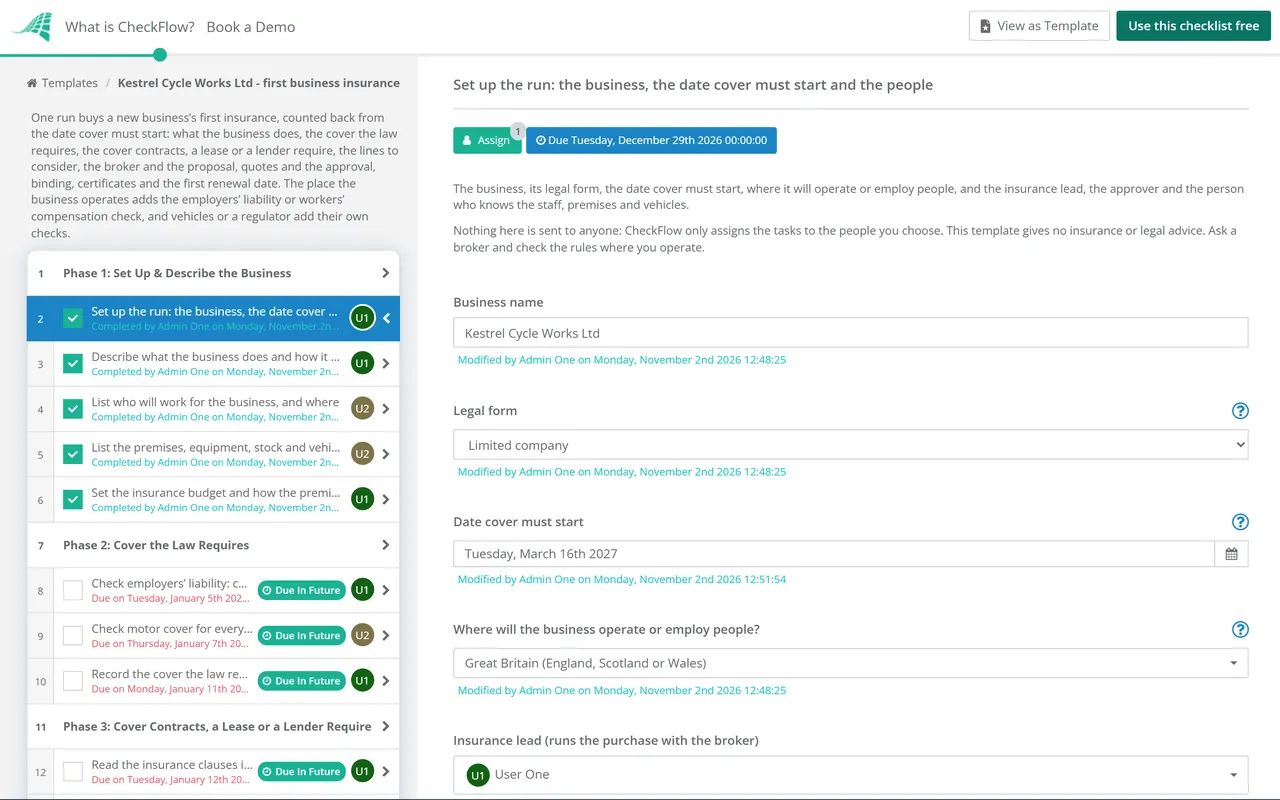
    Owned by the insurance lead. Enter the date cover must start on the first task: every due date counts back from it in working days, and the last few count forward. The answers in this phase decide which of the legal checks in Phase 2 appear.

    • Set up the run: the business, the date cover must start and the people — the business, its legal form, the date cover must start, where it will operate or employ people, and the insurance lead, the approver and the person who knows the staff, premises and vehicles
    • Describe what the business does and how it does it — the products or services, the customers, the expected turnover in the first year, whether it gives advice or designs things, makes, imports or sells products, handles customer data or takes payments online, and whether it will use vehicles on the road
    • List who will work for the business, and where — employees and their start dates, directors, family members, contractors and freelancers, and anyone based abroad or coming from abroad to work
    • List the premises, equipment, stock and vehicles — what the business owns, leases or hires, with a value or a rebuilding cost for each and where it is kept
    • Set the insurance budget and how the premium will be paid — the amount the approver expects to spend in the first year, and whether the premium will be paid in one go or in instalments
  2. Phase 2

    Phase 2: Cover the Law Requires

    6 tasks

    Some cover is compulsory before the business takes its first step. The places ticked on the first task add the employers’ liability or workers’ compensation check, the vehicle answer adds motor cover and the regulator answer adds the professional requirement. The last task records the result, whatever applies.

    • Check employers’ liability: cover of at least £5 million, or the exemption that applies — decide whether the business needs employers’ liability insurance from the date cover starts, from the first employee’s start date or not at all, and record why
    • Check workers’ compensation in each state where you will employ people — for each state, whether the business must carry workers’ compensation, how cover is bought there, and any other insurance the state requires of a business like yours
    • Find out which insurance the law requires where the business operates — the compulsory cover for employees, vehicles and the work the business does in each country outside the UK and the US, read on an official government site or confirmed by a local broker
    • Check motor cover for every vehicle used on the road for the business — each vehicle the business owns, leases or hires, and any staff using their own cars for business journeys, with the cover each one needs
    • Confirm the insurance your regulator or professional body requires — the body, the rule, the cover it requires, any minimum terms or limits, and whether the insurer must be on an approved list
    • Record the cover the law requires and the date each must start — every compulsory cover that applies, its minimum limit and the date it must be in force, or a note that none applies yet
  3. Phase 3

    Phase 3: Cover Contracts, a Lease or a Lender Require

    4 tasks

    Customers, landlords, lenders and platforms may set insurance terms of their own. Read each one before the broker is briefed, so the quotes include the limits and wording they ask for.

    • Read the insurance clauses in customer and supplier contracts — each contract signed or about to be signed: the cover required, the minimum limit, whether the other party must be named on the policy, and the evidence they want
    • Read the insurance terms in the lease or licence for the premises — who insures the building, what the tenant must insure, whether the landlord must be noted on the policy, and the evidence the landlord asks for
    • Check what lenders, investors, grant funders or platforms require — insurance terms in a loan or finance agreement, an investment agreement, a grant offer, an equipment lease or a marketplace’s seller terms
    • Record every insurance requirement in one place — one row per requirement found in this phase, with the evidence each party needs and by when
  4. Phase 4

    Phase 4: Choose the Lines of Cover

    8 tasks

    Go through each line of cover the business might need, using what it does, what it owns and what the contracts ask for. Mark each one Needed, Consider or Not needed now, then agree the list to take to the market.

    • Public or general liability: claims from customers and the public — injury to other people or damage to their property caused by the business, at the premises, on a customer’s site or at an event
    • Property and contents: premises, equipment and stock — buildings the business must insure, and its equipment, stock, tools and computers, at the values listed in Phase 1
    • Business interruption: lost income after an insured loss — the income and extra costs the business would lose if a fire, flood or other insured damage stopped it trading, and how long recovery could take
    • Professional indemnity: claims that your advice or work was wrong — for a business that gives advice, designs, consults or provides professional services, including any limit a regulator or a contract sets
    • Product liability: products you make, import or sell — injury or damage caused by a product the business makes, imports, labels or sells, including products sold online
    • Cyber: data breaches, ransomware and system outages — the customer data held, online payments, the systems the business depends on, and the security questions a cyber insurer may ask
    • Other cover to discuss with the broker — for example directors’ and officers’ liability, goods in transit, tools, key person cover, legal expenses or trade credit, where the business needs it
    • Agree the cover to ask the market for — the list of lines with the limit sought for each, marked must have or nice to have, checked against the compulsory cover and the requirements found in Phase 3
  5. Phase 5

    Phase 5: Broker & Proposal

    7 tasks

    Choose who will place the cover, then prepare the proposal: the facts the insurers rely on when they quote. A director reads and signs off the proposal before it goes out.

    • Choose a broker or agent and check they are authorised or licensed — who will place the cover, or a decision to buy direct, with a check that the broker and each insurer are authorised in the UK or licensed in the US state
    • Agree the broker’s terms of business and how they are paid — the services the broker will provide, whether they are paid by commission, a fee or both, and the terms in writing
    • Gather the facts the proposal will ask for — activities, turnover, payroll and headcount estimates, premises and security, values, vehicles and drivers, contract requirements, and any past claims or insurance refused for the owners if the proposal asks
    • Ask the people who know the business what the insurer should be told — the founders, directors and anyone else arranging the insurance, so every material fact they know, or ought to know, is in the proposal
    • Check every proposal answer against the facts — each question on the proposal or application, its answer and the evidence behind it, with any answer that is an estimate marked as one
    • Have a director read and sign off the proposal — the approver reads the proposal and the answers before the broker sends it to insurers, and either signs it off or lists what must change
    • Send the proposal to the broker for quotes — the signed-off proposal and the cover list, with the date quotes are needed by
  6. Phase 6

    Phase 6: Quotes & Approval

    6 tasks

    Compare the quotes on the same basis and recommend one. The approver’s decision is the gate: nothing after it can be completed until they record it. Approved with changes adds a task to make them; Not approved adds a task to revise the cover and bring it back.

    • Compare the quotes like for like — for each quote: the cover and limits, the excess, the exclusions and conditions, the insurer, the premium with tax and fees, and any line not quoted
    • List the conditions to meet before or after cover starts — for example security requirements, surveys, information the insurer still needs, or anything that must be fixed by a date, with who will meet each one
    • Prepare the recommendation for approval — the quotes recommended, the total cost against the budget, the gaps and any risk the business will carry itself
    • Approve the cover and the spend — the approver decides on the recommended cover, the insurers, the limits, the excesses and the total cost, before anything is bound
    • Make the approved changes before binding — agree the changes the approver listed with the broker, such as a different limit, excess or insurer, and record what was changed
    • Revise the cover and return it for approval — the cover was not approved: change what the approver asked for, get new quotes if needed, then ask the approver to change the decision, or to un-complete the approval and complete it again
  7. Phase 7

    Phase 7: Bind & Pay

    4 tasks

    Bind the approved cover in writing so it starts on the right date, pay for it, and check the documents when they arrive.

    • Give the broker written instructions to bind cover from the start date — the approved quotes, the start date entered on the first task and the names of the businesses to be insured
    • Get written confirmation that cover is in force from the start date — a cover note, confirmation of cover or the policy schedule for each line, received before the date cover must start
    • Pay the premium or set up the instalments — on the insurer’s or broker’s payment terms, so cover is not cancelled for non-payment
    • Check the policy documents against the quote — the names, addresses, activities, limits, excesses, endorsements and start date on each schedule and wording, with any error sent back to the broker
  8. Phase 8

    Phase 8: Certificates, Records & the First Renewal

    5 tasks

    Show the cover to the people who need to see it, keep the record, and set the date the first renewal starts. A business in Great Britain or Northern Ireland also displays its employers’ liability certificate.

    • Display the employers’ liability certificate where every employee can see it — on paper at each workplace or electronically where every employee can reach it, ready to show an inspector
    • Send evidence of cover to everyone who asked for it — the customers, landlord, lender and platforms listed in Phase 3, with the certificate, schedule or broker’s letter each one asked for
    • Set up the insurance register and file the documents — one row per policy with the insurer, policy number, limits, excess, premium and renewal date, and the documents stored where the team can find them
    • Tell the team how to report an incident or a claim — who to tell, the insurer’s or broker’s claims contact, the time limits for notifying in each policy, and what to record at the time
    • Set the renewal date and plan the first renewal — the first renewal date from the policy schedules, the date the renewal work starts, and any change during the year the insurers must be told about

Business Insurance for a New Business at a Glance

Cover a new business should consider

What each line is for, who may require it, and where it appears in the checklist.

Cover What it is for Who may require it Where in the checklist
Employers’ liability (UK)Claims from employees injured or made ill by their workThe law, for most employers in Great Britain and Northern Ireland, from the first employee, at £5 million or morePhases 2 and 8
Workers’ compensation (US)Benefits for employees injured at workFederal and state rules, described differently by the SBA and the Department of Labor (second table)Phase 2
MotorVehicles used on the road for the businessThe law: third party cover at least on UK roads; state rules in the USPhase 2
Professional indemnityClaims that advice, design or professional work was wrongSome regulators and professional bodies, and some client contractsPhases 2 and 4
Public or general liabilityClaims from customers and the public for injury or damageYour contracts, lease or venue may require it; HSE calls it generally voluntaryPhases 3 and 4
Property and contentsPremises, equipment, stock and toolsYour lease or lender may require itPhases 3 and 4
Business interruptionLost income after an insured loss stops tradingYour choice, with the broker’s advicePhase 4
Product liabilityInjury or damage caused by products you make, import or sellYour contracts or a marketplace may require itPhase 4
CyberData breaches, ransomware and system outagesYour contracts may require itPhase 4

Which lines you need depends on the business. The SBA’s guide lists general liability, product liability, professional liability, commercial property, home-based business insurance and a business owner’s policy as common types, and suggests insuring against things you could not pay for on your own. HSE’s guide HSE40 says public liability insurance covers claims from the public and other businesses but not from employees. The third column is a starting point, not a list of every rule: ask your broker, and read your contracts.

Compulsory cover by country

The places ticked on the first task add these checks.

Where Rule What it says Source
Great BritainEmployers’ Liability (Compulsory Insurance) Act 1969 and the 1998 RegulationsInsurance with an authorised insurer from the day you become an employer, for at least £5 million; the certificate displayed where employees can access it. Gov.uk: fines of £2,500 for every day without proper cover and £1,000 for not displaying the certificategov.uk, legislation.gov.uk, HSE40
Northern IrelandIts own employers’ liability law, enforced by HSENIAt least £5 million, similar exemptions, fines of up to £2,500 a day without cover and up to £1,000 for not displaying the certificatenibusinessinfo.co.uk
UKMotor insurance (in Great Britain, Road Traffic Act 1988 section 143)Motor insurance to drive on UK roads; third party cover is the legal minimumgov.uk, legislation.gov.uk
UKInsurance Act 2015 section 3A fair presentation of the risk before the contract of insurance is entered intolegislation.gov.uk
United StatesState workers’ compensation laws; other state insurance rulesThe two federal sources put this differently. The Department of Labor sends people injured working for a private company to their state’s workers’ compensation board. The SBA’s guide says the federal government requires every business with employees to have workers’ compensation, unemployment and disability insurance, and that laws requiring insurance vary by state. Read each state’s own rulesdol.gov, sba.gov
Regulated professionsThe regulator’s own rulesFor example, the SRA Indemnity Insurance Rules require an authorised body to hold qualifying insurance with a participating insurersra.org.uk

Where the sources differ. The two federal sources put this differently: the SBA’s guide lists workers’ compensation, unemployment and disability insurance as federal requirements, while the US Department of Labor sends people injured working for a private company to their state’s workers’ compensation board. Read the rules of each state where you employ people. Gov.uk’s employers’ liability page describes the exemptions more briefly than HSE40: the family-business exemption does not apply to a limited company.

Sources. gov.uk: Employers’ liability insurance and Vehicle insurance; legislation.gov.uk: Employers’ Liability (Compulsory Insurance) Act 1969 section 1, the 1998 Regulations, regulation 3, Road Traffic Act 1988 section 143 and Insurance Act 2015 section 3; HSE: HSE40; nibusinessinfo.co.uk; SRA Indemnity Insurance Rules; SBA: Get business insurance; US Department of Labor: Workers’ compensation. Read on 2 November 2026. The timings and roles in this template are its own choices. This table is not insurance or legal advice.

Why Buy Your First Business Insurance in CheckFlow?

1

Compulsory cover in place on the day

Every due date counts back from the date cover must start, so the legal checks, the quotes and the binding happen in time. The place the business operates adds the employers’ liability or workers’ compensation check, and vehicles or a regulator add theirs. Overdue alerts go to the people assigned.

2

Nothing bound before the approver decides

The approver chosen on the first task is the only person who can record the decision on the cover and the spend, and binding cannot be ticked off until they do. A decision other than Approved adds the task to act on it.

3

A record of what you told the insurers

The proposal, the facts behind each answer, the director’s sign-off, the quotes and the certificates sit on their tasks with a timestamped activity trail. The Reports Grid lists every run with its answers, and Analytics shows where tasks are waiting.

CheckFlow is not a broker or an insurer, and it does not give insurance advice or compare quotes for you. It runs the work around the purchase: who does each step, by when, with what evidence, and who approved the spend. See how a running checklist works.

Set up payroll for the first employee with the New Hire Payroll Setup Checklist, look at the risks behind the cover with the Operational Risk Assessment Checklist and the Health & Safety Risk Assessment Checklist, and test how the business would recover from a loss with the Business Continuity Plan Testing Checklist. Business vehicles are checked with the Fleet Vehicle Inspection Checklist, and the cyber application is prepared with the Cyber Insurance Readiness Checklist.

AI generator

Didn’t find what you need? Describe it.

Describe the process in a sentence and the AI checklist generator drafts the phases and tasks for you.

Frequently Asked Questions

What insurance does a new business legally need?

It depends on where it operates and what it does. In Great Britain, most employers need employers’ liability insurance of at least £5 million as soon as they become an employer, and vehicles on UK roads need at least third party motor cover. Some regulators require professional indemnity. In the US, the SBA and the Department of Labor describe the workers’ compensation rules differently, so read each state’s own rules. This template adds the checks for the places you tick and gives no legal advice.

What should a new business insurance checklist include?

What the business does, who it employs and what it owns; the cover the law requires; the insurance terms in contracts, a lease or a loan; the lines to consider, such as public liability, property, business interruption, professional indemnity, product liability and cyber; a broker; an accurate proposal; quotes compared; an approval before binding; certificates displayed and sent; and the first renewal date. This template runs those steps in that order.

When should a new business buy insurance?

Before the first day it needs cover: the day it starts trading, takes on its first employee, starts a lease or a customer contract, or first uses a vehicle for work. Gov.uk says employers’ liability insurance is needed as soon as you become an employer. This template counts every step back from that date, starting about eleven weeks ahead, so the cover is bound and confirmed in writing before it.

Does a one-person limited company need employers’ liability insurance?

HSE’s guide HSE40 says a company employing only its owner, where that employee owns 50% or more of the issued share capital, is exempt. A family business whose employees are all close relatives is also exempt, but not if it is a limited company. The exemption ends when the company hires someone else. This template records the exemption that applies, and asks you to look again before the first hire.

What is the difference between public liability and employers’ liability insurance?

Employers’ liability covers claims from your own employees injured or made ill by their work, and is compulsory for most employers in Great Britain. Public liability covers claims from members of the public or other businesses, not employees, and HSE describes it as generally voluntary. A customer contract, a lease or a venue may still require it, which is why this template reads them before choosing the lines of cover.

Should a new business use an insurance broker?

It can buy direct or through a broker or agent. Gov.uk says you may want to use a broker for employers’ liability insurance, and the SBA suggests a reputable licensed agent and comparing offers. A broker is paid by commission, a fee or both. This template records the broker’s terms and checks that the broker and each insurer are authorised or licensed before the proposal goes out.

What does an insurer need to know about a new business?

What it does and for whom, turnover and payroll estimates, staff, premises, values, vehicles, contracts and anything else that affects the risk. In the UK, the Insurance Act 2015 requires a fair presentation of the risk before the contract is entered into, covering every material circumstance the business knows or ought to know. This template asks the people who know the business, checks each answer and has a director sign off the proposal.

What happens once the first policies are in place?

Display the employers’ liability certificate where employees can see it, send evidence of cover to the customers, landlord and lender who asked, set up an insurance register, tell the team how to report an incident and check the policy documents against the quote. This template ends by recording the first renewal date, and the Business Insurance Renewal Checklist takes over 120 days before it.

Is CheckFlow free for this template?

14-day free trial, no card required. The Business plan is $10 per user per month after the trial. Full details at checkflow.io/pricing.

Have Your First Business Insurance in Force on Day One

Free trial — no credit card required.

14-day free trial, no credit cardFull refund in your first 30 daysUS hosting, EU on request