Loan Covenant Compliance Checklist Template

A covenant is more than the leverage ratio. The register also holds the deliverables, the baskets, the insurance and the notices, and a breach found the week before the certificate is due leaves little time to agree a waiver.

Last reviewed: November 2026

Printed from checkflow.io/templates/finance-accounting/loan-covenant-compliance-checklist

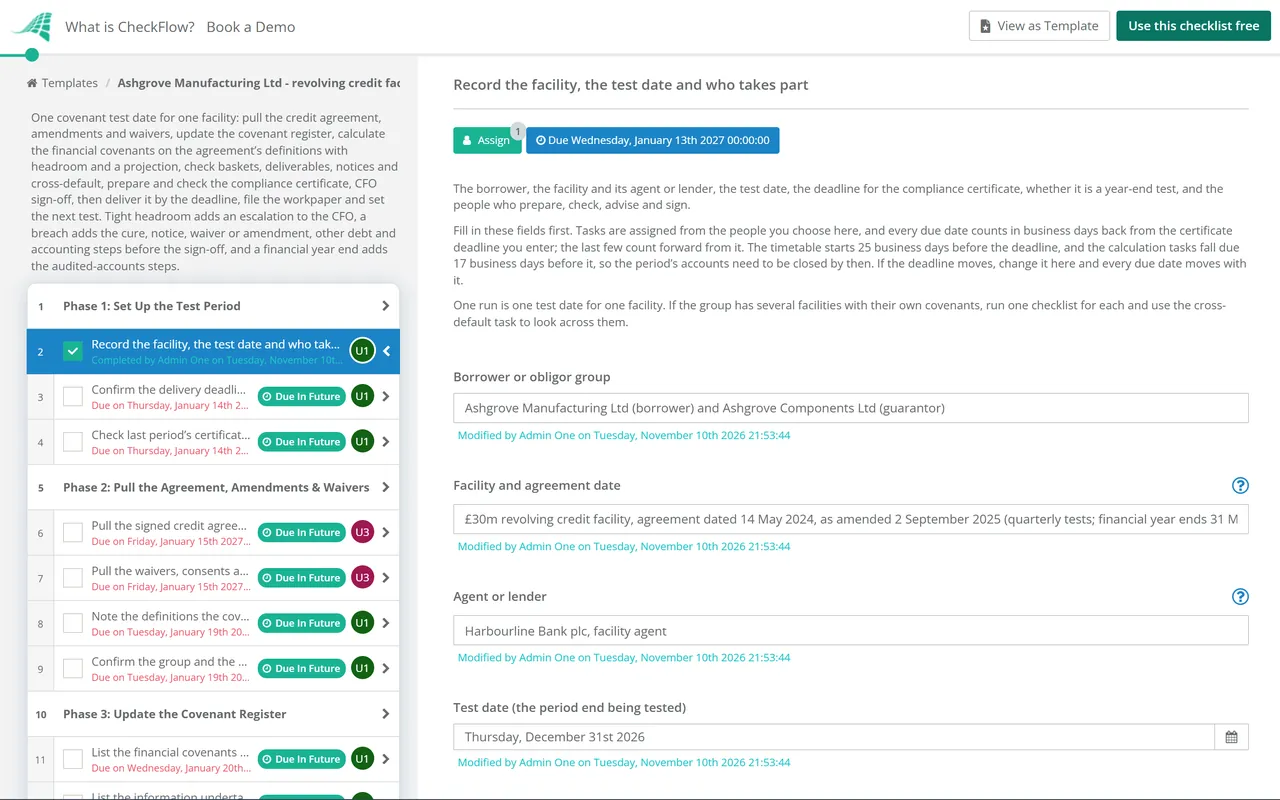
This free loan covenant compliance checklist is the work behind each covenant test for one facility, for treasurers, financial controllers and the CFO who signs the compliance certificate. One run is one test date. It starts from the signed credit agreement, every amendment and the waivers in force, and updates the covenant register: the financial covenants, the information undertakings and deliverables, the negative covenants and their baskets, insurance and the other undertakings, and the notice duties. Each financial covenant is calculated on the agreement’s own definitions, with its headroom and a projection for the next test dates. Basket usage, the deliverables, the notices and a cross-default check across the group’s other debt complete the picture. The conclusion task records the result: tight headroom or a projected failure goes to the CFO, and a breach adds the cure, notice, waiver or amendment, other debt and accounting steps, all before the sign-off. The CFO signs off the certificate as the gate, it is delivered to the agent or lender by the deadline, and the workpaper is filed with the next test date set. A financial year end adds the audited-accounts steps.

One Facility’s Whole Covenant Register, Every Test Date

The Quarter-End Close Checklist has a covenant phase, shown when a test falls in the quarter: the financial tests, headroom, the compliance certificate, escalation and delivery, as part of closing the books. The Weekly Cash Flow Forecast Checklist looks ahead at upcoming covenant tests every week.

This checklist is the covenant work in full for one facility at each test date: the agreement, amendments and waivers pulled, the whole covenant register checked rather than only the ratios, basket usage, cross-default across other debt, a breach taken to the lenders before the deadline, and the next test set up. Use the close’s covenant phase when one simple facility’s tests are a small part of the close. Use this checklist when the facility has several covenants, baskets and deliverables, when headroom is tight, or when a test date is not a quarter end. If you run both, answer the close’s covenant question truthfully, mark its covenant tasks not applicable with a note pointing to this run, and run this checklist for the facility.

This checklist

One facility’s covenants at each test date

Covers: the agreement and waivers, the covenant register, the tests on the agreement’s definitions, headroom and the projection, baskets, deliverables, notices, cross-default, the certificate, sign-off and delivery.

When: every test date, for each facility.

Output: an up-to-date register, a checked and signed certificate delivered on time, and a filed workpaper.
Every quarter

The Quarter-End Close Checklist

Covers: closing month three, true-ups, the interim tax provision, quarterly reporting and, when a test falls in the quarter, a short covenant phase.

Use it: to close the quarter whose accounts this checklist tests. Quarter-End Close Checklist.

Every week

The Weekly Cash Flow Forecast Checklist

Covers: the rolling cash forecast, with a check of upcoming covenant tests and reporting dates.

Use it: to see a squeeze coming; this checklist’s projection task reads from it. Weekly Cash Flow Forecast Checklist.

What the Loan Covenant Compliance Checklist Covers

Eight phases take one facility from the signed agreement to the next test date. The first task sets the deadline and the people, and later answers add only what this test needs: the year-end steps, an escalation to the CFO when headroom is tight, and the cure, notice and waiver or amendment steps when a covenant is breached. The checks in Phase 5 run alongside the calculations, and a second person checks the figures before the result is recorded, so a breach reaches the lenders well before the deadline. The CFO’s sign-off of the certificate is the gate: nothing is delivered until it is done.

  1. Phase 1

    Phase 1: Set Up the Test Period

    3 tasks

    The person preparing the covenant work starts the run for one facility and one test date. The answers on the first task assign every task, set each due date in business days back from the certificate deadline and add the year-end steps when the test date is a financial year end.

    • Record the facility, the test date and who takes part — the borrower, the facility and its agent or lender, the test date, the deadline for the compliance certificate, whether it is a year-end test, and the people who prepare, check, advise and sign
    • Confirm the delivery deadline and method in the agreement — the clause that sets when the compliance certificate and financial statements are due for this test date and how they are delivered: to the agent, through a lender portal or to a named address, in any form the agreement prescribes
    • Check last period’s certificate and open items — the certificate delivered for the last test date, any query the agent or lenders raised, the conditions of any waiver still running and every action carried forward, so this period starts where the last one ended
  2. Phase 2

    Phase 2: Pull the Agreement, Amendments & Waivers

    4 tasks

    Work from the signed documents, not from memory or last period’s spreadsheet. A covenant level, a definition or a basket can change with each amendment, and a waiver can come with conditions of its own.

    • Pull the signed credit agreement and every amendment — the executed facility or credit agreement and each amendment, amendment and restatement or supplemental agreement, in date order, from the legal file rather than a draft or a summary
    • Pull the waivers, consents and side letters in force — each waiver letter, consent and side letter, with what it covers, the test dates it applies to and any condition attached, such as a fee, a reporting duty or a level that applies instead
    • Note the definitions the covenants use — the agreement’s own definitions for each figure in the tests, such as EBITDA, net debt, finance charges, cash flow and the relevant period, with every adjustment, add-back and cap they allow
    • Confirm the group and the accounting basis the tests use — which companies the tests cover, whether they are measured on the group’s consolidated accounts, and whether the agreement fixes the accounting principles at a date so later changes in accounting standards do not move the covenants
  3. Phase 3

    Phase 3: Update the Covenant Register

    6 tasks

    List everything the facility asks of the borrower for this period, not only the ratios. Information undertakings, negative covenants and baskets, insurance and notice duties are covenants too, and the agreement decides what happens if one is missed.

    • List the financial covenants and their levels for this test date — each financial covenant, such as leverage, interest cover, cash flow cover, minimum liquidity or a capital expenditure limit, with the level the agreement sets for this test date, since levels can step up or down over the life of a facility
    • List the information undertakings and their due dates — every deliverable the agreement requires, such as quarterly and annual financial statements, the compliance certificate, a budget or business plan and other information the agent asks for, with its due date and form
    • List the negative covenants and their baskets — the restrictions on the borrower, such as the negative pledge and limits on disposals, other borrowing, guarantees, loans, acquisitions and distributions, with each permitted basket and its limit
    • List the insurance and other undertakings — the undertakings the borrower must keep to, such as keeping insurance in place, maintaining authorisations, complying with laws and sanctions rules, any hedging the agreement requires and conditions still to be met after signing
    • List the notice duties — the events the borrower must tell the agent or lender about, such as a default, litigation, a change of control or a change in the business, with the time the agreement allows for each
    • Record the covenant register for this test date — one row per covenant or undertaking with its clause, its level, limit or due date, its owner and its status, which is the list the rest of the run works through
  4. Phase 4

    Phase 4: Calculate the Financial Covenants

    8 tasks

    Calculate each test on the agreement’s definitions from final figures, then work out the headroom and look ahead to the next test dates. At a financial year end, two more tasks check the covenant notes in the accounts and tie the figures to the audited accounts.

    • Confirm the period’s figures are final — the management accounts for the test period closed and reviewed, or at a year end the audited accounts or the draft the auditors are working on, with the relevant period the test measures, such as the last twelve months, built from them
    • Build each figure from the agreement’s definitions — each input, such as EBITDA, net debt or finance charges, calculated as the agreement defines it rather than as the management KPI of the same name, with a line for each step from the accounts
    • Apply only the adjustments the agreement allows — each adjustment or add-back, such as an exceptional item or a pro forma figure for an acquisition or disposal, checked against the clause that allows it and any cap, with its support
    • Calculate each covenant against its level — each ratio or test worked out, compared with the level for this test date from the register and marked met or not met, with the calculation kept in the workpaper
    • Work out the headroom on each covenant — how far each figure could move before the test fails, such as how much EBITDA could fall or net debt could rise, in money and as a percentage
    • Project the next test dates from the forecast — the next one or two test dates worked out from the latest forecast and the levels that will apply then, so a breach that is coming shows up while there is time to act
    • Year-end: check the covenant notes before the accounts are signed — the notes about covenants on loans classified as non-current checked against these calculations, and any breach or waiver discussed with the auditors before the accounts are signed
    • Year-end: reconcile the covenant figures to the audited accounts — each figure in the calculations traced to the audited financial statements, with any audit adjustment carried into the tests and the tests worked out again
  5. Phase 5

    Phase 5: Baskets, Undertakings & Cross-Default

    7 tasks

    Run these checks alongside the calculations in Phase 4: what each basket has used, whether every deliverable and notice went on time, whether insurance and the other undertakings are met, and whether other borrowing is in good standing. A second person checks the calculations, then the conclusion task records the result, and its answer adds the escalation steps.

    • Check the usage of each basket against its limit — for each permitted basket, such as other borrowing, disposals, distributions, acquisitions or guarantees, what has been used to date, what remains and when it resets, with each transaction in the period that used it
    • Check every information undertaking was met on time — each deliverable due since the last test date delivered by its date and in its form, with anything missed or late listed
    • Check insurance and the other undertakings — the insurance the agreement requires in force with the cover it asks for, and each other undertaking in the register checked for the period
    • Check whether any notice was due in the period — each event on the notice list checked for the period, with any notice given recorded and any notice that should have been given raised with the CFO straight away
    • Check other debt for cross-default — the group’s other borrowing, such as other loans, notes, leases and hedging, checked for a missed payment, a breach or an acceleration that this agreement’s cross-default clause would pick up, with that clause’s threshold
    • Check the covenant calculations before the conclusion — a second person in finance goes through each figure, adjustment, ratio and headroom against the agreement’s definitions and the accounts, so a breach or tight headroom is never reported to the CFO or the lenders on an unchecked calculation
    • Conclude on compliance for the test date — the results read together: every financial covenant, basket, undertaking and notice met or not, the headroom and the projection, and one answer that decides whether the escalation steps are added
  6. Phase 6

    Phase 6: Escalate a Breach or Tight Headroom

    8 tasks

    Applies only when the conclusion records tight headroom, a projected failure or a breach. Raise it with the CFO at once and, in a breach, agree the route with legal counsel and approach the agent or lender before the certificate deadline. These steps sit before the sign-off, so none of them waits for it.

    • Escalate to the CFO with the figures and the projection — the covenant affected, the figures, the headroom or shortfall, the projection for the next test dates and what is driving it, raised with the CFO as soon as the conclusion is reached
    • Agree the response with the CFO — the actions agreed, such as a change to the plan or to cash management, an early conversation with the agent or lender, or a request for a waiver or amendment, with who does what by when
    • Breach: check the cure, waiver and amendment terms — what the agreement allows: any cure right or grace period, what counts as a default, who must consent to a waiver or amendment, such as the majority lenders, and what notice is required
    • Breach: notify the agent or lender as the agreement requires — the notice of the breach or default the agreement asks for, given in its form and within its time, once legal counsel has agreed the wording
    • Breach: request a waiver or amendment — the request sent through the agent, or to the lender for a bilateral facility, with the figures, the cause, the proposed waiver, reset levels or other terms, and the date a response is needed by
    • Breach: check the effect on other debt and hedging — whether the breach is a default or a cross-default under any other loan, note, lease or hedging agreement, and any notice those agreements require
    • Breach: tell the auditors and check the accounting effect — the breach and any waiver discussed with the auditors, including how they affect the classification of the loan as current or non-current and what the notes must say
    • Breach: record the lenders’ response — the waiver, amendment or other answer received, signed and dated, with its conditions and any fee, added to the covenant register, or the position written down if no answer has arrived
  7. Phase 7

    Phase 7: Prepare & Sign Off the Compliance Certificate

    6 tasks

    Prepare the certificate in the agreement’s form with every figure from the workpaper, have a second person check it, and get it signed. The CFO’s sign-off is the gate: nothing in Phase 8 can be completed until it is done.

    • Prepare the compliance certificate in the agreement’s form — the form attached to the agreement, with each covenant’s figures and result from the workpaper and any confirmation the form asks for, such as that no default is continuing, given only if it is true
    • Attach the supporting calculations and schedules — the calculations, reconciliations and any schedules the agreement asks to go with the certificate, agreed to the figures in it
    • Check the certificate and the workpaper — a second person in finance checks each figure back to the accounts and the definitions, the levels against the register and the statements in the certificate against the conclusion, with any query answered
    • Year-end: check whether the auditors must report on the certificate — if the agreement asks for the auditors to report on the year-end certificate or its calculations, the auditors’ report requested in time and attached
    • Certificate not approved: make the changes the CFO asked for — each change the CFO recorded on the sign-off task made to the certificate, the calculations or the conclusion, then this task completed and the certificate passed back to the CFO
    • CFO signs off the compliance certificate — the certificate, the calculations and the conclusion approved and the certificate signed by the CFO or the officer the agreement names; if it is not ready, choose Not approved and leave this task open, because nothing in Phase 8 can be completed until it is done
  8. Phase 8

    Phase 8: Deliver, File & Set the Next Test

    5 tasks

    Deliver the signed certificate and financial statements by the deadline, answer any query, file the workpaper and set up the next test date, so the next run starts from an up-to-date register.

    • Deliver the certificate and financial statements by the deadline — the signed certificate, the financial statements and any schedules delivered to the agent or lender in the way the agreement requires, with the date and the proof of delivery kept
    • Answer any query from the agent or lenders — each question on the certificate or the figures answered and recorded, with any correction agreed with the CFO before it is sent
    • Breach: add the waiver’s conditions to the next test — each condition of the waiver or amendment, such as a reporting duty, a fee or a new level, added to the register and to the next run with its date
    • File the workpaper with the period’s records — the agreement extracts, the register, the calculations, the certificate, the approvals, the proof of delivery and any waiver kept together for the test date
    • Set the next test date and its deadline — the next test date and certificate deadline from the agreement, the next run started or scheduled, and each deliverable due before then given a date and an owner

What Goes in a Covenant Register, and What Each Result Adds

Five kinds of covenant

The register on the Phase 3 task holds every one of these, not only the ratios.

Kind of covenant What it covers Examples What this checklist does
Financial covenantsTests of the borrower’s figures at each test dateLeverage, interest cover, cash flow cover, minimum liquidity, a capital expenditure limitCalculates each on the agreement’s definitions, with headroom and a projection
Information undertakingsWhat the borrower must send, and whenFinancial statements, the compliance certificate, a budget, other information the agent asks forLists each deliverable and checks it went on time
Negative covenants and basketsWhat the borrower may not do beyond permitted amountsThe negative pledge, limits on disposals, other borrowing, guarantees, acquisitions and distributionsTracks what each basket has used and what remains
Insurance and other undertakingsWhat the borrower must keep doingInsurance in place, authorisations, compliance with laws and sanctions rules, required hedgingChecks each for the period
Notice dutiesWhat the borrower must tell the lenders aboutA default, litigation, a change of controlChecks whether any notice was due, and that it was given

The three results

The conclusion task in Phase 5 takes one answer, and the answer decides what the run adds before the sign-off.

Result on the conclusion task What it adds When
All met, with headroom the CFO is comfortable withNothing: the certificate goes aheadNo extra steps
All met, but headroom is tight or a later test is projected to failAn escalation to the CFO and an agreed response, such as an early word with the lenderAs soon as the checked calculation shows it, before the sign-off
A covenant or undertaking is breachedThe escalation, then the cure and waiver terms, the notice, the waiver or amendment request, the effect on other debt, the auditors and the lenders’ responseAs soon as the checked calculation shows it, so the waiver request goes early; all before the sign-off

The facility agreement governs: its definitions, levels, deadlines and cure rights are the rules, and this template types none of them. The Loan Market Association (LMA), for the syndicated loan markets in Europe, the Middle East and Africa, and the Loan Syndications & Trading Association (LSTA), for the US corporate loan market, publish recommended documents your agreement may follow. They are for members, and this template does not quote them.

In the accounts: under IFRS Accounting Standards, the October 2022 amendments to IAS 1 (Non-current Liabilities with Covenants, effective for annual periods beginning on or after 1 January 2024) say covenants to be complied with after the reporting date do not affect whether a loan is classified as current or non-current at that date, and require information about them in the notes. For annual periods beginning on or after 1 January 2027, with earlier application permitted, IFRS 18 replaces IAS 1 and carries these requirements; the UK Endorsement Board published its adoption statement for IFRS 18 on 12 December 2025. US GAAP, FRS 102 and other frameworks have their own rules, so agree any breach’s effect with your auditors.

Why Run Loan Covenant Compliance in CheckFlow?

1

Every test date, on time

Enter the certificate deadline and every task gets a due date counted back from it in business days. A recurring schedule can start a run for each test date, and each facility’s runs sit on the Reports Grid with their answers, so a certificate still open stands out.

2

Signed off before it leaves

The CFO’s sign-off is a gate: the certificate cannot be marked delivered until it is done. Tight headroom or a breach adds the escalation steps before the gate, so a waiver request never waits for a signature. See how approval steps work.

3

The whole register, not only the ratios

Each deliverable, basket, undertaking and notice duty is checked at every test date, with an owner and a due date, and overdue alerts go to every assignee. Analytics shows completion rates and overdue and late work by person and by step, test after test.

CheckFlow does not hold your agreement or calculate your covenants; your spreadsheet or treasury system does that. CheckFlow runs the process around it: who pulled which documents, who calculated and checked each test, what was found, who signed and when the certificate went.

Close the quarter first with the Quarter-End Close Checklist, and watch upcoming tests in the Weekly Cash Flow Forecast Checklist. Check capex limits in the agreement before approving a project with the Capital Expenditure (CapEx) Approval Checklist, keep the cover the agreement requires through the Business Insurance Renewal Checklist, and report headroom to the board in the Monthly Management Reporting Pack Checklist.

AI generator

Didn’t find what you need? Describe it.

Describe the process in a sentence and the AI checklist generator drafts the phases and tasks for you.

Frequently Asked Questions

What is loan covenant compliance?

Loan covenant compliance is keeping the promises a borrower makes in its credit or facility agreement, and showing the lender that it has. The promises include financial covenants tested at set dates, such as leverage or interest cover, information undertakings such as delivering accounts and a compliance certificate, negative covenants that limit borrowing, disposals or distributions, and duties to keep insurance and give notice of certain events. The agreement sets what each one requires, when it is tested and what happens if it is breached.

What is a covenant compliance certificate?

A covenant compliance certificate is the document a borrower sends the agent or lender, with its financial statements, to show the financial covenants for a test date. It sets out each covenant’s figures and result, in any form the agreement prescribes, and is signed by an officer such as the CFO. The form may also ask the signer to confirm that no default is continuing, which they should do only if it is true. The agreement sets the deadline, the form and who may sign.

What should a debt covenant checklist include?

The signed agreement, every amendment and the waivers in force; a register of every covenant, not only the ratios; each financial covenant calculated on the agreement’s definitions, with headroom and a projection for the next test dates; basket usage; deliverables and notices checked; a cross-default check across other debt; the certificate prepared, checked and signed; delivery by the deadline; and the workpaper filed. This checklist covers each one, with escalation steps when headroom is tight or a covenant is breached.

What is covenant headroom?

Headroom is how far a figure can move before a covenant test fails. For a maximum leverage covenant it might be shown as how much EBITDA could fall, or net debt rise, before the ratio passes the level for that test date, in money and as a percentage. This checklist works it out for every financial covenant and projects it for the next one or two test dates from the latest forecast, because the levels can change over the life of a facility.

What happens if you breach a loan covenant?

That depends on the agreement. A breach can be an event of default, which may let the lenders demand repayment, unless the agreement gives a cure right or a grace period. Read the terms first, take legal advice, give any notice the agreement requires and ask the agent or lender for a waiver or amendment as early as you can. Check whether the breach is a default under other borrowing, and tell your auditors. In this checklist a breach answer adds those steps before the sign-off.

What is the difference between financial covenants and negative covenants?

Financial covenants test numbers at set dates, such as leverage, interest cover or minimum liquidity. Negative covenants stop the borrower doing certain things beyond agreed limits, such as granting security over its assets, selling assets, borrowing more or paying distributions; the permitted amounts are called baskets. Positive undertakings, such as keeping insurance or delivering accounts, are the third kind. A breach of any of them can matter, so this checklist puts all three in the register.

Does a covenant breach change how the loan is shown in the accounts?

It may. Under IFRS Accounting Standards, a loan is non-current only if the company can avoid settling it in the 12 months after the reporting date, so a breach by then that lets the lenders demand repayment can make it current. Covenants to be complied with after the reporting date do not affect this, but are disclosed in the notes (IAS 1 as amended in 2022, and IFRS 18 for periods beginning on or after 1 January 2027). US GAAP and FRS 102 have their own rules: ask your auditors.

Do I need this if my quarter-end close already tests covenants?

The Quarter-End Close Checklist’s covenant phase covers the financial tests, headroom, the certificate, escalation and delivery inside the close. This checklist is the whole covenant register for one facility: the agreement and waivers, deliverables, baskets, insurance, notices, cross-default, a breach taken to the lenders, and the next test date. Use the close’s phase for a simple facility. Use this checklist when the facility has several covenants and baskets, when headroom is tight, or when a test date is not a quarter end.

Is CheckFlow free for this template?

14-day free trial, no card required. The Business plan is $10 per user per month after the trial. Full details at checkflow.io/pricing.

Deliver Every Compliance Certificate on Time, With the Register Behind It

Free trial — no credit card required.

14-day free trial, no credit cardFull refund in your first 30 daysUS hosting, EU on request