
The annual renewal
- Run by finance with the broker, every year
- Starts 120 days before expiry
- Updates exposures, discloses changes, binds cover
- Ends with certificates and next year’s date
Last reviewed: October 2026
No Credit Card Required
Printed from checkflow.io/templates/finance-accounting/business-insurance-renewal-checklist
The insurance renewal arrives once a year, usually lands on finance, and needs information held by half the business: payroll from HR, property values from facilities, vehicles from operations, contracts from legal and security controls from IT. This free business insurance renewal checklist gives finance managers, controllers and CFOs a 120-day process for renewing a company’s commercial insurance programme with a broker. It covers the renewal plan and broker strategy, updated exposure data and claims history, a review of each line of cover against your contracts, the submission and your duty of disclosure, quotes, approval and binding, and the certificates and statutory cover that follow. A scope question at the start switches on the UK phase, the US phase or both.
The easy renewal is the one where last year’s figures get a new turnover number and the policy rolls over. It is also the one most likely to leave the company underinsured or exposed to a disputed claim. Property values rise with rebuilding costs, a new customer contract demands a higher liability limit, a new office opens in another country, and none of it reaches the insurer unless somebody asks.
The renewal is also the point where you make representations to the insurer. In the UK, the Insurance Act 2015 requires a business to make a fair presentation of the risk before the contract is entered into or varied. In the US, the answers on an application are representations, and under most states’ law a material misrepresentation can allow the insurer to rescind the policy. Either way, what you tell the insurer at renewal decides whether the policy pays when you need it. This checklist covers the annual renewal. For a one-off, in-depth review of a programme, before an acquisition for example, use the insurance due diligence template.
Seven phases run from 120 days before expiry to the month after renewal. Phase 6 appears when the company has UK operations and Phase 7 when it has US operations, so a business in both sees both.
Owned by the renewal lead in finance. The scope questions decide which later phases and tasks appear.
Shown only when the company has UK operations.
Shown only when the company has US operations.
Brokers commonly ask for renewal information two to three months before expiry, and longer when the programme is going to market or a line is hard to place. Starting at 120 days leaves time to fix a gap before the submission goes out rather than explain it afterwards.
Register updated, owners named, strategy agreed and the timetable set backwards from expiry.
Revenue, payroll, values, vehicles and locations collected; loss runs or claims experience requested from every insurer.
Gaps against contracts resolved or accepted, application answers checked, and the submission approved by a director.
Terms negotiated through the broker and a recommendation prepared for the CFO.
CFO approval, written binding instructions and premium payment or finance arranged.
Certificates displayed and issued, policy wordings checked against the quote, and next year’s renewal scheduled.
| Topic | United Kingdom | United States |
|---|---|---|
| Injury to employees | In Great Britain, employers’ liability insurance is compulsory under the Employers’ Liability (Compulsory Insurance) Act 1969, with cover of at least £5 million. Fines of up to £2,500 for each day without cover and up to £1,000 for not displaying the certificate. Exemptions include a company whose only employee owns 50% or more of its shares | Workers’ compensation is set by state law. Every state except Texas requires private employers to carry it, subject to state thresholds; North Dakota, Ohio, Washington and Wyoming require cover from a state fund |
| Duty when applying | Insurance Act 2015: a fair presentation of the risk, covering what senior management and the people arranging the insurance know or should find by a reasonable search, for contracts entered into or varied on or after 12 August 2016 | Application answers are representations; under most states’ law a material misrepresentation can let the insurer rescind. In Travelers v. International Control Services (2022) a cyber policy was rescinded over an MFA answer |
| If disclosure falls short | Proportionate remedies: the insurer applies the terms it would have offered and can reduce a claim in proportion to the premium it would have charged. For a deliberate or reckless breach it can avoid the policy and keep the premium | Varies by state, from rescission of the policy to denial of the affected claim |
| Proof of cover for others | Employers’ liability certificate displayed to staff; evidence of cover or a broker’s letter for landlords, lenders and customers | Certificates of insurance such as ACORD 25, which do not amend or extend the policy: additional insured status needs an endorsement on the policy |
| Tax on premiums | Insurance Premium Tax at the standard rate of 12% on most commercial policies | Admitted insurers pay state premium tax and build it into the premium; surplus lines policies carry a separate surplus lines tax on the invoice |
Underinsurance is the quiet risk. Many UK property policies include an average clause, and many US property policies a coinsurance clause. If the sum insured is below the value the policy requires at the time of a loss, the insurer pays only a proportion of the claim, even for a partial loss. Updating rebuilding costs and stock values in Phase 2 matters as much as the premium negotiation.
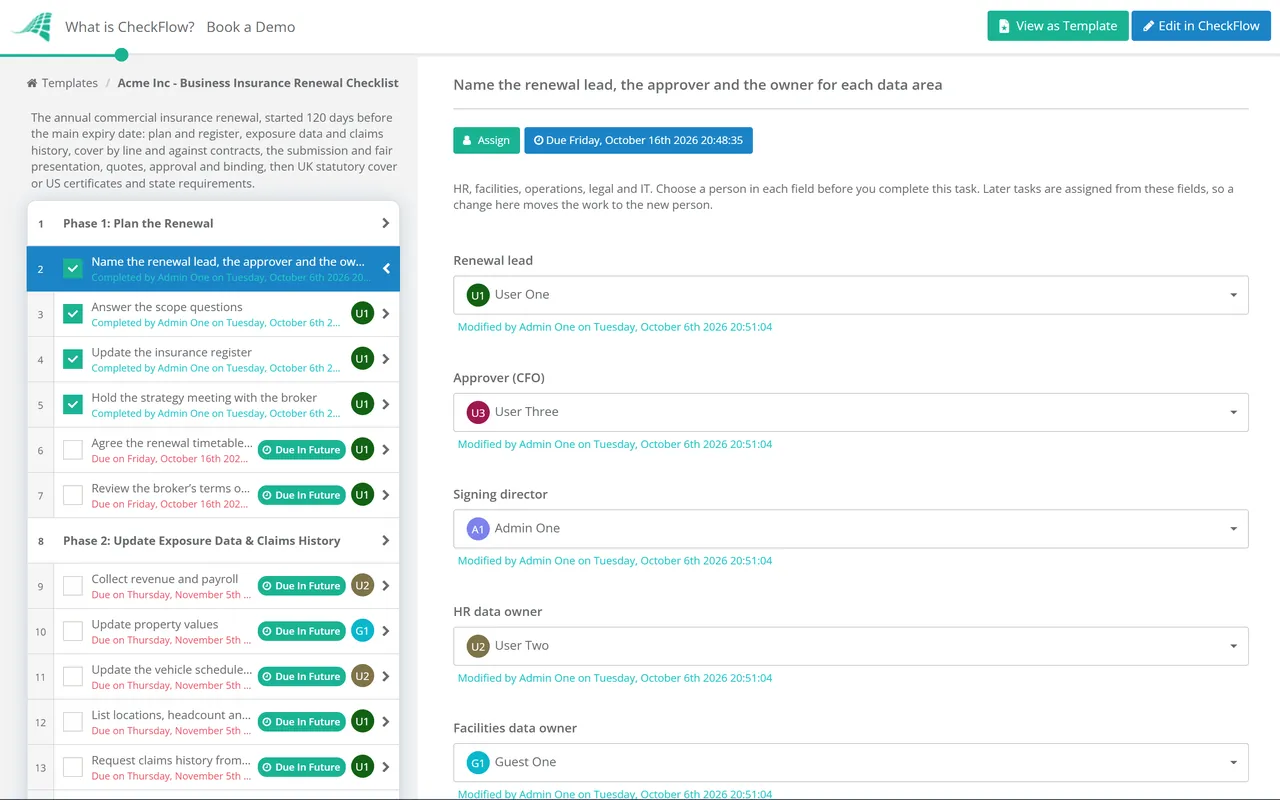
An annual schedule creates the renewal checklist four months before expiry, with every due date counted back from the renewal date, so the data request never arrives three weeks late.
Payroll goes to HR, values to facilities and contracts to legal, each with a due date. The Tasks grid shows finance what is outstanding without chasing by email.
The signed submission, application answers, evidence and the CFO’s approval are attached to the tasks, with a timestamped activity trail you can export if a claim is ever disputed.
The renewal sits alongside other annual work. The Annual Budget Planning Checklist sets the premium budget, the Contract Renewal Reminder flags customer contracts with insurance clauses, and the Cyber Insurance Readiness Checklist prepares the evidence behind the cyber application. Spending on new equipment or premises goes through the CapEx Approval Checklist, which includes an insurance review.
CheckFlow is not a broker, an insurer or a policy administration system, and it does not give insurance advice or compare quotes for you. It runs the workflow around your broker and insurers, with your policies and locations kept as a data set so each task can pick from a live list.

Company Insurance Policies Due Diligence Process

Cyber Insurance Readiness Checklist Template

Annual Budget Planning Checklist

Contract Renewal Reminder

Business Continuity Plan Testing Checklist
Describe the process in a sentence and the AI checklist generator drafts the phases and tasks for you.
Three to four months before the expiry date. Brokers commonly want updated information two to three months ahead, and starting earlier leaves time to collect property values and payroll, review contracts and fix gaps before the submission goes to insurers.
Usually revenue and payroll, headcount, locations and activities, property and stock values, business interruption figures, vehicles and drivers, claims history, and any material changes since last year such as acquisitions, new products or new countries. Cyber and D&O insurers also ask detailed questions about security controls and the company’s financial position.
It is the UK rule, in the Insurance Act 2015, that a business must disclose every material circumstance it knows or ought to know, or enough to put the insurer on notice to ask, in a way that is reasonably clear and accessible. Knowledge includes that of senior management and the people responsible for the insurance, plus what a reasonable search would reveal. If the duty is breached, the insurer’s remedy depends on what it would have done with the full picture.
In Great Britain, yes for most employers, with cover of at least £5 million from an authorised insurer. Exemptions include some family businesses that are not limited companies and a company whose only employee owns 50% or more of its shares. In the US the equivalent is workers’ compensation, which every state except Texas requires private employers to carry, subject to each state’s rules.
A summary of a company’s cover issued to a customer, landlord or lender who needs evidence of it, in the US usually on an ACORD form. It is for information only: it does not change the policy, and a party that needs to be an additional insured must be added by an endorsement to the policy itself.
14-day free trial, no card required. The Business plan is $10 per user per month after the trial. Full details at checkflow.io/pricing.
14-day free trial, no credit cardFull refund in your first 30 daysUS hosting, EU on request