
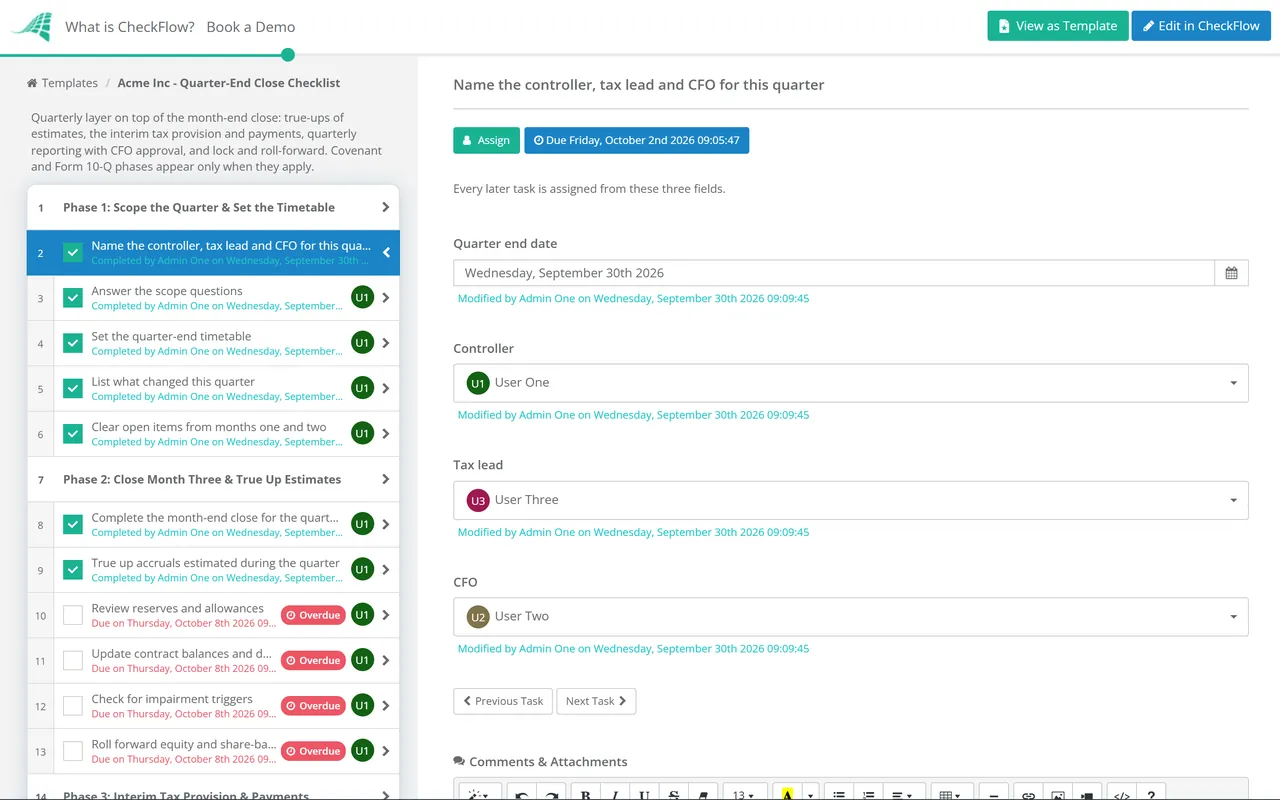
Handled by the month-end close
- Cut-off and posting of the month’s transactions
- Bank, subledger and balance sheet reconciliations
- Routine accruals, prepayments and depreciation
- Monthly management accounts
Most finance teams close the month on a routine. The quarter is where the routine runs out. Accrual estimates need a proper true-up, the tax provision has to be re-estimated for the year, the lender wants a compliance certificate and the board expects a quarterly pack, each with a deadline set outside finance. This free quarter-end close checklist gives controllers, finance managers and CFOs the quarterly layer on top of the month-end close. It covers scoping and timetable, quarterly true-ups and estimates, the interim tax provision and estimated tax payments, covenant testing, quarterly reporting with CFO approval, and the lock and roll-forward, with covenant and Form 10-Q phases that appear only when they apply.
A quarter-end close is the month-end close for the third month of the quarter, plus the work that only comes round every three months. This template assumes the monthly close runs through the Month-End Close Checklist and adds only what the quarter needs.
The quarterly items fall into three groups. Estimates made roughly each month get a documented true-up. Tax moves from a monthly accrual to a year-to-date provision based on the expected annual rate, and cash leaves the business for estimated tax or instalment payments. And people outside finance receive something: the board, investors, lenders and, for public companies, the SEC. In the fourth quarter, the Year-End Close Checklist adds the annual layer on top of this one.
Seven phases run from scoping the quarter to locking it. Phase 4 appears only when a covenant test is due, and Phase 6 only when the company files a Form 10-Q for the quarter.
Answer the two scope questions first. They decide which of the later phases this quarter’s checklist shows.
Shown only when a covenant test or compliance certificate is due this quarter.
Shown only for SEC registrants filing a 10-Q for this quarter. There is no 10-Q for the fourth quarter, when the 10-K covers it.
The quarterly deadlines that matter most are set by securities regulation, tax law and your loan agreements, and they are counted from your own quarter-end. The table shows the main US and UK examples for a company with a 31 December year end. Lender deadlines are whatever your facility agreement says, so add them to the template as due dates.
| Obligation | United States | United Kingdom |
|---|---|---|
| Interim financial report | SEC registrants file Form 10-Q within 40 days of each of the first three quarters (large accelerated and accelerated filers) or 45 days (all others); no 10-Q for the fourth quarter | Issuers under the FCA’s Disclosure Guidance and Transparency Rules publish a half-yearly report within three months of the half-year end; no quarterly report is required |
| Auditor involvement | 10-Q financial statements must be reviewed by an independent accountant before filing (Regulation S-X Rule 10-01(d)), under PCAOB AS 4105; private companies use AU-C 930 when they engage one | Half-yearly reviews are voluntary for most issuers and follow ISRE (UK) 2410 when performed |
| Corporate income tax during the year | Estimated tax is required if the corporation expects to owe $500 or more; instalments are due on the 15th day of the 4th, 6th, 9th and 12th months (15 April, 15 June, 15 September and 15 December), or the next business day | Large companies (profits above £1.5 million) pay quarterly instalments on the 14th day of months 7, 10, 13 and 16 of the accounting period; very large companies (above £20 million) in months 3, 6, 9 and 12 |
| Quarterly tax returns | Form 941 by the last day of the month after the quarter (30 April, 31 July, 31 October, 31 January); sales tax on each state’s own calendar | VAT returns, usually quarterly, filed and paid one calendar month and 7 days after the period ends |
Interim tax is a year-to-date estimate. Under both IAS 34 and US GAAP (ASC 740-270), the tax charge for an interim period is based on the rate you expect for the full year, applied to year-to-date profit, with one-off items recorded in the quarter they occur. UK entities reporting under FRS 102 apply FRS 104, which is based on IAS 34. The payment is a separate calculation. In the US, each instalment is generally 25% of this year’s or last year’s tax, and a corporation with taxable income of $1 million or more in any of the three previous years can use last year’s tax only for the first instalment. Form 1120-W is now historical (its 2022 revision was the last), so use the worksheet in IRS Publication 542 and Form 2220 for any underpayment penalty. In the UK, the £1.5 million and £20 million thresholds are divided between associated companies, which brings more groups into instalments than expected.
Several of these may change. On 5 May 2026 the SEC proposed letting companies choose a semiannual report on a new Form 10-S instead of quarterly 10-Qs, due within the same 40 or 45 days. On 19 May 2026 it proposed replacing five filer statuses with two. Large accelerated filer status would need a public float of $2 billion or more and 60 months of reporting, and non-accelerated filers with total assets of $35 million or less would get 50 days for a 10-Q. Neither proposal had been adopted by the end of September 2026. The IAASB published a proposed revision of ISRE 2410 in May 2026, and FASB’s ASU 2025-11 changes interim reporting under ASC 270 for public business entities from interim periods in annual periods beginning after 15 December 2027.
A quarterly schedule creates the checklist on the first working day after each quarter-end, with the controller, tax lead and CFO assigned and every due date counted from the start.
Two questions in Phase 1 decide the rest. A quarter with no covenant test hides the lender phase. A private company, or a public company in its fourth quarter, never sees the 10-Q tasks.
Tax workings, covenant schedules, certificates and the approved board pack are attached to the tasks that produced them, and every task records who completed it and when. When the auditors or the lender ask, the file is already assembled.
The quarter-end depends on a clean third-month close. Our month-end close guide covers the reconciliations and journals that come first, and the Month-End Close Checklist runs them every month.
The quarterly board pack starts life as a monthly one. The Monthly Management Reporting Pack Checklist produces the KPIs and commentary, the Weekly Cash Flow Forecast Checklist gives you covenant headroom, and the Tax Preparation Checklist covers the annual return behind the estimated payments.
Month-End Close Checklist
Year-End Close Checklist

Balance Sheet Reconciliation Checklist

Monthly Management Reporting Pack Checklist

Budget Variance Review Checklist
Describe the process in a sentence and the AI checklist generator drafts the phases and tasks for you.
It is the list of tasks a finance team completes at the end of each quarter on top of the normal month-end close: true-ups of estimates and reserves, the interim tax provision and estimated tax payments, covenant tests, quarterly reporting to the board and investors and, for public companies, the quarterly filing.
The month-end close produces reconciled management accounts every month. The quarter-end adds work with external deadlines and a higher bar for accuracy: estimates are trued up rather than rolled forward, tax is re-estimated for the full year, lenders and boards receive reporting, and SEC registrants file a 10-Q reviewed by their auditors.
Within 40 days of the quarter-end for large accelerated and accelerated filers, and 45 days for all other registrants. A 10-Q is filed for the first three fiscal quarters only; the annual report on Form 10-K covers the fourth. The SEC proposed in May 2026 to allow a semiannual report instead and to simplify filer categories, but neither proposal had been adopted by the end of September 2026.
Not by law in most cases. The interim review requirement in Regulation S-X applies to financial statements in a 10-Q. Private companies often agree to one in a loan agreement or with investors, and in the US the auditor then follows AU-C 930.
In the US, a corporation that expects to owe $500 or more pays four instalments, generally each 25% of this year’s expected tax or of last year’s tax, due on the 15th day of the 4th, 6th, 9th and 12th months of its tax year. In the UK, large companies pay quarterly instalments based on their expected liability for the current period, starting in month 7, and very large companies start in month 3. Re-estimate every quarter: an early underpayment can be penalised even if later payments catch up.
14-day free trial, no card required. The Business plan is $10 per user per month after the trial. Full details at checkflow.io/pricing.
14-day free trial, no credit cardFull refund in your first 30 daysUS hosting, EU on request