
Commercial Real Estate Lender Due Diligence Checklist

One commercial real estate loan from term sheet to closing: the borrower and its owners, the appraisal or valuation, the leases and reports, the loan metrics against your credit policy, the credit committee decision and the security.

Last reviewed: November 2026

Printed from checkflow.io/templates/due-diligence/commercial-real-estate-lender-due-diligence-checklist

This free commercial real estate lender due diligence checklist is for loan officers, underwriters, credit teams and lenders’ counsel at banks and other commercial real estate lenders. One run covers one loan, with every due date counted from the target closing date. It sizes the loan against your credit policy and issues the term sheet, identifies and screens the borrower, its beneficial owners and guarantors, orders and reviews the appraisal or valuation, reconciles the rent roll and leases, and reviews the condition, environmental, title, survey and flood findings. The underwriter records the loan to value, debt service coverage and debt yield, and a loan outside your limits goes to the credit officer for an exception before the credit committee decides. The loan documents, conditions precedent, funding and the registration of the security follow. A United States or England & Wales answer adds that route’s rules as notes.

The Lender’s Side of a Property Deal

A commercial real estate loan is only as good as the property, the income behind it and the people who owe it. Lender due diligence checks all three before the credit committee commits the money: who the borrower and its owners are, what the property is worth to an independent valuer, whether the leases pay the debt, what the reports say about condition, contamination, title and flood, and whether the numbers fit the lender’s own credit policy.

The Commercial Property Acquisition Due Diligence Checklist is the buyer’s review of the same property before it exchanges or closes; its financing tasks are the buyer meeting the lender’s conditions. The Loan Origination Checklist covers consumer and business loans other than mortgages, with the Regulation B notices they need, and the Mortgage Application Processing Checklist covers home loans. The Financial Due Diligence Checklist is a buyer’s review of a company’s numbers in an acquisition. Once the loan has closed, the borrower runs its covenant tests in the Loan Covenant Compliance Checklist.

The buyer

Property acquisition due diligence

Covers: the buyer’s title, survey, leases, environmental and condition checks before it commits, in the Commercial Property Acquisition Due Diligence Checklist.

Ends: with the investment decision, exchange or closing and registration of the purchase.

This checklist

Lender due diligence on a CRE loan

Covers: the borrower and its owners, the appraisal or valuation and its review, the leases, the third-party reports, the loan metrics against credit policy, any policy exception and the credit committee, on the US or England & Wales route.

Ends: with the loan funded, the security registered and the post-closing items collected.

Other loans

Consumer and business loans

Covers: intake, underwriting, credit approval, adverse action notices and funding for consumer and small business credit, in the Loan Origination Checklist.

Ends: with the loan booked and the post-closing quality check.

What the Commercial Real Estate Lender Due Diligence Checklist Covers

Nine phases take one loan from the request and term sheet, about 10 weeks before closing, to the post-closing items. The checklist halts at the credit committee decision in Phase 7. The first task’s answers add the US or England & Wales notes and, when the property is let, the lease phase; an environmental finding, a US flood zone and a loan outside policy each add their own tasks, and the committee’s decision decides whether the documents and closing follow.

  1. Phase 1 — about 10 weeks before closing

    Phase 1: Loan Request, Sizing & Term Sheet

    5 tasks

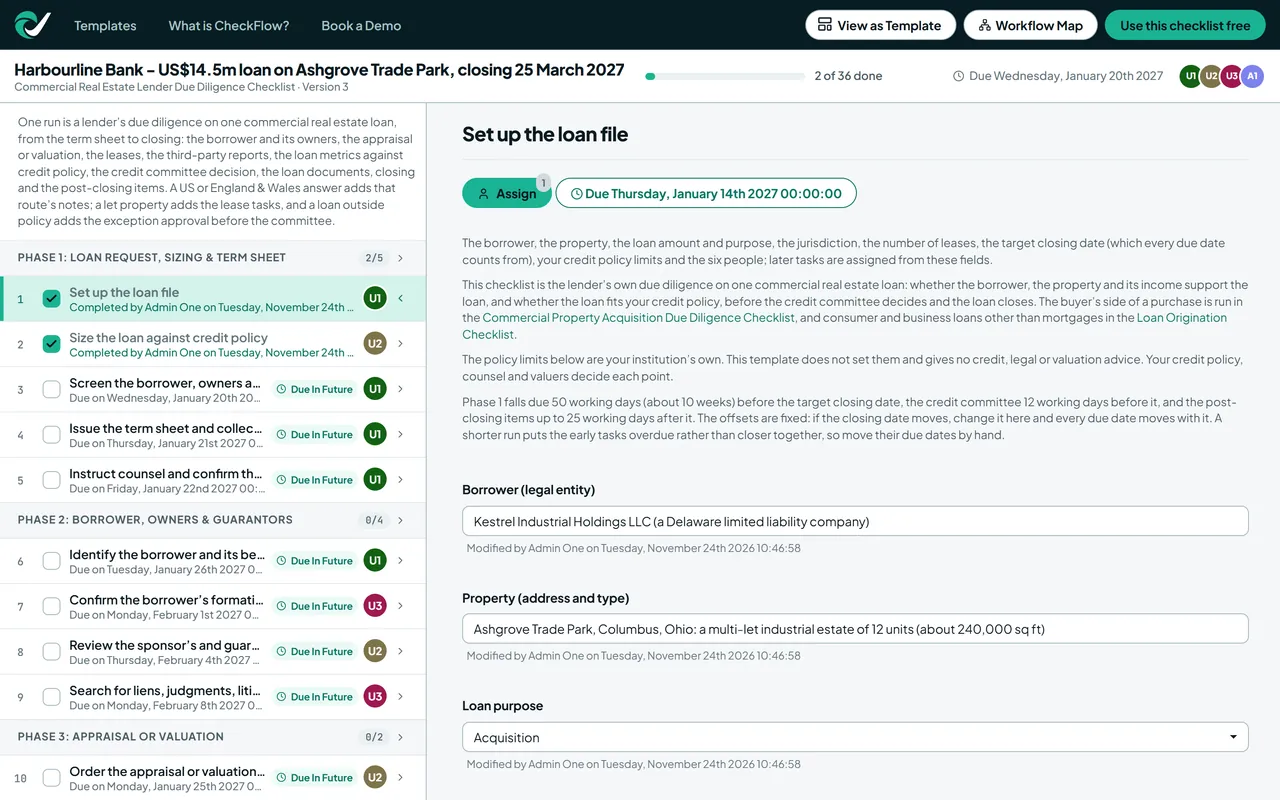
    Start when the request arrives, about 50 working days before the target closing date. The first task names the borrower, the property, the loan, the jurisdiction and the six people, and sets the credit policy limits. Every due date counts from the target closing date, in working days.

    • Set up the loan file — the borrower, the property, the loan amount and purpose, the jurisdiction, the number of leases, the target closing date (which every due date counts from), your credit policy limits and the six people; later tasks are assigned from these fields
    • Size the loan against credit policy — the value used for sizing (the purchase price or the borrower’s estimate), the borrower’s net operating income, the proposed debt service and the indicative loan to value, debt service coverage and debt yield, before a term sheet is offered
    • Screen the borrower, owners and guarantors against sanctions lists — the borrower, its owners and guarantors as disclosed so far, the seller on an acquisition and the main tenants screened before the term sheet is issued or any money is taken, with any possible match resolved and recorded; anyone added later is screened when added
    • Issue the term sheet and collect the deposit — the term sheet signed by the borrower, its expiry, the deposit for third-party report costs received, and the closing timetable agreed
    • Instruct counsel and confirm the deal team — the lender’s counsel instructed, the borrower’s counsel and any guarantors named, and the dates each report and document is due back
  2. Phase 2

    Phase 2: Borrower, Owners & Guarantors

    4 tasks

    Owned by the loan officer and the underwriter. Identify and verify who the borrower is and who owns it, confirm its authority, and check the sponsor and guarantors can support the loan.

    • Identify the borrower and its beneficial owners — the borrowing entity, the individuals who own or control it, and the guarantors, identified and verified under your customer due diligence procedures
    • Confirm the borrower’s formation and authority to borrow — the formation documents, evidence the entity exists and is in good standing, the resolution approving the loan and the security, and who may sign
    • Review the sponsor’s and guarantors’ financial strength — financial statements, tax returns where your policy asks for them, credit reports for individual guarantors, real estate owned, contingent liabilities, and liquidity and net worth against any guarantee covenants
    • Search for liens, judgments, litigation and insolvency — searches against the borrower and the guarantors, with anything found cleared before closing or accepted in the credit memo
  3. Phase 3

    Phase 3: Appraisal or Valuation

    2 tasks

    Owned by the underwriter. The lender orders the appraisal or valuation itself, and reviews it before the credit decision.

    • Order the appraisal or valuation directly from an independent valuer — the appraiser or valuer chosen by the lender, not the borrower, with the scope, the value basis and the date the report is due
    • Review the appraisal or valuation before the credit decision — a review by someone independent of the loan officer: the assumptions, comparables, income approach and condition, any issue resolved with the valuer, and the value carried into the loan metrics
  4. Phase 4 — let property only

    Phase 4: Leases, Rent Roll & Tenants

    4 tasks

    Applies only when the first task records one or more leases. Owned by the underwriter, with the lender’s counsel on estoppels and subordination.

    • Reconcile the rent roll with the leases — each lease, amendment and side letter checked against the certified rent roll: rent, term, breaks, options, rent reviews, arrears and deposits
    • Abstract the main leases and check tenant strength — lease abstracts for the main tenants, the share of rent each pays, lease expiries in the loan term, and each main tenant’s financial standing
    • Collect tenant estoppel certificates or confirmations — signed confirmations from the tenants your term sheet or policy names, checked against the lease abstracts, with any difference resolved
    • Settle subordination and non-disturbance with the main tenants — where your terms require it, the form of agreement settled with each main tenant that sets the order between its lease and the loan, so the signed copies can be collected as conditions precedent
  5. Phase 5

    Phase 5: Third-Party Reports, Title & Insurance Risks

    9 tasks

    Owned by the underwriter and the lender’s counsel. Order every report as soon as the term sheet is signed, so each is back before the loan metrics are set.

    • Order the third-party reports — the property condition report, the environmental report, the title work, the survey and zoning or planning information and, in the US, the flood determination, each with its provider and due date
    • Determine the flood zone — whether the buildings securing the loan are in an area at risk of flooding, and the flood insurance or other cover that follows
    • Review the property condition report — the building’s condition, immediate repairs, the capital expenditure expected over the loan term, and whether repairs are made before closing or reserved for
    • Review the environmental report — the environmental professional’s findings on contamination on or near the property, and whether further investigation is recommended
    • Check the EPCs against the minimum energy efficiency standard — a valid energy performance certificate for each let unit, any unit below band E, and any registered exemption (mark this task not applicable when nothing is let)
    • Review the title — ownership, charges and liens to be cleared at closing, easements, covenants and restrictions, and anything that could affect the lender’s first ranking security
    • Review the survey, zoning and planning — boundaries, access, encroachments and parking, the permitted use, and open violations or breaches of planning or building control
    • Decide on further environmental investigation — whether to commission an intrusive investigation, require remediation, take an environmental indemnity or insurance, or decline, with the cost and who pays it
    • Give the borrower the flood notice and require flood insurance — the notice to the borrower about the special flood hazard area and federal disaster assistance, and evidence of flood insurance for the term of the loan
  6. Phase 6

    Phase 6: Underwriting, Loan Metrics & Credit Policy

    6 tasks

    Owned by the underwriter. The underwritten figures replace the sizing figures. A loan outside any policy limit adds the exception tasks before the credit committee.

    • Underwrite the net operating income and debt service — income from the leases (or the business, for an owner-occupied property), vacancy and credit loss, operating expenses and reserves, and the annual debt service at the rate and amortisation proposed
    • Calculate the loan metrics and check them against credit policy — loan to value, debt service coverage and debt yield on the underwritten figures, compared with the policy limits on the first task, and whether the loan needs a policy exception
    • Write up the policy exception and its mitigants — which limit is broken and by how much, why the loan is still sound (other credit factors, guarantees, reserves, amortisation), and how the exception will be tracked
    • Credit officer decides on the policy exception — approve the exception for the credit committee to consider, or refuse it so the loan is restructured within policy
    • Restructure the loan within policy or withdraw it — a lower amount, more equity, extra security or a guarantee agreed with the borrower, the metrics recalculated, or the request withdrawn
    • Write the credit memo — the borrower, sponsor and property, the findings of every report, the metrics, the risk rating, the structure, covenants and conditions, and any exception
  7. Phase 7 — the decision

    Phase 7: Credit Committee Decision

    5 tasks

    The credit committee decision halts the checklist: nothing after it can be completed until it is. Not approved yet and Declined hide the loan documents and closing.

    • Send the credit pack to the committee — the credit memo, the appraisal or valuation review, the report summaries, the metrics and any exception decision, sent in time for the members to read
    • Rework the proposal and present it again — the changes the committee asked for, made with the borrower, and the loan presented again
    • Tell the borrower the loan is declined and close the file — the decline sent to the borrower, any unused deposit handled under the term sheet, and the reasons recorded
    • Credit committee decides on the loan — the committee’s decision, the conditions it sets and any exception it accepts, completed by the committee member named on the first task
    • Agree the committee’s conditions with the borrower — each condition the committee set, built into the loan documents or the conditions precedent, and any change of terms accepted by the borrower
  8. Phase 8

    Phase 8: Loan Documents & Conditions Precedent

    5 tasks

    Applies only when the credit committee approves the loan. Owned by the lender’s counsel and the closing officer. The documents follow the approved terms; any change to them goes back to the approver.

    • Prepare the loan documents from the approved terms — the loan or facility agreement, the mortgage or legal charge, guarantees and any assignment of leases and rents, checked against the approval before they go to the borrower
    • Collect the conditions precedent — every condition in the loan agreement and the committee’s conditions, received and checked: entity documents, opinions, reports, insurance, the equity contribution and the fees
    • Confirm the insurance and the lender’s interest — property cover for the reinstatement or replacement value, liability and loss of rent, the lender noted on the policies as your terms require, and the renewal date
    • Settle the title insurance or the certificate of title for closing — the final title position before funding, so the lender’s security will rank as approved
    • Confirm nothing material has changed before closing — an updated rent roll, no new defaults, liens or litigation, the sanctions screen refreshed, and the borrower’s confirmations repeated
  9. Phase 9 — closing and after

    Phase 9: Closing, Funding & Post-Closing

    5 tasks

    Applies only when the credit committee approves the loan. Owned by the closing officer. Funding needs a second check on the payment details, and the security is registered straight after closing.

    • Close and fund the loan — the documents signed, the funds flow agreed, the payment details confirmed by a call to a known contact, a second person checking the payment, and the funds sent
    • Register the security — the mortgage or legal charge and any other security registered in the right registers within their time limits, and the evidence kept
    • Book the loan and set up the covenant and insurance diary — the loan booked with its rate, schedule, collateral and risk rating, and the covenant tests, financial reporting, insurance renewals and other follow-ups diarised
    • Collect the post-closing items — the final title policy or registration results, recorded or registered documents, and any item the borrower was allowed to deliver after closing
    • Close the due diligence file — every report, review, approval and closing document filed, exceptions recorded for reporting, and the retention date set under your policy

The Same Loan in the United States and England & Wales

The credit work is the same in both places. These are the rules and documents that differ, as the official sources and standard-setters put them on 24 November 2026. The first task’s jurisdiction answer adds the matching notes.

Area United States England & Wales Phase
Beneficial owners31 CFR 1010.230: individuals owning 25 percent or more, and one control person; optional FinCEN relief since 13 February 2026 for repeat accounts; changes proposed on 19 November 2026 (comments close 19 January 2027)Money Laundering Regulations 2017, regulations 5 and 28: individuals who exercise ultimate control over management, own or control more than 25%, or control the customer2
SanctionsOFAC’s Specially Designated Nationals and Blocked Persons ListThe UK Sanctions List, the only source since the OFSI Consolidated List closed on 28 January 20261
ValueAn appraisal by a State certified appraiser above $500,000, ordered by the lender (12 CFR 34.43 and 34.45 for national banks); an evaluation at or below itA Red Book valuation for secured lending, instructed by the lender (RICS Valuation – Global Standards, effective 31 January 2025)3
Loan to value limitsEach lender’s own, within the supervisory limits in the Interagency Guidelines for Real Estate Lending Policies (85 percent for improved property)Each lender’s own credit policy1, 6
TitleTitle commitment and lender’s title policyCertificate of title (City of London Law Society form) or report on title5, 8
FloodFEMA’s Standard Flood Hazard Determination Form; flood insurance and a borrower notice in a special flood hazard area (12 CFR 22.3, 22.6, 22.9)Flood risk reported in the environmental search5
EnergyLocal building performance rules where they applyLet non-domestic units below EPC band E cannot be let without an exemption (SI 2015/962, regulation 27)5
Registering the securityRecord the mortgage or deed of trust in the county; UCC-1 for fixtures and personal property, effective five years unless continuedRegister the legal charge at HM Land Registry within the 30 working day priority period; a company’s charge at Companies House within 21 days (Companies Act 2006, s.859A)9

The US rules cited are the OCC’s for national banks; the FDIC and the Federal Reserve have matching appraisal and flood rules for the institutions they supervise. ASTM, ALTA/NSPS, RICS and City of London Law Society standards are named, not summarised. None of this replaces your own credit policy or advice from your counsel.

Why Run Commercial Real Estate Loans in CheckFlow?

1

Nothing closes before the credit committee decides

The committee member named on the first task is the only person who can complete the credit committee decision, and the checklist halts there: the loan documents, funding and registration cannot be completed until it does. Not approved yet adds a rework task and Declined adds the task to close the file, and both hide the closing phases. See how approvals that halt a checklist work.

2

The loan sets the checklist

One or more leases adds the rent roll, estoppel and subordination tasks. A US flood zone adds the flood notice, an environmental finding adds the decision on further investigation, and a loan outside policy adds the exception write-up and the credit officer’s approval. The US or England & Wales answer adds that route’s notes. Conditional logic keeps the rest out of the way.

3

Timed from the closing date, owned by name

Enter the target closing date and every task falls due a set number of working days before or after it. Tasks go to the loan officer, underwriter, counsel, closing officer, credit officer and committee member named on the first task, and each sees their work in the Tasks Grid. Every loan in progress sits in the Reports Grid with its progress, and the loan amounts and ratios are recorded as numbers.

CheckFlow runs the due diligence: who does what and by when, the figures recorded, the exception and the committee decision. It does not value property, set credit policy or give legal or credit advice, and it does not calculate the ratios. Your underwriters, valuers and counsel do that, and the checklist records what they found and decided.

For due diligence in general, see the glossary. To screen customers and payments across your book, use the Sanctions Screening Checklist.

AI generator

Didn’t find what you need? Describe it.

Describe the process in a sentence and the AI checklist generator drafts the phases and tasks for you.

Frequently Asked Questions

What is commercial real estate lender due diligence?

It is the checking a lender does before it commits to a loan secured on commercial property: who the borrower and its owners are, what the property is worth, whether its income covers the debt, and what the condition, environmental, title, survey and flood reports say. The findings go into a credit memo and the loan metrics, the credit committee decides, and the security is taken at closing. This template runs it as one checklist with named owners and dates.

What does a lender check before making a commercial real estate loan?

This template has nine stages: the request, sizing and term sheet; the borrower, its beneficial owners and guarantors; the appraisal or valuation and its review; the rent roll and leases when the property is let; the third-party reports, title and flood; the underwriting and loan metrics against credit policy; the credit committee; the loan documents and conditions precedent; and closing, funding and the post-closing items.

How are loan to value, debt service coverage and debt yield calculated?

Loan to value is the loan amount divided by the property’s value, as a percentage; for a US purchase, the interagency guidelines use the lower of the price and the appraised value. Debt service coverage is the net operating income divided by the annual debt service. Debt yield is the net operating income divided by the loan amount, as a percentage. This template records each as a number beside your policy limits.

What debt service coverage ratio does a commercial lender need?

There is no single figure. Each lender sets its own minimum debt service coverage, loan to value and debt yield in its credit policy, and may vary them by property type. US banks set loan to value limits within supervisory limits, such as 85 percent for improved property. In this template you enter your own limits on the first task, and a loan outside any of them adds the exception approval before the credit committee.

When is an appraisal required for a commercial real estate loan in the US?

Under the OCC’s rule for national banks (12 CFR 34.43), a federally related commercial real estate transaction of more than $500,000 needs an appraisal by a State certified appraiser. At $500,000 or less it is exempt, and the bank must instead obtain an appropriate evaluation consistent with safe and sound banking practices. The FDIC and the Federal Reserve have matching rules. In this template a loan amount of $500,000 or less adds that note.

Can the borrower order the appraisal for a commercial loan?

In the US, not for a federally regulated lender. A fee appraiser must be engaged directly by the institution or its agent (12 CFR 34.45), and the 2010 Interagency Appraisal and Evaluation Guidelines say a borrower-ordered or borrower-provided appraisal violates the agencies’ appraisal regulations, though an institution may request a current appraisal directly from another financial institution. In England and Wales, the lender instructs the valuer, often from its own panel.

What is a certificate of title in a commercial property loan?

In England and Wales, it is the report a solicitor gives the lender on the title to the property, the searches, the leases and other matters, so the lender can rely on it when taking its legal charge. The City of London Law Society publishes a standard form, and some lenders accept a report on title instead. In the US, the lender relies on a lender’s title insurance policy instead.

What happens when a commercial loan is outside credit policy?

The lender decides whether to make an exception. In this template the underwriter records the loan metrics, and choosing Outside a policy limit adds a task to write up the exception and its mitigants and a task for the named credit officer to approve or refuse it. A refusal adds the task to restructure the loan within policy. The credit committee still makes the decision on the loan.

Is CheckFlow free for this template?

14-day free trial, no card required. The Business plan is $10 per user per month after the trial. Full details at checkflow.io/pricing.

Close Every Loan on a Complete File

Free trial — no credit card required.

14-day free trial, no credit cardFull refund in your first 30 daysUS hosting, EU on request