A structured deployment framework that takes a training programme from built to launched — with adoption, not just completion, as the measure of success.
A training programme that nobody completes is an expensive document. The gap between a well-developed course and a well-adopted one is not content quality — it is execution. Learners who do not understand why the training matters, managers who were not briefed and therefore do not support it, an LMS that was never properly tested, communications that arrived too late or not at all, a pilot phase that was skipped to save time: these are the reasons training programmes fail to deliver their intended outcomes. A structured training programme rollout process addresses all of them — systematically, in the right sequence, with every stakeholder engaged at the right moment. This free training program rollout checklist gives L&D teams, training managers, and HR directors a structured framework for deploying any training programme — from compliance training to leadership development to new hire onboarding — at any scale.
Why Training Programmes Fail at Rollout — Not at Development
Most investment in training goes into content: the instructional design, the production quality, the SME time, the authoring tools. The rollout is treated as the easy part — “just turn it on and tell people to do it.” The result is predictable: completion rates that disappoint, managers who did not know the programme was launching and therefore did not reinforce it, learners who do not understand why the training is relevant to them, and post-training behaviour that does not change because no one planned for what should happen after the course. The training was good. The rollout was an afterthought.
A structured rollout process treats deployment as a project in its own right — with defined phases, named owners, a communications plan, a pilot, a phased launch, adoption monitoring, and a post-rollout evaluation. It coordinates L&D, IT, HR, communications, and line managers around a shared timeline. It ensures that by the time the first learner logs in, every technical, operational, and engagement prerequisite is in place. The difference between a training programme that delivers its intended outcomes and one that does not is almost never the content.
What the Training Program Rollout Checklist Covers
This checklist covers eight phases of a training programme rollout — from initial rollout strategy through stakeholder engagement, platform setup, content readiness, communications, pilot, full deployment, and post-rollout evaluation.
Phase 1
Phase 1: Rollout Strategy & Planning
Rollout planning should begin before the course is finished developing — not after. Learner segmentation, manager engagement, and LMS configuration all take time. Starting them late is the most common cause of a rushed, under-supported launch.
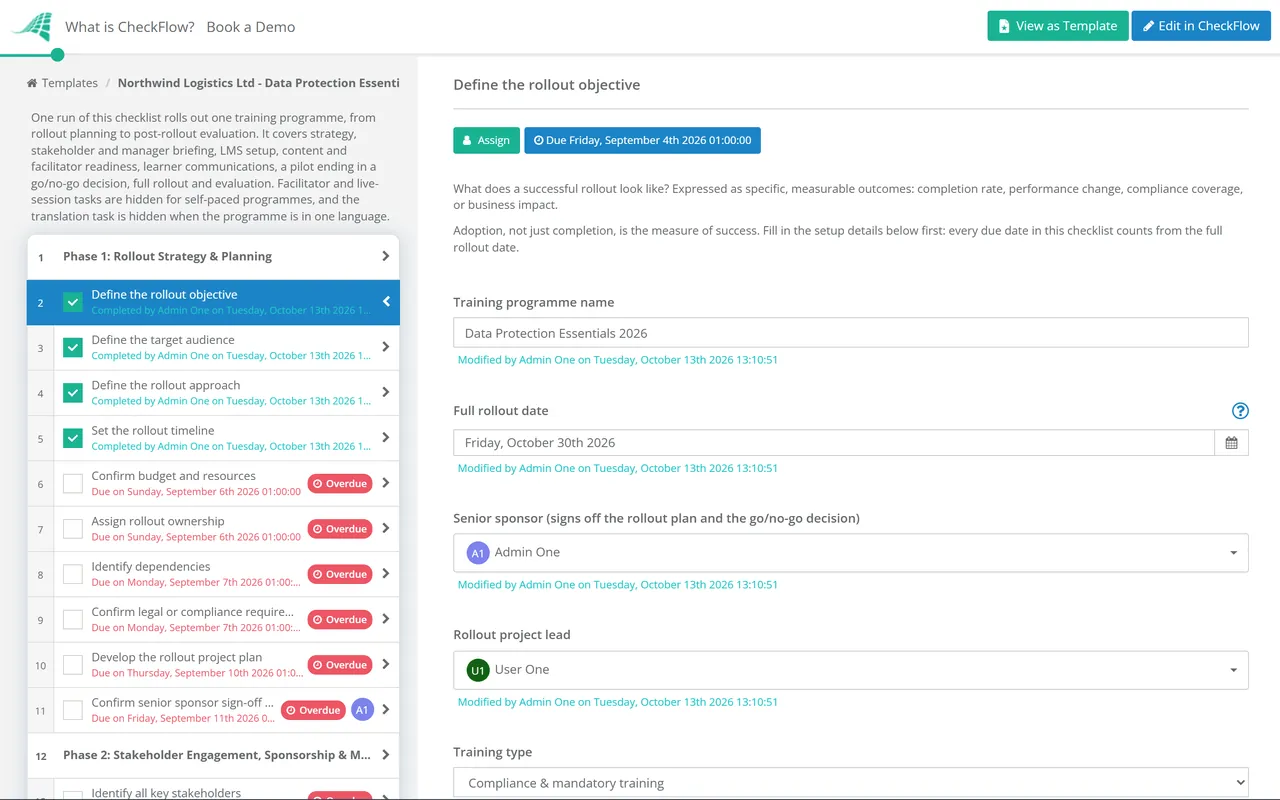
Define the rollout objective — what does a successful rollout look like? Expressed as specific, measurable outcomes: completion rate, performance change, compliance coverage, or business impact
Define the target audience — who must complete this training, who should complete it, and who the training is not intended for; confirm audience segmentation in the LMS or HR system
Define the rollout approach — mandatory or optional; phased or all-at-once; self-paced, instructor-led, or blended; single cohort or rolling intake
Set the rollout timeline — pilot dates, limited launch dates, full rollout date, completion deadline, and evaluation date
Confirm budget and resources — LMS costs, facilitation costs, communications costs, and internal staff time required
Assign rollout ownership — a named project lead responsible for the overall rollout; named owners for each workstream (IT, comms, facilitation, evaluation)
Identify dependencies — anything that must be in place before the rollout can proceed: content finalisation, LMS readiness, stakeholder alignment, or regulatory approvals
Confirm legal or compliance requirements — any mandatory completion deadlines, regulatory evidence requirements, or record-keeping obligations associated with this training
Develop the rollout project plan — written, shared with all workstream owners; milestones, responsibilities, and dependencies documented
Confirm senior sponsor sign-off on the rollout plan — the programme owner and senior stakeholders are aligned before work begins
Manager buy-in is the single most powerful predictor of training completion and behaviour transfer. A manager who does not understand why the training matters will not reinforce it, will not create time for it, and will signal to their team that it is optional in practice even if mandatory in name.
Identify all key stakeholders — senior sponsors, line managers, HR business partners, team leads, and anyone who influences whether learners prioritise the training
Secure visible executive sponsorship — a named senior leader who endorses the programme and is willing to communicate its importance; confirm their involvement in launch communications
Brief line managers in advance of the launch — what the training covers, why it matters, what is expected of learners, the timeline, and how managers should support completion
Equip managers to champion the training — a brief manager guide, talking points, and answers to common questions; make it easy for managers to communicate the value to their teams
Confirm manager expectations — are managers expected to complete the training themselves? To discuss it with their teams? To track their team’s completion? Clarify before launch
Brief HR business partners — confirm they understand the programme, can support manager queries, and know how to escalate concerns
Identify and brief learning champions or early adopters — people in each team or region who will enthusiastically adopt the training first and help others; involve them in the pilot
Communicate the rollout timeline to all stakeholders — everyone should know what is coming and when, with enough lead time to prepare
Confirm any union or works council consultation requirements — where applicable; mandatory training may require consultation in some organisations
Document stakeholder briefing completion — confirm all required stakeholders have been briefed before the pilot launch
Phase 3
Phase 3: LMS & Technical Setup
Confirm the delivery platform — LMS, HRIS, virtual classroom platform, or other; confirm the platform is appropriate for the programme format and audience
Upload and configure the course in the LMS — content uploaded, SCORM/xAPI settings configured, completion criteria defined, and grading or pass marks set correctly
Set up audience enrolment — correct learner groups, roles, or cohorts enrolled; confirm the right people will see the right content
Configure automated notifications — enrolment notifications, deadline reminders, completion confirmations, and any overdue alerts set up and tested
Configure reporting and dashboards — completion tracking, assessment scores, time on task, and any other required reporting available for L&D and manager views
Test the full learner journey in the platform — enrolment, login, navigation, content delivery, assessment, completion recording, and certificate generation (if applicable)
Test on all required devices and browsers — desktop, mobile, and tablet; confirm the experience is acceptable on all devices learners will use
Confirm SSO or authentication — learners can access the programme with their existing credentials; no separate registration required if possible
Configure manager dashboards — line managers can see their team’s completion status; confirm the view is accurate and accessible
Confirm IT support procedures — who handles learner technical issues; what is the support process and response time?
Confirm final content is approved and uploaded — no further changes expected; the version in the platform is the final, approved version
Conduct a final content quality check — all links working, all media playing, all assessments functioning, and no placeholder or draft text remaining
Confirm accessibility compliance — content meets WCAG 2.1 AA or applicable accessibility standard; captions, alt text, and keyboard navigation confirmed
Prepare facilitator guide and materials for any instructor-led components — session plans, slide decks, participant materials, and reference guides
Brief and train facilitators — hands-on rehearsal or walkthrough for any live or virtual instructor-led sessions; confirm all facilitators are confident in the material
Prepare learner support materials — quick-start guide, FAQ document, job aids, or reference materials that support learning transfer
Confirm scheduling for any live sessions — calendar invites sent, meeting links or room bookings confirmed, and attendance tracked
Prepare evaluation instruments — post-training survey, assessment questions, and any follow-up evaluation tools ready before the pilot launches
Confirm translation or localisation is complete — for programmes with multi-language requirements; all language versions tested and approved
Archive the pre-launch version — source files and final approved content version archived; a clear record of what was deployed at launch
Develop the communications plan — what messages, to whom, through which channels, and at what times; confirm the plan is reviewed before the first communication goes out
Send the pre-launch announcement — communicating the training is coming, why it matters, what learners will gain, and when they can expect their enrolment notification
Ensure the “why” is clear in all communications — WIIFM (what’s in it for me?) must be answered for learners; generic compliance messaging without clear personal relevance consistently reduces completion
Send enrolment notifications — clear instructions on how to access the training, the completion deadline, and who to contact with questions
Plan the deadline reminder cadence — automated reminders at defined intervals before the completion deadline; confirm tone is supportive not punitive
Prepare manager completion reports — how and when managers will receive their team’s completion status; confirm they know to follow up with non-completers
Plan for resistance or low engagement — what happens if completion rates are below target in the first two weeks? Confirm an escalation and re-engagement process
Celebrate early completion — acknowledge early adopters and completions; recognition is a low-cost, high-impact adoption driver
Communicate post-training expectations — what should learners do differently after completing the training? Make the behaviour transfer expectation explicit
Confirm communications are accessible — plain language, accessible formats, and any translation requirements addressed
Phase 6
Phase 6: Pilot Launch
Skipping the pilot is the most common and most expensive shortcut in training rollout. A pilot with 50–100 representative learners catches technical issues, content problems, and user experience friction before they affect the full audience — and creates internal champions who accelerate adoption at full launch.
Select the pilot group — a representative sample of 50 to 100 learners from different roles, locations, technical ability levels, and seniority; include at least some likely resisters, not just enthusiasts
Brief the pilot group — confirm they understand they are in the pilot, why their feedback matters, and how to submit it
Launch the pilot — confirm access, monitor technical performance, and track completion in real time
Collect structured pilot feedback — content relevance, technical experience, duration, navigation, and overall experience; gather both survey and interview feedback for depth
Monitor pilot completion rates and drop-off points — where are learners leaving the course? Is there a specific point where engagement drops?
Identify and prioritise issues — distinguish technical bugs (must fix), content improvements (should fix), and minor usability issues (could fix); triage before making changes
Implement pre-launch fixes — address all must-fix issues before full launch; document all changes made between pilot and launch
Gather pilot champions — identify pilot participants who had a positive experience and are willing to share it with colleagues at full launch
Confirm the go/no-go decision — based on pilot outcomes, confirm the programme is ready for full launch or document what must happen first
Document pilot findings — a brief report covering completion rate, key findings, changes made, and the go-launch decision
Phase 7
Phase 7: Full Rollout & Adoption Management
Execute the full launch — all learner communications sent, all enrolments confirmed, and the programme live for the full audience
Monitor completion rates in the first two weeks — early completion rates signal whether communications landed and whether access is working
Identify and escalate teams or regions with significantly low completion — early intervention is more effective than last-minute chasing before the deadline
Support manager-led completion drives — provide managers with their team’s completion status weekly; equip them to have supportive conversations with non-completers
Address technical issues promptly — monitor IT support queries for patterns; resolve systemic issues quickly and communicate the fix to affected learners
Manage exceptions — learners on leave, learners with accessibility requirements, or learners who joined after the rollout start date; confirm processes for each exception type
Track and report completion progress — weekly dashboard updates to the programme sponsor and HR stakeholders
Respond to content or relevance feedback emerging at scale — if the same complaints appear repeatedly at full launch, assess whether a content fix is needed
Confirm compliance evidence is being captured — completion records, assessment scores, and timestamps are all recorded correctly for any regulatory or audit purposes
Confirm post-completion actions are triggered — certificates issued, follow-up resources sent, manager notifications delivered, and any behavioural reinforcement activities activated
Collect and analyse completion data — final completion rate against target, time taken to complete, assessment pass rates, and any notable drop-off patterns
Collect Level 1 evaluation data — learner satisfaction and reaction survey; analyse for actionable insights beyond the headline satisfaction score
Collect Level 2 evaluation data — assessment results and knowledge checks; confirm learners achieved the stated learning objectives
Plan and collect Level 3 evaluation data — behaviour change follow-up 30–90 days post-completion; manager survey or performance data review where feasible
Assess Level 4 outcomes where measurable — has the training contributed to the business outcome it was designed to address?
Produce the rollout report — final completion rate, evaluation findings, lessons learned, and recommendations for the next iteration or similar programme
Brief stakeholders on outcomes — share results with the programme sponsor, HR leadership, and any regulatory body where required
Identify content and process improvements — what should be updated in the content? What should be done differently in the rollout process?
Schedule the next content review — confirm when the programme content will next be reviewed for currency and effectiveness
Archive the complete rollout record — completion data, evaluation findings, communications archive, and the rollout report; available for future cycles and audit purposes
This checklist is available as a free, runnable template in CheckFlow — with tasks assigned across L&D, IT, HR, and communications teams, the pilot phase enforced before full rollout, and completion data and evaluation tracked through to the final rollout report.
Why a Phased Rollout Consistently Outperforms a Big-Bang Launch
Organisations that launch training to the full audience on day one without a pilot consistently experience more technical problems, lower completion rates, and less useful post-launch feedback than those that run a phased process. A phased rollout validates assumptions, catches issues before they affect thousands of learners, and creates internal champions who accelerate adoption at full launch.
Stage 1
Pilot
Who: 50–100 representative learners from different roles, locations, and seniority levels. Include likely resisters, not just enthusiasts.
Purpose: Validate the technical setup, identify content issues, assess the learner experience, and gather evidence for the go/no-go decision.
Duration: 2–4 weeks. Fix all material issues before proceeding.
Output: Pilot report, list of fixes implemented, and confirmed go-launch decision.
Stage 2
Limited Launch
Who: A defined subset of the full audience — one department, one region, or one cohort.
Purpose: Test rollout operations at meaningful scale before full deployment. Validate communications, manager support, and IT capacity under realistic load.
Output: Refined communications, resolved operational issues, and validated readiness for full rollout.
Stage 3
Full Rollout
Who: All intended learners.
Purpose: Deploy the programme to the full audience with confidence that content, technology, communications, and stakeholder support are all in place.
Duration: Defined completion window appropriate to the programme and audience.
Output: Target completion rate achieved, evaluation data collected, and rollout report produced.
CheckFlow’s enforced task order ensures the full rollout phase cannot begin while the pilot phase has outstanding items — the go/no-go confirmation task must be marked complete before full-launch tasks are unlocked.
The Rollout Framework Across Training Types
The same eight-phase rollout framework applies to any training programme type — adapted in emphasis, identical in structure.
Compliance & Mandatory Training
Completion deadlines are often non-negotiable and audit evidence is required. Communications must be unambiguous about what is mandatory and by when. Manager accountability for team completion is typically higher. LMS completion records are the primary regulatory evidence.
New Hire Onboarding Programmes
Phased rollout is replaced by cohort-based rollout — each new intake goes through the same structured programme. Communications integrate with the broader onboarding experience. Completion is typically tracked against the new hire’s first 30, 60, and 90-day milestones.
Leadership & Management Development
Senior stakeholder sponsorship is particularly important — leaders who do not visibly support development programmes signal low priority to participants. Programme design typically combines self-paced and cohort learning. Manager nomination processes require additional planning.
Technical & Skills Training
Role-based audience segmentation is critical — not all employees need all technical training. Manager buy-in to release staff for training time is a practical adoption barrier. Assessment and certification may be integrated into the programme completion.
Culture & Values Programmes
Employee trust in senior leadership authenticity is a key adoption factor — generic messaging delivers low engagement. Executive sponsorship and visible leader participation carry more weight than in other training types. Evaluation should include qualitative as well as quantitative data.
Customer-Facing & Product Knowledge Training
Business impact measurement is more direct — sales performance, customer satisfaction scores, or product adoption rates can serve as Level 4 evaluation data. Launch timing often aligns with product or service releases, adding timeline pressure.
Why Run Your Training Rollout in CheckFlow?
1
Enforce the pilot before the full launch
CheckFlow’s enforced task sequence means full-launch tasks are locked until the pilot phase is complete and the go/no-go decision is documented. The temptation to skip the pilot because the content is good and the timeline is tight is built into every training deployment — CheckFlow removes the ability to act on it.

2
Coordinate L&D, IT, HR, and communications in one process
A training rollout involves L&D (content and evaluation), IT (platform setup and support), HR (audience definition and manager briefing), and communications (campaign and messaging) — all running in parallel across a defined timeline. CheckFlow assigns each workstream to the right team, sends reminders as milestones approach, and gives the project lead a live view of readiness across every workstream before launch.
3
A complete rollout record for compliance and audit
Every task completed in CheckFlow is timestamped and attributed to a named person. The full rollout record — pilot findings, go/no-go decision, communications sent, completion data, evaluation results, and stakeholder reports — builds automatically as the process runs. When a regulatory audit asks for evidence of programme delivery and completion, the record is complete and immediately accessible.
A successful training rollout starts with a well-developed programme. CheckFlow’s New Course Development Checklist covers the full ADDIE process — from needs analysis through design, development, and content sign-off — producing the approved programme that this rollout checklist then deploys. See the New Course Development Checklist →
For L&D teams running regular training cohorts — monthly compliance refreshers, quarterly onboarding programmes, or annual leadership development intakes — CheckFlow’s recurring checklist feature schedules each rollout automatically so the same structured process runs for every cohort without manual setup. Learn more about recurring checklists in CheckFlow →
What is a training program rollout and what does it involve?
+
A training programme rollout is the structured process of deploying a developed training programme to its intended audience — distinct from the development of the content itself. It involves eight phases: rollout strategy and planning (defining objectives, audience, approach, and timeline), stakeholder engagement (securing executive sponsorship and briefing line managers), LMS and technical setup (platform configuration, audience enrolment, and testing), content and facilitation readiness (final quality checks and facilitator preparation), learner communications (building the communications campaign and driving awareness), pilot launch (testing with a representative group and incorporating feedback), full rollout and adoption management (deploying to the full audience with completion tracking and manager support), and post-rollout evaluation (collecting Kirkpatrick Level 1–4 data and producing the rollout report). A well-executed rollout typically takes four to eight weeks from planning to full launch for a standard programme, longer for complex or global deployments.
Why do training programmes fail to achieve high completion rates?
+
Low completion rates almost always trace back to one or more of five root causes. First, unclear communications — learners do not understand why the training matters to them personally, so it is deprioritised. Second, manager disengagement — managers who were not briefed or do not support the programme do not create time for it in their teams’ schedules. Third, access problems — login issues, compatibility problems, or a poor user experience on mobile devices cause learners to abandon early and not return. Fourth, an unrealistic completion window — either too long (causing procrastination) or too short (causing resentment). Fifth, no consequence for non-completion — when nothing happens to non-completers, completion becomes genuinely optional in practice regardless of policy.
What is the difference between a training rollout and a training deployment?
+
Training rollout and training deployment are often used interchangeably and refer to the same process — making a training programme available to its intended audience. In some organisations, “deployment” refers specifically to the technical act of publishing content to an LMS, while “rollout” encompasses the broader operational and communications process of getting learners to engage with and complete it. In the context of this checklist, rollout includes both the technical deployment and all the operational elements that determine whether learners actually complete the training and apply what they have learned.
How should training completion be measured and reported?
+
Training completion should be measured at multiple levels: raw completion rate (percentage of enrolled learners who completed within the defined window), time to completion (how quickly learners are completing after enrolment, which signals engagement quality), assessment pass rate (where assessments are used, the proportion achieving the required score), and drop-off rate by module or section (which identifies where learners are disengaging). For mandatory compliance training, completion records must typically identify each individual learner by name, the date of completion, and the assessment outcome — for regulatory audit purposes. Reporting should be available at three levels: the overall programme view for the L&D team, team-level views for line managers, and individual records for HR and compliance purposes.
Should training rollout be managed differently for global audiences?
+
Global training rollouts require additional planning across several dimensions: translation and localisation (confirming all language versions are complete, tested, and culturally appropriate before launch — not an afterthought), time zone management (ensuring communications and live sessions reach learners at appropriate local times), platform accessibility (confirming the LMS performs adequately on the bandwidth and devices available in each region), local stakeholder engagement (briefing regional HR and team leads in their own language and time zone), and compliance variation (mandatory training requirements and completion documentation standards may differ by jurisdiction). Phased rollout is particularly valuable for global programmes — launching in one or two pilot regions first gives time to identify localisation gaps and platform issues before the full global rollout.
Is CheckFlow free to use for this template?
+
You can start a free 14-day trial with no credit card required, giving you full access to all features including this template. The Business plan is $10 per user per month after the trial. Full details at checkflow.io/pricing.
Launch Training Programmes That Actually Get Completed
Free trial — no credit card required.
Do you like cookies? 🍪 We use cookies to ensure you get the best experience on our website. Learn more