
New Course Development Checklist Template

A structured development framework that builds the design before building the content — and produces a course that actually achieves its learning objectives.

The most expensive mistake in course development is not a production error — it is building the wrong course confidently. Teams that rush from “we need a course on X” directly to content creation, skipping proper needs analysis, learning objectives, and assessment design, produce content that is comprehensive but does not change behaviour, thorough but does not close the skills gap, polished but not aligned to what learners actually need to be able to do differently afterwards. A structured course development process — following the ADDIE framework (Analyze, Design, Develop, Implement, Evaluate) — ensures every development decision is grounded in learner needs, every piece of content serves a defined objective, and every assessment validly measures whether the objectives have been achieved. This free new course development checklist gives educators, instructional designers, and L&D teams a structured framework for developing any course — from university modules to corporate training programmes to eLearning courses.

Use This Template Free See Live Example
No Credit Card Required

Why Most Course Development Problems Start in Phase One — And Are Discovered in Phase Five

Course development problems are rarely discovered during content creation. They are discovered at evaluation — when learner satisfaction scores are low, when post-training performance data shows no change, when the learning outcomes that were promised are not the ones the course actually delivered. By that point, the course has been fully built, often deployed, and the rework cost is significant. The root cause is almost always in Phase One: an incomplete needs analysis that produced learning objectives disconnected from real performance gaps; a target audience that was assumed rather than investigated; a delivery modality chosen for convenience rather than appropriateness.

The ADDIE model — Analyze, Design, Develop, Implement, Evaluate — exists precisely to prevent this pattern. Each phase has defined outputs that must be completed before the next begins. Analysis produces the evidence base for design decisions. Design produces the blueprint that guides development. Development produces the content that the analysis and design justified. Implementation produces the evidence for evaluation. Evaluation informs the next iteration. A course developed in this sequence consistently outperforms one built by instinct — regardless of the subject matter expertise of the developer.

What the New Course Development Checklist Covers

This checklist maps to the five phases of the ADDIE model — the most widely used instructional design framework in higher education and corporate L&D. Each phase has defined inputs, activities, and outputs that must be completed before the next phase begins.

Analyze

Phase 1: Needs Analysis & Learning Environment Assessment

The analysis phase is the investment that makes everything else more efficient. Teams that rush past analysis build courses that solve the wrong problem well. Spend adequate time here — it prevents rework at every subsequent phase.

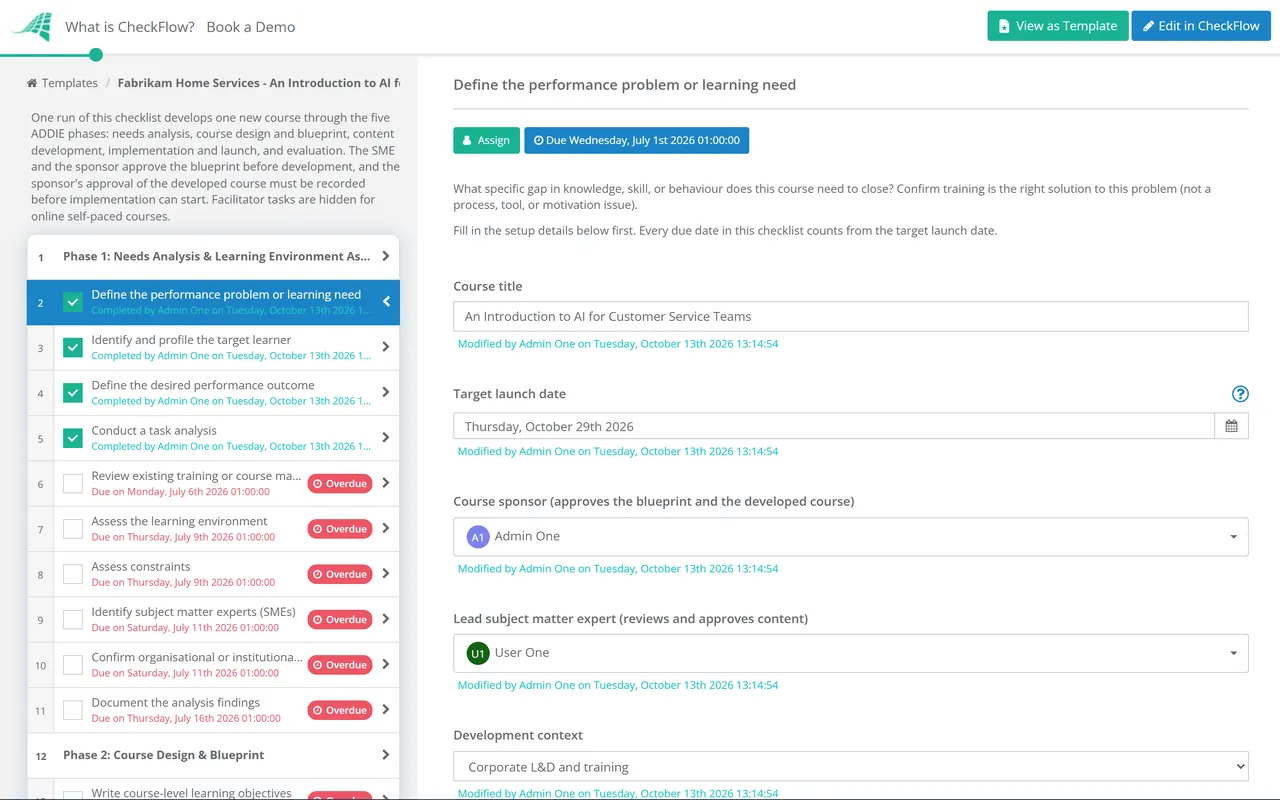
  • Define the performance problem or learning need — what specific gap in knowledge, skill, or behaviour does this course need to close? Confirm training is the right solution to this problem (not a process, tool, or motivation issue)
  • Identify and profile the target learner — prior knowledge and experience, learning context, technology access, accessibility needs, and any relevant demographic or situational characteristics
  • Define the desired performance outcome — what should learners be able to do differently as a result of completing this course? Expressed as observable, measurable behaviour, not content coverage
  • Conduct a task analysis — break down the desired performance into the component tasks, knowledge, and skills that must be addressed by the course
  • Review existing training or course materials on this topic — what already exists? Can it be adapted? Is there a gap in the existing provision?
  • Assess the learning environment — where and how will learning take place? Face-to-face, online, blended, on-the-job, or self-paced? What technology is available?
  • Assess constraints — budget, timeline, development resources, SME availability, LMS or technology platform, and any mandatory content requirements
  • Identify subject matter experts (SMEs) — who will provide or validate content? Confirm their availability and the process for engaging them
  • Confirm organisational or institutional requirements — any mandatory inclusions, regulatory requirements, style guides, or approval processes that will affect the course
  • Document the analysis findings — a written summary that will serve as the reference document for all subsequent design decisions
Design

Phase 2: Course Design & Blueprint

Design is the blueprint phase. Every content and production decision in Phase 3 should be traceable to a design decision made here. If it cannot be traced, question whether it belongs in the course.

  • Write course-level learning objectives — using a clear taxonomy (Bloom’s is widely used); confirm each objective is specific, measurable, achievable, relevant, and time-bound; objectives drive all subsequent design decisions
  • Write module or unit-level learning objectives — breaking down the course-level objectives into the component outcomes for each section of the course
  • Design assessments using backward design — before designing content, design the assessments that will measure whether learners have achieved each objective; confirm assessment validity (does it measure what the objective requires?)
  • Select the instructional strategy — what approach will be used to help learners achieve each objective? Lecture, case study, practice and feedback, simulation, problem-based learning, social learning, or a combination?
  • Design the course structure — number of modules or units, sequence, estimated duration, and the logic of progression through the course
  • Select the delivery modality and media — confirm the mix of media types (text, video, audio, interactive, simulation, live session) appropriate for each learning objective
  • Develop the course blueprint or storyboard — a document outlining the complete structure, content outline, assessment design, and media plan for the full course
  • Obtain SME review and approval of the course blueprint — confirm content accuracy and completeness at the design stage, before development resources are invested
  • Obtain stakeholder or sponsor approval of the blueprint — confirm the course design meets the original brief before development begins
  • Confirm the style guide and branding — visual design standards, voice and tone, terminology, and any institutional or organisational branding requirements
Develop

Phase 3: Content Development & Production

  • Develop content following the approved blueprint — write scripts, develop slides, create exercises, and produce any supplementary materials in accordance with the approved design
  • Engage SMEs throughout content development — confirm accuracy of all technical, professional, or subject-specific content; document SME review and approval for each section
  • Apply AI tools where appropriate — AI tools can assist with first draft content, scenario generation, image creation, and translation; confirm all AI-generated content is reviewed for accuracy, appropriateness, brand alignment, and bias before inclusion
  • Produce multimedia elements — videos, audio, graphics, and interactive elements in accordance with the media plan and quality standards
  • Build the course in the LMS or authoring tool — structure the course in the delivery platform; configure navigation, completion tracking, and grading as specified
  • Build assessments in the platform — confirm all assessment items are correctly configured, scored, and aligned to the learning objectives
  • Apply accessibility standards throughout development — alt text for all images, captions for all video, sufficient colour contrast, keyboard navigability, and screen reader compatibility; WCAG 2.1 AA is the widely accepted standard for online content
  • Conduct internal quality review — review all content against the blueprint and learning objectives before SME or stakeholder review; check for factual accuracy, spelling, grammar, and alignment to the design
  • Conduct SME content review — structured review of completed content for accuracy and completeness; document all feedback and revisions
  • Obtain final stakeholder approval of the developed course before implementation — confirm that the developed course meets the design brief and quality standards
Implement

Phase 4: Implementation & Launch

  • Conduct a technical review of the course in the live or staging environment — test all links, media playback, assessments, completion tracking, and grading on all intended devices and browsers
  • Test the full learner journey — complete the course as a learner would; confirm navigation, progress tracking, assessment submission, and completion record all function correctly
  • Test accessibility in the live environment — run accessibility checking tools and test with keyboard navigation and a screen reader; do not rely solely on the development-stage check
  • Prepare facilitator or instructor materials where applicable — facilitator guide, session plan, and any supporting materials for instructor-led components
  • Brief facilitators or instructors — confirm all delivery staff are fully briefed on the course objectives, content, assessment approach, and any known learner support considerations
  • Prepare learner communications — enrolment notifications, course introduction materials, access instructions, and any pre-course preparation guidance
  • Conduct a pilot delivery — run the course with a small representative group of learners before full launch; collect feedback on content, usability, duration, and learning experience
  • Review pilot feedback and make final revisions — address all material issues identified in the pilot before full launch
  • Launch the full course — confirm enrolment, access, and any launch communications are complete
  • Confirm LMS data and reporting are functioning — completion records, assessment scores, and any xAPI or SCORM reporting are capturing data correctly from the first real deliveries
Evaluate

Phase 5: Evaluation & Continuous Improvement

Evaluation is not the end of the development process — it is the beginning of the next iteration. A course that is never evaluated is a course that never improves.

  • Collect Level 1 evaluation data — learner reaction; satisfaction surveys completed at or immediately after the course; confirm survey questions are designed to generate actionable data, not just a rating
  • Collect Level 2 evaluation data — learning; assessment results and pre/post knowledge checks; confirm learners achieved the stated learning objectives
  • Collect Level 3 evaluation data where feasible — behaviour change; are learners applying what they learned in their work or academic context? Gather manager or supervisor feedback 30–90 days after completion
  • Collect Level 4 evaluation data where measurable — results; is there evidence that the course contributed to the organisational or educational outcome it was designed to address?
  • Review completion and engagement data — completion rates, time on task, drop-off points, and assessment attempt patterns; identify any course sections where learner engagement is unexpectedly low
  • Analyse assessment results — which questions or assessments are too easy, too hard, or poorly discriminating? Is there evidence that specific learning objectives are not being achieved?
  • Gather facilitator or instructor feedback — what is working well, what is difficult to facilitate, and where does the course need strengthening?
  • Identify course maintenance requirements — content that will become outdated and needs scheduled review; confirm a content review date is set
  • Prioritise and implement revisions — address any material issues from evaluation data; document all changes made and the rationale
  • Archive the complete development record — needs analysis, design documents, SME review records, approval history, and evaluation data; available for future course updates and quality assurance purposes

This checklist is available as a free, runnable template in CheckFlow — with tasks assigned to instructional designers, SMEs, content developers, and LMS administrators, development phases enforced in sequence, and every approval and review logged for the course development record.

Use This Template Free

The ADDIE Model — What Each Phase Produces

The ADDIE model is the most widely used instructional design framework in higher education and corporate L&D. Each phase has a defined output that feeds the next.

Analyze

What problem are we solving and for whom?

Output: Needs analysis report — documenting the performance gap, target audience profile, learning environment, constraints, and desired performance outcome.

Common mistake: Assuming the problem without investigating it. Building a course because a topic exists, not because a specific gap has been identified.

Design

What will learners be able to do, and how will we help them?

Output: Course blueprint — learning objectives, assessment design, instructional strategy, course structure, media plan, and approved storyboard.

Common mistake: Writing content outlines instead of learning objectives. Describing topics covered rather than performance outcomes achieved.

Develop

How do we build what the design specifies?

Output: Fully developed and reviewed course — content, assessments, media, and LMS configuration; approved by SMEs and stakeholders.

Common mistake: Starting development before design is approved. Building content based on SME expertise rather than the design blueprint.

Implement

How do we deliver this course effectively?

Output: Launched course — technically tested, accessible, pilot-refined, and live for learners.

Common mistake: Skipping the pilot. Discovering technical, usability, or content issues during the first full delivery rather than before it.

Evaluate

Did it work — and how do we make it better?

Output: Evaluation report — Kirkpatrick Level 1–4 data, engagement analytics, identified improvements, and a revised or confirmed course.

Common mistake: Collecting Level 1 satisfaction data only and treating it as evaluation. Not connecting course outcomes to performance data.

ADDIE is iterative, not linear. Evaluation findings from Phase 5 feed directly into Phase 1 of the next development cycle — either for a course update or for planning the next related course.

New Course Development Across Different Contexts

Higher Education Faculty

Developing a new university course or module — from learning outcome design through assessment development, content creation, and LMS setup. Particularly useful for online and blended learning course development where the technical and accessibility requirements add complexity.

Corporate L&D & Training Teams

Developing new training programmes for employee onboarding, skills development, compliance training, or leadership development. The needs analysis phase is particularly valuable for ensuring training addresses real performance gaps rather than assumed knowledge needs.

Instructional Designers

Running a structured client engagement or internal project from brief through delivery. The blueprint approval checkpoint and the SME review process are particularly valuable for managing scope and quality on complex multi-stakeholder development projects.

eLearning & Online Course Creators

Developing online courses for commercial or institutional distribution. The accessibility, technical testing, and LMS setup phases are most relevant; the evaluation phase is critical for improving course completion and satisfaction rates post-launch.

Vocational & Professional Training Providers

Developing new qualifications or short courses aligned to occupational standards or employer requirements. The analysis phase — particularly task analysis and SME identification — is typically the most resource-intensive in this context.

Regulatory & Compliance Training

Developing mandatory training on regulatory requirements, safety procedures, or compliance obligations. The assessment design and evidence of completion phases are critical for meeting regulatory evidence requirements.

Why Run Course Development in CheckFlow?

1

Enforce the design before the development starts

The most expensive rework in course development happens when content is built before the design is approved. CheckFlow’s enforced task sequence means development tasks cannot be started while design approval is outstanding — the blueprint must be signed off before content creation begins. The process disciplines that experienced instructional designers apply instinctively become built into the checklist for every developer regardless of experience.

2

Coordinate SMEs, designers, and developers simultaneously

Course development involves instructional designers, subject matter experts, content writers, media producers, LMS administrators, and accessibility specialists — often working on different elements at the same time. CheckFlow assigns each workstream to the right person, notifies them when their contribution is needed, and gives the project lead a live view of what is complete and what is blocking progress.

3

A documented development record for quality assurance

Every approval, review, and revision in CheckFlow is logged with a timestamp and the name of the responsible person. When a quality assurance review, accreditation audit, or post-launch evaluation asks how the course was developed, the full record is already there — needs analysis findings, blueprint approvals, SME sign-offs, accessibility checks, and pilot feedback.

New course development is the beginning of a course’s life — not the end of your involvement with it. Once a course is live, it needs periodic review and update to remain current and effective. CheckFlow’s Curriculum Review Process Checklist provides the structured framework for evaluating and improving existing courses on a defined cycle. See the Curriculum Review Process Checklist →

For L&D teams developing multiple courses simultaneously, CheckFlow’s grid dashboard shows every active development project’s phase and status in one view — which courses are in analysis, which are in development, and which are awaiting stakeholder approval — without clicking into each project individually. See how CheckFlow handles multi-project visibility →

Frequently Asked Questions

What is the ADDIE model and why is it used for course development?

+

ADDIE is the most widely used instructional design framework, originally developed for the US Military by Florida State University in the 1970s and now standard across higher education and corporate L&D. It is an acronym for the five phases of the course development process: Analyze (define the problem, audience, and desired outcomes), Design (write learning objectives, design assessments, and create the course blueprint), Develop (build the content and configure the delivery platform), Implement (pilot, refine, and launch), and Evaluate (assess whether the course achieved its objectives and improve accordingly). The model is valued because each phase produces outputs that feed the next, creating a logical, evidence-based development sequence that consistently produces better courses than instinct-driven development.

What is the most common mistake in course development?

+

Starting content development before completing analysis and design. The pressure to produce visible output — slides, video scripts, activities — pushes development teams to skip or rush needs analysis and design in favour of content creation. The result is content that is often accurate, comprehensive, and well-produced, but misaligned with what learners actually need to be able to do differently. The investment of time in analysis (confirming the problem and audience) and design (writing clear learning objectives and assessment designs) before any content is created consistently reduces total development time and rework, because the content that is built has a clear, validated purpose.

What are learning objectives and how should they be written?

+

Learning objectives are specific, measurable statements of what learners will be able to do as a result of completing a course or module. Effective learning objectives describe an observable performance — not a topic covered, not a feeling, not a vague aspiration. Bloom’s Taxonomy provides a widely used framework for writing objectives at different cognitive levels: remember, understand, apply, analyse, evaluate, and create. A well-written objective begins with an active verb that describes a specific behaviour: “apply the five-step performance review framework in a live conversation” is a learning objective; “understand performance management” is not. Every content, activity, and assessment decision in the course should be traceable to at least one learning objective.

How should AI tools be used in course development?

+

AI tools are increasingly used in course development for first-draft content generation, scenario and case study creation, image and graphic generation, translation and localisation, and assessment item drafting. They can significantly accelerate the development phase when used well. Three principles apply when using AI in course development: AI-generated content must always be reviewed by a subject matter expert for accuracy — AI tools generate plausible content, not necessarily correct content; all AI-generated content must be reviewed for alignment with the learning objectives and the course blueprint, not accepted as-is; and AI-generated content should be reviewed for bias, stereotyping, and cultural appropriateness before inclusion. AI accelerates production; it does not replace the analysis, design, or quality review that makes content effective.

What is accessibility in online course development and why does it matter?

+

Accessibility in online course development means designing and building course content so it can be used by learners with a range of disabilities — including visual, auditory, motor, and cognitive impairments. The Web Content Accessibility Guidelines (WCAG) 2.1 AA level is the widely accepted standard for online educational content and a legal requirement in many jurisdictions. Key requirements include: text alternatives (alt text) for all meaningful images; accurate captions or transcripts for all audio and video content; sufficient colour contrast for text and interface elements; keyboard navigability for all course interactions; and compatibility with screen readers. Accessibility is significantly easier and less costly to build in during development than to retrofit after a course is launched — making it a Phase 3 checklist item, not an afterthought.

Is CheckFlow free to use for this template?

+

You can start a free 14-day trial with no credit card required, giving you full access to all features including this template. The Business plan is $10 per user per month after the trial. Full details at checkflow.io/pricing.

Build Courses That Actually Achieve Their Learning Objectives

Free trial — no credit card required.