School Safeguarding Audit Checklist Template

A safeguarding audit is only as good as the evidence behind each answer: a policy reviewed on paper but never read by staff, a single central record with one date missing, a filtering review nobody wrote down. This checklist asks for that evidence and ends with the governing body’s decision.

Last reviewed: October 2026

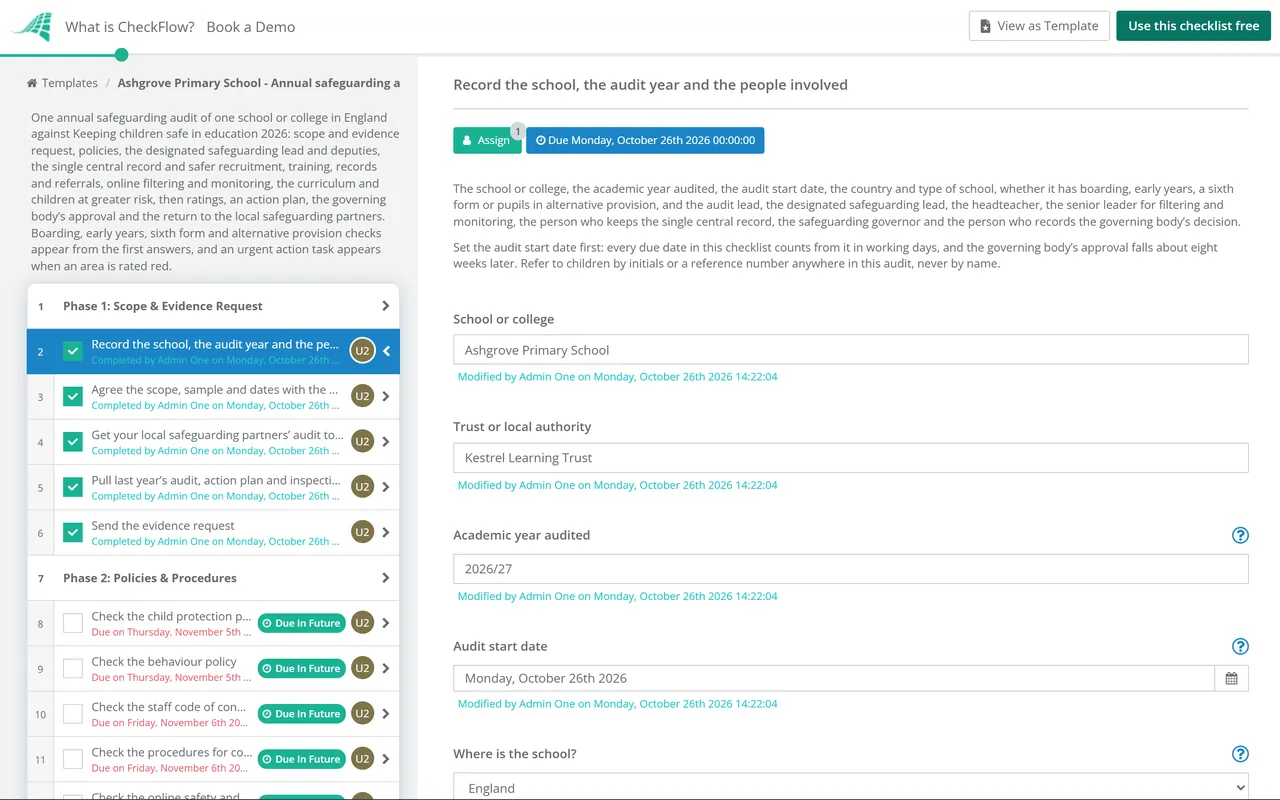
This free school safeguarding audit checklist is for designated safeguarding leads, headteachers, safeguarding governors and trust safeguarding leads in England. One run is one annual audit of one school or college against Keeping children safe in education (KCSIE) 2026, the edition in force since 1 September 2026. It plans the audit and requests the evidence, then checks the policies, the designated safeguarding lead and deputies, the single central record and safer recruitment, training and induction, child protection records and referrals, online filtering and monitoring, the curriculum, support for children at greater risk, and the governing body’s oversight. It ends with ratings, an action plan, the governing body’s approval and the follow-up. Answers on the first task add checks for boarding, early years, a sixth form and alternative provision, and notes for your type of school. It helps you complete the safeguarding self-assessment your local safeguarding partners ask for, often called a section 175 or section 157 audit, but it is not that form.

An Annual Safeguarding Audit Checks the Whole School, Not One Appointment

A safeguarding audit looks at how the whole school keeps children safe across one academic year. It reads the policies, checks the designated safeguarding lead’s role and cover, samples the single central record and child protection files, tests the filtering and asks whether staff and governors were trained. Working Together to Safeguard Children 2026 (paragraph 83) expects schools to respond to the “safeguarding audits of quality and compliance” their local authority or safeguarding partners ask for, and to report their audits to their governing bodies and proprietors. This template runs that audit; the local partners’ own form is where its answers go.

It sits beside two other education templates. The Teacher Onboarding Workflow Checklist carries out the pre-appointment checks and induction for one new teacher, which this audit then samples. The Education Accreditation Preparation Checklist prepares the evidence for an external review against an accreditor’s standards.

Safeguarding audit

Checks the whole school’s safeguarding once a year

Asks: do our policies, people, records and systems keep children safe as KCSIE 2026 expects?

When: once a year, and when the local safeguarding partners ask for their self-assessment.

Output: findings by area, an action plan with owners and the governing body’s approval.

Teacher onboarding

Checks and inducts one new teacher

Asks: has this new teacher been checked, trained and supported before and after their first day?

When: for each new appointment.

Output: completed pre-appointment checks, a single central record entry and an induction record.

Accreditation preparation

Prepares for an external review

Asks: can we show an accreditor that we meet its standards?

When: ahead of an accreditation or re-accreditation visit.

Output: a self-study, organised evidence and a response to the review.

What the School Safeguarding Audit Checklist Covers

Nine phases take one school’s annual safeguarding audit from the evidence request to the governing body’s approval and the follow-up. Phases 2 to 8 follow the areas KCSIE 2026 covers, from the policies and the designated safeguarding lead to the single central record, training, records, online safety and the curriculum. Answers on the first task add the boarding, early years, sixth form and alternative provision checks, and notes for your type of school. An area rated red adds an urgent action before the approval.

  1. Phase 1

    Phase 1: Scope & Evidence Request

    5 tasks

    Agree what the audit covers, find out what your local safeguarding partners ask for, and request the evidence before the review starts. Answer the questions on the first task first: they add the checks for boarding, early years, a sixth form and alternative provision, and the notes for your type of school and country. Every due date counts from the audit start date.

    • Record the school, the audit year and the people involved — the school or college, the academic year audited, the audit start date, the country and type of school, whether it has boarding, early years, a sixth form or pupils in alternative provision, and the audit lead, the designated safeguarding lead, the headteacher, the senior leader for filtering and monitoring, the person who keeps the single central record, the safeguarding governor and the person who records the governing body’s decision
    • Agree the scope, sample and dates with the headteacher — which areas the audit covers, how many staff records and child protection files to sample, which staff and pupils to talk to, when the evidence will be reviewed, and the governing body meeting that will receive the report
    • Get your local safeguarding partners’ audit tool and deadline — the safeguarding self-assessment your local authority or local safeguarding partners ask schools to complete, often called a section 175 or section 157 audit, its sections, how to return it and the date it is due
    • Pull last year’s audit, action plan and inspection findings — which actions were closed, which are still open, what the last inspection report said about safeguarding, and any feedback from the local authority or trust on last year’s return
    • Send the evidence request — a dated list to the designated safeguarding lead, the person who keeps the single central record and the senior leader for filtering and monitoring: the policies, training records, the single central record, recent recruitment files, the child protection file sample, the filtering and monitoring review, governor training records and minutes
  2. Phase 2

    Phase 2: Policies & Procedures

    6 tasks

    Check that each policy KCSIE asks for exists, says what it should, was reviewed when it should have been, and reached staff. KCSIE 2026 paragraph 123 lists the policies, and paragraph 124 says they go to all staff at induction with Part one of KCSIE and the name of the designated safeguarding lead.

    • Check the child protection policy — reviewed at least once a year and updated if needed, published on the website or by other means, in line with the local safeguarding partners’ arrangements and local criteria for action, and covering child-on-child abuse, how children report concerns, online safety with filtering and monitoring, and children with special educational needs and disabilities
    • Check the behaviour policy — in place, with measures to prevent bullying, including cyberbullying and prejudice-based and discriminatory bullying, and alongside a policy on physical contact and the use of reasonable force that lets staff act when they need to
    • Check the staff code of conduct — covering low-level concerns, allegations against staff and whistleblowing, acceptable use of technology including mobile devices, and relationships and communications between staff and pupils, including social media
    • Check the procedures for concerns and allegations about staff — how staff report a concern or allegation about another adult, including supply staff, trainee teachers, volunteers and contractors, how low-level concerns are shared and recorded, when the local authority designated officer (LADO) is consulted, and the duty to refer to the Disclosure and Barring Service and to consider a referral to the Teaching Regulation Agency
    • Check the online safety and mobile phone policies — online safety reflected in the child protection policy, using the four areas of risk (content, contact, conduct and commerce) and including filtering and monitoring on school devices and networks, and a mobile phone policy that makes the school phone-free by default during the school day
    • Check arrangements for children absent from education — how the school responds to children absent for long periods or repeatedly and to children missing education, how it works with children’s social care when absence is a safeguarding concern, and whether it holds more than one emergency contact for each pupil where it can
  3. Phase 3

    Phase 3: Leadership & the Designated Safeguarding Lead

    5 tasks

    The designated safeguarding lead (DSL) takes lead responsibility for safeguarding and child protection, including online safety and understanding the filtering and monitoring systems. KCSIE 2026 adds an expectation of dependable cover for times when the DSL is unavailable.

    • Check the DSL’s appointment and job description — a senior member of the leadership team, never the proprietor, with lead responsibility for safeguarding and child protection, including online safety and filtering and monitoring, written into their job description, and given the time, funding, training, resources and support the role needs
    • Check the deputy DSLs — how many deputies there are, that each is trained to the same standard as the DSL, that the role is in each deputy’s job description, and that lead responsibility stays with the DSL
    • Check cover when the DSL is unavailable — a DSL or deputy available during school hours in term time, cover arranged for out-of-hours and out-of-term activities, and a clear, known arrangement for illness and leave, such as a confidential shared mailbox, so concerns are received, monitored and acted on without delay
    • Check DSL and deputy training is in date — formal training updated at least every two years, Prevent awareness training, and knowledge refreshed at least once a year, for example through bulletins, meetings with other DSLs or reading safeguarding updates
    • Check the designated teacher for looked-after children — a designated teacher for looked-after and previously looked-after children, working with the DSL and the Virtual School Head, and the DSL knowing which children have or have had a social worker
  4. Phase 4

    Phase 4: Single Central Record & Safer Recruitment

    7 tasks

    The single central record shows the pre-appointment checks for everyone it must cover and the date of each check. Sample it, then follow recent appointments from advert to start date. Since 1 September 2026 more volunteers are in regulated activity. If a check finds a child at risk now, such as a missing barred list check for someone working with children, tell the headteacher and the designated safeguarding lead the same day; do not wait for the ratings.

    • Sample the single central record — for each person sampled, an identity check, an enhanced DBS check with children’s barred list information, a separate barred list check where someone started before their certificate arrived, a prohibition from teaching check, checks for anyone who has lived or worked outside the UK, professional qualifications where required and the right to work in the UK, each with the date it was done
    • Check who the single central record covers — all staff, including agency and supply staff even if they work for one day and trainee teachers on salaried routes, with the details of anyone who has left removed, and for academies and independent schools the members and trustees or the proprietor body
    • Check agency and supply staff confirmations — for each agency or third-party supply worker, written confirmation that the agency carried out the checks, the date it was received and whether details of an enhanced DBS certificate were provided, and a check on arrival that the person is the one the checks were made on
    • Check safer recruitment training — everyone involved in recruiting staff to work with children trained in safer recruitment, covering at least Part three of KCSIE, and in maintained schools and pupil referral units at least one person on every interview panel trained, as the regulations require
    • Follow a sample of recent appointments from advert to start — the advert’s safeguarding statement, an application form rather than a CV alone, the self-declaration at shortlisting, references, an online search with shortlisted candidates told it may happen, the interview, an offer conditional on the checks, and every check done before the start date
    • Check volunteers against the 2026 regulated activity rules — every volunteer who teaches, trains, instructs or supervises children frequently, on more than 3 days in a 30-day period or overnight now treated as in regulated activity, with an enhanced DBS check with children’s barred list information, existing volunteers’ barred list status checked, and a recorded risk assessment for every other volunteer
    • Check contractors, governors and visitors — contractors checked at the level their work needs and identified on arrival, the enhanced DBS checks maintained school governors need, section 128 checks on governors, and professional visitors’ identity checked with their DBS checks confirmed by their employer
  5. Phase 5

    Phase 5: Training & Induction

    4 tasks

    Everyone who works in the school needs safeguarding training at induction and regular updates, and governors need training too. KCSIE 2026 now asks that staff who do not work directly with children also read Part one.

    • Check staff have read Part one of KCSIE 2026 — a record that every member of staff read Part one of the 2026 edition, including staff who do not work directly with children, and a short conversation with a sample of staff about who the DSL is, what they would do if a child told them something worrying and how they would report a concern about another adult
    • Check induction covers safeguarding — the child protection policy, the behaviour policy, the staff code of conduct, the arrangements for children absent from education, Part one of KCSIE and who the DSL and deputies are, given to every new member of staff, with proportionate information for temporary staff, volunteers and contractors
    • Check safeguarding training and updates for all staff — training at induction that includes online safety and each person’s part in filtering and monitoring, regularly updated, plus safeguarding updates at least once a year, in line with any advice from the local safeguarding partners
    • Check governor and trustee training — every governor or trustee trained in safeguarding and child protection, including online safety, at induction, with training updated regularly, so they can challenge and test whether the school’s policies and procedures work
  6. Phase 6

    Phase 6: Records, Referrals & Information Sharing

    6 tasks

    Read a sample of child protection files and recent referrals with the DSL. Leave the files in the school’s own secure system and refer to children by initials or a reference in this audit. If a check finds a child at risk now, such as a referral that was never made, tell the headteacher and the designated safeguarding lead the same day; do not wait for the ratings.

    • Sample child protection files — a separate file for each child, kept up to date and stored securely, with a clear summary of each concern, how it was followed up and resolved, the actions, decisions and outcome, written factually so observed concerns, professional opinion and historic information can be told apart, and seen only by those who need to
    • Check referrals were made and followed up — referrals to children’s social care, the police or the Channel programme made in line with the local criteria for action, the outcome followed up and recorded, and local escalation procedures used when a child’s situation did not improve
    • Check child protection files moved in and out on time — files for leavers sent within 5 days for an in-year move or within the first 5 days of a new term, separately from the main pupil file, securely, with a structured summary and confirmation of receipt, and files received reviewed by a trained member of staff
    • Check information-sharing arrangements — clear processes for sharing information within the school and with children’s social care and other agencies, staff knowing they can share special category data without consent to keep a child safe, and the school knowing how to handle a subject access request where the serious harm test is met
    • Check child-on-child abuse records and support — each report recorded, investigated and dealt with as the policy says, support recorded for every child involved, any pattern looked into, and every incident of making or sharing nudes or semi-nudes given a safeguarding response, whether consensual or not
    • Check low-level concern and allegation records — low-level concerns recorded in writing with the concern, its context and the action taken, reviewed for patterns, the LADO consulted when in doubt, and allegations against staff managed and recorded as Part four of KCSIE says
  7. Phase 7

    Phase 7: Online Safety, Filtering & Monitoring

    5 tasks

    KCSIE 2026 asks governing bodies and proprietors to make sure filtering and monitoring is reviewed at least once every academic year, by the senior leader responsible with the DSL and IT support, with checks that filtering works on every internet-connected device in every relevant location and a record of those checks. The DfE filtering and monitoring standards set out how.

    • Check who is responsible for filtering and monitoring — a member of the senior leadership team and a governor named as responsible for meeting the standards, the DSL’s lead on online safety written into their role, and IT staff or the provider clear on what they maintain and report
    • Check the annual filtering and monitoring review — done this academic year by the senior leader responsible with the DSL and IT support, covering current provision, gaps and the needs of pupils and staff, with checks that filtering works on every internet-connected device in every relevant location, and a record of the checks and actions
    • Test that filtering blocks harmful content — a test on a sample of devices, locations and user groups that the filtering blocks at least illegal child abuse material, unlawful terrorist content and adult content, without blocking what teaching needs
    • Check monitoring reports reach the DSL and are acted on — how pupils’ use of school devices is monitored, at least weekly reports highlighting incidents and immediate reports of high-risk incidents going to the DSL, and what was done about recent alerts
    • Check the online safety review, AI use and cyber security — an annual review of the school’s approach to online safety backed by a risk assessment, safe use of any generative AI tools staff or pupils use, and cyber security measures checked against the DfE cyber security standards for schools and colleges
  8. Phase 8

    Phase 8: Curriculum, Children at Greater Risk & Other Provision

    8 tasks

    Check what children are taught and how they can tell someone they are worried, then the support for children at greater risk and the activities run by others on the site. The boarding, early years, sixth form and alternative provision checks appear from the answers on the first task.

    • Check children are taught how to keep safe, including online — relationships education or relationships, sex and health education taught as the statutory guidance (revised for September 2026) says, covering healthy relationships, consent, how to report concerns and online harms such as sharing images, deepfakes and misogynistic influencers, at a stage that suits each child
    • Check children know how to report a concern — reporting routes that are well promoted, easy to understand and easy to use, asked about with a sample of pupils, and children’s wishes and feelings taken into account when action is decided
    • Check support for children at greater risk of harm — children with a social worker, looked-after and previously looked-after children, children with special educational needs and disabilities, young carers, children with medical conditions and children who need mental health support identified, with their support recorded and the DSL working with the senior mental health lead
    • Check lettings and activities run by other organisations — for each organisation that hires or uses the premises, assurance that it has safeguarding policies and procedures, safeguarding requirements written into the hire agreement as a condition of use, and a way for it to liaise with the school
    • Check alternative provision placements — shown when pupils are placed in alternative provision: written confirmation from each provider that its staff have been checked and that it will report changes that may put a child at risk, the address of every site each child attends, and each placement reviewed at least half termly
    • Check boarding or residential safeguarding — shown when the school has boarding or residential provision: the National Minimum Standards for the setting met, the extra vulnerabilities of boarders with special educational needs and disabilities considered, the DSL working with the host local authority and any placing authorities, and sleeping arrangements that follow KCSIE 2026
    • Check early years safeguarding requirements — shown when the school has early years provision or wraparound care: section 3 of the EYFS statutory framework followed alongside KCSIE, no staff member or volunteer starting in the early years setting until their enhanced DBS certificate with barred list information has arrived, and childcare disqualification checks for staff working in or managing that provision
    • Check sixth form and post-16 safeguarding — shown when the school has a sixth form or post-16 students: students under 18 treated as children for safeguarding, work experience providers checked for policies to protect children, and DBS checks considered for students aged 16 or over whose work experience in a school gives them contact with children
  9. Phase 9

    Phase 9: Findings, Governing Body Sign-off & Follow-up

    9 tasks

    Rate each area the same way every year so the results can be compared. A red finding adds an urgent action before the sign-off. The governing body, trust board or proprietor approves the audit and the action plan, and nothing after the approval can be completed until the decision is recorded.

    • Check the governing body’s oversight of safeguarding — a senior board-level lead for safeguarding, governors who know the local safeguarding arrangements and their duties under the Human Rights Act 1998, the Equality Act 2010 and the Public Sector Equality Duty, and minutes showing they challenged and tested the safeguarding reports they received
    • Rate each area and the overall result — each area rated green, amber or red from its findings, with a short reason, and an overall rating; any area rated red adds the urgent action task
    • Take urgent action on red findings before sign-off — shown when an area is rated red: for each red finding, what was done straight away to keep children safe, who did it and when, and the headteacher and the safeguarding governor told before the report goes to the governing body
    • Write the action plan with owners and dates — one action for each finding that was partly met or not met, with the area, who will do it and by when, the most serious first
    • Write the audit report and fill in the local self-assessment — what was audited and sampled, what works well, the ratings, the action plan and anything not checked and why, with the answers copied into your local safeguarding partners’ self-assessment ready for approval
    • Present the audit to the governing body — the report, the action plan and the draft self-assessment taken to the governing body, trust board or proprietor, with the DSL there to answer questions
    • Governing body approves the audit and the action plan — Approved, Approved with changes or Not approved, with the date of the meeting and any changes or reasons recorded
    • Return the self-assessment to the local safeguarding partners — the approved answers sent in the form and by the date your local authority or safeguarding partners asked for, with a copy kept with this audit
    • Share the outcome, track the actions and set the next audit — what the audit found and what changes shared with staff, each owner given their actions, progress reported to the governing body each term until every action is closed, and the start date of next year’s audit set

The Law and Guidance Behind a School Safeguarding Audit

These are the main sources this checklist follows, what each says and who it applies to. Paragraph numbers are from KCSIE 2026. Rows marked new or changed in 2026 are the ones most worth checking this year.

Source What it says Who it applies to
Education Act 2002, section 175Local authorities, the governing bodies of maintained schools and further education institutions, and the proprietors of 16 to 19 Academies must make arrangements so their functions are carried out with a view to safeguarding and promoting the welfare of children, and must have regard to the government’s guidance (subsection 4).Maintained schools, maintained nursery schools and pupil referral units, further education colleges and 16 to 19 Academies. The section also applies in Wales, with Welsh Government guidance.
Education Act 2002, section 157, and the Education (Independent School Standards) Regulations 2014, Schedule, paragraph 7Section 157 provides for standards on the welfare, health and safety of pupils at independent schools. Paragraph 7 is met if the proprietor ensures arrangements are made to safeguard and promote the welfare of pupils, with regard to the Secretary of State’s guidance.Independent schools, including academies and free schools, where the academy trust is the proprietor. The 2014 regulations are made under section 94 of the Education and Skills Act 2008.
Keeping children safe in education 2026Statutory guidance that schools and colleges must have regard to. In force from 1 September 2026, replacing the 2025 edition. Annex C lists the changes.All schools and colleges in England, including independent schools, academies and free schools.
Working Together to Safeguard Children 2026, paragraph 83Settings should respond to the safeguarding audits of quality and compliance the local authority or safeguarding partners request, and report their audits to their governing bodies and proprietors, to be shared as the partners ask.Schools, colleges and early years settings, which local safeguarding partners are expected to name as relevant agencies.
KCSIE 2026, paragraphs 347 to 354A single central record of pre-appointment checks, showing whether each check was done and its date: identity, children’s barred list, enhanced DBS, prohibition from teaching, checks for people who lived or worked outside the UK, qualifications and right to work.All schools and colleges. What it covers differs for colleges, academies and independent schools.
KCSIE 2026, paragraphs 127 to 130 and Annex B (cover arrangements new in 2026)A designated safeguarding lead from the leadership team, deputies trained to the same standard, formal training updated at least every two years, and cover arrangements for when the DSL is unavailable, such as a confidential shared mailbox.All schools and colleges.
KCSIE 2026, paragraph 173, and the DfE filtering and monitoring standards (changed in 2026)Filtering and monitoring reviewed at least once every academic year by the senior leader responsible, with the DSL and IT support, including checks that filtering works on all internet-connected devices in all relevant locations, and a record of the checks.All schools and colleges.
KCSIE 2026, paragraphs 383 to 385 (new in 2026)Since the Crime and Policing Act 2026, volunteers who teach, train, instruct or supervise children frequently, on more than 3 days in a 30-day period or overnight are in regulated activity and need an enhanced DBS check with children’s barred list information. Existing volunteers’ barred list status must be checked.All schools and colleges that use volunteers.
KCSIE 2026, paragraph 170 (new in 2026)All schools should be mobile phone-free environments by default, with pupils not having access to their phones throughout the school day.Schools.

Wales, Scotland and Northern Ireland. KCSIE applies in England. Schools in Wales follow the Welsh Government’s Keeping learners safe (last updated April 2022), schools in Scotland the National Guidance for Child Protection in Scotland 2021 (updated 2023), and schools in Northern Ireland the Department of Education’s Child Protection and Safeguarding in Education guidance (Circular 2026/17, August 2026), which replaced Safeguarding and Child Protection in Schools: A Guide for Schools. The country question on the first task shows a note.

United States. Safeguarding and child protection duties for US schools are set by state law and district policy, so this template is written for schools in England and has no US version of its checks.

Ratings. None of the sources quoted here sets a rating scale for a school safeguarding audit. This template rates each check Met, Partly met or Not met and each area green, amber or red; use your local partners’ scale if their tool has one.

Why Run School Safeguarding Audits in CheckFlow?

1

The audit fits your school

The first task records the type of school and whether it has boarding, early years, a sixth form or pupils in alternative provision. The matching checks appear, notes say who the single central record covers and who approves the audit for your type of school, and a country note points schools outside England to their own guidance.

2

No audit is approved by default

The person who records the governing body’s decision is chosen on the first task. The approval is assigned to them, and nothing after the approval step can be completed until they record a decision. An area rated red adds an urgent action task ahead of the approval.

3

Every year on the same footing

Start each year’s audit on a recurring schedule. Every due date counts from the audit start date, each run keeps its findings, ratings and action plan, and the Reports Grid lists every audit with its answers, with filters and export. Analytics shows overdue and late tasks by person and step.

CheckFlow does not decide whether a child is safe or whether a referral is needed. That judgement belongs to the designated safeguarding lead, children’s social care and the police, under your policies and local arrangements. CheckFlow runs the audit around it: who checks what, by when, with what evidence, and who approved the result. Keep child protection records in your school’s own secure system and refer to children by initials or a reference in the audit. CheckFlow’s compliance checklist software shows how the same approach handles other audits.

New teachers are checked and inducted with the Teacher Onboarding Workflow Checklist, and the Pre-Employment Background Check Checklist covers the order of checks for any hire. Lessons are observed with the Teacher Observation Checklist, and training gaps the audit finds can feed the Training Needs Analysis Checklist.

AI generator

Didn’t find what you need? Describe it.

Describe the process in a sentence and the AI checklist generator drafts the phases and tasks for you.

Frequently Asked Questions

What is a safeguarding audit for schools?

A safeguarding audit is a yearly check of how a school keeps children safe, measured against Keeping children safe in education (KCSIE). It reads the policies, checks the designated safeguarding lead’s role and training, samples the single central record and child protection files, and tests filtering and monitoring. The result is a rating for each area, an action plan with owners and dates, and the governing body’s approval. Working Together to Safeguard Children 2026 expects schools to report their audits to their governing bodies and proprietors.

What is a section 175 or section 157 audit?

It is the common name for the safeguarding self-assessment a local authority or local safeguarding partners ask schools to complete. The names come from the Education Act 2002: section 175 places the safeguarding duty on maintained schools and colleges, and section 157 provides for the independent school standards, which cover academies too. Working Together to Safeguard Children 2026 (paragraph 83) expects schools to respond to these audits. Each area has its own form and deadline, so this template gathers the answers rather than replacing the form.

How often should a school do a safeguarding audit?

None of the sources quoted on this page sets a frequency for a whole-school audit, and this template runs one audit per academic year. KCSIE 2026 does set yearly checks: the child protection policy reviewed at least annually (paragraph 123), the filtering and monitoring review at least once every academic year (paragraph 173) and staff safeguarding updates at least annually (paragraph 154). Your local safeguarding partners decide when their self-assessment is due. Audit again sooner after a serious incident or a poor inspection finding.

What should a school safeguarding audit checklist include?

At least the child protection, behaviour, staff conduct, online safety and mobile phone policies; the designated safeguarding lead, deputies, training and cover; the single central record, safer recruitment, volunteers, contractors and governors; staff and governor training; child protection files, referrals, file transfers and information sharing; child-on-child abuse and low-level concerns; filtering and monitoring; the curriculum and support for children at greater risk; and governance. Add boarding, early years, sixth form and alternative provision where they apply, then rate, plan actions and get the governing body’s approval.

What changed in KCSIE 2026?

KCSIE 2026 came into force on 1 September 2026 and replaced the 2025 edition. Changes this audit checks include cover for when the designated safeguarding lead is unavailable, such as a confidential shared mailbox; a recorded yearly filtering and monitoring review covering every internet-connected device; a mobile phone policy section; volunteers who teach or supervise children frequently, on more than 3 days in 30 or overnight, now in regulated activity; and Part one for staff who do not work with children. Annex C lists every change.

What must the single central record include?

KCSIE 2026 paragraph 350 says it must show whether each check was done and the date: an identity check, a children’s barred list check, an enhanced DBS check, a prohibition from teaching check, further checks for anyone who lived or worked outside the UK, professional qualifications where required, and the right to work in the UK. It covers all staff, including agency and supply staff even for one day. Academies and independent schools also record their members, trustees or proprietor body and section 128 checks.

Who should carry out a school safeguarding audit?

In this template an audit lead, such as the designated safeguarding lead or another senior leader, works with the governor or trustee who leads on safeguarding. KCSIE 2026 asks governing bodies and proprietors to have a senior board-level lead for safeguarding (paragraph 86) and to train governors so they can test whether policies work (paragraph 87). A trust safeguarding lead or a colleague from another school can give a second view. The governing body, trust board or proprietor approves the result.

Can schools in Wales, Scotland, Northern Ireland or the US use this template?

It is written for England, where KCSIE applies. Schools in Wales follow Keeping learners safe, schools in Scotland the National Guidance for Child Protection in Scotland 2021 (updated 2023), and schools in Northern Ireland the Department of Education’s Child Protection and Safeguarding in Education guidance, issued in August 2026. Many checks carry across, but duties and records differ, so audit against your own guidance. In the United States, school safeguarding duties are set by state law and district policy, so this template has no US version.

Is CheckFlow free for this template?

14-day free trial, no card required. The Business plan is $10 per user per month after the trial. Full details at checkflow.io/pricing.

Audit Safeguarding Once a Year, Then Close Every Action

Free trial — no credit card required.

14-day free trial, no credit cardFull refund in your first 30 daysUS hosting, EU on request