Education Accreditation Preparation Checklist Template

A structured preparation framework for institutional and programmatic accreditation — from eligibility review to self-study, site visit, and post-visit action.

Accreditation is not something an educational institution can prepare for in the weeks before the site visit — it requires 12 to 24 months of structured preparation, coordinated across academic, administrative, and student services teams, with the self-study report at its centre. A structured preparation process ensures that evidence is gathered systematically against every applicable standard, gaps are identified and addressed before the review team arrives, the self-study report reflects honest and rigorous institutional self-assessment, and the site visit proceeds with confidence rather than last-minute scrambling. This free education accreditation preparation checklist gives accreditation coordinators, academic administrators, and quality assurance teams a structured framework for the full preparation cycle — from governance and eligibility review through self-study development, evidence compilation, stakeholder engagement, site visit preparation, and post-visit response.

Use This Template Free See Live Example
No Credit Card Required

Why Accreditation Preparation Fails Without a Structured Process

Most accreditation failures — and most last-minute panics before site visits — are not caused by institutions genuinely failing to meet standards. They are caused by poor preparation: evidence that exists but cannot be located, standards that are met in practice but not documented, stakeholders who were not briefed before the review team arrived, and self-study reports written under time pressure that do not accurately represent the institution’s actual quality and outcomes. A poorly prepared institution can fail an accreditation it deserved to pass. A well-prepared institution demonstrates quality confidently.

The preparation process is also the improvement process. The self-study is not just an accreditation document — it is the institution’s most comprehensive evidence-based review of its own quality. Institutions that approach it as a genuine self-evaluation rather than a compliance exercise consistently produce better outcomes: they identify real gaps before the review team does, address them proactively, and approach the site visit from a position of institutional confidence. A structured checklist ensures the preparation process produces both a successful accreditation outcome and genuine institutional improvement.

What the Accreditation Preparation Checklist Covers

This checklist covers seven phases of the accreditation preparation cycle — from initial eligibility review and team formation through self-study development, standards evidence gathering, stakeholder engagement, site visit preparation, and post-visit response and follow-up.

Phase 1

Eligibility, Governance Review & Preparation Planning

Preparation planning should begin 18–24 months before the site visit for institutional accreditation, and 12–18 months for programmatic accreditation. Starting too late is the most common and most avoidable cause of accreditation preparation failure.

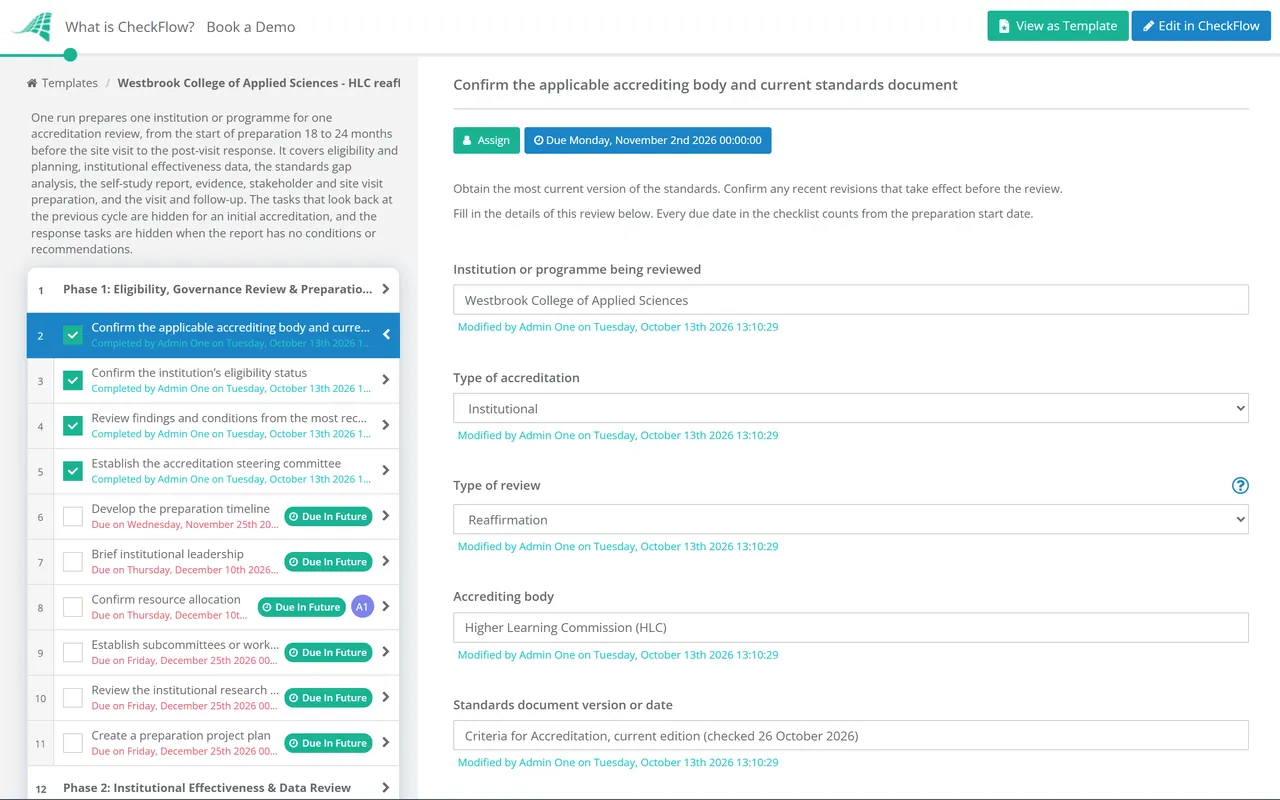
  • Confirm the applicable accrediting body and current standards document — obtain the most current version of the standards; confirm any recent revisions that take effect before the review
  • Confirm the institution’s eligibility status — for initial accreditation, confirm all eligibility requirements are met before application; for reaffirmation, confirm the timeline and any outstanding conditions from the previous cycle
  • Review findings and conditions from the most recent accreditation cycle — what was commended, what recommendations or conditions were issued, and what has been done to address them?
  • Establish the accreditation steering committee — define membership, roles, and governance structure; confirm the accreditation coordinator or liaison is named and briefed
  • Develop the preparation timeline — work backwards from the site visit date through self-study submission, internal review, evidence gathering, and initial gap analysis; assign milestone dates
  • Brief institutional leadership — confirm that senior leadership (president, provost, board) understand the timeline, resource requirements, and their roles in the process
  • Confirm resource allocation — staff time, budget for preparation activities, data and technology systems, and any external consultants engaged
  • Establish subcommittees or working groups for each major standards area — assign responsibility for evidence gathering and self-study writing for each standard to named individuals or teams
  • Review the institutional research function — confirm access to the data systems and institutional research capacity needed to support the self-study with accurate evidence
  • Create a preparation project plan — a written document shared with all participants covering timeline, responsibilities, and key deliverables
Phase 2

Institutional Effectiveness & Data Review

  • Review student learning outcome data — programme-level and course-level assessment results; confirm assessment processes are functioning and data is current
  • Review student achievement indicators — retention, progression, completion, and graduation rates; confirm data is disaggregated by relevant student populations
  • Review post-completion outcomes — employment rates, further study progression, licensure exam pass rates, and other relevant outcome measures
  • Review student satisfaction data — course evaluations, programme satisfaction surveys, and any national benchmarking data available
  • Review faculty and staff satisfaction and development data — where applicable to the accreditor’s standards
  • Review financial health indicators — operating margin, reserves, debt, and any financial sustainability concerns that may be flagged by the accreditor
  • Review programme review data — confirm all programmes have completed required periodic reviews and that findings have been addressed
  • Assess alignment between the mission statement and actual institutional activity — does what the institution does align with what it says it does?
  • Identify data gaps — areas where required evidence does not yet exist or is incomplete; develop plans to address gaps before the self-study deadline
  • Document the institutional effectiveness data review — a summary of key data findings that will inform the self-study narrative
Phase 3

Standards Gap Analysis

The gap analysis is the most valuable step in the preparation process — it identifies what needs to be addressed before the site visit while there is still time to address it. An honest gap analysis is worth more than a polished self-study that ignores real weaknesses.

  • Map all applicable standards to current institutional practice — for each standard or criterion, assess current compliance status (meets, partially meets, does not meet, not applicable)
  • Identify areas of strong compliance — where the institution not only meets standards but demonstrates exemplary practice; document these as strengths for the self-study
  • Identify gaps and areas of partial compliance — where policies are in place but not consistently implemented, where documentation is missing, or where practice does not yet meet standards
  • Prioritise gaps by severity — distinguish between gaps that must be addressed before the site visit, gaps that can be noted in the self-study with improvement plans, and minor documentation gaps
  • Assign owners and timelines to each gap — confirm that every identified gap has a named person responsible for addressing it and a target completion date
  • Address critical gaps before the self-study is finalised — where substantive changes are needed, confirm they are implemented and documented before the self-study is submitted
  • Review the accreditor’s recent findings at peer institutions — what issues have commonly been raised at similar institutions? Are there any that apply here?
  • Confirm all policies and procedures referenced in the self-study are formally documented, current, and accessible
  • Review any areas flagged in the previous accreditation cycle — confirm that prior recommendations or conditions have been fully addressed
  • Document the gap analysis findings — a structured report shared with the steering committee and institutional leadership
Phase 4

Self-Study Report Development

  • Obtain and study the accreditor’s self-study guide or handbook — confirm understanding of format, length, evidence requirements, and submission specifications
  • Assign self-study writing responsibilities — each standards chapter or section assigned to a named individual or subcommittee; confirm writing quality standards and style guidelines
  • Develop the self-study outline — confirm the structure of the report reflects the accreditor’s required format before writing begins
  • Draft each chapter or section — honest, evidence-based narrative that describes what the institution does, evaluates its effectiveness, and identifies areas for improvement
  • Ensure all claims in the self-study are supported by referenced evidence — every assertion should be traceable to specific evidence in the evidence room
  • Conduct internal review of each chapter — peer review by colleagues not involved in writing; senior leadership review of key sections
  • Ensure consistency across chapters — confirm the self-study presents a coherent institutional narrative; no contradictions between sections
  • Review the self-study for honest identification of improvement areas — a self-study that only highlights strengths lacks credibility; genuine self-evaluation includes honest acknowledgement of challenges
  • Obtain senior leadership and board review and endorsement of the final self-study
  • Submit the self-study to the accrediting body by the required deadline — confirm submission receipt
Phase 5

Evidence Compilation & Document Management

  • Create a comprehensive evidence index — a catalogue of all documents, data, and artefacts that will be available to the review team; each piece of evidence linked to the standard(s) it supports
  • Organise the evidence room or digital document repository — clearly structured, logically navigable, and accessible to the review team before and during the site visit
  • Confirm all referenced evidence is available — every document cited in the self-study is present in the evidence repository and accessible
  • Verify document currency — confirm that policies, procedures, and strategic plans cited in the evidence room are the most current versions and have been formally adopted
  • Organise evidence logically — by standard or criterion; the review team must be able to find evidence for any standard quickly during the site visit
  • Confirm digital accessibility of the evidence room — all materials accessible on the devices the review team will use; confirm Wi-Fi access and system reliability
  • Include supplementary evidence — student work samples, programme assessment results, committee meeting minutes, and any other materials that add depth to the self-study narrative
  • Prepare evidence summaries for complex or voluminous materials — executive summaries that direct the review team to key sections of lengthy documents
  • Assign evidence room custodians — named individuals responsible for each section of the evidence room who can answer reviewer questions about specific materials
  • Conduct a final evidence room audit — confirm all evidence is present, accessible, and accurately referenced in the self-study before the site visit date
Phase 6

Stakeholder Engagement & Site Visit Preparation

Review teams speak with faculty, staff, students, and administrators separately and without institutional oversight. The quality of those conversations — not the quality of the self-study document — often determines the review team’s most important impressions.

  • Communicate the accreditation process to the full institution — all faculty, staff, and students should understand that an accreditation review is taking place, why it matters, and what to expect
  • Conduct stakeholder information sessions — briefings for faculty, staff, and student leaders on the institution’s self-study findings and the accreditation standards
  • Prepare faculty for reviewer conversations — faculty should be familiar with the self-study narrative and able to speak authentically about student learning, assessment practices, and institutional effectiveness
  • Prepare student representatives for reviewer conversations — students should understand the institution’s student support services, learning outcome processes, and any improvements made in response to student feedback
  • Prepare administrators for standards-specific discussions — each administrator responsible for a standards area should be fully briefed on the relevant self-study section and evidence
  • Conduct a mock site visit — simulate reviewer conversations with key stakeholder groups; identify gaps in knowledge or inconsistent messaging before the real visit
  • Confirm site visit logistics — room bookings, technology setup, catering, transportation, and all practical arrangements for the review team’s visit
  • Prepare the visit schedule — confirm sessions, attendees, room locations, and any flexibility built in for reviewer-requested additions
  • Confirm evidence room is fully set up and accessible — all evidence available and navigable for the review team from day one of the visit
  • Brief the accreditation coordinator and steering committee on final pre-visit arrangements — confirm all responsibilities for the visit days
Phase 7

Site Visit, Post-Visit Response & Ongoing Compliance

  • Manage the site visit — maintain availability of key personnel; respond promptly to reviewer requests for additional evidence or meetings; maintain a professional and collegial tone
  • Monitor the visit for any emerging concerns — review team requests for specific documents or unusual lines of questioning may signal areas of concern; address where possible
  • Debrief after the visit — immediately document reviewer observations, questions raised, and any informal feedback provided during the exit interview
  • Review the draft report for factual accuracy — most accreditors provide an opportunity to correct factual errors in the draft report before it is finalised
  • Respond to any conditions or recommendations — develop a detailed response plan for each finding; assign owners and target dates
  • Submit the institution’s response to findings within the accreditor’s required timeframe — confirm substantive evidence of corrective action is included
  • Communicate the accreditation outcome to the institution — faculty, staff, students, and the board should be informed of the outcome and what it means
  • Begin addressing any ongoing monitoring requirements — some accreditation decisions include interim reports or monitoring visits; schedule and plan for these
  • Document lessons learned from the preparation and visit process — what worked well, what should be done differently in the next cycle
  • Set the next reaffirmation preparation start date — typically 18–24 months before the next visit; confirm it is scheduled before the current cycle is archived

This checklist is available as a free, runnable template in CheckFlow — with tasks assigned across accreditation subcommittees and institutional teams, multi-year preparation timelines tracked from a single dashboard, and a complete documented record for the accrediting body and institutional governance.

Use This Template Free

Institutional Accreditation vs Programmatic Accreditation — What Each Requires

The preparation framework above applies to both institutional and programmatic accreditation. The scope, standards, and reviewing body differ — the process structure is the same.

Institutional Accreditation

The whole institution — mission, governance, all programmes, and overall educational quality

What it covers: The entire institution — mission and governance, academic programmes, student services, financial stability, institutional effectiveness, and overall educational quality.

Key accreditors (US): HLC, MSCHE, SACSCOC, ACCJC, NEASC, WSCUC, and other regional accreditors; NAEYC (early childhood); Cognia/AdvancED (K-12)

Typical cycle: 7–10 years between comprehensive reviews; interim reporting and monitoring between cycles

Stakes: Institutional accreditation is required for Title IV federal financial aid eligibility in the US; loss of accreditation affects the entire institution and all students

Programmatic / Professional Accreditation

A specific programme — curriculum quality, faculty qualifications, student outcomes, and professional standards alignment

What it covers: A specific programme or professional preparation area — curriculum quality, faculty qualifications, student outcomes, clinical or practical education components, and alignment with professional standards.

Key accreditors: AACSB (business), ABET (engineering/technology), CAEP/NCATE (teacher education), ACEN/CCNE (nursing), LCME (medicine), ABA (law), and many others

Typical cycle: 5–8 years; often includes annual reporting and interim monitoring

Stakes: Some professional licences and certifications require graduation from an accredited programme; loss of programmatic accreditation affects student career outcomes

Many institutions pursue both institutional and programmatic accreditation simultaneously. CheckFlow allows separate checklists to run in parallel — each with its own team, timeline, and evidence collection — visible from a single dashboard.

Why Run Accreditation Preparation in CheckFlow?

1

Coordinate across every team in a multi-year process

Accreditation preparation involves academic affairs, student services, finance, institutional research, faculty, student representatives, and board governance — all contributing to different standards areas across an 18–24 month preparation period. CheckFlow assigns tasks to the right team or individual for each phase, sends reminders as milestones approach, and gives the accreditation coordinator a real-time view of what has been completed and what is outstanding across every standards area simultaneously.
2

Track every evidence item against the standards

The evidence compilation phase of accreditation preparation involves hundreds of documents linked to specific standards — policies, assessment reports, meeting minutes, student outcome data, financial statements, and faculty credentials. CheckFlow tracks the status of every evidence item — gathered, reviewed, approved, or outstanding — so the accreditation coordinator knows the completeness of the evidence base for every standard before the self-study deadline.

3

Build the institutional record for every review cycle

Every completed task in CheckFlow is timestamped and attributed to a named individual. The full preparation record — gap analysis findings, self-study review approvals, evidence confirmations, stakeholder briefings, and post-visit response actions — is archived for the next cycle and for any interim monitoring requirements. The institutional memory of how the last accreditation was prepared does not depend on the person who managed it still being at the institution.

Accreditation preparation and curriculum review are closely linked — accreditors consistently assess whether programmes have a systematic curriculum review process. CheckFlow’s Curriculum Review Process Checklist gives your institution the documented, structured review cycle that accreditation standards expect to see. See the Curriculum Review Process Checklist →

Accreditation preparation is a multi-year project that repeats on a defined cycle. CheckFlow’s recurring checklist feature can schedule the preparation kickoff automatically — 18 months before the site visit date — so the next cycle begins on time regardless of staff changes or institutional transitions. Learn more about recurring checklists in CheckFlow →

Frequently Asked Questions

What is education accreditation and why does it matter?

+

Education accreditation is the formal process by which an independent accrediting body evaluates an educational institution or programme against established quality standards and certifies that it meets them. In the US, institutional accreditation by a recognised regional accreditor is required for students to access federal financial aid (Title IV funds) and for the institution’s degrees to be widely recognised by employers and other educational institutions. Programmatic accreditation by a professional body is often required for graduates to sit for professional licensure examinations or to be considered for certain employment. Loss of accreditation has severe consequences for institutions and their students — making the preparation process one of the highest-stakes processes any educational institution undertakes.

How long does accreditation preparation typically take?

+

For a comprehensive institutional accreditation reaffirmation, preparation should begin 18 to 24 months before the site visit. The self-study report typically takes 12 to 18 months to prepare properly, and the evidence compilation, gap analysis, and stakeholder engagement processes that precede it add further time. Programmatic accreditation preparation is generally shorter — 12 to 18 months for a full self-study process. Initial accreditation preparation (for new institutions or new programmes) may take longer, as the institution must demonstrate that its policies, processes, and quality systems are fully operational before the application is submitted.

What is a self-study report and what makes one effective?

+

A self-study report (also called a self-evaluation report, institutional self-study, or comprehensive evaluation report) is the institution’s own detailed assessment of how it meets each applicable accreditation standard. It is the central document of the accreditation process — the primary evidence the review team uses before, during, and after the site visit. An effective self-study is honest and evidence-based: it identifies and acknowledges genuine areas for improvement, not only strengths; every claim is supported by referenced evidence; it reflects genuine institutional self-reflection rather than a compliance exercise; and it presents improvement plans for identified weaknesses. Review teams are experienced evaluators who identify self-studies that overstate institutional quality — honesty consistently produces better outcomes than defensive self-presentation.

What do accreditation review teams typically focus on during a site visit?

+

Site visit review teams typically focus on three areas: verifying that what the self-study reports matches what actually exists in practice, through document review and stakeholder conversations; exploring areas where the self-study identified gaps or challenges, to assess the quality of the institution’s self-awareness and improvement planning; and conducting conversations with faculty, staff, students, and administrators without institutional oversight, to verify that the self-study narrative matches stakeholders’ lived experience. The quality of these conversations — whether faculty can authentically describe student learning processes, whether students understand their institution’s quality systems, whether administrators demonstrate reflective practice — often determines the review team’s overall impression more than the self-study document itself.

What happens if an institution receives conditions or sanctions following accreditation?

+

Following a site visit, accrediting bodies may issue a range of decisions from full reaffirmation to reaffirmation with recommendations, probation, show-cause, or withdrawal of accreditation. Recommendations require the institution to address specific areas through annual reports or follow-up visits. Probation or show-cause decisions indicate more serious concerns and require a comprehensive response demonstrating corrective action within a defined timeframe. The institution’s response to conditions or recommendations — the specificity, evidence, and urgency of corrective action — significantly influences whether the accreditor escalates or resolves the concern. A structured response process with named owners, documented actions, and clear evidence of improvement is the most effective approach to resolving accreditation conditions.

Is CheckFlow free to use for this template?

+

You can start a free 14-day trial with no credit card required, giving you full access to all features including this template. The Business plan is $10 per user per month after the trial. Full details at checkflow.io/pricing.

Start Your Accreditation Preparation With a Structured Process

Free trial — no credit card required.