Pre-Construction Meeting Checklist Template

Most problems on a new site were visible before it opened. The permit was still pending, the long-lead windows were never ordered, or the first subcontractor learned the delivery rules when their lorry was turned away at the gate.

Last reviewed: October 2026

This free pre-construction meeting checklist is for contractors’ project managers, site managers, clients’ representatives and contract administrators who run the meeting between contract award and the start on site. One run is one meeting for one project. It starts by agreeing the attendees and the agenda and asking each party what to bring, then checks the contract documents, the drawing status, the pre-construction information, the programme, long-lead items, insurances and permits. It covers health and safety, site logistics, and the procedures for inspections, RFIs, submittals, changes and payment, then the meeting itself, the minutes and the action log. It ends when the contractor confirms it is ready and the client confirms the start date. Choose Great Britain (CDM 2015) or the United States (OSHA) and the matching legal steps appear, including an F10 task for a notifiable project. A task to keep the site apart from an occupied building appears when one adjoins it.

One Meeting Between Contract Award and Start on Site

Between contract award and the first day on site there is one meeting that sets how the job will run. The client, the contract administrator, the designers, the main contractor and the first subcontractors sit in one room and agree the programme, the site rules, the logistics and the paperwork routes before anyone is under pressure. Some teams call it the pre-start meeting. Most of its value comes from the work before it, checking that the contract, the drawings, the permits and the safety plan are ready, and the follow-up after it, closing the actions that stand between the project and its start date.

It is not the same as a project kickoff, which aligns your own team on a plan, and it does not replace the site induction each worker gets on arrival. This checklist covers one project’s meeting, from setting it up to the client confirming the start date.

Pre-construction meeting

Once per project, between the parties

Who: the client, contract administrator, designers, main contractor and key subcontractors.

When: after the contract is awarded and before work starts on site.

Output: agreed procedures, minutes, an action log and a confirmed start date.

Site induction

Once per worker, at the gate

Who: every person who comes to work on the site, whoever employs them.

When: on arrival, before they start work.

Output: a worker who knows this site’s hazards, rules and emergency route.

Progress meetings

Regularly, for the length of the job

Who: the same parties, at the cadence agreed in the pre-construction meeting.

When: weekly to monthly, from the start on site to completion.

Output: progress against the programme, issues, changes and the next actions.

What the Pre-Construction Meeting Checklist Covers

Eight phases take one meeting from setting it up to the start on site. Choose Great Britain or the United States on the first task and the matching legal steps appear; an F10 notification task appears for a notifiable project in Great Britain, and a task to keep the site apart from an occupied building appears when one adjoins it. Nothing after the client’s confirmation of the start date can be completed until it is given.

  1. Phase 1

    Phase 1: Set Up the Meeting

    5 tasks

    One run is one pre-construction meeting for one project. Enter the meeting date first, because every due date counts from it, and choose the rules that apply so the matching health and safety steps appear.

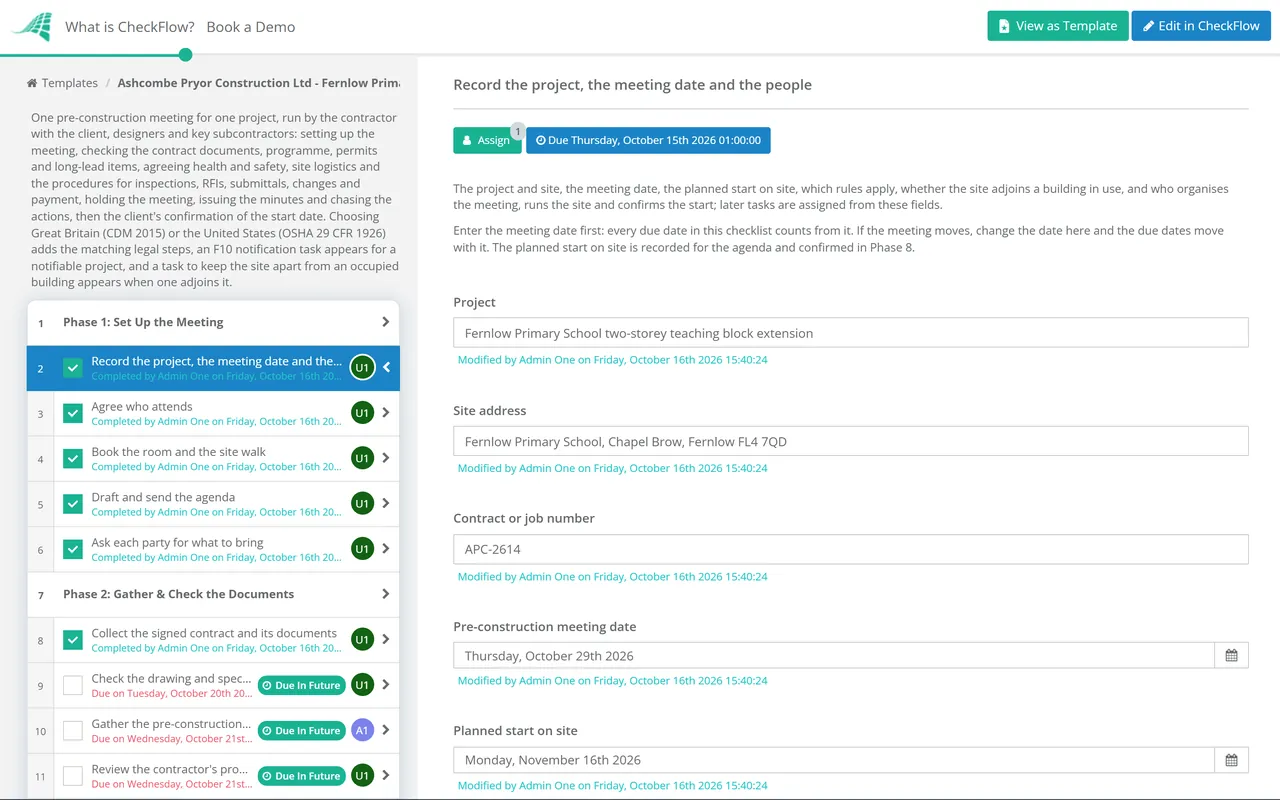
    • Record the project, the meeting date and the people — the project and site, the meeting date, the planned start on site, which rules apply, whether the site adjoins a building in use, and who organises the meeting, runs the site and confirms the start; later tasks are assigned from these fields
    • Agree who attends — the client or owner, the contract administrator, the architect and designers, the contractor's project and site managers, the health and safety lead and the key subcontractors
    • Book the room and the site walk — a room on or near the site that holds everyone, a walk round the site afterwards, and a link for anyone joining remotely
    • Draft and send the agenda — the topics in this checklist, who leads each item and how long it takes, sent with the invitation
    • Ask each party for what to bring — the client's surveys and information, the designers' drawing register, the contractor's programme, logistics plan and safety plan, and each subcontractor's contacts and method statements
  2. Phase 2

    Phase 2: Gather & Check the Documents

    7 tasks

    Check the documents before the meeting, so the meeting settles the gaps instead of discovering them.

    • Collect the signed contract and its documents — the form of contract and any amendments, the drawings, the specification and the pricing document, and confirm who the contract administrator is
    • Check the drawing and specification issue status — which drawings are issued for construction, which are still to come, and when the designers will issue them
    • Gather the pre-construction information — ground, asbestos and utility surveys, existing drawings, any existing health and safety file, and the known hazards of the site
    • Review the contractor's programme — the start and completion dates, any sections, the milestones, the critical path and the client's own fixed dates
    • List the long-lead items — anything with a long manufacture or delivery time, the date each must be ordered, and the approvals needed before the order
    • Check the insurances and bonds — the insurances the contract requires and any performance bond or parent company guarantee, with the certificates in hand before work starts
    • Check the permits and consents — planning conditions to discharge before work starts, building control or the building permit, and licences for hoardings, scaffolds or skips on the road
  3. Phase 3

    Phase 3: Health & Safety

    8 tasks

    The legal steps differ by country. In Great Britain the dutyholder and notification tasks appear; in the United States the competent persons task appears.

    • Check the dutyholder appointments in writing — Great Britain only: where more than one contractor will work on the project, the client appoints a principal designer and a principal contractor in writing before the construction phase begins
    • Check whether the project is notifiable — Great Britain only: notifiable if construction work is scheduled to last longer than 30 working days with more than 20 workers at once at any point, or to exceed 500 person days
    • Confirm the F10 notification was sent to HSE — notifiable projects only: the client gives notice to HSE before the construction phase begins, and a copy is displayed in the site office
    • Review the construction phase plan or site safety plan — the health and safety arrangements, the site rules and the specific measures for high-risk work, ready before the site is set up
    • Name the competent persons — United States only: who inspects the site, and who is the competent person for each activity that needs one, such as excavations and scaffolds
    • Confirm the first aid and emergency arrangements — the first aiders and kits, the nearest hospital, the fire and emergency procedures, and how the emergency services will find the site
    • Agree the site induction arrangements — who gives the induction, when it runs, and the cards, training records and method statements each worker brings
    • Agree the site rules — PPE, parking, radios and mobile phones, smoking, restricted areas, hot work and emergency arrangements, and any translations needed
  4. Phase 4

    Phase 4: Site Logistics

    8 tasks

    Agree how the site works day to day before anyone arrives. Most early disputes with neighbours and occupiers start with deliveries, hours and parking.

    • Agree site access and security — the site boundary, gates and hoarding or fencing, who holds keys, and how unauthorised people are kept out, out of hours too
    • Agree the working hours — the hours the contract and any planning or local authority conditions allow, weekend work, and when noisy work may happen
    • Agree deliveries, storage and traffic routes — how deliveries are booked, the routes in and out, who guides vehicles, the storage and laydown areas, and where cranes or hoists stand
    • Confirm welfare facilities from the first day — toilets, washing, drinking water, changing and rest areas, ready before any construction work starts
    • Agree parking for workers and visitors — where workers and visitors park, and the roads, drives and spaces that are off limits
    • Agree how neighbours are told and kept informed — a letter or drop-in before work starts, a named contact for complaints, and notice before disruptive work
    • Separate the site from the building in use — shown only when the site adjoins a building that stays in use: fenced routes, separate access, deliveries outside its busiest times, and its fire escape routes kept clear
    • Confirm the utilities and buried services — temporary power, water and drainage, and the buried and overhead services traced from plans and surveys before anyone digs
  5. Phase 5

    Phase 5: Quality, Change & Payment Procedures

    6 tasks

    Agree how the paperwork will flow before the first request arrives. Each procedure needs a named person, a route and a response time.

    • Agree the inspections and hold points — the work inspected before it is covered up, who inspects it, how much notice they need, and the building control or third-party inspections
    • Agree the RFI procedure — how requests for information are raised and numbered, who answers them, and how quickly
    • Agree the submittal and approval procedure — shop drawings, samples and product data: who reviews them, the review time, and what the review statuses mean
    • Agree the change and instruction procedure — who may instruct a change, how it is priced and agreed before work goes ahead, and that nobody acts on a verbal instruction alone
    • Agree payment applications and valuations — the valuation or application dates, what goes with each application, who certifies it, and when payment is due
    • Set the meeting and reporting cadence — progress meetings, design and subcontractor meetings, site reports, and who chairs, attends and receives minutes for each
  6. Phase 6

    Phase 6: Hold the Meeting

    6 tasks

    Work through the agenda in order. Confirm each item in the room and log anything that cannot be settled as an action with an owner and a date.

    • Record attendance and confirm roles and contacts — who attended for each party and who sent apologies, then each person's role, deputy and contact details
    • Walk through the project, scope and contract — what is being built, what is excluded, who the contract administrator is, and who may issue instructions
    • Present the programme and key dates — the start, the milestones and completion, the long-lead items and the client's fixed dates
    • Present health and safety and the site rules — the construction phase plan or site safety plan, the main risks, the induction, the welfare and the emergency arrangements
    • Confirm the logistics, procedures and meeting dates — the logistics plan and the procedures from Phase 5, confirmed or changed in the room, and the date of the first progress meeting
    • Log the open questions and actions — each one with an owner and a date before the meeting closes, marked where it must be closed before the start on site
  7. Phase 7

    Phase 7: Minutes & Follow-Up

    4 tasks

    The minutes are the record of what was agreed. Issue them quickly, and close every action that stands between the project and its start date.

    • Issue the minutes and the action log — to every attendee and everyone who sent apologies, the next working day, with a date for comments
    • Update the contact sheet, programme and plan — with every change the meeting agreed, and reissue them
    • Chase the actions that must close before start — permits, insurances, appointments, surveys and anything else on the action log marked as needed before work starts
    • Confirm each subcontractor's start information — their start date, supervisor, method statements and risk assessments, and inductions booked for their first workers
  8. Phase 8

    Phase 8: Confirm Start on Site

    4 tasks

    The contractor confirms it is ready, then the client confirms the start date. Nothing after the client's confirmation can be completed until it is given.

    • Contractor confirms ready to start — the before-start actions closed, the plan in place, welfare and security ready, and the first trades booked
    • Client confirms the start date — the client's representative reviews the open actions and confirms, or moves, the date work starts on site
    • Issue the start confirmation — the confirmed start date and any conditions, sent to every party and subcontractor
    • Book the first progress meeting — with its agenda, the action log carried forward and the same attendees' roles

A Pre-Construction Meeting Agenda

A running order for a meeting of about two hours, followed by a walk round the site. Send it with the invitation, so each party comes with answers. Keep the leads as they are where you can: the person who owns a topic should present it, and the chair’s job is to stop the meeting moving on until each item is settled or logged as an action.

Agenda item Led by What to settle in the room
1. Introductions and rolesContractor’s project managerWho is here for each party, who decides what, deputies and the contact sheet
2. The project and the contractClient and contract administratorWhat is being built and what is excluded, the contract documents, and who may issue instructions
3. Programme and key datesContractor’s project managerStart, milestones, completion, long-lead items and the client’s fixed dates
4. Design informationArchitect or lead designerDrawings issued for construction, information still to come and when
5. Health and safetyContractor’s site manager or safety leadThe construction phase plan or site safety plan, main risks, induction, first aid and emergencies
6. Site logisticsContractor’s site managerAccess, security, hours, deliveries, storage, welfare, parking, neighbours and any building in use
7. Permits and utilitiesContractor and clientConsents still open, licences, temporary supplies and buried services
8. Quality and inspectionsContract administrator and contractorHold points, inspections and the notice each one needs
9. RFIs, submittals and changesContract administratorRoutes, response times and who may instruct a change
10. PaymentClient’s cost consultant or contract administratorValuation dates, what goes with an application and who certifies it
11. Meetings and reportingContractor’s project managerProgress meeting dates, site reports and who receives the minutes
12. Actions and start dateChairEvery open item read back with an owner and a date, and the date work starts

What must be ready before work starts in Great Britain. Under CDM 2015, where more than one contractor will work on the project, the client appoints a principal designer and a principal contractor in writing before the construction phase begins (regulation 5). The client must ensure a construction phase plan is drawn up before then (regulation 4(5)(a)), and for a notifiable project gives notice to HSE as soon as is practicable before it begins (regulation 6). A project is notifiable if its construction work is scheduled to last longer than 30 working days with more than 20 workers at once, or to exceed 500 person days. Welfare facilities must be available before any construction work starts.

In the United States. Several OSHA duties fall before work starts. Provisions for prompt medical attention in case of serious injury must be made before the project begins (29 CFR 1926.50(b)), the location of underground utilities must be determined before an excavation is opened (1926.651(b)), and each employer’s program must provide for frequent and regular inspections by competent persons (1926.20(b)). Check your contract and your state and city rules as well.

Why Run Pre-Construction Meetings in CheckFlow?

1

No start date without the client’s confirmation

The client’s representative is named on the first task, and the confirmation of the start date is assigned to them alone. The checklist halts there, so the start confirmation cannot go out until they record a decision, and the record shows the date was approved before work began.

2

The legal steps match the site

Choose Great Britain or the United States on the first task and the CDM 2015 or OSHA steps and notes appear. The F10 task appears only for a notifiable project, and the occupied-building task only where one adjoins the site. Adapt the agenda and the procedures to your own contracts in the template designer.

3

Every action has an owner and a date

Tables hold the attendees, long-lead items, permits, hold points and the action log, beside the minutes and the signed documents. Due dates count from the meeting date, so the follow-up lands on the right people’s lists, and the Reports Grid shows every project still waiting to start.

CheckFlow is not a scheduling, document control or contract management system. It runs the steps around your own contract, programme and safety plan, so every project starts the same way, with a record of who agreed what and when. See how CheckFlow’s workflow software handles handoffs and approvals between several parties.

This template covers one project’s pre-construction meeting. Induct each worker who arrives with the Construction Site Induction Checklist, control high-risk work with the Permit to Work Checklist, assess the wider risks with the Health & Safety Risk Assessment Checklist, and handle a change to the agreed scope with the Scope Change Request Checklist.

AI generator

Didn’t find what you need? Describe it.

Describe the process in a sentence and the AI checklist generator drafts the phases and tasks for you.

Frequently Asked Questions

What is a pre-construction meeting?

A pre-construction meeting is held after the contract is awarded and before work starts on site, between the client or owner, the contract administrator, the designers, the main contractor and the key subcontractors. It confirms who does what, the programme and key dates, the health and safety arrangements, the site logistics, and the procedures for inspections, requests for information, submittals, changes and payment. It ends with minutes, an action log and an agreed start date. Some teams call it the pre-start meeting.

What should be on a pre-construction meeting agenda?

Introductions and roles; the project scope and the contract documents; the programme, key dates and long-lead items; outstanding design information; health and safety, including the construction phase plan or site safety plan, induction and emergency arrangements; site logistics such as access, hours, deliveries, welfare and neighbours; permits and utilities; inspections and hold points; RFIs, submittals and changes; payment; the meeting and reporting cadence; and a read-back of every action with an owner and a date. The agenda table above gives a running order with a lead for each item.

Who should attend a pre-construction meeting?

Everyone who will make or need decisions once work starts: the client or owner’s representative, the contract administrator, the architect and the lead designers, the main contractor’s project manager and site manager, its health and safety lead, and the subcontractors who start first or whose work drives the programme. In Great Britain, on a project with more than one contractor, that includes the principal designer and the principal contractor. Invite subcontractors who start later to a briefing of their own before they arrive.

When should the pre-construction meeting be held?

After the contract is awarded or a letter of intent is in place, and early enough before the start on site to close the actions it raises. In Great Britain, several things must be done before the construction phase begins, including the dutyholder appointments, the construction phase plan and, for a notifiable project, the notice to HSE, so hold the meeting while there is still time to finish them. This checklist counts every due date from the meeting date you enter.

Is a pre-construction meeting a legal requirement?

CDM 2015 does not require a meeting by that name, and neither do the OSHA standards this checklist cites. What they require is much of the work it covers. In Great Britain, CDM 2015 makes everyone with duties cooperate, and HSE’s guidance suggests coordination and progress meetings as one way to do it. It also requires appointments, a construction phase plan, welfare facilities and, for notifiable projects, notification before the construction phase begins. In the United States, OSHA requires provisions for prompt medical attention before the project starts and the location of underground utilities before excavation. The meeting is where the parties confirm those are done.

When does a construction project need an F10 notification?

Under regulation 6 of CDM 2015, a project is notifiable if its construction work is scheduled to last longer than 30 working days and have more than 20 workers working at the same time at any point, or to exceed 500 person days. HSE’s guidance counts every day work is likely to take place, including weekends and bank holidays. The client notifies HSE through the online F10 form as soon as is practicable before the construction phase begins, and a copy is displayed in the site office. For a domestic client, the contractor or principal contractor notifies.

Is a pre-start meeting the same as a pre-construction meeting?

Often, but not always. Many teams use pre-start meeting for the single meeting before a project begins, which is what this checklist covers. On other sites, a pre-start is the short briefing held every morning before work, where the supervisor goes through the day’s tasks, hazards and permits with the crew. That daily briefing is closer to a toolbox talk. If you mean the daily kind, run it as a short recurring checklist and keep this one for the project start.

Is CheckFlow free for this template?

14-day free trial, no card required. The Business plan is $10 per user per month after the trial. Full details at checkflow.io/pricing.

Start Every Project With the Same Agreed Plan

Free trial — no credit card required.

14-day free trial, no credit cardFull refund in your first 30 daysUS or EU hosting