Compliance Program Checklist Template

The list of obligations lives in one person’s head, the risk assessment is two years old, and the board hears about compliance only when something has gone wrong.

Last reviewed: October 2026

Printed from checkflow.io/templates/compliance/compliance-program-checklist

This free compliance program checklist is for compliance leads, general counsel and company secretaries who set up a company’s compliance programme or refresh it each year. One run is one cycle. It scopes the programme, builds the obligations register (the laws, regulations, contracts and standards that apply), runs a compliance risk assessment and a gap assessment, writes the remediation plan, maps policies to owners, plans the training and the monitoring, and takes the programme to the board, a committee or the senior executive for approval. After approval it launches the programme, runs the first monitoring and testing cycle with an issue log, reports to the board and sets the annual review. Use it as a compliance project plan for a first set-up or as the yearly plan for a refresh: each adds the tasks it needs, a regulated firm adds its regulator’s rules, and two legal tasks appear when an issue may need reporting to a regulator.

A Compliance Framework Template That Runs as a Checklist

A compliance programme is how an organisation knows which laws, regulations, contracts and standards apply to it and keeps to them: who owns each obligation, which risks matter most, the policies, training and checks that address them, how issues are found and fixed, and how the board knows it works. The US Sentencing Guidelines define a compliance and ethics program as “a program designed to prevent and detect criminal conduct”. This checklist applies the same cycle to every obligation on your register, not only criminal law. It is framework-neutral: it follows no single standard, and following it does not make a programme legally sufficient. The page uses the US spelling “program” in its name and when describing US sources, as the Justice Department does, and the British “programme” everywhere else.

In the US, the Justice Department’s Evaluation of Corporate Compliance Programs (updated September 2024) gives prosecutors three “fundamental questions”: is the program well designed, is it “being applied earnestly and in good faith” (that is, adequately resourced and empowered to function effectively), and does it work in practice? It is guidance for prosecutors, not a duty on companies. This checklist follows the same order: design in Phases 1 to 5, approval and resources in Phase 6, and launch, testing and reporting in Phases 7 to 9.

This checklist

One programme cycle

Covers: the whole programme, set up or refreshed: the register, the risk and gap assessments, policies, training, monitoring, issues and the board report.

Planned around: the approval meeting, from about eleven weeks before it to about twelve weeks after.

Output: an approved programme, a remediation plan, the first test results and a report to the board or committee.

The dates

Annual compliance calendar

Covers: each filing, renewal and certification deadline in the year, with owners and lead times.

Planned around: the calendar year.

Output: no missed deadline, in the Annual Compliance Calendar Checklist. Phase 7 here puts the programme’s own recurring tasks into that calendar.

What the Compliance Program Checklist Covers

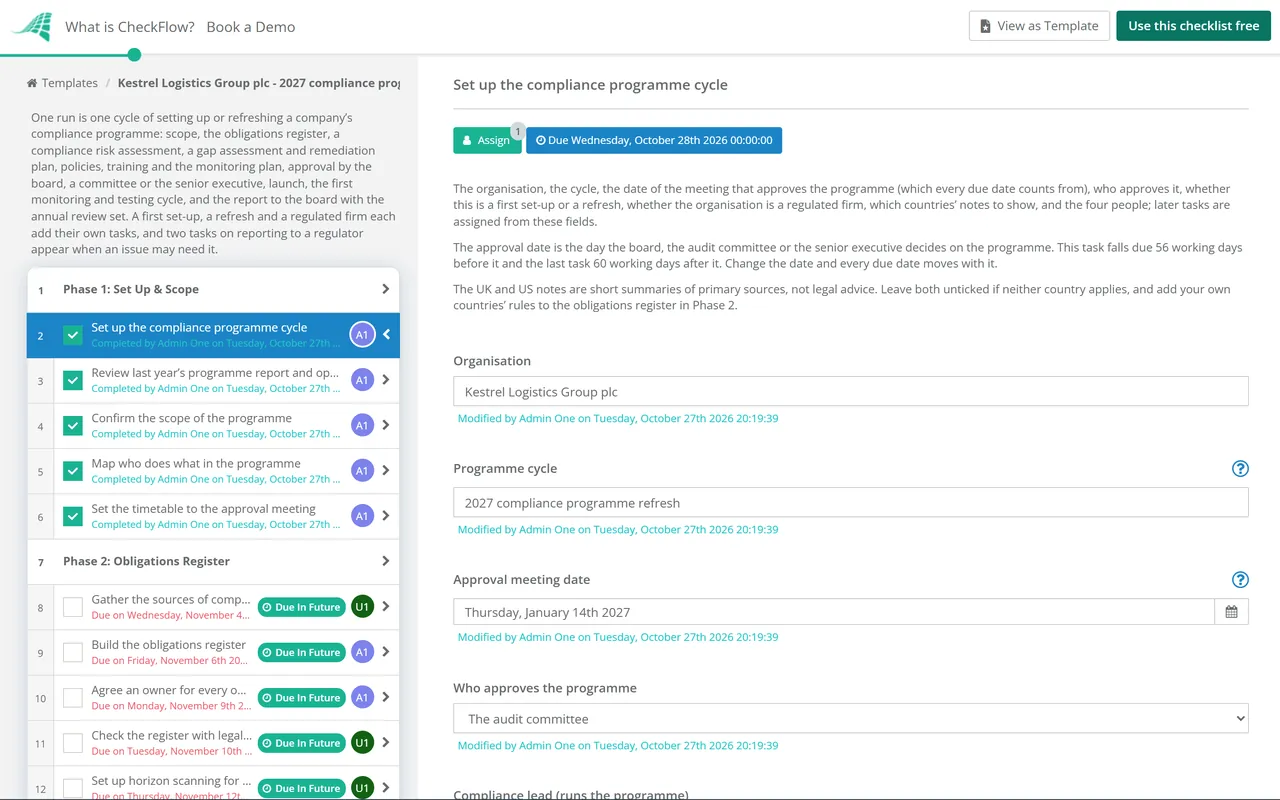
Nine phases take one programme cycle from scoping, about eleven weeks before the approval meeting, to the report to the board or committee about twelve weeks after it. The first task’s answers add the tasks for a first set-up, a refresh or a regulated firm, and short UK or US notes. Nothing after the approval of the programme can be completed until the decision is recorded, and two legal tasks appear when an issue may need reporting to a regulator.

  1. Phase 1

    Phase 1: Set Up & Scope

    6 tasks

    Start about eleven weeks before the meeting that approves the programme. The first task names the four people and asks whether this is a first set-up or a refresh, whether the organisation is a regulated firm and which countries’ notes to show; each answer adds what it needs. Every due date counts from the approval meeting, in working days.

    • Set up the compliance programme cycle — the organisation, the cycle, the date of the meeting that approves the programme (which every due date counts from), who approves it, whether this is a first set-up or a refresh, whether the organisation is a regulated firm, which countries’ notes to show, and the four people; later tasks are assigned from these fields
    • Review last year’s programme report and open issues — the last annual review, the board’s or committee’s questions and actions, issues and remediation actions still open, and any regulator contact since
    • Agree the programme’s mandate, owner and reporting line — the senior executive with overall responsibility, the compliance lead who runs it day to day, their authority and resources, and their direct access to the board or a committee
    • Confirm the scope of the programme — the entities, countries and business lines, the subject areas in scope, and any area run as its own programme, named with its owner
    • Map who does what in the programme — the board or committee that oversees it, the senior executive responsible, the compliance lead, obligation and policy owners, managers in the business and internal audit
    • Set the timetable to the approval meeting — the dates for the register, the risk assessment, the gap assessment, the paper deadline and the meeting, and the meeting that will receive the first report
  2. Phase 2

    Phase 2: Obligations Register

    6 tasks

    The register is the list every later phase works from: what the organisation must do, where the duty comes from and who owns it. An obligation that is not on it will not be assessed, tested or reported.

    • Gather the sources of compliance obligations — laws and regulations, licences and permissions, regulator rules and guidance, contracts with customers, suppliers and funders, standards and certifications the organisation has signed up to, and its own codes and public commitments
    • Build the obligations register — one row per obligation: its source, what it requires, who it applies to, the owner, how compliance is shown, and when it was last checked
    • Agree an owner for every obligation — a named owner in the business who accepts each obligation, not only the compliance team, and the obligations still without one
    • Add the regulator’s rules on compliance arrangements — the rules that say what a regulated firm’s compliance arrangements must include, such as a compliance function, a named officer or an annual review
    • Check the register with legal and the business — new products, markets, contracts and changes in the law since the register was last checked, and anything missing added
    • Set up horizon scanning for new and changed obligations — who watches which sources, how often, and how a change reaches the register and its owner
  3. Phase 3

    Phase 3: Compliance Risk Assessment

    6 tasks

    Rate where a breach is most likely and would do most harm, before and after the controls, so the effort in the rest of the cycle goes to the highest risks.

    • Choose the risk assessment method and scale — likelihood and impact, inherent and residual risk, the rating scale and what each rating means, matched to the organisation’s own risk register
    • Identify where a breach could happen — for each obligation area, the activities, places, people and third parties where a breach could happen, drawing on past incidents, audit findings, speak-up reports and regulator feedback
    • Rate the inherent risk of each area — likelihood and impact before any controls, with the reason for each rating
    • Map the controls and rate the residual risk — the policies, approvals, checks, systems and training that reduce each risk, how well they work, and the risk left
    • Agree the ratings with the risk owners — each owner sees and challenges the ratings for their area, and changes are recorded with the reason
    • Rank the risks and set this cycle’s priorities — the highest residual risks first, and where monitoring, training and resources go because of them
  4. Phase 4

    Phase 4: Gap Assessment & Remediation Plan

    5 tasks

    Compare what the register and the risks call for with what is in place today. Each gap gets an owner, an action and a date, and the plan goes to the approval meeting with the resources it needs.

    • Assess the programme against the register and the risks — for each obligation and each high risk, whether a policy, a control, training and monitoring cover it
    • Check the programme’s own building blocks — written standards, oversight, resources, training, monitoring and auditing, a speak-up route, incentives and discipline, the response to issues, and a periodic review
    • Record each gap with its severity and owner — the gap, the obligation or risk it affects, its severity, its owner, the action and the due date
    • Write the compliance remediation plan — one action per gap, with its owner, due date and priority by risk, and quick fixes kept apart from projects that need budget
    • Confirm the people, systems and budget — compliance staff, time from the business, systems, the training budget and external advice the plan needs, and what is still missing
  5. Phase 5

    Phase 5: Policies, Training & Monitoring Plan

    6 tasks

    Decide what staff will be told, trained on and tested on in the coming year. The approval meeting sees these plans with the risk assessment and the remediation plan.

    • Map policies to the obligations and risks — which policy covers each obligation and high risk, the new policies to write, and the old ones to update or retire
    • Name an owner and a review date for every policy — each policy’s owner, approver and next review date in the policy register
    • Plan the training by role — who needs which course (the board, managers, high-risk roles, all staff and, where it fits, third parties), when and how often, and how completion is recorded
    • Write the compliance monitoring and testing plan — what is checked, by whom, how often and how: checks in the business, compliance monitoring and internal audit reviews, with the highest risks tested first
    • Check the speak-up and investigation routes — how staff and others raise a concern, confidentially or anonymously where allowed, who investigates, and how people are protected from retaliation
    • Choose the measures the board will see — training completion, test results, issues found and closed, overdue remediation actions, speak-up reports and regulatory changes
  6. Phase 6

    Phase 6: Approval

    5 tasks

    Nothing after the approval of the programme can be completed until the decision is recorded. Approved with changes and Not approved each add a task that says what to do next.

    • Prepare the programme paper for approval — the scope, the register, the top risks, the gaps, the remediation plan, the training and monitoring plans, the resources and the decision asked for
    • Review the paper with legal — statements about compliance with the law, how issues are described, and whether any part needs legal advice before it goes to the meeting
    • Approve the compliance programme — the approver records the decision of the board, committee or senior executive on the programme and its plans; nothing after this task can be completed until it is done
    • Make the changes the approver asked for — each change made before launch, and the approver told what changed
    • Rework the programme and record a fresh decision — the compliance lead reworks the paper and takes it back to the approver, who changes the decision on the approval task to Approved, or un-completes and completes it again; do not launch until it reads Approved
  7. Phase 7

    Phase 7: Launch & Embed

    6 tasks

    Tell people what the programme expects of them, start the training and the remediation actions, and put every recurring task in the calendar so the programme runs between cycles.

    • Publish the approved programme and policies — where staff find them, with the owners, the speak-up route and where to ask questions
    • Communicate the senior commitment — a message from the chief executive or the chair on why the programme matters and what is expected of everyone
    • Open the compliance issue log — one place for every issue from any source (tests, audits, speak-up reports, incidents and regulator contact), with its severity, owner, root cause and status
    • Launch the training — the courses by role with their deadlines, and completion tracked against the training plan
    • Start the remediation actions — each action in the plan opened with its owner and due date, and the quick fixes done first
    • Put the recurring tasks in the compliance calendar — monitoring tests, training refreshers, policy reviews, register checks, board reports and the annual review, each with an owner
  8. Phase 8

    Phase 8: Monitor, Test & Remediate

    7 tasks

    Run the first monitoring and testing cycle, log what it finds and fix the cause, not only the symptom. The answer on the issue log task adds two tasks when an issue may need reporting to a regulator.

    • Run the first monitoring and testing cycle — the tests in the plan for the highest risks, with the results and the evidence recorded
    • Log every issue found — each issue in the issue log with its severity and owner, and whether any may need reporting to a regulator or another authority
    • Take legal advice on reporting the issue — whether the law, a regulator’s rules or a contract requires the issue to be reported, by when and to whom, and who decides; access to the details restricted
    • Find the root cause of each significant issue — why the control failed, not only what happened, and whether the same cause affects other areas
    • Record the decision on reporting and any report made — the decision, who made it and when, the date and reference of any report, and the board or committee told
    • Track remediation actions to closure — overdue actions escalated to their owner’s manager, and each closure checked before it is marked closed
    • Retest the controls that were fixed — the tester confirms each fix works before the issue is closed in the log
  9. Phase 9

    Phase 9: Report & Annual Review

    5 tasks

    Report what the first cycle found to the board or committee, then set the date and scope of the next annual review so the programme is refreshed rather than left to age.

    • Report to the board or committee — the measures, test results, issues and their status, remediation progress, regulatory changes and what the programme needs
    • Record the board’s questions and actions — what the board or committee asked, the actions it set, their owners and dates
    • Compare this cycle with last year’s — the measures, the issues and repeat findings, and the actions from last year that are still open
    • Set the scope and date of the annual review — the next review date, what triggers an earlier one (a new law, market or product, a significant issue, an acquisition), and who leads it
    • File the programme records — the register, the risk assessment, the gap register, the plans, the approval, the test results and the reports, with the retention period

What Each Source Says a Compliance Programme Needs

Search for a “regulatory compliance framework template” and you find frameworks under many names. These are the primary sources this checklist draws on, what each says in brief and where the checklist uses it. It is a summary, not legal advice.

Source Who it is for What it says Where this checklist uses it
US Sentencing Guidelines §8B2.1 (November 2025 manual; unchanged by the 1 November 2026 amendments)Organisations sentenced for a US federal offence; an effective program counts in the culpability score (§8C2.5(f))At minimum: standards and procedures, an informed board with reasonable oversight and named owners, training, monitoring and auditing, periodic evaluation, a reporting system, incentives and discipline, a response to misconduct, and a periodic risk assessmentPhases 3, 4, 5 and 9, and the US notes
DOJ Evaluation of Corporate Compliance Programs (updated September 2024)Federal prosecutors assessing a company’s programThree fundamental questions on design, resources and whether the program works in practice, with topics including risk assessment, policies, training, reporting and investigations, third parties, testing and root cause analysisThe whole cycle; the gap analysis in Phase 4 and root causes in Phase 8
Bribery Act 2010, section 7, and the Ministry of Justice guidanceCommercial organisations within the Act’s definitionFailure to prevent bribery by an associated person, with a defence of “adequate procedures”; the guidance sets six principlesUK notes in Phases 2 and 4
Economic Crime and Corporate Transparency Act 2023, section 199, and the Home Office guidanceLarge organisations, since 1 September 2025Failure to prevent fraud, with a defence of reasonable prevention procedures; the guidance uses the same six principlesUK notes in Phases 2, 4 and 9
Criminal Finances Act 2017, section 45The bodies the Act calls “relevant bodies”Failure to prevent the facilitation of UK tax evasion, with a defence of reasonable prevention proceduresUK note in Phase 2
FCA Handbook SYSC 6.1.1RThe regulated firms the rule applies toAdequate policies and procedures sufficient to ensure compliance with the firm’s obligations under the regulatory systemThe regulated-firm task in Phase 2
SEC Rule 206(4)-7 (17 CFR 275.206(4)-7)SEC-registered investment advisersWritten policies and procedures, a review at least once a year and a designated chief compliance officerThe regulated-firm task in Phase 2; the Investment Adviser Annual Compliance Review Checklist runs the annual review
ISO 37301:2021, Compliance management systems: requirements with guidance for useOrganisations that choose to use it (a paid standard)Not quoted here; ISO describes it as a standard for establishing, implementing, evaluating, maintaining and improving a compliance management systemNot followed clause by clause

Which apply to you. The US sources matter to organisations that could face a US federal investigation or sentence, the UK offences apply to the organisations within their scope, and a regulator’s rules apply to the firms it regulates. The obligations register in Phase 2 is where you record which apply, with your legal adviser.

Dates. The DOJ lists the September 2024 update as its current evaluation guidance. The Sentencing Guidelines text is the November 2025 manual; the amendments that take effect on 1 November 2026 do not change §8B2.1. ISO lists ISO 37301:2021 as current and confirmed in 2026, with one amendment (Amd 1:2024). All were read on 27 and 28 October 2026.

Why Run Your Compliance Program in CheckFlow?

1

Nothing launches until the programme is approved

The approval is assigned to the approver alone, and the checklist halts there: nothing after it, including publishing the programme and launching the training, can be completed until the decision is recorded. Approved with changes or Not approved adds the next step. See how approvals that halt a checklist work.

2

Only the tasks this cycle needs

A first set-up adds the programme’s mandate and reporting line; a refresh adds last year’s review and the comparison with it. A regulated firm adds its regulator’s rules to the register, a tick for the UK or the US shows short notes on that country’s sources, and an issue that may need reporting adds legal advice and the decision.

3

Timed from the approval meeting

Enter the meeting date and every task falls due a set number of working days before or after it. Tasks are assigned from the four people named in the first task, and the Tasks Grid shows each of them what is due. Run it on a recurring schedule so next year’s refresh starts on time.

CheckFlow runs the cycle: who does what and by when, the register and risk tables, the approval, the issue log and the record. It does not tell you which laws apply or whether a control is enough; that is for your legal and compliance advisers. The Reports Grid lists every cycle with its answers, so next year starts from this one.

Keep the year’s deadlines in the Annual Compliance Calendar Checklist, review the policies with the Annual Policy Review Checklist and collect staff statements with the Compliance Attestation Checklist. The Fraud Risk Assessment Checklist and the Anti-Bribery & Corruption Compliance Checklist go deeper on two common risk areas, and the Whistleblowing Report Handling Checklist handles a concern raised through the speak-up route. A regulated AML programme has its own monthly review in the AML Compliance Programme Review Checklist, and a US investment adviser’s yearly Rule 206(4)-7 review is in the Investment Adviser Annual Compliance Review Checklist. Working towards a management system standard? See the ISO Compliance Checklist. Running several programmes at once? CheckFlow’s compliance checklist software keeps owners, evidence and sign-offs in one place.

AI generator

Didn’t find what you need? Describe it.

Describe the process in a sentence and the AI checklist generator drafts the phases and tasks for you.

Frequently Asked Questions

What is a compliance program?

A compliance programme is the set of owners, policies, controls, training, monitoring and reporting an organisation uses to keep to the laws, regulations, contracts and standards that apply to it. The US Sentencing Guidelines define a compliance and ethics program as one “designed to prevent and detect criminal conduct”. This checklist runs one cycle of it: the obligations register, a risk and gap assessment, the plans, approval, launch, testing and the report to the board.

What should a compliance program checklist include?

This one has nine phases: scope and roles, the obligations register, a compliance risk assessment, a gap assessment and remediation plan, policies, training and the monitoring plan, approval, launch, monitoring and testing with an issue log, and the board report with the annual review. It is framework-neutral, so it covers every area on your register rather than one law or standard.

Can I use this as a compliance framework template?

Yes. The paper in Phase 6 is the framework: the scope, the roles, the obligations register, the top risks, the remediation plan, the training and monitoring plans, the measures the board will see and the review date. Because it is built from your own register and risk assessment, it fits your organisation rather than a generic list. Upload the approved version to the approval task as the record of what was decided.

Is this a compliance management system template?

It covers the same ground in different words, but it is not built on a standard. ISO 37301:2021 is the international standard for compliance management systems; it is a paid standard, so this page names it but does not quote it. This checklist does not follow it clause by clause and does not prepare you for certification. If you are working towards a management system standard, use the ISO Compliance Checklist alongside it.

What goes in a compliance remediation plan?

One action per gap or issue, with its owner, its due date and its priority by risk, and what each action needs in budget or people. This template keeps quick fixes apart from larger projects, opens every action at launch, escalates overdue ones and has the tester confirm a fix works before the issue is closed. The DOJ guidance also asks whether a company found the root cause of what went wrong.

How often should a compliance risk assessment be done?

The sources say periodically rather than giving an interval. The US Sentencing Guidelines expect an organisation to “periodically assess the risk of criminal conduct”, and the DOJ guidance asks whether the risk assessment is current and subject to periodic review. This template does it once per cycle, sets the next annual review in Phase 9 and records what should trigger an earlier one, such as a new market, a significant issue or an acquisition.

Who should approve the compliance programme?

Whoever your governance gives that decision to: the board, the audit committee, a risk or compliance committee or the senior executive. This checklist asks you to name them in the first task and halts at the approval. The US Sentencing Guidelines expect the governing authority, normally the board, to be “knowledgeable about the content and operation” of the program and to exercise reasonable oversight of it.

Does following this checklist make our compliance programme legally sufficient?

No. It organises the work and keeps the record, but whether a programme is adequate depends on your obligations, your risks and how well the controls work in practice. The UK offences speak of “adequate” or reasonable prevention procedures, and the DOJ says it uses no “rigid formula” to assess a program. Take legal advice on what your organisation needs.

Does UK law require a compliance programme?

For some organisations, parts of one. Regulated firms have their regulator’s rules, such as the FCA’s SYSC 6.1.1R. Other organisations should look at three failure-to-prevent offences, for bribery, the facilitation of tax evasion and, for large organisations, fraud, each with a defence of having had prevention procedures in place. The UK notes in this checklist summarise them; check which apply with your legal adviser.

Is CheckFlow free for this template?

14-day free trial, no card required. The Business plan is $10 per user per month after the trial. Full details at checkflow.io/pricing.

Every Obligation Owned, Every Risk Rated, Every Gap on a Plan

Free trial — no credit card required.

14-day free trial, no credit cardFull refund in your first 30 daysUS hosting, EU on request