
Annual Policy Review Checklist Template

Every cover page says ‘reviewed annually’. Yet the travel policy still names a finance director who left in 2024, and nobody can show who approved the current information security policy.

This free annual policy review checklist is for compliance managers, company secretaries and the HR, risk and information security leads who look after a policy library. It runs one review cycle across the whole library: the policy register and its owners, the year’s triggers, redlining, the legal check, approval by the right authority, publication with version control, staff attestation, retiring what is no longer needed and setting next year’s review dates. Each cycle leaves a record of what changed in every policy, who approved it and who has acknowledged it.

Use This Template Free See Live Example
No Credit Card Required

Last reviewed: October 2026

A Review That Changes Something, or Proves Nothing Needed To

Auditors rarely find that a policy is missing. They find that it no longer describes what the organisation does. The access policy promises quarterly reviews and the team runs them twice a year. The incident policy routes reports to a mailbox that was closed in a migration. The review date was updated, but nobody read the text.

Several frameworks expect policies to be reviewed, not just stored. ISO/IEC 27001:2022 Annex A control 5.1 asks for policies that are approved by management, communicated, acknowledged by relevant personnel and reviewed at planned intervals and when significant changes occur. PCI DSS v4.0.1 Requirement 12.1.2 sets the interval for the information security policy: at least once every 12 months. A useful review answers three questions for each document: is it still right, is it still followed, and does everyone it applies to know the current version?

The annual cycle

Every policy, once a year, against a fixed deadline

Who: each policy owner, chased by a coordinator, with sign-off by the authority that owns the policy.

Depth: varies. A full rewrite for high-risk or heavily triggered policies, a light check for stable ones, and a documented ‘no change’ where that is the honest answer.

Output: an approved, version-controlled library and a register with new review dates.

Triggered reviews

Events that should not wait for the annual cycle

Law or regulation: a new obligation, or one with a new commencement date, that a policy must reflect.

Incidents and findings: a breach, a near miss, an audit finding or a run of policy exceptions.

Organisation: a restructure, an acquisition, a new system or outsourcing that changes who does what.

Log each trigger as it happens. The annual cycle then picks up anything still open.

This template reviews the content of the library. Knowing when the review is due, alongside every filing, renewal and audit date, is the job of the Annual Compliance Calendar Checklist. Writing a new procedure from scratch is a different task too: our guide to writing an SOP covers it.

What the Annual Policy Review Checklist Covers

Six phases, one checklist per review cycle, started each year by an annual schedule. A material change brings in the legal check, consultation and re-attestation steps.

Phase 1

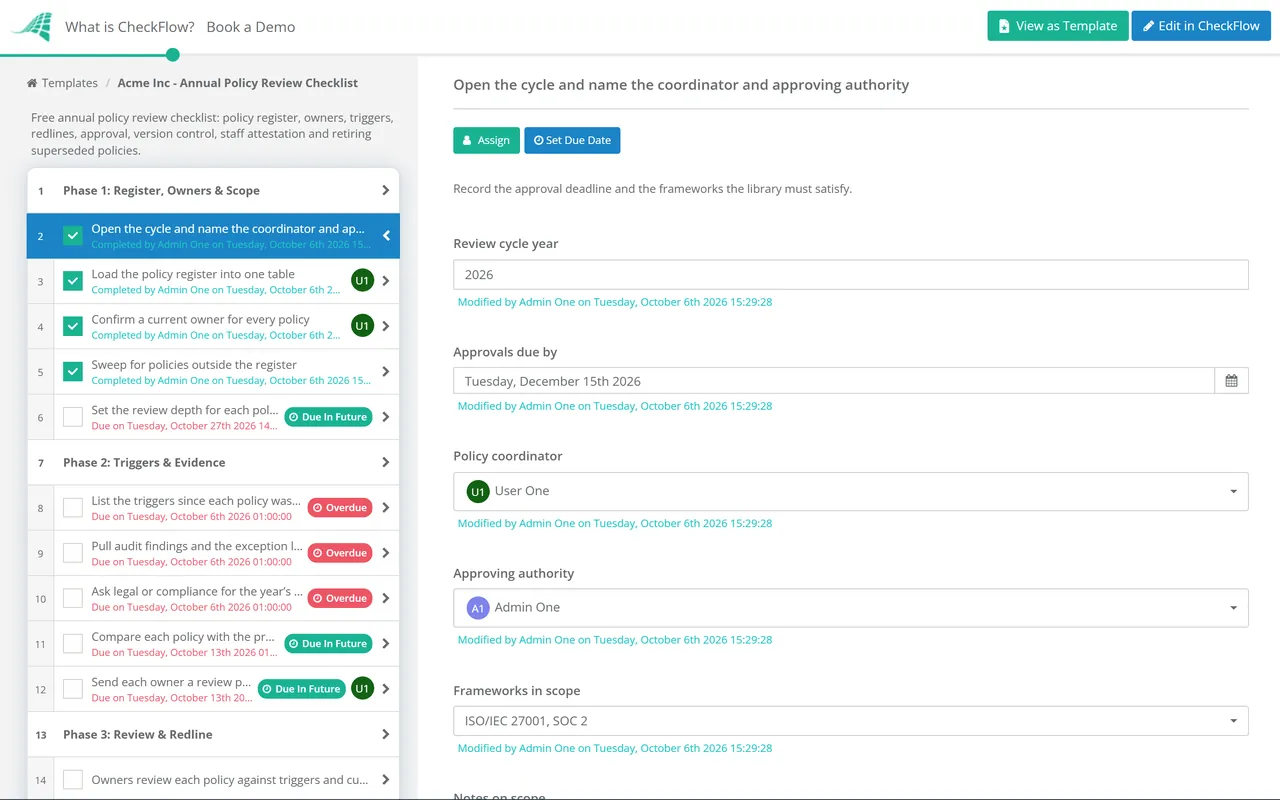
Phase 1: Register, Owners & Scope

The first task sets the approval deadline, names the coordinator and the approving authority, and records which frameworks apply.

  • Open the cycle and name the coordinator and approving authority — record the approval deadline and the frameworks the library must satisfy
  • Load the policy register into one table — title, reference, owner, approving body, version, last approval, next review date, audience and linked framework
  • Confirm a current owner for every policy — reassign anything owned by a leaver or a role that no longer exists before the review starts
  • Sweep for policies outside the register — check the intranet, shared drives, the staff handbook and team wikis; register them or retire them
  • Set the review depth for each policy — full rewrite, light review or confirm no change, based on risk, age and the triggers logged against it
Phase 2

Phase 2: Triggers & Evidence

Due dates in this phase run back from the approval deadline set in Phase 1.

  • List the triggers since each policy was last approved — law changes, incidents, audit findings, complaints, restructures and new systems, with dates
  • Pull audit findings and the exception log for each policy — repeated exceptions mean either the policy or the practice is wrong
  • Ask legal or compliance for the year’s regulatory changes — a dated list showing which policies each change touches
  • Compare each policy with the procedures beneath it — a policy promising quarterly checks over a procedure that runs them yearly is a finding waiting to happen
  • Send each owner a review pack and a deadline — the current version, the trigger list, relevant findings and the redline rules
Phase 3

Phase 3: Review & Redline

The last task asks whether the review found a material change. A Yes shows the legal check, consultation and re-attestation tasks in Phases 4 and 5.

  • Owners review each policy against triggers and current practice — record No change, Minor edit or Material change in the register
  • Mark every change in a tracked redline — never overwrite the approved text; add a one-line summary of each change for approvers and staff
  • Correct names, roles, systems and links — job titles, team names, mailboxes and cross-references go out of date first
  • Keep mandatory wording to what you can enforce — use ‘must’ only where someone monitors it; move aspirations to guidance
  • Decide whether the review found a material change — new or removed obligations, scope, responsibilities or risk appetite; wording fixes are not material
Phase 4

Phase 4: Legal Check & Approval

The first two tasks appear only after a material change. The approval is assigned to the approving authority named in Phase 1, and the checklist waits for the decision.

  • Legal or compliance checks each materially changed policy — confirms it reflects current law and contracts and promises nothing you cannot deliver
  • Consult the people the change affects — HR for employment terms, information security, finance, and employee representatives where local law or agreements require it
  • Prepare the approval pack — every policy with its outcome and change summary, plus redlines for the material changes
  • Approving authority approves the reviewed library — checks the pack, then records Approved or Not approved with any conditions
  • Record board or committee approval for reserved policies — attach the minute reference for policies only the board may approve, such as the code of conduct
  • Assign version numbers and effective dates — a new version for every changed policy, and a new approval date for those confirmed unchanged
Phase 5

Phase 5: Publish, Communicate & Attest

Re-attestation appears after a material change. The PCI DSS task appears when PCI DSS is among the Phase 1 frameworks, because that acknowledgement is due every 12 months regardless.

  • Publish the approved versions in one place — the location staff are told to use, with version, owner, approval date and next review on each cover
  • Withdraw superseded copies wherever they were copied — intranet pages, shared drives, onboarding packs and supplier portals; archive rather than delete
  • Tell staff what changed, not just that something did — a short summary per material change, sent to the people it affects
  • Collect re-attestations for materially changed policies — from the population each policy applies to; chase stragglers through their managers
  • PCI DSS: collect the 12-month security policy acknowledgements — Requirement 12.6.3 needs personnel to confirm they have read and understood it at least once every 12 months
  • Update training and guidance that quotes the policies — induction slides, e-learning, manager guides and customer-facing summaries
Phase 6

Phase 6: Retire, Record & Reschedule

The annual schedule starts next year’s checklist on the same date.

  • Retire policies that are no longer needed — the approving authority agrees the retirement, and the last version is archived for its retention period
  • Update the register with versions, dates and owners — the register is the index auditors sample from, so it must match what is published
  • Log follow-up actions with owners and dates — procedure rewrites, training changes and exceptions the review uncovered
  • Set each policy’s next review date — annual by default, sooner for high-risk policies, and passed to the compliance calendar
  • Report the cycle to the approving authority — policies reviewed, changed, retired and overdue, plus attestation rates

Policy Review Requirements Mapped to the Checklist

The table lists the framework requirements most often behind an annual policy review and the phase that produces the evidence. Sector regulators and contracts can add their own, so treat the table as a starting point, not legal advice.

Framework Requirement What it asks Evidenced in
ISO/IEC 27001:2022Clause 5.2Top management establishes the information security policy; it is available as documented information, communicated within the organisation and available to interested parties as appropriatePhases 4 and 5
ISO/IEC 27001:2022Annex A 5.1Policy and topic-specific policies defined, approved by management, published, communicated, acknowledged, and reviewed at planned intervals and after significant changesPhases 1 to 5
ISO harmonized structure (ISO/IEC 27001:2022, ISO 9001:2026 and other management system standards)Clause 7.5Review and approval of documented information for suitability and adequacy; control of changes such as version control; retention and dispositionPhases 3, 4 and 6
PCI DSS v4.0.1Requirements 12.1.1 and 12.1.2Security policy established, published, maintained and disseminated; reviewed at least once every 12 months and updated as neededPhases 1 to 5
PCI DSS v4.0.1Requirement 12.6.3Personnel acknowledge at least once every 12 months that they have read and understood the security policy and proceduresPhase 5
PCI DSS v4.0.1Requirements 1.1.1 to 11.1.1Each requirement’s policies and procedures are documented, kept up to date, in use and known to all affected partiesPhase 2
SOC 2 (2017 Trust Services Criteria)CC5.3, COSO Principle 12Point of focus: management periodically reviews control activities for continued relevance and refreshes them when necessaryPhases 2 to 4
NIST CSF 2.0GV.PO-02Cybersecurity risk policy reviewed, updated, communicated and enforced to reflect changes in requirements, threats, technology and missionPhases 2 and 5
HIPAA Security Rule45 CFR 164.316(b)(2)Review documentation periodically and update it as needed; make it available to those who implement it; keep it for six years from creation or from when it was last in effect, whichever is laterPhases 5 and 6

Most of these texts say ‘planned intervals’ or ‘periodically’. Of the frameworks above, only PCI DSS fixes the interval at 12 months, so an annual cycle is a convention that satisfies the rest, provided triggered reviews happen in between. The HIPAA row reflects the current Security Rule. A proposed update was published in January 2025, and at the time of review the Federal Register showed no final rule. Nothing on this page is legal advice.

Why Run Your Policy Review in CheckFlow?

1

The cycle starts itself every year

An annual recurring schedule opens the review on the same date each year. Owner deadlines run back from the approval date you enter, and the register sits in a table on the first task, so the coordinator chases from one list rather than a spreadsheet emailed around.

2

A material change brings its own steps

Conditional logic shows the legal check, consultation and re-attestation tasks only when the review finds a material change. A quiet year stays short, and the PCI DSS acknowledgement step appears only for libraries that need it.

3

Approval with a name and a date

The approval is assigned to the authority you named and the checklist waits for it. Redlines, minute references and attestation exports attach to their tasks, and the activity trail shows who did what, and when, for the auditor who asks.

CheckFlow is not a document management system or a policy portal, and it does not give legal advice. Your policies stay where staff read them; CheckFlow runs the review around them. Recurring checklists keep the annual cycle and the triggered reviews on schedule, and CheckFlow’s SOP software turns the procedures beneath each policy into checklists people actually follow.

Some policies drive their own annual process. The Conflict of Interest Declaration Checklist runs the yearly declaration campaign once the policy is approved, and the Whistleblowing Report Handling Checklist handles reports made under your speak-up policy. To standardise the procedures beneath your policies, start from the Process Standardization Checklist.

Frequently Asked Questions

How often should company policies be reviewed?

+

At least once a year is the common standard, and for the information security policy under PCI DSS it is a requirement. ISO/IEC 27001 and SOC 2 leave the interval to you, but an auditor will expect a defined cadence and evidence that you kept to it. Higher-risk policies, such as access control or anti-bribery, may warrant a shorter cycle. Whatever the cadence, review straight away when a law, an incident or a restructure makes a policy wrong.

Who should approve a policy after its annual review?

+

The authority your governance framework gives that policy, recorded in the register. A common pattern is the board for the code of conduct and other reserved matters, the executive team for organisation-wide policies such as information security, and a function head for narrower topic policies. ISO/IEC 27001 requires management approval and top management to establish the information security policy. The owner who wrote the redline should not be the only approver.

What counts as a material change to a policy?

+

A change to what people must do, who must do it, who the policy covers or how much risk the organisation accepts. Adding a reporting deadline, widening scope to contractors or changing an approval limit are material. Fixing a job title, a broken link or the layout is not. Material changes need the legal check, communication and re-attestation; minor edits need approval and a new version number.

Do employees have to re-sign policies every year?

+

For the security policy in a PCI DSS environment, yes: Requirement 12.6.3 needs an acknowledgement at least once every 12 months. ISO/IEC 27001 Annex A 5.1 asks for policies to be acknowledged by relevant personnel but sets no interval. Elsewhere it is your choice. Many organisations ask for annual acknowledgement of the code of conduct and a fresh one whenever another policy changes materially, with records kept against each person and version.

How long should we keep superseded versions of a policy?

+

As long as you might need to show what applied at a past date, which your retention schedule should state. For HIPAA Security Rule documentation, 45 CFR 164.316 sets six years from creation or from the date it was last in effect, whichever is later. Archive superseded versions with their approval record rather than deleting them; the Data Retention & Disposal Review Checklist helps set the periods.

What is the difference between a policy, a standard and a procedure?

+

A policy states what the organisation requires and why, and is approved at a senior level. A standard sets the specific rules that meet it, such as password length. A procedure describes how a task is done, step by step, and is owned by the team that does it. Review them together, because most policy failures are a policy and a procedure that no longer agree.

Is CheckFlow free for this template?

+

14-day free trial, no card required. The Business plan is $10 per user per month after the trial. Full details at checkflow.io/pricing.

Review Every Policy on Time, With the Approvals to Prove It

Free trial — no credit card required.