Compliance Monitoring & Testing Checklist Template

The test was done, but nobody can redraw the sample, half the evidence is in someone’s inbox, and the workpaper went to the committee before anyone reviewed it.

Last reviewed: October 2026

Printed from checkflow.io/templates/compliance/compliance-monitoring-testing-checklist

This free compliance monitoring checklist is for compliance officers and monitoring teams who run planned tests of the business. One run is one test of one obligation area for one period, for example a quarter’s financial promotions, complaints handling, AML customer files or privacy notices. It takes the test from the monitoring plan, designs it, gets the population and checks it is complete, draws the sample, builds the workpaper from the evidence, records the results and rates each finding. A reviewer who did not do the work signs it off before the report goes to the compliance committee, and the plan is updated from the result. A remediation and retest phase appears when the test finds exceptions. Ticks on the first task add short notes and reporting tasks for FCA firms, EU MiFID II firms, SEC-registered advisers and FINRA members. It is framework-neutral, and following it does not by itself meet any rule.

A Compliance Testing Workpaper That Runs as a Checklist

Compliance monitoring is the compliance function’s continuing check that the business keeps to its obligations. A compliance test is one planned piece of that work: a defined population, a sample, set criteria and a conclusion, done in this template by someone who does not run the activity tested. The record of the test is the workpaper: what was tested, against which requirement, on what evidence, what was found and who reviewed it. This checklist builds the workpaper as it goes, so the record is complete when the reviewer signs it off.

In the US, the Justice Department’s Evaluation of Corporate Compliance Programs (updated September 2024) asks prosecutors to look at a company’s control testing, including “How are the results reported and action items tracked?” It is guidance for prosecutors, not a duty on companies. This checklist answers that question for one test: Phases 5 to 7 record the results, the reviewer’s sign-off and the report, and Phase 9 tracks the actions and the retest.

This checklist

One test of one area

Covers: one planned test from the monitoring plan: its design, population and sample, the workpaper, the findings, the reviewer’s sign-off, the committee report and the retest.

Planned around: the compliance committee meeting, from about six weeks before it to about seven weeks after.

Output: a signed-off workpaper, rated findings with owners and dates, and a report to the committee.
The programme

The programme and its monitoring plan

Covers: the obligations register, the compliance risk assessment and the monitoring plan the tests come from, in the Compliance Program Checklist. Its Phase 8 runs the first monitoring cycle at programme level.

Planned around: the meeting that approves the programme.

Output: an approved programme and monitoring plan. Each test in the plan then runs here.

Financial reporting

Testing financial reporting controls

Covers: internal control over financial reporting, samples set by how often each control runs, and the hand-off to the external auditor, in the SOX Internal Control Testing Checklist.

Planned around: the financial year end.

Output: tested key controls and evaluated deficiencies. An audit of a legal team’s own compliance is in the Compliance Audit Checklist for a Legal Department.

What the Compliance Monitoring & Testing Checklist Covers

Nine phases take one test from the monitoring plan, about six weeks before the compliance committee meeting, to the retest of what was fixed about seven weeks after it. The first task’s answers add a review of the last test for a repeat, and short notes and reporting tasks for the rules that apply. Nothing after the reviewer’s sign-off can be completed until the decision is recorded. The finding tasks and the remediation and retest phase appear when the test finds exceptions, and two tasks on reporting a breach appear when a finding may need it.

  1. Phase 1

    Phase 1: Set Up the Test

    5 tasks

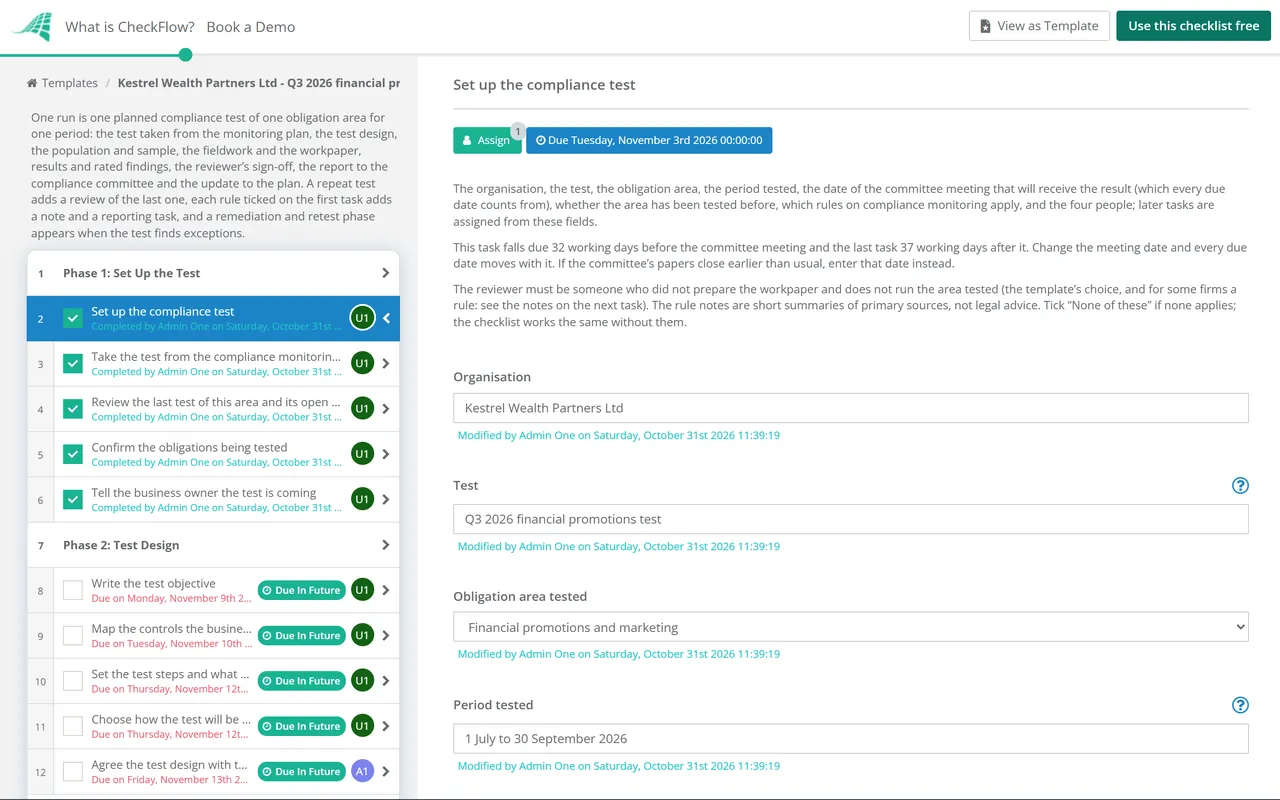
    Start about six weeks before the compliance committee meeting that will receive the result. The first task names the four people, says whether the area has been tested before and which rules on compliance monitoring apply to the firm; each answer adds what it needs. Every due date counts from the committee meeting, in working days.

    • Set up the compliance test — the organisation, the test, the obligation area, the period tested, the date of the committee meeting that will receive the result (which every due date counts from), whether the area has been tested before, which rules on compliance monitoring apply, and the four people; later tasks are assigned from these fields
    • Take the test from the compliance monitoring plan — the line in the monitoring plan this test comes from, the risk rating that put it there, and why it is due now
    • Review the last test of this area and its open findings — the last workpaper and report, findings still open, actions overdue, and what has changed in the area since
    • Confirm the obligations being tested — the rules, the firm’s own policies and procedures, and any contract terms the area must follow, with the reference for each, so every test step points back to a requirement
    • Tell the business owner the test is coming — the scope, the period, the evidence that will be asked for and the dates, so the people who run the area can plan for it
  2. Phase 2

    Phase 2: Test Design

    5 tasks

    Write down what the test must show and how, before anyone looks at the evidence, so the results cannot shape the method. The reviewer agrees the design before fieldwork starts.

    • Write the test objective — what the test must show, in one or two sentences, for example that every complaint closed in the period had a final response that followed the firm’s procedure
    • Map the controls the business relies on — the checks, approvals, system controls and reports in the business that should prevent or catch a breach, who runs each one and what record it leaves
    • Set the test steps and what counts as an exception — the attributes checked on each item, the evidence that proves each one, and what makes an item an exception
    • Choose how the test will be done — document review, re-performance of the control, analysis of system data, interviews, observation in the business or a review of customer contacts, with the reason for each
    • Agree the test design with the reviewer — the reviewer reads the objective, the controls, the steps and the method before fieldwork starts, and records any change
  3. Phase 3

    Phase 3: Population & Sample

    5 tasks

    A test is only as good as the list it samples from. Get the whole population for the period, show it is complete, then draw the sample in a way someone else could repeat.

    • Request the population for the period — the full list of items in the period (every promotion issued, every complaint closed, every customer file opened), the system it comes from and the date it was run
    • Check the population is complete — agree the count or the total to a second source, such as a finance report, a log or a system count, and record any gap and why
    • Choose the sampling method and size — the whole population, a random sample, a sample chosen by risk, or a mix, and the reason for the size; this template sets no size, because none of the rules it cites does
    • Select the sample and record how it was drawn — the items picked, with the random start or the risk criteria used, so a reviewer could draw the same sample again
    • Request the evidence for each sample item — the list of records the business must provide for each item, where to put them and the date they are due back
  4. Phase 4

    Phase 4: Fieldwork & the Workpaper

    6 tasks

    The workpaper is the record of the test: what was checked, against what, on which evidence, and what was found. Someone who was not there should be able to follow it and reach the same conclusion.

    • Open the workpaper — the header with the test reference, the area, the obligations, the period, the population and the sample, the preparer and the reviewer, and where the evidence is filed
    • Provide the evidence for each sample item — the business owner sends the records for every item, says which cannot be found and why, and does not change a record after the request
    • Test each sample item against the steps — each item checked against every step, marked pass or exception, with the evidence reference beside it
    • Talk to the people who run the process — how the process works in practice compared with the procedure, observed where it can be, with notes of who said what and when
    • Check every result points to its evidence — each pass and each exception traced to a record kept in the file, and any result without one tested again or removed
    • Note anything found outside the scope — issues seen during the test that it was not designed to cover, passed to their owner or added to the monitoring plan, not rated as findings of this test
  5. Phase 5

    Phase 5: Results & Findings

    7 tasks

    Count the results, then turn each exception into a finding with a root cause, a rating and an action. The answer on the results task adds the finding tasks when there are exceptions, and the rating task asks whether a finding may need reporting.

    • Summarise the results — items tested, items passed, exceptions and the exception rate, and whether the exceptions share a cause
    • Confirm each exception with the business owner — the owner sees each exception and can show evidence that was missed; an exception stands unless the evidence clears it
    • Find the root cause of each exception — why it happened: a gap in the procedure, a step not followed, a training or resourcing gap, a system fault or a third party, and whether the same cause affects other areas
    • Rate each finding — High, Medium or Low on this template’s scale, by the harm to customers or markets, the regulatory exposure and how widespread it is
    • Agree an action, an owner and a date for each finding — the business owner proposes the fix for each finding, with a named owner and a due date set by its rating, and compliance agrees it
    • Take advice on whether the finding must be reported — whether the law, a regulator’s rules or a contract requires it to be reported, by when and to whom, and who decides; access to the details restricted
    • Draft the conclusion on the area — Effective, Needs improvement or Not effective on this template’s scale, with the reasons in two or three sentences
  6. Phase 6

    Phase 6: Review & Sign-Off

    7 tasks

    The reviewer, who did not prepare the workpaper, checks it and signs off the test and its findings. Nothing after the sign-off can be completed until the decision is recorded, so a decision on reporting a finding is recorded before it. Approved with changes and Not approved each add a task that says what to do next.

    • Send the workpaper for review — complete, cross-referenced, and with every exception, rating and action in it
    • Review the workpaper — the reviewer checks the population, the sample, the steps, the evidence behind each result, the ratings and the conclusion, and writes review notes
    • Clear the review notes — the tester answers each note, changes the workpaper where needed and records what changed
    • Record the decision on reporting the finding — the decision, who made it and when, the date and reference of any report made, and the committee told
    • Sign off the test and its findings — the reviewer records the decision on the workpaper, the findings, their ratings and the conclusion; nothing after this task can be completed until it is done
    • Make the reviewer’s changes — each change made in the workpaper and the report before it goes to the committee, and the reviewer told what changed
    • Rework the test and ask for a fresh sign-off — the tester does the extra testing or rewrites the findings, and the reviewer changes the decision on the sign-off task to Approved, or un-completes and completes it again; nothing goes to the committee until it reads Approved
  7. Phase 7

    Phase 7: Report to the Compliance Committee

    7 tasks

    Report the result to the committee with the findings, their ratings and the actions agreed, and record what the committee asks for. Each rule ticked on the first task adds a task to put the result where that rule expects it.

    • Write the test report for the committee — the objective, scope and period, the population and sample, the results, each finding with its rating and action, and the conclusion, sent by the committee’s paper deadline
    • Present the results to the compliance committee — the conclusion, the High findings and any actions from earlier tests that are overdue, first
    • Record the committee’s questions and actions — what the committee asked, the actions it set, their owners and dates
    • Add the result to the compliance report to the management body — for a common platform firm, SYSC 6.1.3-A R(3) requires the compliance function to report to the management body at least annually on the overall control environment, the risks identified and complaints handling; add this test to the record for that report. Another FCA firm adds it to the report its compliance function makes to its board, if it makes one, or marks this task not applicable
    • Add the result to the compliance function’s report to management — ESMA’s guidelines list what the mandatory compliance report should contain, including a summary of on-site inspections or desk-based reviews, the major findings and the actions taken; add this test to it
    • File the workpaper with the annual review record — the adviser’s annual review under Rule 206(4)-7(b), whose records Rule 204-2(a)(17)(ii) requires it to keep; this template files each test’s workpaper and report with that record
    • Add the result to the Rule 3120 report to senior management — the summary of the test results and significant identified exceptions, and any supervisory procedure created or amended because of them
  8. Phase 8

    Phase 8: Update the Plan & File

    3 tasks

    Feed what the test found back into the monitoring plan, so the next test of this area is timed by its result, and file the workpaper where it can be found again.

    • Compare the results with the last test — repeat findings, new findings, and actions from the last test that did not work
    • Update the monitoring plan from the result — the area’s risk rating, the date of the next test and any change to how often it is tested, with the retest date if there are findings
    • File the workpaper and the evidence — the signed-off workpaper, the evidence, the report and the committee’s actions, kept for the period your record-keeping rules set
  9. Phase 9

    Phase 9: Remediation & Retest

    4 tasks

    Applies only when the test found exceptions. Track each action to its date, check the evidence that it is done, then retest the fixed control on items from after the fix before the finding is closed.

    • Track the actions to their due dates — overdue actions chased with their owner and escalated to the committee when they slip
    • Check the evidence that each action is done — the changed procedure, the training record, the system change or the corrected files, seen by compliance and not only reported by the business
    • Retest the fixed controls — a fresh sample of items from after the fix, tested with the same steps, and the result recorded in a retest section of the workpaper
    • Close the findings or escalate them — the reviewer closes each finding that passed its retest; any that failed goes back to the business owner with a new date and to the committee

What a Compliance Testing Workpaper Records

Search for “compliance workpaper templates” and you mostly find blank forms. In this checklist the workpaper is built by the tasks themselves: each part below is written in the task named, by the person named, and checked by the reviewer before sign-off. Keep the evidence itself in your document store and its reference in the workpaper.

Part of the workpaper What it records Prepared by Checked by Where in this checklist
HeaderTest reference, area, period, preparer, reviewer and where the evidence is keptTesterReviewerOpen the workpaper (Phase 4)
Objective and obligationsWhat the test must show, and the rules, policies and procedures it tests againstTesterReviewer, before fieldworkPhases 1 and 2
Controls and test stepsThe controls the business relies on, each step, the evidence that proves it and what counts as an exceptionTesterReviewer, before fieldworkPhase 2
PopulationThe full list for the period, its source and how completeness was checkedTester, from the business’s recordsReviewerPhase 3
SampleThe method, the size, the reason for both, and how the items were drawn so the sample can be drawn againTesterReviewerPhase 3
ResultsEach item against each step, pass or exception, with its evidence referenceTesterReviewerTest each sample item (Phase 4)
FindingsEach exception confirmed with the business, its root cause, rating, action, owner and dateTester, with the business ownerReviewerPhase 5
ConclusionEffective, Needs improvement or Not effective, with the reasonsTesterReviewerDraft the conclusion (Phase 5)
Review notesEach note and how it was clearedReviewer writes them; tester clears themReviewerPhase 6
Sign-offThe decision, any changes asked for and the dateReviewerNot applicableSign off the test and its findings (Phase 6)
RetestA fresh sample from after the fix, and whether the control now worksTesterReviewer, who closes the findingPhase 9

What the rules say about monitoring and testing. Short summaries of primary sources, read on 31 October 2026. They are notes, not legal advice. Ticking one on the first task adds its note and a reporting task; a firm under none of them can use the checklist as it stands.

Who it is for Source What it says What this checklist adds
UK common platform firms (FCA)FCA Handbook SYSC 6.1.3-A R to SYSC 6.1.3-C RMonitor on a permanent basis and assess regularly; a risk-based monitoring programme set from a compliance risk assessment; report to the management body at least annually; compliance staff not involved in what they monitorA note on the plan task and a task to add the result to the report to the management body
Other FCA-regulated firmsSYSC 6.1.3 R and SYSC 6.1.3A GSYSC 6.1.3 R requires management companies and operators of electronic lending systems to monitor, and regularly assess, their compliance measures and procedures; other firms take account of it as guidance. It sets no annual report and no independence conditionThe same note; the reporting task applies only if the firm’s compliance function reports to its board
EU investment firms under MiFID IIESMA guidelines on the MiFID II compliance function (ESMA35-36-1952)A risk-based monitoring programme; monitoring that is not only desk-based; tools such as desk reviews and staff interviews; what the compliance report should containA note and a task to add the test to the compliance report
US SEC-registered investment advisersRules 206(4)-7(b) and 204-2(a)(17)(ii)Review at least annually the adequacy of the policies and procedures and the effectiveness of their implementation, and keep records documenting the reviewA note and a task to file the workpaper with the annual review record
US FINRA membersFINRA Rules 3120 and 3110(c)Test and verify the supervisory procedures, amend them where testing shows a need, and report the test results and significant exceptions to senior management at least annually; review the businesses each yearA note and a task to add the result to the Rule 3120 report
Organisations that could face a US federal investigationDOJ Evaluation of Corporate Compliance Programs (updated September 2024)Prosecutors ask what control testing the company does and how the results are reported and action items trackedThe whole checklist, with root causes in Phase 5 and tracking and retest in Phase 9

Dates. The DOJ’s corporate enforcement page lists the September 2024 update as its evaluation guidance. The FCA Handbook shows SYSC 6.1 as last updated on 23 October 2025, and it still carries a note pointing to ESMA’s guidelines, which are dated 6 April 2021. The SEC and FINRA rules are as published on 31 October 2026. This checklist does not decide whether a test meets any of them; your compliance and legal advisers do.

Why Run Compliance Testing in CheckFlow?

1

No report before the reviewer signs

The sign-off is assigned to the reviewer alone, and the checklist halts there: nothing after it, including the committee report, can be completed until the decision is recorded. Approved with changes or Not approved adds the next step. See how approvals that halt a checklist work.

2

Only the tasks this test needs

A repeat test adds the last test’s open findings at the start and a comparison at the end. Exceptions add the finding tasks and the remediation and retest phase, and a finding that may need reporting adds legal advice and the decision. Each rule ticked on the first task adds its note and its reporting task.

3

Timed from the committee meeting

Enter the meeting date and every task falls due a set number of working days before or after it. Tasks are assigned from the four people named in the first task, and the Tasks Grid shows each of them what is due. Start each test in the plan on a recurring schedule so none is missed.

CheckFlow runs the test: who does what and by when, the sample, results and findings tables, the sign-off and the record. It does not decide what to test, how big a sample must be or whether a rule is met; that is for your compliance function and its advisers. The Reports Grid lists every test with its answers, so the next test of an area starts from the last.

Set up the programme and write the monitoring plan with the Compliance Program Checklist, and keep the year’s testing dates in the Annual Compliance Calendar Checklist. Financial reporting controls are tested in the SOX Internal Control Testing Checklist. When a test of complaints finds problems, the Customer Complaints Handling Checklist handles each complaint, and the FCA Consumer Duty Annual Review Checklist, the AML Compliance Programme Review Checklist and the Investment Adviser Annual Compliance Review Checklist use test results in their own reviews. Preparing for a regulator’s visit? See the Regulatory Examination Preparation Checklist. Running many tests at once? CheckFlow’s compliance checklist software keeps owners, evidence and sign-offs in one place.

AI generator

Didn’t find what you need? Describe it.

Describe the process in a sentence and the AI checklist generator drafts the phases and tasks for you.

Frequently Asked Questions

What is the difference between compliance monitoring and compliance testing?

Monitoring is the continuing watch over an area: risk indicators, exception reports and reviews of activity as it happens. Testing is a planned check of a defined population against set criteria, with a sample, evidence and a conclusion. ESMA’s MiFID II guidelines list both kinds of tool in a risk-based monitoring programme. This checklist runs one test; the plan that schedules the tests sits in the Compliance Program Checklist.

What should a compliance testing workpaper include?

The test reference, area and period, the objective and the obligations tested, the controls relied on, the steps and what counts as an exception, the population and how completeness was checked, the sample and how it was drawn, the result for each item with its evidence reference, the findings with root causes and ratings, the conclusion, the review notes and the sign-off. The table above shows who prepares and checks each part.

Who should review and sign off a compliance workpaper?

In this template, someone who did not prepare it and does not run the activity tested, such as the head of compliance monitoring. The reviewer is named on the first task, the sign-off is assigned to them alone, and nothing after it can be completed until they record a decision. For a UK common platform firm, SYSC 6.1.3-C R(4) says the people in the compliance function must not be involved in the services or activities they monitor.

How does one test fit into the compliance monitoring plan?

The monitoring plan lists the areas to test, how often and why, set by the compliance risk assessment. Each line in the plan becomes one run of this checklist: Phase 1 records the plan reference and the area’s rating, and Phase 8 updates the plan with the result and the date of the next test. To write the plan itself, use the Compliance Program Checklist, whose Phase 5 builds it.

How large should a compliance test sample be?

None of the rules cited on this page sets a sample size for compliance tests. This checklist asks for the method (the whole population, random, risk-based or a mix), the size and the reason for both, and records how the sample was drawn so a reviewer could draw it again. This template’s approach is to test the whole population where the data allows, and otherwise to show the reviewer why the sample supports the conclusion.

How should compliance test findings be rated?

By the harm a breach could do to customers or markets, the regulatory exposure and how widespread it is. This template uses three ratings: High (a breach of a rule or harm to customers, told to the compliance lead straight away), Medium (a control gap that could lead to a breach) and Low (a weakness in records or process with no breach). Use your firm’s own scale if it has one, and keep it the same from test to test.

Is compliance testing the same as internal audit?

No. Compliance testing is done by the compliance function, checking that the business keeps to its obligations. Internal audit reviews the control framework as a whole, compliance included. ESMA’s guidelines say reviews by internal audit and other control functions should be coordinated with compliance monitoring, while respecting each function’s independence and mandate. This checklist runs a compliance test; an internal audit is a separate piece of work with its own plan.

Do regulators require compliance testing?

Some do, for the firms they regulate. SYSC 6.1.3-A R requires a UK common platform firm’s compliance function to monitor and regularly assess its measures and procedures. SEC Rule 206(4)-7(b) requires a registered adviser to review at least annually the adequacy and effectiveness of its policies and procedures. FINRA Rule 3120 requires members to test and verify their supervisory procedures and report the results at least annually. None says a test must look like this one; take advice on your firm’s rules.

Is CheckFlow free for this template?

14-day free trial, no card required. The Business plan is $10 per user per month after the trial. Full details at checkflow.io/pricing.

Every Test Planned, Every Result Evidenced, Every Finding Owned

Free trial — no credit card required.

14-day free trial, no credit cardFull refund in your first 30 daysUS hosting, EU on request