
Compliance Attestation Checklist Template

The code of conduct attestation went out in January, nobody chased the people who never answered, and the conflicts staff disclosed are still sitting unread in a survey tool.

Last reviewed: October 2026

Printed from checkflow.io/templates/compliance/compliance-attestation-checklist

This free compliance attestation checklist is for compliance, legal, HR and company secretarial teams who run the yearly campaign in which employees, directors and others confirm the code of conduct and key policies. One run is one campaign. It decides who attests and to what (the code of conduct, named key policies, conflicts of interest, gifts and hospitality, and required training), prepares the statements and the population list, gets the statements approved before launch, chases everyone who has not answered, reviews every disclosure and exception, escalates what needs it, and reports completion and exceptions to the board or audit committee. It ends with the record filed and next year’s date set. A first campaign, a repeat and a US SEC registrant each add the tasks they need, and an escalation phase appears when a disclosure needs one.

An Attestation Campaign Asks Everyone the Same Questions Once a Year

A compliance attestation is a recorded statement in which an employee, director or contractor confirms that they have read the code of conduct and named policies and will follow them, have completed the training they must do, and have disclosed any conflict of interest, gift or breach they know of. An annual campaign asks everyone in scope at the same time and keeps the answers as evidence. Most of what this checklist does is practice, not law: where a task rests on a rule, it names the source.

In the US, the Justice Department’s Evaluation of Corporate Compliance Programs (updated September 2024) tells prosecutors to assess how policies have been integrated into the organisation, “including through periodic training and certification for all directors, officers, relevant employees”, and, where appropriate, agents and business partners. It is guidance for prosecutors, not a duty on companies.

This is not a PCI DSS Attestation of Compliance, the official form a merchant or service provider uses to attest to the results of a PCI DSS assessment (see the PCI DSS 4.0 Compliance Checklist), and it is not the certification a company’s chief executive and chief financial officer give on each annual and quarterly report under section 302 of the Sarbanes-Oxley Act (see the SOX 404 Compliance Checklist). Licences, continuing education and fit and proper certificates in a regulated financial firm are tracked in the Employee Compliance Certification Tracking Checklist and the SM&CR Annual Fitness & Propriety Certification Checklist.

This checklist

One attestation campaign

Covers: everyone in scope confirming the code of conduct, named policies, conflicts of interest, gifts and hospitality, and training, once a year.

Planned around: the launch date, a two-week response window and the board or committee meeting.

Output: a completion rate, every disclosure reviewed and decided, and a report to the board or audit committee.


The policies

Annual policy review

Covers: the policies themselves: owners, triggers, redlines, approval, versions and retirement.

Planned around: each policy’s review date.

Output: an approved policy library, in the Annual Policy Review Checklist. Re-attestation for materially changed policies is one task there; this campaign asks about the current versions.

Each interest

Conflict of interest declarations

Covers: the full declaration form, and the assessment and mitigation of each declared interest.

Planned around: the declaration year and each person’s return.

Output: an approved register of interests, in the Conflict of Interest Declaration Checklist. Gifts, donations and agents are reviewed in depth in the Anti-Bribery & Corruption Compliance Checklist. This campaign collects headline disclosures and passes them on.

What the Compliance Attestation Checklist Covers

Eight phases take one campaign from setting the scope, about five weeks before launch, to the report to the board or committee and next year’s date. The first task’s answers add the tasks for a first campaign, a repeat or a US SEC registrant. Nothing after the approval of the statements and the launch plan can be completed until it is given, and an escalation phase appears when a disclosure needs one.

  1. Phase 1

    Phase 1: Set Up & Scope

    8 tasks

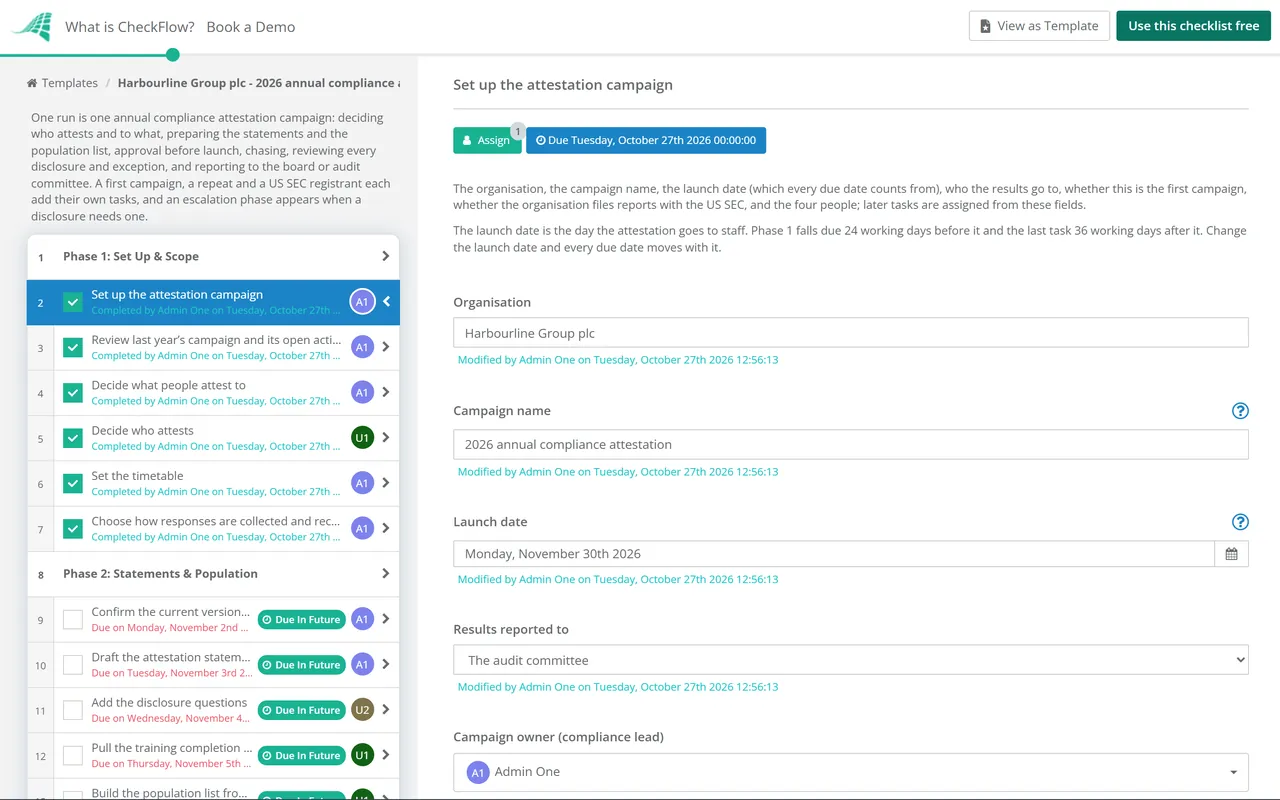
    Start about five weeks before launch. The first task names the four people and asks whether this is the first campaign and whether the organisation files reports with the US SEC; each answer adds the tasks it needs. Every due date counts from the launch date, in working days.

    • Set up the attestation campaign — the organisation, the campaign name, the launch date (which every due date counts from), who the results go to, whether this is the first campaign, whether the organisation files reports with the US SEC, and the four people; later tasks are assigned from these fields
    • Review last year’s campaign and its open actions — the completion rate, late and missing responses, the disclosures and exceptions still open, and anything the board or committee asked for
    • Agree the purpose and the rules of the campaign — who owns it, which policy asks for the attestation, what happens when someone does not attest or qualifies a statement, and who sees the answers
    • Check the code of ethics covers the senior financial officers — a code that applies to the principal executive, financial and accounting officers, meets the Item 406(b) definition, and is filed, posted on the website or offered on request
    • Decide what people attest to — the code of conduct, named key policies, conflicts of interest, gifts and hospitality, and required training completed, with one statement for each
    • Decide who attests — employees, directors and officers, contractors and temporary staff, and any agents or business partners asked to certify, with the statements each group gets
    • Set the timetable — the launch date, the response deadline, the reminder and chase dates, the review period and the date of the board or committee meeting that receives the report
    • Choose how responses are collected and recorded — the tool, how each response is tied to the person and the version they saw, how it is time-stamped, and how a disclosure reaches the reviewer and nobody else
  2. Phase 2

    Phase 2: Statements & Population

    8 tasks

    Statements that name the current version of each policy, a way to disclose an exception rather than only agree, and a population list that matches HR records today, not last year.

    • Confirm the current version of each policy in scope — the version, approval date and owner from the policy register; a policy in the middle of its review is attested at the version staff can read today
    • Draft the attestation statements — short, plain statements that say what “I have read and will follow” means, name each policy and version, and let people disclose an exception instead of only agreeing
    • Add the disclosure questions — new conflicts of interest, gifts and hospitality given or received above the threshold, outside roles, and known or suspected breaches, each with a nil answer and a free-text box
    • Pull the training completion records — completion of each required course from the learning records, so the training statement can be checked against them instead of taken on trust
    • Build the population list from HR records — name, role, department, manager, location, type of worker and start date, and the statements each person gets
    • Reconcile the population with joiners, leavers and last year’s list — joiners, leavers, role changes and people on long-term leave, so nobody is missed or chased in error
    • Update the privacy information for the campaign — why the answers are collected, who sees a disclosure, and how long the records are kept
    • Write the launch message and the staff FAQ — what to do and by when, a named contact, how to disclose an exception, and that a disclosure is a way to ask for a decision, not an admission
  3. Phase 3

    Phase 3: Approve & Launch

    7 tasks

    Nothing after the approval of the statements and the launch plan can be completed until it is given. Approved with changes and Not approved each add a task that says what to do next.

    • Test the campaign with a pilot group — a few people in different roles complete it; check the links, the statements, the disclosure route and the record each response leaves
    • Approve the statements and the launch plan — the approver checks the statements, the disclosure questions, the population and the privacy information, then records the decision; nothing after this task can be completed until it is done
    • Make the changes the approver asked for — each change made before launch, and the approver told what changed
    • Revise the campaign and record a fresh decision — the campaign owner makes the changes, then the approver records a new decision here; do not launch until it reads Approved
    • Brief managers before launch — what is coming and when, how they help chase their teams, and where to send questions; managers do not see their team’s disclosures
    • Launch the campaign — send it to the population on the launch date, with the deadline and the named contact, and record how many people it reached
    • Answer questions during the window — log each question and the answer given, and add the common ones to the staff FAQ
  4. Phase 4

    Phase 4: Track & Chase

    6 tasks

    A campaign that only sends the statements proves people were asked. Chasing by name, with managers copied and an escalation route, is what turns it into a completion rate the board can rely on.

    • Check response rates after the first week — by department, location and manager, and fix access problems before the reminder goes out
    • Send a reminder before the deadline — to everyone who has not responded, restating the deadline and the contact
    • Chase non-responders after the deadline — each person by name with their manager copied; for directors and officers, through the company secretary or the chair
    • Escalate people who still have not responded — to the senior manager responsible and HR, with the chase history, and apply what the policy says happens next
    • Record agreed exceptions and late responses — long-term leave, new joiners and role changes, each with a new date and who agreed it
    • Close the campaign and confirm the final figures — attested, attested with a disclosure, not responded and excused, against the population list
  5. Phase 5

    Phase 5: Review Disclosures & Exceptions

    8 tasks

    Every disclosure gets a reviewer, a decision and a reason. The answer on the last-but-one task decides whether the escalation phase appears.

    • Log every disclosure and exception in the review register — the person or a reference, the statement, what was disclosed, the category and the outcome, starting as they arrive
    • Review the conflict of interest disclosures — against the register of interests; new or changed interests go through the organisation’s conflict of interest process for assessment and mitigation
    • Review the gifts and hospitality disclosures — against the gifts register and the policy limits; items above the threshold that never reached the register are a finding
    • Check training statements against the training records — people who attested to training the records do not show as complete, and how each one was resolved
    • Review refusals, qualified statements and reported breaches — anyone who declined to attest, changed a statement or reported a known or suspected breach, and why
    • Check senior officers’ exceptions for code of ethics waivers — an exception by the principal executive, financial or accounting officer that the organisation approves, or fails to act on, may be a waiver that must be disclosed
    • Decide whether any disclosure needs escalation — a suspected breach of law or of the code, a serious conflict, or a refusal that needs a formal response; Yes adds the escalation phase
    • Record the outcome for each disclosure — no action, mitigation agreed, a registers update, training, a policy clarification or escalation, with who decided and why
  6. Phase 6 (If Needed)

    Phase 6: Escalation

    4 tasks

    Applies only when a disclosure needs escalation. The details stay with the people who need them, and each matter is tracked to a recorded outcome.

    • Refer each escalated matter to the right process — whistleblowing, an investigation, HR, legal or the conflict of interest process, each with an owner and a reference
    • Restrict the details to the people who need them — access to the disclosure and the evidence limited as soon as the matter is escalated, and the person who disclosed protected from retaliation
    • Take advice on whether anything must be reported — legal advice on whether a regulator or another authority must be told, with the decision and who made it
    • Track each escalated matter to closure — the status of each referral, reported to the board or committee in summary without names
  7. Phase 7

    Phase 7: Report to the Board or Committee

    6 tasks

    The report gives completion, exceptions and disclosures in summary. The approver checks it before it goes, without halting the checklist.

    • Analyse the results — completion by department and location, repeat non-responders, the kinds of disclosure, and the training mismatches
    • Compare the results with last year’s — completion rate, disclosures by kind, and whether last year’s actions made a difference
    • Draft the report to the board or committee — the completion rate, exceptions and disclosures in summary, escalations without names, the follow-up actions and what will change next year
    • Approver reviews the report — the approver checks the figures and the wording before it goes to the board or committee
    • Present the report and record the response — the meeting date, the minute reference and any actions the board or committee asked for
    • Assign and track the follow-up actions — policy clarifications, training, process fixes and register updates, each with an owner and a due date
  8. Phase 8

    Phase 8: Keep the Record & Plan Next Year

    5 tasks

    The record shows who was asked, who answered, what they saw and what was done with each disclosure. Keep it for the period your retention schedule sets, then delete it.

    • Update the registers from accepted disclosures — the register of interests and the gifts and hospitality register, so they match what people disclosed
    • File the campaign record — the population, the statements and versions, every response with its time stamp, the chase history, the disclosures and outcomes, and the report
    • Set the retention date for the records — the period your retention schedule sets for attestation records, and the date they are reviewed or deleted
    • Set up attestation for joiners between campaigns — new joiners and people who change role attest when they start, so nobody waits up to a year
    • Set the date of next year’s campaign — the next launch date, and the events that would bring it forward: a new code, a merger or a serious breach

Attestation, Certification and AOC: Which Is Which

Search for “annual compliance certification” or “attestation of compliance” and you find several different things. The table sets them side by side, with the source of each. It is a summary, not legal advice.

Term Who signs or files it What it confirms Source
Employee compliance attestation (this checklist)Employees, directors, officers and anyone else the organisation choosesThat they have read and will follow the code of conduct and named policies, have completed required training, and have disclosed conflicts, gifts and breachesThe organisation’s own policy; the DOJ’s Evaluation of Corporate Compliance Programs (September 2024) looks for periodic training and certification
PCI DSS Attestation of Compliance (AOC)A merchant or service providerThe results of a PCI DSS assessment, documented in a Self-Assessment Questionnaire or a Report on CompliancePCI Security Standards Council glossary
Sarbanes-Oxley section 302 certificationThe principal executive and financial officers of a company that files periodic reports with the SECFor each annual and quarterly report: they have reviewed it; based on their knowledge, it contains no untrue statement or misleading omission of a material fact, and the financial statements fairly present, in all material respects, the company’s financial condition and results; and they are responsible for internal controls15 U.S.C. 7241
FINRA Rule 3130 annual certificationThe chief executive officer (or equivalent) of a FINRA member firmThe firm has processes to establish, maintain, review, test and modify written compliance policies and supervisory procedures, and the CEO has met the chief compliance officer in the past 12 monthsFINRA Rule 3130(b)
SEC code of ethics disclosureA company that files reports with the SECWhether it has adopted a code of ethics for its principal executive, financial and accounting officers; amendments and waivers for those officers are disclosed under Form 8-K Item 5.05, or by a foreign private issuer in its Form 20-F annual reportItem 406 of Regulation S-K (17 CFR 229.406); Form 8-K; Form 20-F Item 16B

What the US Sentencing Guidelines say. Section 8B2.1 of the Guidelines Manual (November 2025) describes an effective compliance and ethics program. The organisation takes “reasonable steps to communicate periodically and in a practical manner” its standards and procedures to the members of its governing authority, high-level and substantial authority personnel, employees and, as appropriate, agents, through training and other information suited to their roles, and the people with day-to-day responsibility report periodically to high-level personnel and, as appropriate, to the governing authority or a subgroup of it. Section 8B2.1 does not mention attestations, but a campaign like this is one way to show both happening.

Waivers for senior officers. For a company that files reports with the SEC, Form 8-K Item 5.05 treats the approval of a material departure from the code of ethics as a waiver, and a failure to act within a reasonable period on a material departure an executive officer knows about as an implicit waiver. A waiver for the principal executive, financial or accounting officer that relates to the code’s required elements is disclosed within four business days. A foreign private issuer reports its code of ethics and any such waiver in its annual report on Form 20-F instead (Item 16B). The SEC answer on the first task adds a task to check senior officers’ exceptions for this.

Personal data. The answers are personal data. In the UK, Article 13 of the UK GDPR requires people to be told, when their data is collected, why it is collected, who receives it and how long it will be kept. Regulated firms should also check their own regulator’s rules on acknowledgements.

Why Run Your Compliance Attestation in CheckFlow?

1

No launch until the approver decides

The approver’s decision on the statements and the launch plan is assigned to them alone, and the checklist halts there: nothing after it, including the launch, can be completed until the approver records a decision. Approved with changes or Not approved adds the next step, and a campaign that is not approved is not launched until a fresh decision reads Approved. See how approvals that halt a checklist work.

2

Only the tasks this campaign needs

A first campaign adds the task that sets the rules for people who do not attest; a repeat adds last year’s review and the comparison with it. A company that files with the SEC adds the code of ethics and waiver checks, and a disclosure that needs escalation adds a phase that tracks each matter to closure.

3

Chased by name, timed from the launch date

Enter the launch date and every task falls due a set number of working days before or after it. Tasks are assigned from the four people named in the first task, and the Tasks Grid shows each of them what is due. Run it on a recurring schedule so next year’s campaign starts on time.

CheckFlow runs the campaign: who does what and by when, the chase, the review of each disclosure, the approval and the record. It is not an e-signature tool, and it does not decide whether a disclosure is a conflict or a breach. The Reports Grid lists every campaign with its answers, so next year starts from this one.

Review the policies themselves with the Annual Policy Review Checklist, and take each declared interest through the Conflict of Interest Declaration Checklist. The Anti-Bribery & Corruption Compliance Checklist covers gifts, hospitality and third parties in depth, and the Whistleblowing Report Handling Checklist handles a concern raised through a speak-up channel. In a regulated financial firm, track licences and annual acknowledgements with the Employee Compliance Certification Tracking Checklist. The Annual Compliance Calendar Checklist keeps this campaign on the calendar. Running several compliance programmes? CheckFlow’s compliance checklist software keeps owners, evidence and sign-offs in one place.

AI generator

Didn’t find what you need? Describe it.

Describe the process in a sentence and the AI checklist generator drafts the phases and tasks for you.

Frequently Asked Questions

What is a compliance attestation?

A recorded statement in which a person confirms that they have read and will follow the code of conduct and named policies, have completed required training, and have disclosed any conflict of interest, gift or breach they know of. This template collects it from everyone in scope once a year, and sets up attestation for new joiners when they start. The answers become evidence that the code and policies reached people, and the disclosures are reviewed like any other report.

What should an employee compliance attestation statement include?

This template uses one statement each for the code of conduct, the named key policies at their current versions, conflicts of interest, gifts and hospitality above your threshold, and required training. It adds disclosure questions with a nil answer and a free-text box, so people can report an exception rather than only agree. Name the policies and versions in the statement: “I have read all policies” proves little.

Is an annual code of conduct attestation a legal requirement?

This checklist treats it as practice: its steps are its own choices unless a task names a source. In the US, the Justice Department’s guidance for prosecutors looks for “periodic training and certification” of directors, officers and relevant employees, and the Sentencing Guidelines expect standards to be communicated periodically. A company filing with the SEC must disclose whether it has a code of ethics for its principal executive, financial and accounting officers. Regulated firms should check their own regulator’s rules.

Is this the same as a PCI DSS Attestation of Compliance?

No. The PCI Security Standards Council defines the Attestation of Compliance (AOC) as its official form for merchants and service providers to attest to the results of a PCI DSS assessment, documented in a Self-Assessment Questionnaire or a Report on Compliance. It is about card data security. This checklist collects staff attestations to a code of conduct and policies. For PCI DSS, use the PCI DSS 4.0 Compliance Checklist.

What does annual compliance certification mean?

It depends on who is asking. Some organisations use it for the employee attestation this checklist runs. Under FINRA Rule 3130, a member firm’s chief executive certifies each year that the firm has processes to establish, maintain, review, test and modify its compliance policies. Under section 302 of the Sarbanes-Oxley Act, the chief executive and chief financial officer certify each annual and quarterly report. The table above sets them side by side.

Who should complete the attestation?

Whoever the organisation decides should, and this checklist asks you to decide it in Phase 1. It offers employees, directors and officers, contractors and temporary staff, and agents or business partners, which the DOJ guidance mentions where appropriate. Build the list from HR records, reconcile it with joiners and leavers, and record anyone excused, such as people on long-term leave, with a new date.

What happens when someone discloses an exception or refuses to attest?

The reviewer logs it, reviews it against the registers and records an outcome: no action, mitigation, a register update, training, a policy clarification or escalation. Conflicts go through your conflict of interest process. A suspected breach is referred to the right process, such as whistleblowing or an investigation, with access restricted. What happens to someone who refuses is your policy’s decision; a first campaign sets it in Phase 1.

How long should attestation records be kept?

For the period your retention schedule sets. This template does not set one: it asks you to record the period and a review or delete date in Phase 8. In the UK, Article 13 of the UK GDPR requires staff to be told, when the data is collected, how long it will be kept or the criteria used to decide that, so the privacy information in Phase 2 and the retention date should match.

Is CheckFlow free for this template?

14-day free trial, no card required. The Business plan is $10 per user per month after the trial. Full details at checkflow.io/pricing.

Every Statement Approved, Every Answer Chased, Every Disclosure Reviewed

Free trial — no credit card required.

14-day free trial, no credit cardFull refund in your first 30 daysUS hosting, EU on request