
Fixed or rolling deadlines
Examples: FINRA Regulatory Element, state CE, UK certificates, SPS renewals.
Cadence: annual cut-off or 12 months from issue.
Risk: the person keeps working after cover has lapsed.
Last reviewed: September 2026
No Credit Card Required
In a regulated financial firm, many people may only do their job while a qualification, registration or certificate is current. Broker-dealer representatives need FINRA continuing education. Adviser staff sign the code of ethics. UK certification staff need a fit and proper certificate that expires after 12 months. This free compliance certification tracking checklist gives compliance and HR teams one recurring cycle for all of it. A monthly run refreshes the register, checks expiries and CE progress, chases what is missing and escalates lapses. Conditional phases add the annual attestations and UK certification when they fall due, and every run ends with a named compliance officer’s sign-off.
Most firms already have the raw data: the learning platform, FINRA’s CE records and HR’s joiner and leaver list. What is missing is a cycle that puts those sources side by side, spots the person who appears in one and not the other, and makes someone accountable for the gap.
The obligations also do not share a calendar. Some have a fixed annual deadline, some fall on an individual’s anniversary and some are triggered by an event and must be handled in days. A process that only looks once a year misses the last two.
Examples: FINRA Regulatory Element, state CE, UK certificates, SPS renewals.
Cadence: annual cut-off or 12 months from issue.
Risk: the person keeps working after cover has lapsed.
Examples: code of ethics, holdings, outside activities, conflicts.
Cadence: one annual campaign, plus quarterly trade reports.
Risk: a handful of stragglers nobody chases.
Examples: Form U4 amendments, FCA Directory changes, role changes, new joiners.
Cadence: within 30 days, 10 days or 7 business days of the event.
Risk: a late filing found during an examination.
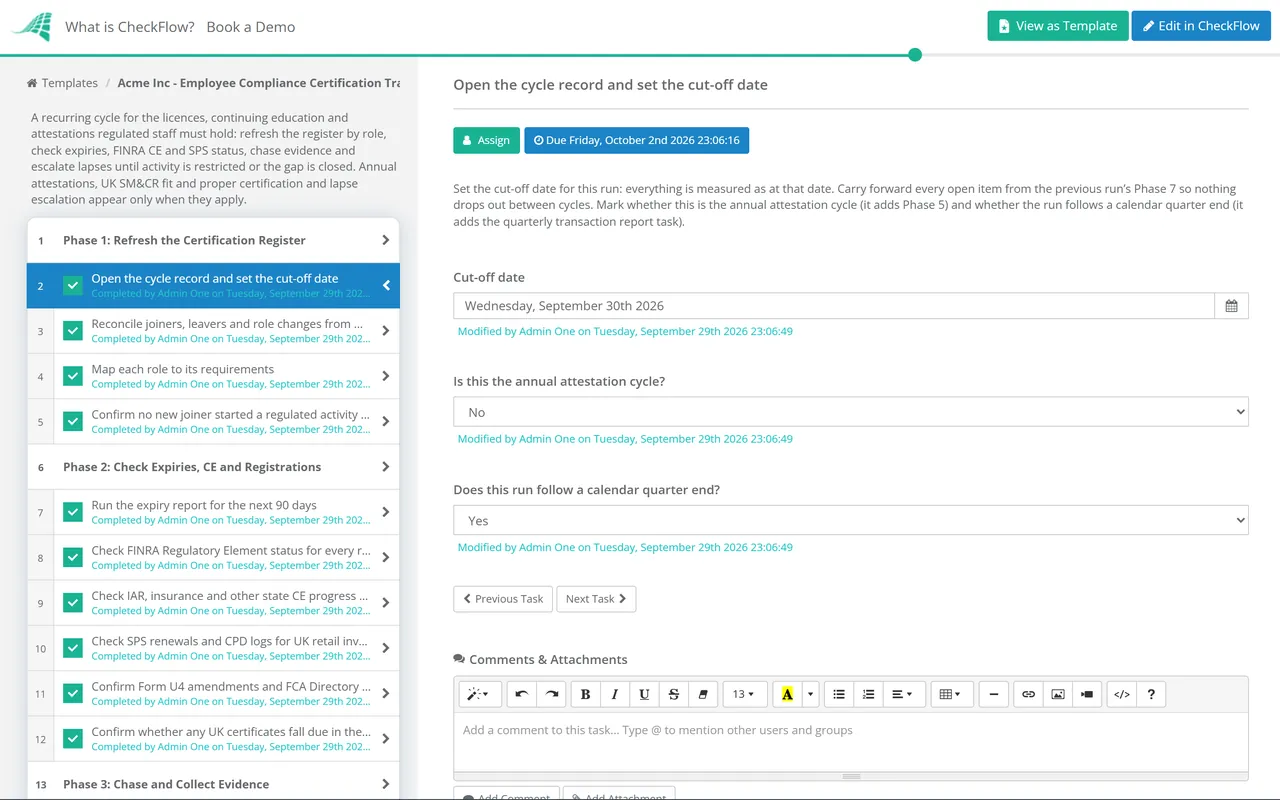
Four phases run every month. Escalation, annual attestations and UK certification switch on only when earlier answers call for them.
Assigned to a compliance analyst. The register is only as good as the HR feed behind it.
Shown only when a lapse or overdue item was recorded at the cut-off.
Shown only when the cycle is marked as the annual attestation cycle in Phase 1.
Shown only when UK certificates fall due. The approval is assigned to the named SMF or HR lead chosen in Phase 1.
Assigned to the compliance officer by name. The analyst who ran the cycle cannot sign it off.
The table lists the US and UK obligations the checklist is built around, with the evidence that proves each one. Which rows apply depends on your firm type and regulator, and state rules vary. Check your own regulator’s current rules and treat the table as a starting point, not legal advice.
| Obligation | Applies to | Cadence / deadline | Evidence | Phase |
|---|---|---|---|---|
| FINRA Regulatory Element CE, Rule 1240(a) | FINRA-registered representatives and principals | Annually by 31 December (first due the year after registering); missed means CE inactive | CE completion record | 2, 4 |
| FINRA Firm Element, Rule 1240(b) | Registered persons at member firms | Needs evaluation and written training plan at least annually | Needs analysis, plan, completion records | 5 |
| Form U4 amendments, FINRA By-Laws Art. V, Sec. 2(c) | Registered persons | Within 30 days of learning the facts; 10 days for a statutory disqualification | Filing confirmation | 2, 4 |
| Annual compliance meeting, Rule 3110(a)(7) | Registered representatives and principals | At least annually | Agenda and attendance | 5 |
| Code of ethics, SEC Rule 204A-1 | Supervised and access persons of SEC-registered advisers | Code acknowledgement; holdings within 10 days of becoming an access person, then annually; transactions within 30 days of quarter end | Signed acknowledgements, holdings and transaction reports | 3, 5 |
| IAR continuing education, NASAA model rule | Investment adviser representatives in adopting states | 12 credits a year (6 ethics, 6 products and practice) by 31 December | CE completion record | 2 |
| UK Certification Regime, FSMA s.63E–63F and SYSC 27 | Staff in certification functions | Fit and proper on appointment and at least annually; certificate valid for 12 months | Assessment and signed certificate | 6 |
| FCA Directory, SUP 16.26 | Directory persons | Changes within 7 business days; annual attestation if nothing changed in 12 months | Submission confirmation | 2, 6 |
| SPS and CPD, TC 2.1.15R and 2.1.27R | UK retail investment advisers | At least 35 hours CPD in each 12 months, 21 structured; SPS from an accredited body | SPS copy and CPD log | 2 |
| Conduct Rules notice and training, FSMA s.64B | Most staff of FCA-regulated firms | Notify staff and provide suitable training | Training records | 6 |
Two parts of this map are moving. In the UK, FCA guidance in force since 24 April 2026 confirms that certificates can be issued digitally and that annual recertification can run through existing appraisal processes. The Financial Services and Markets Bill would go further and remove the Certification Regime and the statutory Conduct Rules training duty from FSMA, leaving the regulators to decide what replaces them. At the time of writing the Bill has passed the House of Lords and is before the Commons, and most of it would commence on a date HM Treasury sets later. Until then, annual certification still applies. In the US, the SEC approved FINRA Rule 3290 on outside activities on 15 September 2026; it replaces Rules 3270 and 3280 from an effective date FINRA has yet to announce. State insurance licences carry CE hours and renewal dates set by each state, and EU investment firms follow the MiFID II knowledge and competence requirements.
A recurring schedule starts the run on the first working day of each month. Conditional logic adds the annual attestations once a year, UK certification when certificates fall due and escalation only when something has lapsed.
The fit and proper decision goes to the SMF or HR lead chosen at the start of the run, and the cycle sign-off goes to the compliance officer. Each task records who completed it and when, with the certificate or CE record attached to it.
When an examiner asks how you knew every registered person was current, you export twelve completed runs with timestamps, restrictions and approvals, showing when each lapse was found and fixed.
CheckFlow is not a learning management system, and it does not deliver CE, file Form U4s or submit to the FCA Directory. It runs the tracking, chasing and sign-off around those systems. CheckFlow’s HR checklist software covers the joiner and leaver processes that feed the register, and our financial services page shows other recurring workflows regulated firms run this way.
Examiners ask for certification records early. The Regulatory Examination Preparation Checklist covers readiness for that visit, the AML Compliance Programme Review Checklist tracks AML training, and CheckFlow’s compliance checklist software shows how the rest of your compliance calendar fits together. UK firms run the yearly fitness and propriety cycle, regulatory references and Directory updates in the SM&CR Annual Certification Checklist.

AML Compliance Programme Review Template

Regulatory Examination Preparation Checklist

Human Resources Audit Checklist

Compliance Audit Checklist for a Legal Department

SM&CR Annual Certification Checklist
Describe the process in a sentence and the AI checklist generator drafts the phases and tasks for you.
It is the recurring process of knowing, for every employee in a regulated role, which qualifications, registrations, CE and attestations they need, when each is due and whether it is current. Good tracking catches expiries before they happen, stops people working without cover when something lapses and leaves evidence that the firm checked.
Under FINRA Rule 1240, registered representatives and principals must complete the Regulatory Element for each registration category annually by 31 December. People registering for the first time complete their first one by 31 December of the year after they register. Anyone who misses it becomes CE inactive and must stop all registered activity until they complete it, and a registration left inactive for two consecutive years is administratively terminated.
On appointment and at least once a year. A certificate is valid for 12 months from the day it is issued, and the firm must take reasonable care that nobody performs a certification function without a valid one. The Financial Services and Markets Bill would remove the Certification Regime from legislation, but at the time of writing it has not become law, and the regulators would consult on any replacement rules. Keep certifying annually until then.
Usually a code of ethics acknowledgement, annual holdings reports for access persons, declarations of outside activities, conflicts and gifts, and key policy acknowledgements. Which parts a rule requires depends on the firm: SEC-registered advisers need code acknowledgements and holdings reports under Rule 204A-1, for example. A single annual declaration is often firm practice rather than a rule, and it catches anything not disclosed during the year.
They stop the activity it covers until it is fixed. The firm decides whether a filing or notification is needed, sets a remediation date and restores the activity only once the evidence is on file. Phase 4 also records a root cause, so the same register gap does not cause next year’s lapse.
No. Your LMS, FINRA’s CE systems and your accredited body deliver and record the learning. This checklist sits on top: it compares their records with the register, chases what is missing, escalates lapses and records the sign-off, with their completion reports attached as evidence.
14-day free trial, no card required. The Business plan is $10 per user per month after the trial. Full details at checkflow.io/pricing.
14-day free trial, no credit cardFull refund in your first 30 daysUS hosting, EU on request