
A pipeline full of opportunities that have not advanced in 60 days, whose close dates are copied forward each week, and whose “probability” percentages reflect optimism rather than evidence is not a pipeline — it is a wish list with a CRM interface.
Pipeline management is the infrastructure of revenue predictability. When it is done well — stages with clear definitions and evidence-based advancement criteria, regular pipeline reviews that challenge stale opportunities, and forecasts built on historical conversion rates rather than rep confidence — the pipeline tells the truth about where the business is going. When it is done badly — stages that advance based on the rep’s feeling about the deal rather than specific buyer actions or commitments, opportunities that have not moved in three months but stay in the active pipeline “because they might close”, and close dates that roll forward every week without explanation — the pipeline is a consensus fiction that misleads every decision made from it. A structured sales pipeline management process converts the pipeline from a reporting artefact into a decision-making tool: every stage has a definition, every advancement requires specific evidence, every stale deal is regularly challenged, and every forecast is built on what the data supports. This free checklist gives sales managers, account executives, and revenue operations teams a structured framework for the full pipeline management process.
Standard B2B Pipeline Stages — and What Makes Each One Valid
Each stage has entry criteria (what must be true for a deal to be here) and exit criteria (what specific buyer action advances the deal). Stage advancement is governed by evidence, not rep sentiment.
Stage 1
Lead / Prospect
Definition: Contact identified as a potential customer; outreach initiated.
Entry criteria: Matches the Ideal Customer Profile (ICP).
Exit criteria to advance: Target contact reached; genuine interest expressed or initial qualification completed.
Stage 2
Qualified
Definition: Initial qualification confirms the prospect has a problem worth solving and meets minimum fit criteria.
Entry criteria: Connected conversation with target contact.
Exit criteria to advance: BANT/MEDDIC partially confirmed — at minimum, the problem is real, the decision-maker is identified, and there is expressed interest in learning more.
Stage 3
Discovery Complete
Definition: Full discovery conducted; pain, impact, decision process, and timeline understood.
Exit criteria to advance: Complete understanding of the buying criteria; proposal or demo requested by the buyer.
Stage 4
Proposal / Demo
Definition: A tailored proposal or demonstration has been delivered.
Entry criteria: Buyer has requested or agreed to receive a proposal or demo.
Exit criteria to advance: Proposal received and acknowledged; decision-maker engaged; verbal or written positive reception; specific next step toward a decision.
Stage 5
Negotiation
Definition: Commercial discussion underway; buyer is evaluating final terms.
Entry criteria: Proposal accepted in principle; discussion moving to commercial terms.
Exit criteria: Signed contract or formal agreement.
Stage 6A
Closed Won
Signed contract received; project initiated. Pipeline stage complete.
Stage 6B
Closed Lost
Definitive decision not to proceed; reason recorded in CRM; prospect moved to long-term nurture if appropriate.
What the Sales Pipeline Stages Checklist Covers
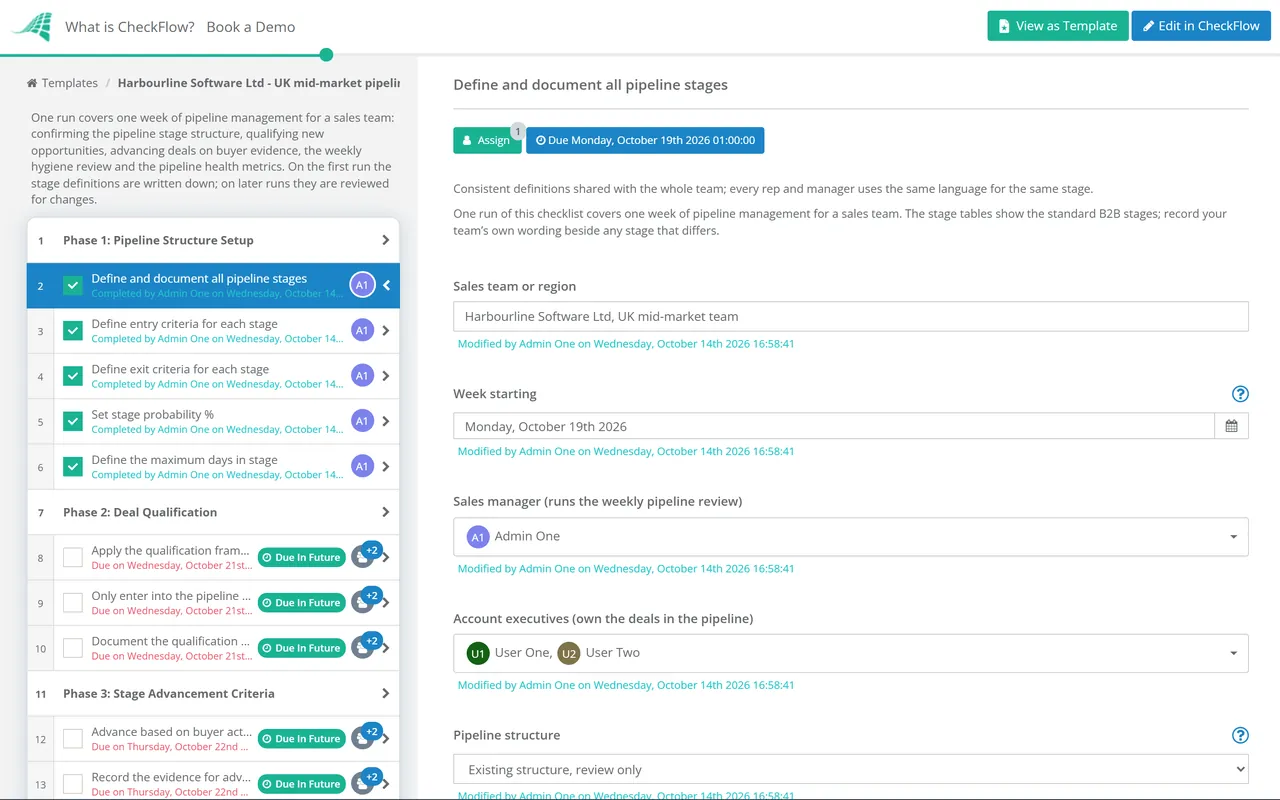
This checklist is structured across five phases covering the full pipeline management process — from stage setup through qualification, advancement, weekly hygiene, and health metrics.
Phase 1
Phase 1: Pipeline Structure Setup
Define and document all pipeline stages — consistent definitions shared with the whole team; every rep and manager uses the same language for the same stage
Define entry criteria for each stage — what specific conditions must be true for a deal to be in each stage?
Define exit criteria for each stage — what specific buyer action or confirmation is required before advancing to the next stage?
Set stage probability % — based on historical close rates at each stage, not subjective assessment; the probability should reflect stage-level data, not the rep’s confidence in a specific deal
Define the maximum days in stage — a deal that has not advanced beyond a set number of days is flagged for review; different for each stage and sales cycle length
Phase 2
Phase 2: Deal Qualification
Apply the qualification framework — BANT (Budget, Authority, Need, Timeline) or MEDDIC (Metrics, Economic Buyer, Decision Criteria, Decision Process, Identify Pain, Champion) or equivalent; applied consistently to every potential opportunity
Only enter into the pipeline if qualification criteria are met — not because the rep wants to have a full pipeline; an unqualified deal in the pipeline distorts forecasts and wastes attention
Document the qualification evidence — in the CRM; what the buyer said about budget, need, timeline, and authority; the qualification is evidenced, not assumed
Phase 3
Phase 3: Stage Advancement Criteria
Advance based on buyer action — not rep action; a rep sending a proposal does not advance the deal; a buyer engaging with the proposal and confirming interest advances the deal
Record the evidence for advancement — “Buyer confirmed proposal reviewed; requested a second meeting with their CFO” is evidence; “Rep feels good about this” is not
Confirm the next specific buyer action — every deal in the pipeline has an agreed next step with a specific date; “will follow up sometime next month” is not a next step
Phase 4
Phase 4: Pipeline Hygiene — Weekly
“The pipeline review that feels confrontational because the manager challenges stale deals is a pipeline review doing its job. The one that just asks ‘how’s it going?’ without challenging the age of deals is producing a comfortable fiction.”
Review all deals inactive for >14 days — has there been any buyer contact? Any response? If not, the deal should either be actively progressed or moved to nurture
Challenge all past-due close dates — a close date that has been copied forward three consecutive months is a wish; either update with a realistic date or move to a later stage
Remove unqualified deals — deals entered without meeting qualification criteria should be removed from the active pipeline; they distort forecasts and create false confidence
Verify all deals have a next action — with a specific date; any deal without a next action is in danger of being forgotten
Phase 5
Phase 5: Pipeline Health Metrics
Calculate total pipeline value — by stage; for the period
Calculate stage conversion rates — Stage 1 to 2 conversion, 2 to 3, 3 to 4, 4 to Closed Won; compared to historical averages
Assess pipeline coverage — total qualified pipeline divided by revenue target for the period; with a ~29% qualified close rate, approximately 3–4x pipeline coverage is required to meet target
Identify top of pipeline health — are there enough leads entering the pipeline to sustain future revenue targets? A pipeline with deals only in late stages will look good this quarter and empty next
This checklist is available as a free, runnable template in CheckFlow — with stage advancement criteria, weekly pipeline hygiene as recurring tasks, and pipeline health metrics structured into a single workflow.
Stage advancement governed by criteria — not confidence
The pipeline stage that advances when the rep “feels good” about a deal rather than when a specific buyer action has occurred is the pipeline that produces forecast misses. CheckFlow’s stage advancement checklist requires specific exit criteria to be evidenced before a deal can move — turning stage advancement from a subjective judgment into an objective process.

2
Pipeline hygiene that runs on a weekly schedule
The weekly pipeline review that challenges stale deals, past-due close dates, and unqualified opportunities requires a consistent structured process. CheckFlow’s pipeline hygiene phase generates the review checklist automatically every week — with the specific checks (inactive deals, past-due dates, missing next actions) as required tasks.
3
Pipeline metrics that support accurate forecasting
A forecast built on rep optimism rather than historical stage conversion rates is a forecast that management cannot trust. CheckFlow builds the stage conversion tracking that makes historical-rate-based forecasting possible — the data infrastructure that turns a pipeline from a list into a predictive tool.
Pipeline entries begin with qualified pitches. CheckFlow’s Sales Pitch Checklist covers the discovery and qualification process that creates pipeline. See the Sales Pitch Checklist →
Pipeline management requires consistent daily oversight. CheckFlow’s Daily Sales Team Supervisor Workflow covers the manager’s daily pipeline review and team management process. See the Daily Supervisor Workflow →
What are the typical stages in a B2B sales pipeline?
+
A typical B2B sales pipeline progresses through stages representing increasing levels of buyer commitment: Lead/Prospect (ICP-matching contact identified, outreach initiated), Qualified (initial qualification confirms a real problem and basic fit criteria), Discovery Complete (full understanding of pain, impact, decision process, and timeline), Proposal/Demo (tailored proposal or demonstration delivered and received), Negotiation (commercial terms under active discussion), and Closed Won or Closed Lost. The specific stage names and count vary by organisation and sales cycle, but the principle is the same: each stage requires specific buyer actions or confirmations before advancement, not just rep activity.
What is pipeline coverage and why does it matter?
+
Pipeline coverage is the ratio of total qualified pipeline value to the revenue target for a given period — typically the current quarter or the next 90 days. With an average qualified opportunity close rate of approximately 29%, a team needs approximately 3–4x their revenue target in qualified pipeline to reliably hit the target (e.g. a team with a £500,000 quarterly target needs £1.5–2 million in qualified pipeline). Pipeline coverage below 3x is an early warning that the target is at risk — giving management time to accelerate new pipeline creation.
What is pipeline hygiene?
+
Pipeline hygiene is the practice of regularly reviewing and cleaning the active pipeline to ensure it accurately reflects the real commercial opportunity — removing or reclassifying deals that no longer meet their stage criteria, updating or challenging past-due close dates, and ensuring every active deal has a specific next action with a scheduled date. Pipelines that are not regularly hygiene-checked accumulate “zombie deals” — opportunities that remain in the active pipeline because removing them would require admitting they are lost, but which distort forecasts and create false confidence.
What is the difference between BANT and MEDDIC?
+
BANT (Budget, Authority, Need, Timeline) is a qualification framework identifying the four conditions that must be true for a deal to be genuinely qualified: the prospect has budget for the purchase, the person has authority to decide, they have a real need the product addresses, and the timeline is defined. MEDDIC (Metrics, Economic Buyer, Decision Criteria, Decision Process, Identify Pain, Champion) is a more comprehensive framework commonly used in enterprise sales, adding specific attention to the quantifiable business impact (Metrics), the senior decision-maker (Economic Buyer), and an internal advocate (Champion). BANT is appropriate for shorter sales cycles; MEDDIC is more appropriate for complex enterprise deals.
Is CheckFlow free to use for this template?
+
You can start a free 14-day trial with no credit card required, giving you full access to all features including this template. The Business plan is $10 per user per month after the trial. Full details at checkflow.io/pricing.
Manage Every Pipeline Deal With Criteria-Based Stages and a Weekly Hygiene Process That Keeps Forecasts Honest
Free trial — no credit card required.
Do you like cookies? 🍪 We use cookies to ensure you get the best experience on our website. Learn more