80% of deals require five or more follow-up touches to close. 44% of sales reps give up after one attempt. The pipeline gap that statistic describes is not a talent problem — it is a process problem.
The math on sales follow-up is both simple and striking. Most deals do not close on the first touch or the second. The research is consistent across industries and sales cycles: the majority of pipeline is lost not because the product was wrong or the price was too high, but because follow-up stopped too early. The rep who sends one email after a discovery call and interprets silence as rejection has abandoned a prospect who might have been a buyer if they had been contacted six more times through two different channels with relevant, value-adding content over the following six weeks. The structured sales follow-up process addresses this with a defined cadence: a specific number of touchpoints, at specific intervals, across the right combination of channels, with content that adds something to each interaction rather than just repeating “just checking in.” This free checklist gives B2B sales reps, business development teams, and sales managers a structured framework for the full sales follow-up lifecycle.
Each touchpoint adds something: a relevant insight, a customer story, a piece of relevant content, an update about a new feature or case study
The interval is respectful but consistent
The tone is helpful, not needy
The prospect who does not respond is treated as someone with competing priorities — not as someone who rejected the product
Pestering
Each touchpoint just repeats the ask: “Just following up to see if you had a chance to...” / “Did you get my last email?”
The interval becomes increasingly frequent as anxiety grows
The tone shifts from helpful to pressuring
The prospect who does not respond is treated as a problem to be overcome rather than a person with other priorities
“The prospect who does not respond may be on annual leave, managing a crisis, waiting for budget to be approved, or simply busy. They are not necessarily uninterested. The follow-up that adds value keeps the relationship warm until their timing aligns with the outreach.”
What the Sales Follow-Up Checklist Covers
This checklist is structured across five phases covering the full follow-up lifecycle — from the immediate post-meeting email through to the break-up message and long-term nurture.
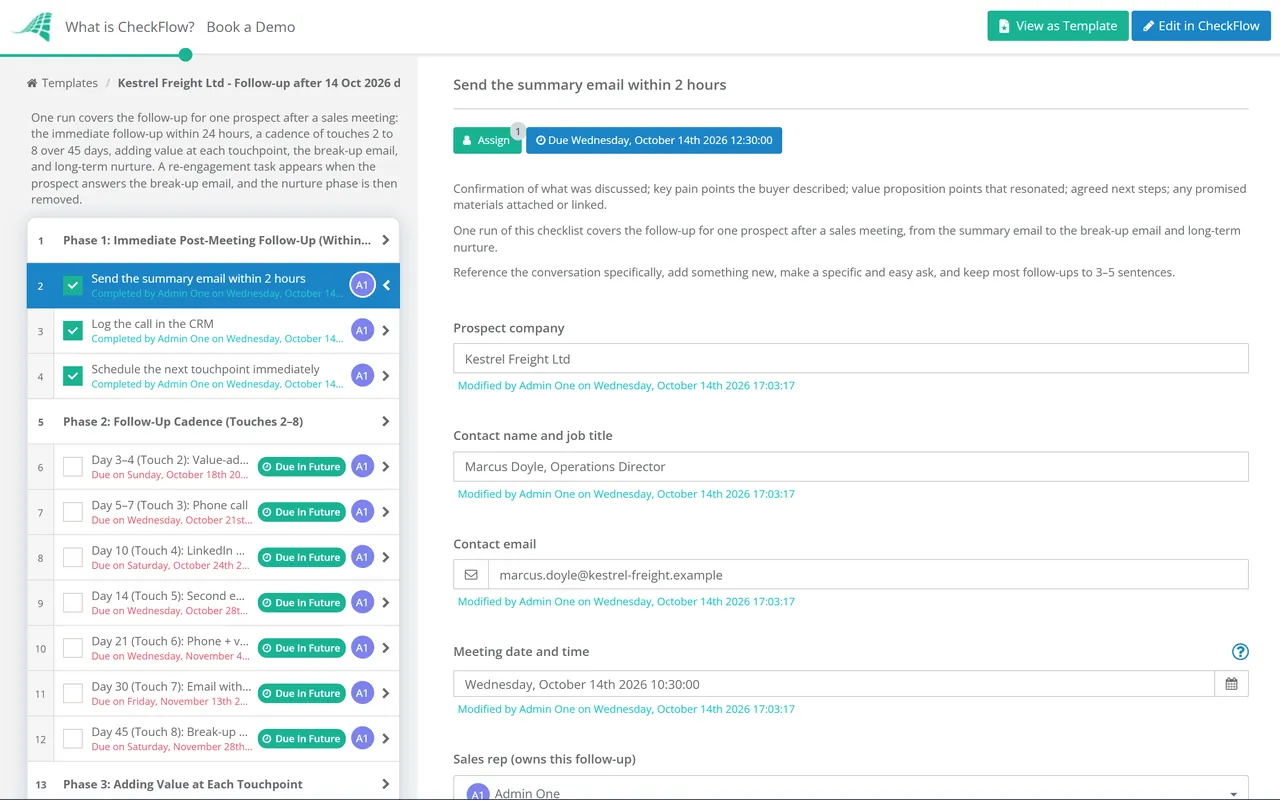
Send the summary email within 2 hours — confirmation of what was discussed; key pain points the buyer described; value proposition points that resonated; agreed next steps; any promised materials attached or linked
Log the call in the CRM — with full notes; outcome; pipeline stage advancement if qualified; next touchpoint scheduled
Schedule the next touchpoint immediately — before moving to another prospect; the follow-up cadence starts now
Phase 2
Phase 2: Follow-Up Cadence (Touches 2–8)
“The cadence below is a proven B2B structure for a prospect at the discovery stage. Adjust the interval and content based on the prospect’s stated timeline and engagement signals.”
Day 3–4 (Touch 2): Value-add email — a relevant piece of content (case study, blog post, report) directly related to a pain they mentioned; not another sales email; something genuinely useful
Day 5–7 (Touch 3): Phone call — brief voicemail if no answer; reference the earlier emails; add a new angle or question relevant to their situation
Day 10 (Touch 4): LinkedIn message or connection — not a sales pitch; a comment on something they shared, a connection request with a personal note, or a brief message referencing the conversation
Day 14 (Touch 5): Second email — different angle; new insight, a relevant stat or industry development, a reference to something timely in their sector
Day 21 (Touch 6): Phone + voicemail — mention you have been trying to reconnect; invite them to suggest a better time or to tell you if the timing has changed
Day 30 (Touch 7): Email with a case study or reference customer — specifically from a company similar to the prospect; makes the value concrete and specific
Day 45 (Touch 8): Break-up email — see Phase 4 below
Phase 3
Phase 3: Adding Value at Each Touchpoint
Collect and organise value-add content — case studies by customer type/industry, relevant reports and research, product updates relevant to specific pain points, and customer testimonials by role/company size; organised for quick retrieval
Match content to the prospect’s stated pain — use what the prospect told you in the discovery call to select the most relevant piece; generic content is less effective than specific content
Track engagement signals — email opens and link clicks (where tracked); website visits; LinkedIn engagement; an engaged prospect who has not replied is a different situation from one who has shown no engagement
Adjust cadence based on engagement — a prospect opening every email warrants a more active follow-up; a prospect with zero engagement after 4 touches may need a longer interval or a different channel
Phase 4
Phase 4: The Break-Up Email
“The break-up email is counterintuitively one of the most effective follow-up techniques in B2B sales. It often generates a higher response rate than all preceding emails combined — because it removes the pressure.”
Send the break-up email after 7–8 touches without response — acknowledge that they may not be interested or the timing may not be right; tell them you will stop following up; leave the door open genuinely
The break-up email should be honest and brief — not passive-aggressive; not a disguised sales email; a genuine acknowledgment that the outreach ends here but the door is open if timing changes
If they respond to the break-up email — treat it as a re-engagement; restart discovery to understand what has changed or what their current situation is
Log the outcome in the CRM — “No response — break-up sent”; schedule a long-term nurture touchpoint in 90 days
Phase 5
Phase 5: Long-Term Nurture (Post Active Cadence)
Move unresponsive prospects to a nurture sequence — 1 touchpoint per quarter; low-frequency; highly relevant content; no sales pressure
Update nurture content seasonally — new case studies, product updates, relevant industry reports; nurture that sends the same email six months apart provides no value
Watch for trigger events — company funding announcement, leadership change, hiring for roles that suggest budget activity, new product launches; these signals warrant reactivating active follow-up
This checklist is available as a free, runnable template in CheckFlow — with the full follow-up cadence as scheduled tasks, value-add content linked at each touchpoint, and CRM update steps built into the workflow.
A follow-up cadence that runs automatically — not from memory
The rep who intends to follow up in three days but gets caught in a busy week and follows up in three weeks has not followed a cadence — they have followed their calendar. CheckFlow’s recurring follow-up tasks generate the next touchpoint reminder automatically at the right interval, regardless of how busy the day was.
2
Consistent touchpoint content across the team
The best-performing follow-up email sequence is the one every rep on the team uses — not the one only the top rep uses because only they know about it. CheckFlow embeds the value-add content strategy into the follow-up workflow, so every rep has access to the right case study at the right touchpoint.
3
Pipeline visibility from follow-up activity
A manager who cannot see whether the team’s follow-up cadences are running, which prospects are stuck in silence, and which have recently re-engaged cannot manage the pipeline effectively. CheckFlow makes the entire follow-up activity visible — by rep, by prospect, and by stage.
Follow-up activity needs to be tracked and logged consistently. CheckFlow’s Sales Call Tracker covers the structured call logging and activity tracking process. See the Sales Call Tracker →
Follow-up converts pipeline. CheckFlow’s Sales Pipeline Stages Template covers the structured process for managing prospects through each stage of the pipeline. See the Sales Pipeline Stages Template →
How many follow-up attempts should a salesperson make?
+
Research consistently shows that 80% of deals require five or more follow-up touches to close — with the majority of deals closing between touches five and twelve in complex B2B sales cycles. For a typical B2B outbound sequence, a structured cadence of 7–8 active touchpoints over 45 days (followed by a break-up email) before moving a non-responsive prospect to long-term nurture is a proven approach. The single most common sales follow-up failure is stopping too early: 44% of reps give up after one attempt, missing the vast majority of deals that require more.
What is a sales follow-up cadence?
+
A sales follow-up cadence is a predefined sequence of touchpoints — specifying the channel (email, phone, LinkedIn), the timing (Day 1, Day 3, Day 7, Day 14, etc.), and the content type (value-add email, phone call, case study, industry insight) for each touchpoint. A structured cadence ensures follow-up happens consistently at the right intervals rather than reactively when the rep happens to remember. The best-performing cadences are multi-channel (combining email, phone, and LinkedIn), add value at each touchpoint rather than just repeating the outreach request, and end with a well-crafted break-up email after 7–8 unsuccessful attempts.
What should a follow-up email say?
+
The most effective follow-up emails: reference the previous interaction specifically (not generically — “following our call where you mentioned [specific pain]” not “following our recent conversation”), add something new (a relevant case study, a piece of industry research, a new product update relevant to their stated situation), make a specific and easy ask (not “let me know your thoughts” but “would Tuesday or Wednesday work for a 20-minute follow-up call?”), and are short (3–5 sentences for most follow-ups — longer emails have lower response rates in outbound sequences).
What is a break-up email?
+
A break-up email is the final touchpoint in a follow-up cadence sent to a non-responsive prospect, acknowledging that the outreach will stop. An effective break-up email is honest, brief, and respectful — it acknowledges that the timing may not be right, tells the prospect this is the last email in the sequence, and leaves the door genuinely open if their situation changes. Break-up emails counterintuitively often generate higher response rates than earlier touchpoints because they remove pressure and create a sense of finality that prompts re-engagement from prospects who were interested but not prioritising the outreach.
Is CheckFlow free to use for this template?
+
You can start a free 14-day trial with no credit card required, giving you full access to all features including this template. The Business plan is $10 per user per month after the trial. Full details at checkflow.io/pricing.
Follow Up Five Times, Not Once — With a Process That Runs Every Time
Free trial — no credit card required.
Do you like cookies? 🍪 We use cookies to ensure you get the best experience on our website. Learn more