
Sales reps spend only 28% of their time actually selling. The rest goes to admin, CRM updates, and internal tasks — most of which exist because the data from the previous call was not captured correctly the first time.
Sales call tracking is both the least glamorous and one of the highest-impact disciplines in sales management. The CRM that is updated accurately after every call is the CRM that produces reliable pipeline forecasts, surfaces coaching opportunities, enables effective follow-up, and allows reps to pick up conversations exactly where they left off. The CRM that is updated from memory at the end of the week — when calls from Tuesday have merged with calls from Thursday in the rep’s recollection — produces pipeline data that everyone knows is unreliable but nobody has time to improve. A structured sales call tracking process minimises the time between call and log, standardises the outcome vocabulary so data is consistent across the team, ensures next actions are always scheduled before moving to the next call, and creates the activity record that both the rep and the manager need to make good decisions. This free checklist gives sales reps, sales managers, and operations teams a structured framework for consistent sales call tracking.
Standardised Call Dispositions — Why a Common Vocabulary Matters
A call disposition is the standardised outcome label applied to every call made — not a free-text note but a selection from a defined set of options that every rep and every manager understands the same way. Without standardised dispositions, pipeline data is not comparable across reps, reporting is unreliable, and the pipeline review becomes a discussion of what people remember rather than what the data shows.
A typical B2B outbound call disposition set covers: No Answer/Voicemail, Gatekeeper/Did Not Connect, Connected/No Interest, Connected/Not Qualified, Connected/Qualified Nurture (interested but wrong timing), Connected/Meeting Scheduled, and Connected/Opportunity Created. The distribution of dispositions across the team is the first input to coaching: a rep with a high “Connected/No Interest” rate may have a qualification or pitch problem; one with a high “Did Not Connect” rate may have a timing or targeting problem.
Disposition
Meaning & Next Action
No Answer
Prospect did not pick up; voicemail left or not; schedule next attempt per cadence
Gatekeeper
Connected to a person who is not the target contact; did not reach target; try a different time or direct line
Connected — Not Qualified
Spoke to target; this is not the right prospect for this product at this time; remove from active pipeline
Connected — Nurture
Spoke to target; there is potential fit but timing is wrong; move to nurture cadence; schedule a long-term follow-up
Connected — Meeting Scheduled
Spoke to target; discovery call or demo booked; move to next pipeline stage
Opportunity Created
Full discovery completed; qualified opportunity; active in pipeline; advance pipeline stage
What the Sales Call Tracker Checklist Covers
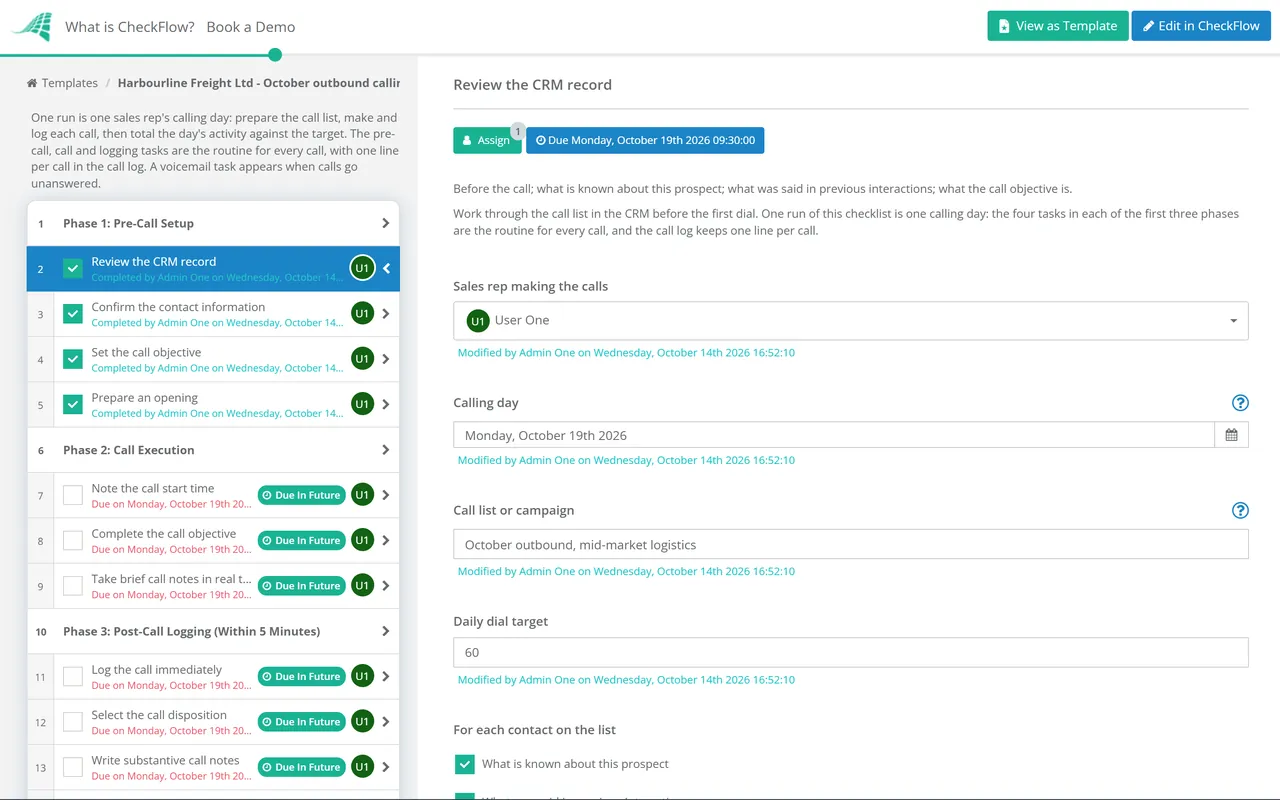
This checklist is structured across four phases covering the full call tracking workflow — from pre-call preparation through immediate post-call logging to the daily activity review.
Phase 1
Phase 1: Pre-Call Setup
Review the CRM record — before the call; what is known about this prospect; what was said in previous interactions; what the call objective is
Confirm the contact information — correct phone number; correct name; correct title; nothing more damaging than calling someone by the wrong name
Set the call objective — one specific desired outcome before dialling; not “have a good conversation” but “book a demo” or “qualify the budget timeline”
Prepare an opening — personalised to this contact; reference the company, the role, or something relevant from the research; not a generic cold script
Phase 2
Phase 2: Call Execution
Note the call start time — for the log; for later analysis of best connection times by hour and day
Complete the call objective — or identify why it was not achieved; if the call produced a next step, confirm it while the prospect is on the line
Take brief call notes in real time — not a transcript but key facts: objections raised, pain points mentioned, decisions described, timeline information, stakeholders identified
Handle the voicemail — if no answer; brief (under 30 seconds); include name, company, one specific reason to call back, and phone number at the end (said slowly); do not re-explain the product
Phase 3
Phase 3: Post-Call Logging (Within 5 Minutes)
“The CRM entry made five minutes after a call is worth ten times the entry made three days later. Capture the notes while the conversation is still in working memory — not at the end of the week when eight calls have blurred together.”
Log the call immediately — in the CRM; call date, time, duration, rep name
Select the call disposition — from the standardised list; not free text; consistent with the team’s definitions
Write substantive call notes — what the prospect said about their situation; specific pains or objections mentioned; what resonated; any commitments made; nothing generic
Record any qualification information — budget, authority, need, timeline (BANT) or equivalent; whatever was revealed in the conversation
Update the pipeline stage — if the call outcome warrants a stage advancement or demotion
Set the next action — scheduled in the CRM or task manager; specific date and task type; a call with no next action is a call that will not be followed up
Phase 4
Phase 4: Daily Call Activity Summary
Count daily calls made — total dials; compare to the daily target
Count meaningful conversations — calls where a target contact was reached and a real conversation occurred (not just a voicemail or gatekeeper interaction)
Count outcomes by disposition — meetings booked, opportunities created, nurture qualified, not interested; the distribution reveals activity quality
Identify any stuck prospects — who has not been contacted in more than the target number of days despite being in an active cadence? Escalate or re-prioritise
Review tomorrow’s call list — any follow-up calls due? Any meetings to prepare for? Queue organised by priority
This checklist is available as a free, runnable template in CheckFlow — with pre-call preparation tasks, standardised disposition selection, CRM update steps, and daily activity review built into a single workflow for every call.
Pipeline forecasting is only as good as the data it is built on. CheckFlow’s call tracking process requires disposition selection and substantive notes immediately after every call — before the rep can move to the next activity — building the consistent data record that makes the pipeline reportable.

2
Activity metrics visible to the manager in real time
The sales manager who finds out at Friday’s review meeting that Tuesday and Wednesday’s call targets were missed cannot intervene. CheckFlow makes daily call activity visible in real time — calls made, connect rate, meetings booked — so coaching conversations happen when they can still change the week’s outcome.
3
Next actions scheduled before moving to the next call
The follow-up that was going to happen “next week” but was never scheduled does not happen. CheckFlow requires a next action to be set before the call log is marked complete — making scheduled follow-up the default outcome of every call, not the exception.
Call tracking and follow-up work together. CheckFlow’s Sales Follow-Up Checklist covers the structured multi-touch follow-up cadence that turns logged calls into closed deals. See the Sales Follow-Up Checklist →
Call quality is tracked by the supervisor through the daily workflow. CheckFlow’s Daily Sales Team Supervisor Workflow covers the manager’s daily oversight and coaching process. See the Daily Supervisor Workflow →
A sales call tracker covers four phases: pre-call preparation (CRM review, contact verification, objective set, opening prepared), call execution (start time noted, call objective pursued, real-time notes, voicemail handled if applicable), immediate post-call logging (CRM updated within 5 minutes, standardised disposition selected, substantive notes written, qualification information recorded, pipeline stage updated, next action scheduled), and daily activity review (total dials vs target, meaningful conversations, outcomes by disposition, stuck prospects identified, next day queue organised).
What are standard call dispositions in sales?
+
Standard call dispositions are the predefined outcome labels applied to every sales call, enabling consistent reporting across the team. A typical B2B outbound set includes: No Answer/Voicemail left, Gatekeeper/Did not connect to target, Connected — Not Qualified (spoke to target but wrong profile), Connected — Nurture (interested but wrong timing), Connected — Meeting Scheduled (demo or discovery booked), and Opportunity Created (fully qualified active opportunity). The value of standardised dispositions is comparability: the distribution of dispositions across the team and over time reveals patterns that inform coaching and strategy adjustments.
Why should CRM notes be written immediately after a call?
+
Research on memory shows that the detail and accuracy of recall drops significantly within hours of an event. For sales calls, this means the specific pain points a prospect mentioned, the objection they raised about a competitor, and the timing comment about Q3 budget — all of which are critically important for follow-up strategy — are substantially less accurately remembered even three hours after the call. CRM notes written within five minutes of the call are substantially more accurate and useful than notes written at the end of the day. More practically, notes written immediately do not require recall — they require transcription of what is still in working memory.
What sales call metrics should a rep track daily?
+
Key daily call metrics include: total dials made (compared to daily target — the activity input metric), connect rate (meaningful conversations with target contacts as a percentage of total dials), meetings booked (the primary output metric for BDR and SDR roles), pipeline created (opportunities qualified today), and outcome distribution by disposition (the ratio of no answers to qualified conversations to meetings booked — reveals targeting, messaging, and timing issues).
Is CheckFlow free to use for this template?
+
You can start a free 14-day trial with no credit card required, giving you full access to all features including this template. The Business plan is $10 per user per month after the trial. Full details at checkflow.io/pricing.
Log Every Call Immediately, Track Every Activity Consistently, Never Miss a Follow-Up
Free trial — no credit card required.
Do you like cookies? 🍪 We use cookies to ensure you get the best experience on our website. Learn more