Daily Sales Team Supervisor Workflow Checklist Template

The sales supervisor who reviews the team’s results on Friday afternoon discovers problems that have been building all week. The supervisor who checks activity inputs at 10am on Monday can change what happens for the rest of the week.

Sales supervision is an intervention discipline. The most valuable time a supervisor spends is not at the end of the period reviewing what happened — it is at the beginning, identifying what is not happening and changing it while there is still time. A rep who made three calls on Monday morning and then spent the afternoon on internal tasks needs a conversation at 2pm on Monday, not at 5pm on Friday. A deal that has been stuck in Stage 3 for 47 days needs a conversation with the rep and possibly a direct contact with the prospect — this week, not at the end-of-quarter review. A structured daily supervisor workflow converts supervision from a reporting function into an intervention function: starting every day with a team pulse, checking activity progress before the day is over, reviewing pipeline health proactively, acting on QA findings promptly, and ending every day with a clear picture of tomorrow’s priorities. This free checklist gives sales team supervisors, team leaders, and sales managers a structured framework for the full daily supervision workflow.

Use This Template Free See Live Example
No Credit Card Required

Manager and Coach — Both Required; Both Distinct

The Manager Role

  • Tracks activity inputs against targets (calls, contacts, meetings)
  • Reviews pipeline health and forecast accuracy
  • Monitors deal progression and identifies stuck deals
  • Escalates or supports deals requiring senior involvement
  • Reports upward on team performance and forecast

The Coach Role

  • Listens to calls and identifies skill development opportunities
  • Delivers specific, timely, evidenced feedback
  • Runs skills practice sessions (roleplay, objection handling)
  • Develops individual development plans for reps with consistent performance gaps
  • Recognises and amplifies high-performance behaviours

“Most supervisors are naturally stronger at one of these roles. The structured daily workflow enforces both — because a supervisor who only manages and never coaches has a team whose performance is governed by talent; a supervisor who only coaches and never manages has a team whose activity is governed by motivation.”

What the Daily Sales Supervisor Workflow Covers

This checklist is structured across five phases covering the full supervision day — from the morning team huddle through activity monitoring, pipeline review, coaching, and end-of-day planning.

Phase 1

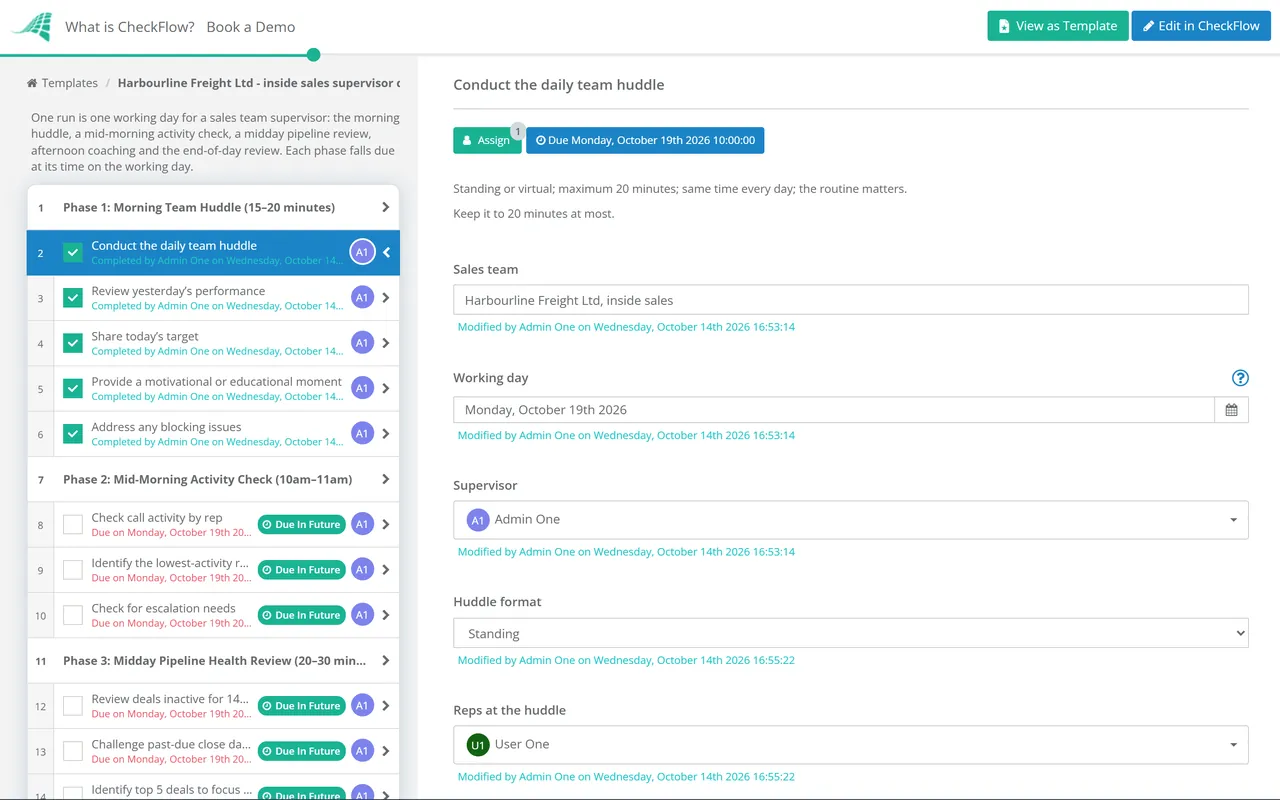
Phase 1: Morning Team Huddle (15–20 minutes)

  • Conduct the daily team huddle — standing or virtual; maximum 20 minutes; same time every day; the routine matters
  • Review yesterday’s performance — briefly: calls made, meetings booked, pipeline created; no individual public callout of underperformers; headline team numbers only
  • Share today’s target — the specific activity targets for today (not the month — today); each rep knows their individual daily call and meeting target
  • Provide a motivational or educational moment — 30–60 seconds; a tip, a customer win from yesterday, a relevant market insight; something that energises the team
  • Address any blocking issues — any system issues, data problems, or product information needed before the team can call effectively
Phase 2

Phase 2: Mid-Morning Activity Check (10am–11am)

  • Check call activity by rep — how many calls made in the first 90 minutes? Any rep significantly behind their daily pace at this point is unlikely to catch up without intervention
  • Identify the lowest-activity rep — and check in personally; is there a problem (system issue, personal issue, list quality) or is it avoidance?
  • Check for escalation needs — any rep on a difficult call or needing pricing authority; supervisors available to assist
Phase 3

Phase 3: Midday Pipeline Health Review (20–30 minutes)

  • Review deals inactive for 14+ days — per rep; what is the status? What is the rep’s plan? Is the plan credible?
  • Challenge past-due close dates — any close date in the past or unrealistically soon; specific evidence required from the rep
  • Identify top 5 deals to focus on today — the highest-value or most-advanced deals that need attention this week; ensure these have specific next actions scheduled
  • Support on specific deals — where a senior touchpoint or introduction from the supervisor would accelerate a deal; offer proactively rather than waiting to be asked
Phase 4

Phase 4: Afternoon Coaching & Individual Development

  • Review QA findings from the past 48 hours — any evaluations completed; coaching priority identified; feedback delivery scheduled
  • Conduct at minimum one individual coaching conversation per day — specific rep; specific skill; based on QA scorecard or observed call; not a general check-in but a focused skills conversation
  • Observe live calls where possible — side-by-side or call recording; the supervisor who does not listen to calls cannot coach calls
  • Acknowledge and amplify high performance — where a rep had a great call or booked a high-value meeting; specific public recognition in the team channel; culture of recognition is built one acknowledgment at a time
Phase 5

Phase 5: End-of-Day Review & Next Day Planning

  • Review team performance against daily targets — total calls made vs target; meetings booked vs target; pipeline advanced; any Closed Won today
  • Identify tomorrow’s priorities — which deals need attention? Which reps need coaching? What is the team’s current pace against the weekly target?
  • Complete any upward reporting — daily or weekly pipeline and activity report to the sales director; accurate, timely, and honest
  • Log the day’s supervision notes — any significant coaching conversations, deal developments, or performance concerns; the record that supports performance management if needed

This checklist is available as a free, runnable template in CheckFlow — with every phase of the supervision day as structured tasks, recurring daily to ensure the routine happens even on busy days.

Use This Template Free

What Supervisors Can Control — and What They Cannot

A common supervisory error is trying to manage outputs (revenue, close rate, pipeline value) rather than the inputs that drive them. A rep cannot will a deal to close faster or make a prospect answer the phone more often. But they can make more calls, improve their opening script, handle objections more effectively, and follow up more consistently. These inputs are directly within the supervisor’s coaching remit.

The supervisor’s management hierarchy: activity inputs (calls, emails, meetings) are directly manageable; conversion rates (connect rate, meeting-to-demo rate, close rate) are improvable through coaching; and revenue results follow from the combination. The supervisor who manages inputs consistently, coaches conversion rates systematically, and tracks results accurately has the full picture — and the ability to intervene at any point in the chain.

Why Run Daily Sales Supervision in CheckFlow?

1

A daily supervision structure that runs regardless of how busy the day gets

The supervisor whose day is consumed by escalations and leadership meetings arrives at 4pm to discover that two reps have made fewer than 15 calls all day. CheckFlow’s daily workflow generates every phase as a structured task — morning huddle, mid-morning activity check, midday pipeline review — ensuring each happens even on busy days.
2

A coaching log that documents individual development

The performance management conversation that needs to refer to coaching provided over the past three months requires documentation. CheckFlow’s daily supervision workflow includes a structured coaching note for every coaching conversation — what was discussed, what was agreed, and whether it was followed up — building the development record that management and HR require.

3

Activity visibility before the day ends

The supervisor’s most powerful intervention is the one that happens on the day the performance problem occurs — not on the day it is reported. CheckFlow’s mid-morning activity check surfaces the rep who is significantly behind pace at 10am — early enough to change the day’s outcome.

Supervisor workflow depends on consistent call quality data. CheckFlow’s Call Center Sales QA Checklist provides the structured evaluation framework that feeds the supervisor’s coaching priorities. See the Call Center Sales QA Checklist →

Pipeline review is one of the supervisor’s daily priorities. CheckFlow’s Sales Pipeline Stages Template covers the structured pipeline management process. See the Sales Pipeline Stages Template →

Frequently Asked Questions

What should a daily sales team supervisor workflow include?

+

A daily sales supervisor workflow covers five phases: morning team huddle (15–20 minutes; yesterday’s performance reviewed, today’s targets shared, motivational moment, blocking issues addressed), mid-morning activity check (call activity by rep checked by 10am; lowest-activity rep contacted; escalation needs identified), midday pipeline review (inactive deals challenged, past-due close dates questioned, top 5 deals identified, supervisor support offered), afternoon coaching and development (QA findings reviewed, individual coaching conversation per rep per week, live call observation, high performance recognised), and end-of-day review and planning (team performance vs target, tomorrow’s priorities identified, upward reporting completed, supervision notes logged).

What is the difference between managing and coaching a sales team?

+

Managing focuses on the measurable business performance of the team: tracking activity inputs (calls, meetings, pipeline created) against targets, reviewing pipeline health and forecast accuracy, and reporting performance to senior leadership. Coaching focuses on the skills and behaviours of individual reps: identifying specific development opportunities from call evaluations, delivering actionable feedback, running skills practice, and building individual development plans. The most effective sales supervisors are competent at both — managing creates accountability; coaching creates capability. A supervisor who only manages has a team whose performance is capped by existing talent; one who only coaches has a team whose activity is governed by self-motivation.

How often should a sales supervisor coach individual reps?

+

Effective sales coaching requires a minimum of one focused individual coaching conversation per rep per week — based on specific QA evaluation findings or observed call behaviour, not a general check-in. More frequent short coaching interactions (observing a live call and providing immediate feedback) are more effective than longer periodic reviews. The research on sales coaching consistently shows that reps with structured weekly coaching outperform those without it by approximately 17%.

How should a sales supervisor handle a rep who is significantly behind activity targets?

+

The first step is a direct, private conversation — not a public callout in the team meeting. The conversation starts with understanding: is there a systemic issue (poor list quality, system problem, unclear expectation), a skills barrier (not confident in the opening or handling early objections), or a motivation or engagement issue? The intervention is calibrated to the cause. Systemic issues are fixed; skills barriers are addressed through coaching; motivation or engagement issues require a more exploratory conversation. The conversation should be documented and followed up within 24–48 hours.

Is CheckFlow free to use for this template?

+

You can start a free 14-day trial with no credit card required, giving you full access to all features including this template. The Business plan is $10 per user per month after the trial. Full details at checkflow.io/pricing.

Supervise the Activity Before the Results — Every Day, With a Process That Doesn’t Skip

Free trial — no credit card required.