AE quota attainment averaged just 51% across B2B SaaS companies in 2024, down from 66% in 2022 — while median ACV quota has risen to $800,000 (Bridge Group, 2024). Read that again: more than half of all sales reps in the sector are not hitting their numbers, and the number they're missing is bigger than ever.
The ramp crisis is part of the cause. The average SaaS AE ramp time has increased 32% since 2020, now reaching 5.7 months. Yet only 43% of sales organisations have a structured methodology for developing selling skills during onboarding (Gartner, 2025). The gap between the ramp period organisations are actually experiencing and the structured programme that would shorten it is widening every year.
The business impact is severe. Replacing one mid-market sales rep costs between $215,500 and $292,000 once you account for recruiting, training, lost pipeline, and the six months of reduced productivity during ramp. At 35% average annual turnover, that cost compounds frighteningly quickly across a team.
Here is the case for this guide: structured 30-60-90 day onboarding — with documented certification gates, clear milestones, and managed tool setup — is the single highest-leverage intervention available to a sales manager or VP of Sales. Companies with structured onboarding achieve 33% higher 12-month rep retention and 27% higher early-tenure win rates. The difference between a team that ramps fast and one that churns is not talent. It is process.
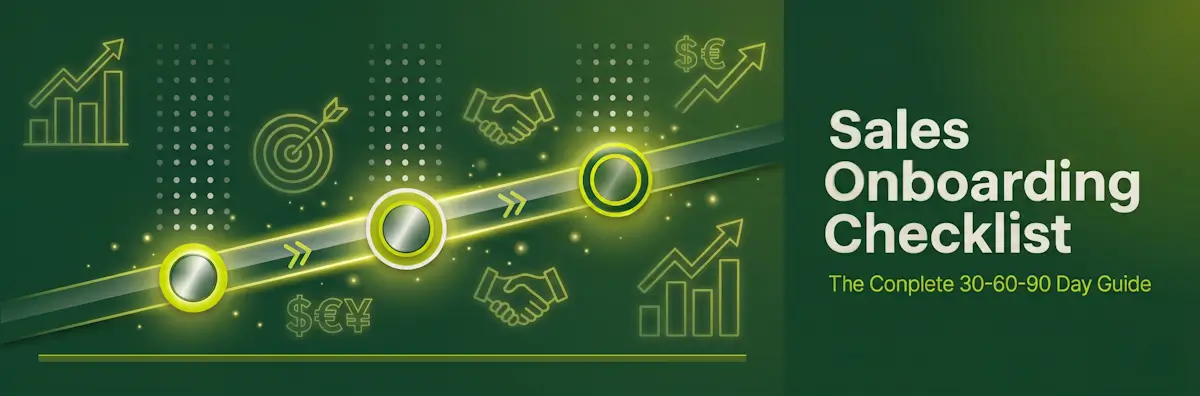
This guide delivers a specific, actionable sales onboarding checklist covering every phase from pre-boarding through Day 90 — plus the tools, metrics, and templates you need to build a repeatable onboarding machine that performs the same way regardless of which manager a new rep reports to.
Why Sales Onboarding Fails
Most organisations treat onboarding as an event — a week-long boot camp, a deck of slides, a set of logins — when it must be a programme: structured, managed, measured, and sustained across 90 days. When onboarding fails, it almost always fails for the same five structural reasons. None of them is about hiring the wrong people.
Information overload before practical application
The majority of sales onboarding programmes spend the first week delivering product, pricing, positioning, compliance, and company culture simultaneously. Working memory cannot absorb and retain a week of continuous new information. Research shows 84% of sales training is forgotten within three months without reinforcement and application. The fix: distribute learning across 90 days using spaced repetition, and introduce product knowledge before, not instead of, call shadowing.
Manager disengagement
In most companies, managers delegate onboarding to HR or a sales enablement team. They check in occasionally but do not actively coach. New hires who have managers meaningfully involved in their onboarding are 3.4x more likely to rate their experience as exceptional — and the correlation with time-to-ramp is strong. Manager involvement is not optional; it is the primary variable that separates a fast-ramping team from a slow one.
No structured certification before going live
Without pass/fail gates, reps advance through onboarding phases regardless of actual readiness. Managers feel uncomfortable holding reps back, so everyone progresses on schedule even when core skills haven't been demonstrated. Organisations that implement certification gates before reps conduct solo calls consistently report faster time-to-first-deal and lower early-tenure attrition.
Too little call shadowing, too late
Many programmes spend three weeks on product training before a new hire observes a single real customer conversation. The fastest path to sales skill development is pattern recognition — hearing how real buyers respond, where they push back, what triggers genuine interest. Call shadowing should begin by Days 3–5, not Days 20–25.
Onboarding stops at Day 90
84% of sales training is forgotten within three months without reinforcement. Stopping structured development at the end of the formal ramp period means reps plateau at whatever skills they developed during onboarding. The most effective organisations build an "everboarding" model — continuous enablement with monthly reinforcement, quarterly competitive updates, and regular coaching cadences that extend well beyond Day 90.
The Cost of Getting It Wrong
It is easy to treat onboarding as a soft, hard-to-measure activity. It isn't. The cost of doing it badly shows up directly in ramp time, turnover, and quota attainment — and the numbers are large enough to fund a structured programme several times over.
The ramp reality
- Average SaaS AE ramp: 5.7 months (2025) — a 32% increase from 4.3 months in 2020.
- Bridge Group 2024 (170+ B2B SaaS companies): median AE ramp-to-quota 4.2 months; median ACV quota $800K; AE quota attainment averaged 51% in 2024, down from 66% in 2022.
- Companies with structured onboarding reach full productivity 30–40% faster than the industry average.
The true cost of rep turnover
When a sales rep leaves, the visible cost — recruiting fees — is the smallest line item. The productivity gap during the replacement's ramp is by far the largest.
| Cost Component | Amount |
|---|---|
| Recruiting (direct costs) | $10,500–$14,000 |
| Onboarding and training | $3,000–$5,000 |
| Ramp productivity gap (5.7 months) | $140,000–$175,000 |
| Pipeline loss during vacancy (45 days) | $50,000–$80,000 |
| Manager time during transition | $12,000–$18,000 |
| Total per replacement event | $215,500–$292,000 |
Source: Zyverno (2026), citing Xactly 2025 for base turnover data.
Turnover is the multiplier
- Average annual sales rep turnover: 35% across all roles.
- SDR/BDR turnover: 40–50%.
- Average sales rep tenure: 18 months; SDR average: 14–16 months.
- Technology/SaaS turnover: 67% higher than other sectors (Xactly, 2025).
At 35% annual turnover on a 10-person team, total annual replacement cost lands between $645,000 and $1.17 million per year. That is the budget you are spending on not fixing onboarding.
The structured onboarding return
- 33% higher 12-month rep retention (Bridge Group, cited by Sales Assembly, 2026).
- 27% higher early-tenure win rates (Bridge Group).
- Reps who complete structured onboarding are 50% more likely to hit quota within 9 months.
- Reps who apply new skills to active deals within 48 hours of training retain those skills at 3x the rate of those trained in isolation (Forrester, 2023).
The productivity gap during ramp is the largest single cost component in sales rep replacement — not recruiting or training. A structured onboarding programme that reduces ramp time from 5.7 months to 3.8 months does not just save months of frustration. At $800K median ACV quota, it recovers approximately $133,000 per rep in additional revenue generated during the gap.
Pre-Boarding Checklist
Pre-boarding is the highest-leverage, most neglected phase of the entire programme. Research shows 64% of new hires who experience strong pre-boarding are more likely to stay beyond three years. The goal is simple: zero friction on Day 1, a rep who feels expected and prepared, and a manager who has done their preparation work before the rep walks in.
HR and Admin — complete 2 weeks before start date
- Offer letter countersigned and start date confirmed
- Employment eligibility and background check completed
- Payroll and direct deposit set up
- Benefits enrolment materials sent with deadline
- Commission/OTE plan explained in writing with worked examples
- First-day schedule and logistics email sent (where to go, who to ask for, what to bring)
IT and Systems — complete 1 week before start date
- Laptop/hardware ordered and shipped (arriving 2 days before start date)
- Corporate email account created
- CRM user account created with correct role/territory assigned
- Sales engagement platform account created (Outreach/Salesloft/Apollo)
- Conversation intelligence tool access set up (Gong/Chorus)
- Slack/Teams account created and added to relevant channels (#sales, #general, #product-updates, #deals)
- Calendar access configured
- Sales enablement platform account created (Seismic/Highspot/Allego/Showpad)
- LinkedIn Sales Navigator seat assigned
- ZoomInfo/Apollo/Cognism access provisioned
Manager Preparation — complete 1 week before start date
- First 3 weeks of 1:1 meetings scheduled (minimum 3× per week, weeks 1–2)
- Week 1 daily schedule built and shared with new hire
- Onboarding buddy identified and briefed — buddy reaches out before Day 1
- Call shadow schedule for weeks 1–2 organised (8–12 calls over 30 days)
- Territory, accounts, and initial prospecting list prepared
- Internal introduction email drafted to send to the full team on Day 1
- First 30-day plan with specific milestones documented
Welcome and Culture — complete 3–5 days before start date
- Welcome email sent from the manager (not the automated HR system): personalised, specific, including the first-day schedule
- "New Rep Toolkit" sent: product one-pager, sales methodology overview (2 pages), ICP summary (1 page), top 5 customer case studies
- Team welcome message sent in Slack/Teams (manager introduces new hire before arrival)
- Buddy makes first contact via Slack/email: introduction and offer to answer any pre-start questions
Strong pre-boarding cuts Day 1 anxiety by up to 40% and significantly improves first-month productivity. The most common pre-boarding failure is hardware arriving late — order hardware 10+ business days before the start date, with the rep's shipping address confirmed directly.
Week 1: Foundation Checklist
Week 1 sets the tone for everything that follows. The goal is not product expertise — it is orientation, first call shadows, and immediate hands-on access to the tools the rep will use every single day. Treat Week 1 as the foundation, not the curriculum.
Day 1 — Welcome and Orient
- In-person/video welcome from direct manager
- Full team introduction (names, roles, responsibilities)
- Office tour or remote environment walkthrough
- HR admin completed (remaining paperwork, badge, benefits)
- All system logins verified working (email, CRM, Slack, all tools)
- Comp plan reviewed and confirmed understood — rep signs acknowledgment
- First 30 days plan and milestones reviewed with manager
- Buddy introduction meeting (30 minutes)
Days 2–3 — Product and Company Foundation
- Company mission, values, and ICP overview (2-hour session with product/marketing)
- Product deep-dive session with product manager or senior AE (features, use cases, primary differentiators)
- Demo environment access confirmed; first product walkthrough completed
- First 2–3 recorded call shadows completed in Gong/Allego (manager selects best-in-class discovery calls)
- Sales playbook and battlecards read (competitive battle cards for top 3 competitors)
- Sales process stages and CRM stage definitions reviewed with RevOps
Days 4–5 — Methodology and Process
- Sales methodology training begins (MEDDIC/MEDDPICC, Challenger, Sandler, or the firm's chosen framework) — Day 1 content introduced
- CRM hands-on training: account creation, opportunity logging, activity recording, stage movement
- Sales engagement platform orientation: sequence structure, email templates, call task setup
- First outbound activity: first 5 prospecting emails or calls sent/made (end of Week 1 target)
- Weekly team pipeline call attended and observed
- Week 1 debrief 1:1 with manager: what's working, what's unclear, first-week feedback
Days 1–30: Learn Phase
The primary objective of the first 30 days is pattern recognition, not performance. Reps should absorb, observe, and begin low-stakes activity — not be measured on output they aren't yet equipped to produce. The phases follow the general 90-day onboarding plan used for every new hire, adapted to quota-carrying roles.
The sequencing error to avoid: many programmes deliver two weeks of product training before any customer conversation is heard. Reverse the sequence. Begin call shadowing in Days 3–5. Product knowledge sticks far better when it is anchored to real customer conversations the rep has actually heard.
Knowledge targets
- Product knowledge assessment passed (≥80%) — completion target: Day 14
- ICP deep-dive completed: primary firmographic and technographic ICP criteria memorised
- Top 3 competitor battle cards memorised with win/loss reasoning
- Top 10 pricing objections reviewed with written responses
- Customer case study library reviewed (5+ case studies, mapped to ICP verticals)
- Commission plan understood and confirmed in writing
Call shadowing targets
- 8–12 call shadows completed with a structured debrief form after each
- Mix of recorded (async) and live (synchronous) calls
- At least 2 shadows with top performers; at least 1 shadow with the manager
- Debrief covers: what questions the rep asked, what they would do differently, questions arising
Sales process and methodology targets
- Sales methodology training completed (MEDDIC/full framework — all elements)
- Sales process stages and exit criteria memorised
- CRM proficiency confirmed: can independently create, update, and advance opportunities without assistance
- First discovery call framework drafted (personal talk track using the firm's methodology)
Activity targets
- First outbound call or email sent by Day 5–7
- 25–30 prospecting touches (calls + emails) completed by Day 30
- First meeting booked (SDRs: target Day 10–14; AEs: target Day 20–25)
Relationship building targets
- 1:1 with product manager completed
- 1:1 with marketing lead completed
- 1:1 with a customer success manager completed
- 1:1 with RevOps/sales operations completed
- Buddy weekly check-in cadence established
Day 30 Milestone Review. A formal manager review with pass/fail criteria — document the outcome. Criteria: product certification passed, all tools operational, at least 8 shadows completed, and the first activity milestone met. If criteria are not met, extend the learning phase with a specific 2-week improvement plan rather than letting the rep drift into the Apply phase unprepared.
Days 31–60: Apply Phase
Days 31–60 is the highest-leverage window — and the most commonly mismanaged. Reps begin running their own conversations, and the gap between what they know and what they can do in a live sales situation becomes visible. This is precisely the moment many managers reduce coaching frequency. It is exactly the moment to increase it.
The coaching intensity shift: manager 1:1 cadence in the Apply phase should remain at 3× per week for weeks 5–6, reducing to 2× per week in weeks 7–8 as rep confidence builds. Call review in Gong — where the manager listens to the rep's own calls and provides specific, timestamped feedback — becomes the primary coaching mechanism. These weekly coaching cadences are themselves a recurring process worth running through structured recurring checklists so no rep's review week is ever skipped.
Milestones
- First solo discovery call completed and reviewed with manager — target: Days 31–35
- Discovery call debrief: rep self-scores on framework adherence before manager feedback
- First independent demo delivered — target: Days 35–45
- First qualified opportunity created in CRM with MEDDIC/qualification criteria documented — target: Day 45–55
- Mid-ramp formal assessment completed (Day 45–50): written evaluation with pass/fail criteria for Month 3 readiness
Certifications (see Certification Gates)
- Discovery Call Certification gate passed
- Demo Certification gate passed
- Objection Handling Certification gate in progress or passed
Skill development
- Weekly Gong call review: manager provides timestamped feedback on 2+ rep calls per week
- Call debrief framework used after every rep-led call (self-scoring before manager feedback)
- At least 3 role-play sessions with manager covering objection scenarios
- Competitive positioning demonstrated in a mock prospect conversation
Pipeline
- Prospecting velocity: 40–60 outbound touches per week (SDRs); 15–25 per week (AEs)
- Pipeline building: minimum 3–5 qualified opportunities by Day 60 (AEs); 8–12 meetings booked by Day 60 (SDRs)
Days 61–90: Accelerate Phase
Days 61–90 is validation: can this rep operate autonomously across a full sales cycle? The coaching relationship shifts from instruction to strategic support. Reps should be carrying their own pipeline, making their own prospecting decisions, and managing deals with minimal hand-holding.
Independence
- Full Sales Cycle Certification gate passed — required before solo deal management without manager supervision
- Running all prospect calls, demos, and follow-ups without manager involvement
- Independent objection handling demonstrated consistently (not just in role-play)
- Capable of building and presenting a business case / ROI model to the economic buyer
Pipeline
- Pipeline at 2–3x quota coverage from own prospecting and inbound (AEs)
- 5–7 qualified opportunities at discovery stage or beyond (AEs)
- 12–15 meetings booked per month (SDRs reaching full target)
- First deal closed or in final stages (AEs: target by Day 75; some deals require a longer cycle)
- CRM data quality: 100% of opportunities have accurate stage, close date, and value; all calls logged
Ongoing development
- Manager formal Day 90 readiness assessment completed (written, retained)
- First 90-day retrospective: what worked in onboarding, what to improve for the next cohort
- "Everboarding" plan established: monthly skill reinforcement cadence agreed
- Full quota target confirmed for Month 4+ and tiered ramp communicated clearly
Tiered quota structure (best practice)
| Ramp Month | Quota Target |
|---|---|
| Months 1–2 | 0% (learning and foundation) |
| Month 3 | 50% of full quota |
| Month 4 | 75% of full quota |
| Month 5+ | 100% of full quota |
Certification Gates
Certification gates are the mechanism that converts a schedule-based onboarding programme into a competency-based one. The principle is simple: no rep advances to the next phase of customer-facing activity until they have demonstrated the skill required for that phase. Each gate below has a documented pass requirement defined in advance — never a post-hoc subjective judgement.
Product Knowledge Certification (Day 10–14)
Completion requirement: a written/quiz assessment of product features, primary use cases, differentiation from the top 3 competitors, and the top 10 pricing objections and responses. Pass threshold: 80% minimum. Consequence of not passing: 2 weeks of additional study with a retake scheduled. Required before: any customer-facing activity of any kind.
Discovery Call Certification (Day 20–25)
Completion requirement: a 30-minute role-play with the manager playing a buyer persona in a realistic buying scenario. The rep must open with a clear agenda, ask a structured series of qualifying questions using the firm's methodology (MEDDIC/SPIN/Challenger), actively listen and probe with follow-up questions, identify a compelling event, and close with a clear next step and timeframe. Video record in Allego/Gong for the rep's own review. The scoring rubric is defined before the session, not after. Pass/fail decision documented and retained. Required before: any solo discovery call.
Demo Certification (Day 25–30)
Completion requirement: a full product demonstration delivered to a panel of manager + one peer AE. The rep must open by confirming the buyer's stated pain points and the agreed agenda, customise the demo to address those specific pain points (not a generic walkthrough), handle at least 2 planted objections mid-demo, and close for a specific next step with a named date. Assessed on: customisation, objection-handling quality, and next-step closing. Required before: any solo product demonstration.
Objection Handling Certification (Day 28–35)
Completion requirement: a live role-play covering the 8 most common objections in the firm's deal cycles. Scored on: use of the methodology framework, empathy and acknowledgment before reframe, quality of response, and ability to move the conversation forward. Required before: solo handling of late-stage objections without the manager on the call.
Full Sales Cycle Certification (Day 35–45)
Completion requirement: an end-to-end simulated sales cycle with a documented scenario (manager provides backstory, buying-committee structure, and deal history). The rep must conduct discovery, deliver a follow-up value demonstration, handle a competitive challenge, and close for the order. Scored on all previous gate criteria applied across a continuous simulation. Required before: managing live opportunities without manager supervision or co-piloting.
Managers often resist certification gates out of concern for morale — especially when a rep fails. The reframe: a failed gate caught in role-play with a manager is a protected learning event. The same failure in front of a £300,000 prospect is not recoverable. Certification gates are not obstacles — they are insurance.
Tool Stack Setup Checklist
Tool access failure is the most easily prevented onboarding blocker — and the one that kills Day 1 momentum most often. A rep who can't log a call, send a sequence, or open the demo environment on their first morning loses confidence and time you never get back. Every rep should have 100% tool access confirmed before or on Day 1.
| Tool | Category | Access Target | Proficiency Target | Notes |
|---|---|---|---|---|
| CRM (Salesforce/HubSpot/Pipedrive) | Pipeline management | Day 1 | Day 30 | Territory and accounts assigned before Day 1 |
| Sales engagement (Outreach/Salesloft/Apollo) | Prospecting execution | Day 1 | Day 7–10 | First sequence running by end of Week 1 |
| Conversation intelligence (Gong/Chorus) | Call recording + coaching | Day 1 | Day 14 | Critical for onboarding — start reviewing recordings Day 3 |
| Sales enablement (Seismic/Allego/Mindtickle) | Content + training | Day 1 | Day 14 | Onboarding path assigned on Day 1 |
| LinkedIn Sales Navigator | Prospecting research | Day 1–3 | Day 14 | Basic account/contact search by Day 7 |
| ZoomInfo/Apollo/Cognism | Contact data + intent | Day 1–3 | Day 7 | ICP list built before first outbound call |
| Communication (Slack/Teams) | Internal collaboration | Day 1 (before) | Day 1 | Set up and confirmed working before start date |
| Video (Zoom/Meet/Teams) | Customer-facing calls | Day 1 | Day 1 | Branded virtual background configured |
| Calendar | Meeting scheduling | Day 1 | Day 1 | Meeting link (Calendly/Chili Piper) set up |
| E-signature (DocuSign) | Contract execution | Day 30 | Day 45 | Not urgent — needed by first deal stage |
Who owns tool access: RevOps or Sales Operations should own the tool-access checklist — not IT, not HR. Sales systems are mission-critical and require sales-context knowledge to configure correctly (territory assignment, user permissions, CRM record access). A misconfigured CRM role on Day 1 contaminates pipeline data before the rep has logged a single call.
Standardise Sales Onboarding Across Every New Hire
CheckFlow gives sales managers a single structured place to track every pre-boarding task, certification gate, and 30-60-90 day milestone — with named owners, due dates, and completion timestamps. No more ad hoc onboarding that varies by cohort and manager.
Start free trialSales Onboarding by Rep Type
The 30-60-90 framework is the backbone — but different roles require meaningfully different programmes laid over it. Applying an enterprise onboarding timeline to an SDR wastes weeks; applying an SDR timeline to an enterprise AE sets the rep up to fail in front of a buying committee they were never prepared for.
SDR/BDR Onboarding (Ramp: 3–4 months)
SDRs and BDRs focus on outbound activity and meeting generation, not full deal ownership. Ramp is faster — but SDR tenure is the shortest in sales (14–16 month average), making onboarding investment particularly high-stakes. Key differences from AE onboarding: higher daily activity targets from Day 7 (40–60 touches/day), an earlier first milestone (first meeting booked by Day 10–14), more emphasis on cold calling and email frameworks, and less emphasis on multi-stakeholder navigation and complex discovery. SDR certification gates focus on cold-call openers, objection handling for prospecting (not deal stage), and meeting-booking conversion.
Account Executive — SMB (Ramp: 1–3 months)
SMB AEs manage shorter sales cycles with simpler buying committees. Onboarding emphasises speed to first deal. Competitive differentiation and objection handling are high priority. MEDDIC qualification still applies but with fewer qualifying criteria. Full quota typically lands by Month 2–3.
Account Executive — Mid-Market (Ramp: 4–6 months)
The standard 30-60-90 day framework applies fully. Multi-stakeholder deal navigation becomes important. MEDDIC/MEDDPICC compliance is required from the first qualified opportunity. Champion identification and multi-threading are core skills to develop during the Apply phase.
Enterprise AE (Ramp: 9–12 months)
Enterprise onboarding requires a longer 30-60-90-120-180 day structure. The buying cycle may run 9–18 months, meaning early-tenure reps manage partially-inherited pipeline more than building their own. Key additions to standard onboarding: executive presence and business-case development training; procurement and legal process navigation; multi-threaded account mapping; and navigating $240K–$320K OTE with appropriate commission understanding.
| Dimension | SDR/BDR | SMB AE | Mid-Market AE | Enterprise AE |
|---|---|---|---|---|
| Average ramp | 3–4 months | 1–3 months | 4–6 months | 9–12 months |
| First milestone | Meeting booked by Day 10–14 | First deal by Day 45 | First deal by Day 60–75 | Inherited pipeline by Day 30 |
| Primary methodology | Cold call/email frameworks | Solution selling | MEDDIC | MEDDPICC |
| Shadowing (minimum) | 5–8 calls | 5–8 calls | 8–12 calls | 12–15+ calls |
| Full quota start | Month 3–4 | Month 2–3 | Month 4–5 | Month 6–9 |
Sales Manager Onboarding (Often Skipped Entirely)
New sales managers — especially those promoted from individual-contributor roles — are the most commonly under-onboarded group in sales organisations. The IC-to-manager transition requires a fundamentally different set of skills, and most newly promoted managers continue to sell rather than coach because they haven't been trained to do otherwise. Manager onboarding essentials: coaching methodology (specific feedback frameworks, not "good job/try harder"); pipeline management and forecast hygiene; performance management (identifying struggling reps early, having difficult conversations); compensation and quota-setting mechanics; and running effective 1:1s, standups, and deal reviews. If manager onboarding is not structured, the team's onboarding will not be structured either.
Common Onboarding Mistakes
Most onboarding programmes fail in predictable ways. If your ramp times are slipping or your early-tenure attrition is climbing, the cause is almost certainly one of the eight mistakes below.
Mistake 1: Death by PowerPoint in Week 1. Cramming product features, company history, compliance training, and sales process into a 4-day boot camp saturates working memory before the rep has any context to anchor the information. Reps retain almost nothing. Solution: distribute information across 90 days with spaced repetition, and begin call shadowing on Days 3–5 before continuing product immersion.
Mistake 2: Not enough call shadowing — starting too late. Seeing how top performers handle real buyer conversations is the fastest path to sales skill development. Starting call shadows in Week 3 instead of Days 3–5 wastes the three highest-attention weeks of onboarding. A structured library of 8–12 shadowed calls across 30 days — starting immediately — is the benchmark.
Mistake 3: No certification gates before going live. Without documented pass/fail checkpoints, whether a rep is ready to conduct solo calls is answered by schedule rather than skill. The result: reps having live customer conversations before they can handle basic objections — damaging deals and buyer relationships at the same time. Certification gates are not optional polish; they are core infrastructure.
Mistake 4: Onboarding doesn't replicate real selling conditions. Role-plays where the "buyer" is easy, always interested, and raises only the three objections covered in training do not prepare reps for real conversations. Realistic onboarding uses actual customer recordings as templates for role-play scenarios, includes competitive pressure and pricing objections, and involves multi-stakeholder scenarios for mid-market and enterprise roles.
Mistake 5: CRM and tools training too late or too shallow. A rep who cannot log a call on Day 1 because access wasn't provisioned, or who can't send a prospecting sequence because Outreach wasn't set up, loses critical early momentum. More insidiously, CRM training left until Week 3 means pipeline data is already contaminated with incorrectly logged or missing activities. Tool access and basic proficiency must precede first customer contact.
Mistake 6: Manager delegates onboarding completely. The manager's role is not to hand off the programme and check in at milestones. It is to be actively present — running weekly (and in weeks 1–2, multiple-times-weekly) 1:1s with structured agendas, listening to the rep's calls in Gong and providing timestamped feedback, personally running certification gate role-plays, and identifying skill gaps before they calcify. New hires are 3.4x more likely to rate their onboarding as exceptional when managers actively participate.
Mistake 7: No tiered quota ramp. Placing a new AE on full quota from Month 1 is a primary cause of early-tenure attrition. Reps guaranteed to miss quota targets become demoralised regardless of effort. A transparent tiered ramp (0% / 50% / 75% / 100% over 4 months) is both a retention mechanism and a reflection of operational reality.
Mistake 8: Onboarding stops at Day 90 ("set and forget"). 84% of sales training is forgotten within three months without reinforcement. A programme that ends at Day 90 without transitioning to a structured ongoing enablement model will see skill degradation in months 4–6. The output of Day 90 should be an "everboarding" plan: monthly skills reinforcement cadences, quarterly competitive updates, and continued Gong-based coaching through Year 1.
Metrics and KPIs
Structured onboarding programmes that aren't measured don't improve. Track metrics across three time horizons — leading, mid-ramp, and lagging — so you can intervene early rather than discovering at Day 90 that a rep was never on track.
Leading Indicators (Weeks 1–4)
| Metric | Target | Why It Matters |
|---|---|---|
| Tool access confirmed (all tools) | 100% by Day 1 | Failure signal: if access isn't ready, nothing else works |
| Training completion rate | 90%+ by Day 30 | Measures programme engagement and completion |
| Call shadows completed | 8–12 by Day 30 | Primary predictor of early discovery call quality |
| Certification pass rate | ≥80% on each gate | Confirms readiness before progression |
| First outbound activity date | Day 5–7 | Early action = faster confidence building |
| Manager 1:1 sessions held | 3×/week in weeks 1–2 | Manager engagement is the #1 onboarding variable |
Mid-Ramp Indicators (30–60 Days)
| Metric | Target |
|---|---|
| First solo discovery call date | Days 31–35 (after Discovery Cert passed) |
| First qualified opportunity (CRM) | Day 45–55 |
| Pipeline-to-quota ratio | 1.5–2x by Day 60 |
| Call-to-meeting conversion | Trending toward team average |
| Gong call quality score | Manager-assessed ≥3.5/5 on recorded calls |
Lagging Indicators (60–90+ Days)
| Metric | Target | Benchmark Source |
|---|---|---|
| Time to first deal | 45–75 days | Dependent on sales cycle length |
| Time to full quota attainment | 4.2 months | Bridge Group, 2024 |
| First-year retention rate | 85%+ | Brandon Hall Group benchmark |
| Quota attainment in first 6 months | 80%+ of ramp quota | Internal benchmark |
| Pipeline coverage at Day 90 | 2–3x quota | Standard pipeline management benchmark |
Cohort analysis is the metric that matters most. Track each hire cohort (by quarter) and compare ramp speed, first-year retention, and 6-month quota attainment. Year-over-year cohort improvement is the ultimate measure of whether your onboarding programme is developing as a system — or simply repeating the same mistakes with new people.
Sales Onboarding Checklist Templates
The fastest way to operationalise everything above is to start from a structured template rather than a blank document. CheckFlow's sales templates cover the workflows a new rep needs to master during onboarding — pitching, follow-up, call tracking, and pipeline management — plus the QA and supervision processes managers run. Each can be assigned, scheduled, and tracked to completion. To run the 90-day plan itself, use the Sales Rep Onboarding Checklist, with SDR and AE paths and manager certifications. Click any card to view the full template.


Give Every New Sales Rep the Same Structured Start
CheckFlow turns your 30-60-90 day onboarding plan into a structured, tracked, repeatable process. Certification gates require manager sign-off before reps progress. Tool access tasks have named owners and due dates. Every milestone is documented. Every rep gets the same onboarding — regardless of which manager they report to.
See Recurring ChecklistsFAQ
How long should sales onboarding take?
Sales onboarding timelines vary significantly by role and deal complexity. SDR/BDR ramp: 3–4 months to full productivity. SMB Account Executive: 1–3 months. Mid-market AE: 4–6 months. The Bridge Group's 2024 SaaS AE Benchmark Report (170+ companies) found the median AE ramp time is 4.2 months. Enterprise AEs can take 9–12 months to reach full productivity given multi-stakeholder selling cycles. Overall, the average SaaS AE ramp time has increased to 5.7 months in 2025 — a 32% increase from 4.3 months in 2020 — driven by higher product complexity, longer buying cycles, and rising quota expectations (median ACV quota is now $800K). Best-in-class onboarding programmes with structured 30-60-90 day frameworks achieve full productivity 30–40% faster than average. The structured 30-60-90 day plan is not a description of when onboarding ends — it is the period of structured, managed development. Post-Day-90 enablement ("everboarding") continues the development investment through ongoing coaching, quarterly product refreshes, and monthly competitive updates.
What should be included in a sales onboarding checklist?
A comprehensive sales onboarding checklist spans five phases. Pre-boarding (1–2 weeks before Day 1): hardware shipped, system access provisioned, buddy assigned, welcome materials sent. Week 1 foundations: HR admin, product overview, tools setup, call shadowing begins. Days 1–30 (Learn): product certification, ICP/persona deep-dives, 8–12 shadowed calls, sales methodology training, CRM proficiency, all tool access confirmed. Days 31–60 (Apply): first solo discovery call, first demo, first qualified opportunity in CRM, certification gates passed, mid-ramp formal review. Days 61–90 (Accelerate): independent pipeline at 2–3x quota coverage, full sales cycle certification, first deal closed or in advanced stages, manager formal readiness assessment. Underpinning all phases: clearly documented pass/fail certification gates before reps proceed, named owners for every task, and completion timestamps for audit purposes. The checklist must cover people (HR, buddy, manager), process (sales methodology, playbooks), and technology (CRM, sales engagement, conversation intelligence, enablement platform).
What is the cost of poor sales onboarding?
Poor sales onboarding has cascading financial consequences. The average total cost of replacing one mid-market sales rep is $215,500–$292,000, broken down as: recruiting ($10,500–$14,000), onboarding and training ($3,000–$5,000), ramp productivity gap over 5.7 months ($140,000–$175,000), pipeline loss during vacancy ($50,000–$80,000), and manager time ($12,000–$18,000) (Zyverno, 2026). With average sales rep turnover at 35% annually, a 10-person team loses 3–4 reps per year — representing $645,000–$1.17 million in annual replacement costs at this scale. Beyond replacement costs, poor onboarding directly damages win rates. Companies with structured onboarding achieve 33% higher 12-month rep retention and 27% higher early-tenure win rates (Bridge Group, cited by Sales Assembly, 2026). AE quota attainment averaged just 51% across all B2B SaaS companies in 2024 (Bridge Group) — structured onboarding is one of the most controllable levers available to improve that figure.
What are the most important sales onboarding certification gates?
Certification gates are pass/fail checkpoints that must be completed before a rep advances to the next phase of onboarding. The five most important gates are: (1) Product Knowledge Certification (Day 10–14): written/quiz assessment of features, use cases, and differentiators; minimum pass threshold 80%; required before any customer-facing activity. (2) Discovery Call Certification (Day 20–25): role-play where rep conducts a full discovery call with manager as the buyer; assessed on agenda setting, question depth, active listening, and next-step commitment. (3) Demo Certification (Day 25–30): rep delivers a full product demo to a panel of manager and peer; assessed on customisation to buyer pain points, objection handling mid-demo, and next-step closing. (4) Objection Handling Certification (Day 28–35): structured role-play covering the top 8–10 most common objections using the firm's sales methodology framework. (5) Full Sales Cycle Certification (Day 35–45): end-to-end simulated sales cycle with documented scoring; rep must pass before carrying live opportunities without manager supervision. All gates require documented pass criteria established in advance — not post-hoc subjective assessment. Allego research (2024) notes that without these checkpoints, "new reps will move from one learning experience to another without any guidelines — without anyone knowing whether they're learning and retaining the information."
What sales onboarding metrics should I track?
Track metrics in three categories: (1) Leading indicators (activity, weeks 1–4): training completion rate by module (target 90%+ by Day 30); certification pass rates; number of call shadows completed (target 8–12 by Day 30); first outbound activity date (target Day 5–7); manager coaching sessions held. (2) Mid-ramp indicators (30–60 days): date of first solo discovery call; date of first qualified opportunity in CRM; call-to-meeting conversion rate; pipeline coverage vs. target. (3) Lagging indicators (60–90+ days): time to first deal (target 45–75 days); time to quota attainment (target 4.2 months median per Bridge Group 2024); first-year retention rate (target 85%+); quota attainment in first 6 months; pipeline-to-quota ratio at Day 90 (target 2–3x). The most important single business metric is cohort analysis: compare ramp speed, first-year retention, and quota attainment across quarterly hire cohorts. This reveals whether your onboarding programme is improving over time.