Call Center Sales Quality Assurance Checklist Template
A call center QA process that evaluates 2% of calls and provides feedback three weeks later is not quality assurance — it is retrospective documentation. Effective QA identifies coaching opportunities before they become performance problems.
Call center sales performance is determined by two things: the quality of the individual rep’s sales conversation skills and the consistency with which those skills are applied across every call. Quality assurance is the mechanism that monitors both — evaluating individual calls against a standardised rubric, identifying specific coaching opportunities, ensuring compliance with legal and regulatory requirements, and tracking performance trends over time. The QA process that works is one that is structured enough to be consistent across evaluators, specific enough to produce actionable coaching feedback, weighted appropriately so compliance failures are treated with zero tolerance, and frequent enough to identify issues before they become patterns. A scorecard that rates every call on the same dimensions — greeting, rapport, discovery, presentation, objection handling, compliance, and close — produces the data that transforms QA from a monitoring exercise into a coaching and improvement programme. This free checklist gives call center QA managers, supervisors, and team leaders a structured framework for the full call evaluation process.
Fatal Errors and Scored Performance — Two Tiers of QA Assessment
Fatal Errors (Automatic Fail)
Calling a number on a do-not-call list; making a claim about the product that is prohibited by regulations (false claims, misleading statements); failing to identify the company and the nature of the call when legally required
Abusive, threatening, or discriminatory language; making unauthorised commitments on behalf of the company
Failing to make a required legal disclosure (privacy policy, right to cancel, material product limitations)
A call with any fatal error receives a failing score regardless of the performance scores elsewhere on the form.
Scored Performance Items (1–5 Rating)
Opening and greeting quality
Rapport and personalisation
Discovery depth (needs uncovered)
Product presentation relevance and clarity
Objection handling technique
Close quality and next steps
Call documentation (CRM updated accurately)
Overall professionalism and tone
Each section is weighted by its impact on call outcome. Section weights are defined in the scorecard below.
The Call Center Sales QA Scorecard
Use this scorecard for every evaluated call. Complete the fatal error check first. If any fatal error is found, stop scoring and escalate immediately.
Phase 1
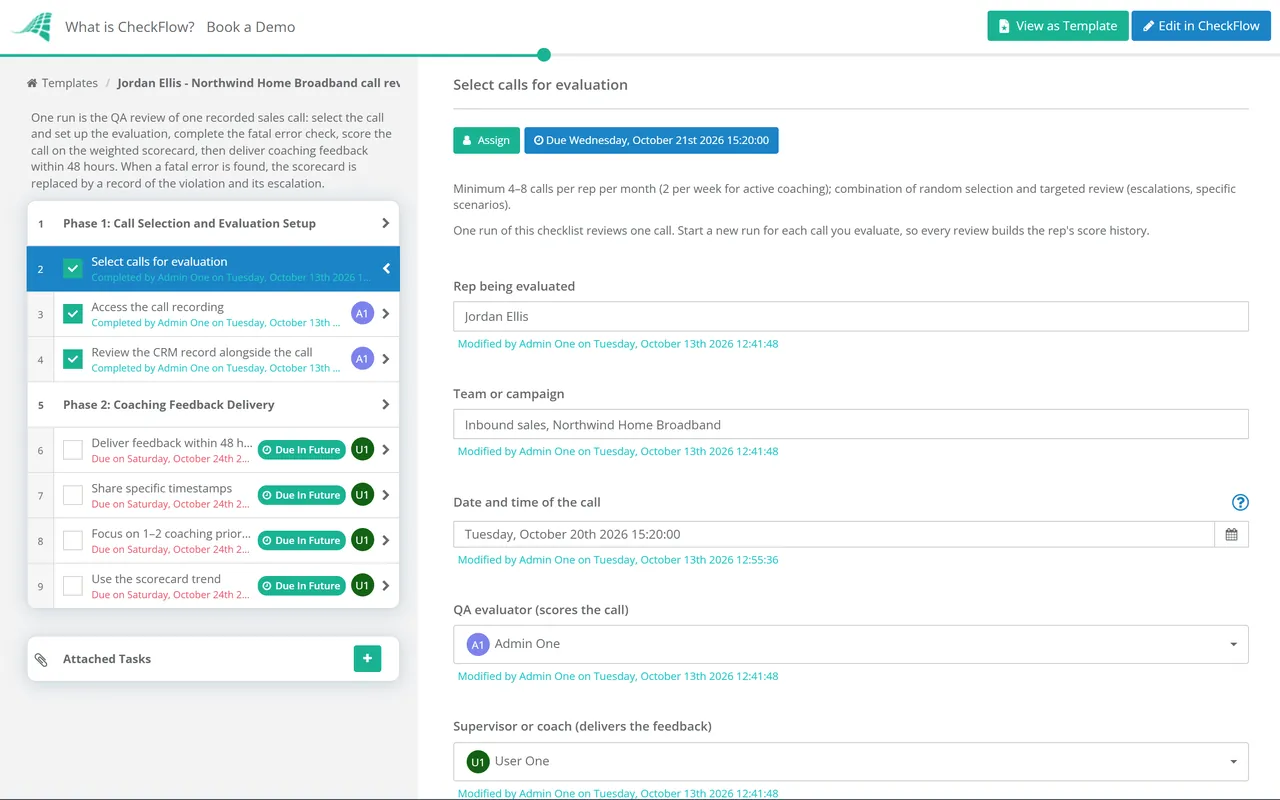
Phase 1: Call Selection and Evaluation Setup
Select calls for evaluation — minimum 4–8 calls per rep per month (2 per week for active coaching); combination of random selection and targeted review (escalations, specific scenarios)
Access the call recording — in the call recording system; confirm the correct call is selected (date, time, rep, duration)
Review the CRM record alongside the call — what did the rep log? Does the CRM entry match what was said on the call?
☐Did the rep call a number on the do-not-call list or an internal opt-out list? Y / N
☐Did the rep make a claim about the product that is prohibited, misleading, or factually incorrect? Y / N
☐Did the rep fail to make any required legal or regulatory disclosure? Y / N
☐Did the rep use abusive, threatening, discriminatory, or unprofessional language? Y / N
☐Did the rep make an unauthorised commitment or promise not within their authority? Y / N
If any answer is YES: AUTOMATIC FAIL — stop scoring, document the specific violation, escalate per policy.
Score 1 = Does Not Meet Standard | 2 = Below Standard | 3 = Meets Standard | 4 = Above Standard | 5 = Excellent
Section A — Opening & Greeting Weight: 10%
A1. Agent identified themselves and the company clearly at the start of the call
1
2
3
4
5
A2. Tone was warm, professional, and confident from the first moment
1
2
3
4
5
A3. Agent confirmed the contact’s identity and available time appropriately
1
2
3
4
5
Section B — Rapport & Engagement Weight: 15%
B1. Agent personalised the approach to this specific prospect (not a generic script reading)
1
2
3
4
5
B2. Conversation felt natural and two-way rather than a monologue
1
2
3
4
5
B3. Active listening demonstrated: agent paused, acknowledged, and built on what the prospect said
1
2
3
4
5
Section C — Needs Discovery Weight: 20%
C1. Agent asked open-ended questions before presenting the product
1
2
3
4
5
C2. Agent uncovered the prospect’s specific situation and pain points
1
2
3
4
5
C3. Agent confirmed their understanding of the prospect’s needs before presenting
1
2
3
4
5
Section D — Product Presentation Weight: 20%
D1. Presentation was tailored to the prospect’s stated needs (not a generic pitch)
1
2
3
4
5
D2. Benefits were explained clearly and specifically (not just features)
1
2
3
4
5
D3. Agent used relevant evidence (case study, stat, or customer reference)
1
2
3
4
5
Section E — Objection Handling Weight: 15%
E1. Agent acknowledged objections without dismissing or talking past them
1
2
3
4
5
E2. Agent responded to the specific objection with a relevant, evidenced response
1
2
3
4
5
E3. Agent confirmed the objection was resolved before moving on
1
2
3
4
5
Section F — Close & Next Steps Weight: 15%
F1. Agent asked for a specific next step clearly and confidently
1
2
3
4
5
F2. Agent confirmed the next step was scheduled or agreed before ending the call
1
2
3
4
5
F3. Call ended professionally and on a positive note
1
2
3
4
5
Section G — Compliance & Documentation Weight: 5%
G1. All required disclosures were made (per the applicable script and compliance requirements)
1
2
3
4
5
G2. CRM was updated accurately (verified against the recording)
1
2
3
4
5
Overall Score___ / 100
Add observations here…
List the 1–2 highest-priority coaching items…
Phase 2
Phase 2: Coaching Feedback Delivery
Deliver feedback within 48 hours of evaluation — feedback on a call from last month has minimal coaching value
Share specific timestamps — “at 3:42 you said X — try this instead” is more useful than “your discovery could be better”
Focus on 1–2 coaching priorities per session — not every scored item; too much feedback at once is less effective than focused coaching on the highest-impact items
Use the scorecard trend — show the rep their score trend over time; improvement and regression are both visible
This QA scorecard is available as a free, runnable template in CheckFlow — with the fatal error check as a required first step, weighted section scores, coaching notes built in, and score trend tracking across all evaluations.
A QA programme where different evaluators score the same call differently provides no reliable data and creates fairness concerns among reps. CheckFlow’s QA scorecard applies the same weighted criteria, the same definitions, and the same fatal error threshold to every evaluation — regardless of which evaluator conducts it.
2
Fatal error detection that escalates automatically
A compliance violation identified in a recorded call that is not escalated promptly creates regulatory exposure. CheckFlow’s fatal error section is a mandatory first step in every evaluation — any yes requires immediate escalation and generates a documented record before any performance scoring begins.
3
Score trend tracking that identifies improvement and regression
The coaching conversation that says “you’ve been consistently below standard on discovery for eight evaluations” is a different conversation from “I noticed something on your last call.” CheckFlow builds the score history that makes trend-based coaching possible.
QA evaluation outcomes drive supervisor coaching priorities. CheckFlow’s Daily Sales Team Supervisor Workflow covers the daily management process for acting on QA findings. See the Daily Supervisor Workflow →
The pitch skills assessed in a QA evaluation are developed through the sales pitch process. CheckFlow’s Sales Pitch Checklist covers the structured approach to preparing and delivering an effective sales pitch. See the Sales Pitch Checklist →
Describe the process in a sentence and the AI checklist generator drafts the phases and tasks for you.
Frequently Asked Questions
What should a call center sales QA checklist include?
A call center sales QA checklist covers two tiers: fatal error checks (compliance violations, prohibited claims, required disclosure omissions, conduct violations — any of which causes an automatic fail), and scored performance items (opening and greeting, rapport and engagement, needs discovery, product presentation, objection handling, close and next steps, compliance and documentation — scored 1–5 with section weights reflecting their relative importance). The scoring should be followed by coaching feedback delivery within 48 hours, focused on the 1–2 highest-priority improvement areas.
What are “fatal errors” in call center QA?
Fatal errors are violations that cause a call to receive a failing score regardless of the performance quality elsewhere on the scorecard. They are typically: calling numbers on a do-not-call or internal opt-out list, making prohibited, misleading, or factually incorrect claims about the product, failing to make legally required disclosures, using abusive or unprofessional language, or making unauthorised commitments. Fatal errors are zero-tolerance items because they represent either regulatory risk, legal exposure, or conduct that is incompatible with the role.
How often should call center QA evaluations be conducted?
For active coaching purposes, 2–4 evaluations per rep per month is the minimum for meaningful trend data — 4–8 is the standard for most call centers. Evaluations should combine random selection (to represent typical performance across all call types) with targeted review (escalated calls, calls in specific difficulty categories, or calls following a performance concern). Frequency should increase during a performance improvement plan.
How should QA feedback be delivered to sales reps?
Effective QA feedback is: timely (within 48 hours of the evaluation, not three weeks later), specific (referencing exact timestamps in the recording — “at 3:42 you moved directly to the pitch without confirming the buyer’s primary concern”), focused (targeting 1–2 priority coaching items per session, not every scored item), evidence-based (using the scorecard trend rather than a single call impression), and developmental (showing what “excellent” looks like, not just what was wrong).
Is CheckFlow free to use for this template?
You can start a free 14-day trial with no credit card required, giving you full access to all features including this template. The Business plan is $10 per user per month after the trial. Full details at checkflow.io/pricing.
Evaluate Every Call Against the Same Standard — and Coach to the Score Trend