ISO/IEC 17025 Accreditation Checklist Template

The assessors can ask for the uncertainty budget, the proficiency testing plan and the records behind one result from last March. Have every clause owned and every record ready before the visit.

Last reviewed: November 2026

Printed from checkflow.io/templates/research-development/iso-iec-17025-accreditation-checklist

This free ISO 17025 checklist is for quality managers and technical managers in testing and calibration laboratories preparing for a first ISO/IEC 17025 assessment, or for the reassessment of an accredited lab. One run is one assessment. It defines the scope of accreditation and reads the accreditation body’s requirements, runs a gap analysis, and works through impartiality and confidentiality, the lab’s structure, personnel competence and authorisation, facilities and environmental conditions, equipment and metrological traceability, measurement uncertainty, methods, technical records, quality control and proficiency testing, reports and certificates, complaints and nonconforming work, and the management system under option A or option B. An internal audit and management review scoped to the standard come next, then the application or reassessment planning, the laboratory director’s decision that the lab is ready, the visit, the findings and the body’s decision. Testing and calibration labs each get their own uncertainty and reporting tasks, and short notes cover UKAS, A2LA and ANAB.

Accreditation Is the Body’s Decision. Getting Ready Is the Lab’s Work.

ISO/IEC 17025:2017 sets the general requirements for the competence of testing and calibration laboratories. Accreditation is the formal recognition of that competence by an accreditation body, such as UKAS in the UK or A2LA and ANAB in the US, for a defined scope of tests or calibrations. Only the body can grant it. This checklist is the lab’s side of the work: one lab, one assessment, from the gap analysis to the body’s decision, run by the quality manager with the technical manager, the equipment lead, an internal auditor and the laboratory director.

ISO/IEC 17025:2017 is a paid standard, so this checklist names its clauses and paraphrases them; read the standard itself for the exact requirement. iso.org shows the 2017 edition as last reviewed and confirmed in 2023, and on 3 November 2026 ISO/CASCO listed no revision of it under development. The international policies behind accreditation (ILAC P9, P10 and P14) are named on the tasks they affect. On 1 January 2026 a single new organisation, Global Accreditation Cooperation Incorporated, replaced ILAC and IAF, with its own recognition arrangement in place of the ILAC MRA; the ILAC website stays up for reference. Ask your body which versions it applies.

Its internal audit and management review are scoped to clauses 8.8 and 8.9. For the general method, see the ISO 9001 Internal Audit Checklist and the ISO Management Review Checklist. A pharmaceutical quality control lab working to GMP inspects itself with the GMP Audit Checklist.

This checklist

One lab, one assessment

Covers: the scope and the body, impartiality and structure, people, facilities and equipment, traceability and uncertainty, methods and reports, the management system, the internal audit and review, the visit, the findings and the decision.

Planned around: the first day of the assessment visit, with work starting about seven months before it.

Output: a lab the director has approved as ready, findings cleared and the body’s decision recorded.

The customer

Calibration management

Covers: one instrument through one calibration cycle, often at an accredited calibration lab: pulling it from use, the certificate review and returning it.

Planned around: the instrument’s calibration due date.

Output: a calibrated instrument and an updated register, in the Calibration Management Checklist. This checklist is the accredited lab’s side.

Before accreditation

New lab setup

Covers: one research lab from an empty room to its first experiments: services, safety approvals, equipment, chemicals and training.

Planned around: the go-live date.

Output: a lab approved as ready for work, in the New Laboratory Setup Checklist. A lab that will seek accreditation then starts this checklist.

What the ISO/IEC 17025 Accreditation Checklist Covers

Nine phases take one lab from the gap analysis, about seven months before the visit, to the accreditation body’s decision. The first task records the first day of the visit, which sets every due date, and the answers that add tasks: the accreditation body, which adds a note on its own steps; a first assessment or a reassessment; and whether the lab tests, calibrates or both. Sampling, the management system option, findings at the visit and the body’s decision each add the tasks that follow. Nothing after the laboratory director’s readiness decision can be completed until it is made.

  1. Plan

    Phase 1: Scope & Accreditation Body

    5 tasks

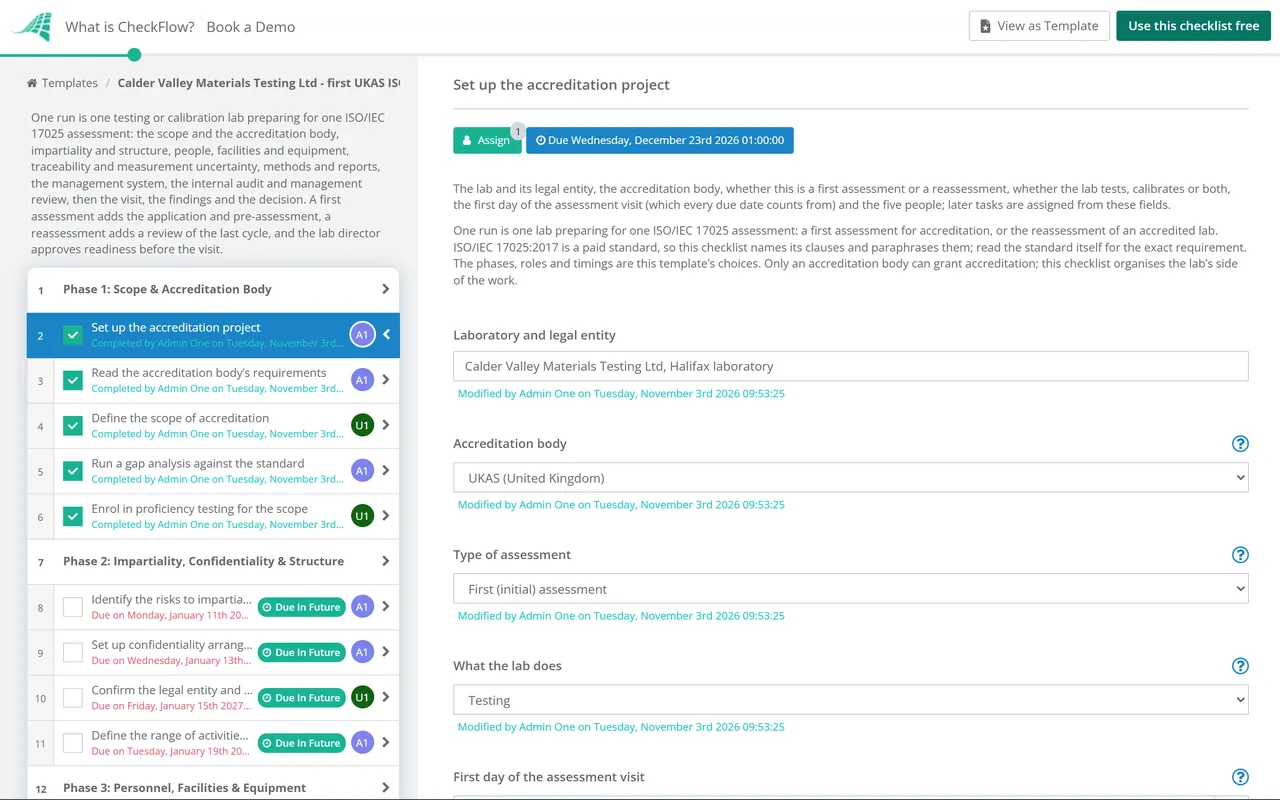
    Start about seven months before the assessment visit. The first task names the lab, the accreditation body, the five people, the type of assessment and whether the lab tests, calibrates or both; each answer adds the tasks or notes it needs. Every due date counts back from the first day of the visit in working days.

    • Set up the accreditation project — the lab and its legal entity, the accreditation body, whether this is a first assessment or a reassessment, whether the lab tests, calibrates or both, the first day of the assessment visit (which every due date counts from) and the five people; later tasks are assigned from these fields
    • Read the accreditation body’s requirements — the standard, the body’s own requirement documents and policies (traceability, proficiency testing, use of its symbol), its application and assessment steps, and its customer agreement
    • Define the scope of accreditation — each test or calibration, the method, the range or matrix, the site, and whether any of the work includes sampling; only what is on the scope is covered by the accreditation
    • Run a gap analysis against the standard — every clause from 4 to 8 and the body’s own requirements, what the lab already has, what is missing, an owner and a date for each gap, and which management system option the lab will use
    • Enrol in proficiency testing for the scope — the schemes or interlaboratory comparisons available for each test or calibration on the scope, the first rounds booked, and where none exists, the alternative the lab will use
  2. Clauses 4 & 5

    Phase 2: Impartiality, Confidentiality & Structure

    4 tasks

    Clauses 4 and 5 come first in the standard: the lab acts impartially, keeps customer information confidential, is a legal entity that is responsible for its work, and has a defined structure with people who have the authority to run it.

    • Identify the risks to impartiality — management’s commitment to impartiality, then each risk from the lab’s activities, its relationships and its people, and how each is eliminated or minimised (clauses 4.1.1 to 4.1.5)
    • Set up confidentiality arrangements — legally enforceable commitments to keep customer information confidential, telling customers in advance what the lab will make public, what happens when the law requires release, information from other sources, and commitments from staff, committee members and contractors (clause 4.2)
    • Confirm the legal entity and who is responsible — the legal entity (or defined part of one) that is legally responsible for the lab’s activities, and the management with overall responsibility for the lab (clauses 5.1 and 5.2)
    • Define the range of activities, the structure and the authorities — the range of activities the lab claims conform to the standard (clause 5.3), the organisation and management structure, responsibilities and relationships (5.5), people with the authority and resources to run the management system and act on deviations (5.6), and management’s communication about the system and its integrity through changes (5.7)
  3. Resources

    Phase 3: Personnel, Facilities & Equipment

    5 tasks

    Clause 6 covers the resources behind every result: competent and authorised people, suitable facilities and environmental conditions, equipment that is calibrated and controlled, and externally provided products and services that are checked before use.

    • Set competence requirements for each role — the education, qualification, training, technical knowledge, skills and experience for each function that affects the results (clause 6.2.2)
    • Train, supervise and authorise the staff — the procedure and records for selection, training, supervision, authorisation and monitoring of competence (clause 6.2.5), and who is authorised to develop, verify or validate methods, analyse results, and report, review and authorise them (6.2.6)
    • Check facilities and environmental conditions — the conditions each method or specification needs, how they are monitored, controlled and recorded, access to areas, prevention of contamination and separation of incompatible work (clause 6.3)
    • Bring the equipment records and the calibration programme up to date — every item that can affect results, including software, standards and reference materials; calibration where accuracy or uncertainty affects validity or traceability, the programme reviewed and adjusted, status labels, intermediate checks and equipment taken out of service (clause 6.4)
    • Control externally provided products and services — requirements for suppliers, calibration providers, proficiency testing providers and any subcontracted lab work, how they are evaluated, selected, monitored and re-evaluated, and checks before use (clause 6.6)
  4. Measurement

    Phase 4: Metrological Traceability & Measurement Uncertainty

    5 tasks

    Results must be traceable through an unbroken chain of calibrations, and every result needs an uncertainty that has been evaluated. The tasks on a calibration lab’s own uncertainty and CMC appear for calibration labs, the testing task for testing labs, and both for labs that do both.

    • Map the traceability chain for each measurement — for each measurement on the scope, who calibrates the equipment and reference standards, and whether each provider gives traceability by a route the accreditation body accepts (clause 6.5)
    • Check calibration certificates and reference materials — each certificate covers the right range and gives results with their uncertainty, and each certified reference material comes from a source with established traceability
    • Evaluate measurement uncertainty for each method — the contributions that are significant, including those from sampling where the lab samples, the method used to combine them, using the verification and validation data, and where each evaluation is recorded (clause 7.6.1)
    • Estimate uncertainty where a test method does not allow a rigorous evaluation — an estimate based on the theoretical principles of the method or practical experience of its performance (clause 7.6.3), and when uncertainty is reported on a test report
    • Evaluate uncertainty for every calibration and set the CMC — the uncertainty of every calibration, including calibrations of the lab’s own equipment (clause 7.6.2), and the calibration and measurement capability (CMC) for each calibration on the scope
  5. Process

    Phase 5: Methods, Records & Reporting

    10 tasks

    Clause 7 covers each job from the customer’s request to the report: the contract review, methods that are verified or validated, sampling and item handling, records that let the work be repeated, quality control and proficiency testing, and reports and certificates.

    • Review requests, tenders and contracts — the customer’s requirements, the method, the lab’s capability, any external provider, and the decision rule agreed with the customer where they ask for a statement of conformity (clauses 7.1.1 to 7.1.3)
    • Select and verify methods — the latest valid version of each standard method unless it is not appropriate, and evidence that the lab can perform each one properly before it is introduced (clause 7.2.1)
    • Validate non-standard and lab-developed methods — methods the lab developed, non-standard methods, and standard methods used outside their intended scope or modified, with the procedure, the performance characteristics and a statement on validity (clause 7.2.2)
    • Write the sampling plan and method — the sampling plan and method for each place the lab samples, the factors that must be controlled, and the records of each sampling (clause 7.3)
    • Set up the handling of test or calibration items — transport, receipt, handling, protection, storage, retention and disposal or return of items, a unique identification for each item, and how problems on receipt are recorded (clause 7.4)
    • Check technical records and data control — records that let each test or calibration be repeated, who did and checked each step, original observations recorded at the time and amendments traceable (clause 7.5), and data and information management, including validation of any LIMS before use (clause 7.11)
    • Plan internal quality control — how the validity of each method’s results is monitored, such as reference materials, replicate tests, retesting retained items, check standards and control charts, with the data recorded so trends can be seen (clause 7.7.1)
    • Review quality control and proficiency testing results — results analysed against the criteria set, used to control and improve the work, and action taken when a result is outside them (clauses 7.7.2 and 7.7.3)
    • Check test reports carry what the standard requires — the general report contents (clause 7.8.2), and for test reports the test conditions, statements of conformity with the decision rule, uncertainty where it is relevant, and opinions and interpretations by authorised people (7.8.3, 7.8.6 and 7.8.7)
    • Check calibration certificates carry what the standard requires — the general report contents (clause 7.8.2), and for certificates the measurement uncertainty, the conditions, how the results are traceable, results before and after any adjustment where available, no recommended calibration interval unless agreed with the customer (7.8.4), and statements of conformity with the decision rule and opinions where relevant (7.8.6 and 7.8.7)
  6. System

    Phase 6: Complaints, Nonconforming Work & the Management System

    6 tasks

    The lab handles complaints and nonconforming work, takes corrective action, and runs a management system to option A or option B. The option chosen in the gap analysis adds its own tasks.

    • Set up the complaints process — how complaints are received, evaluated and decided, a description of the process available to any interested party on request, and outcomes made or reviewed by someone not involved in the original work (clause 7.9)
    • Control nonconforming work — who is responsible, actions based on risk, the impact on earlier results, when customers are told and work recalled, who authorises the work to resume, and records (clause 7.10)
    • Set up corrective action — react to the nonconformity, find its cause, act, review whether the action worked, and update risks and the management system where needed (clause 8.7)
    • Document the management system and control documents and records — policies and objectives covering competence, impartiality and consistent operation, top management’s commitment, control of documents, and control and retention of records (clauses 8.2 to 8.4)
    • Check the ISO 9001 system supports clauses 4 to 7 — the ISO 9001 system, and its certificate and scope where it is certified, and evidence that the system supports and shows the lab meets clauses 4 to 7, so that it meets at least the intent of 8.2 to 8.9 (clause 8.1.3 asks for a system in line with ISO 9001, not a certified one)
    • Address risks and opportunities, and improvement — the risks and opportunities to the lab’s work and the actions planned for them, and improvement, including feedback from customers (clauses 8.5 and 8.6)
  7. Review

    Phase 7: Internal Audit & Management Review

    4 tasks

    An internal audit and a management review scoped to ISO/IEC 17025 (clauses 8.8 and 8.9) before the visit. This template’s choice is a full round of both; A2LA says it does not require a complete one before accreditation, but looks at the programme and records. For the audit and review method in general, see the ISO 9001 and ISO management review templates.

    • Plan the internal audit — an audit programme covering every clause and every test or calibration on the scope, with its frequency, methods, responsibilities, criteria and scope (clause 8.8.2); this template’s choice is auditors who do not audit their own work, as ISO 19011’s guidance on objectivity suggests
    • Carry out the internal audit — the management system clauses, a vertical audit of each test or calibration from request to report, witnessed work, and findings recorded against the clause
    • Correct the internal audit findings — correction and corrective action for each finding without undue delay, with evidence that each action worked (clauses 8.8.2 and 8.7)
    • Hold the management review — the inputs clause 8.9.2 lists, including internal audit results, corrective actions, external assessments, complaints, quality control and proficiency testing outcomes, risks and resources, and the outputs in 8.9.3: effectiveness, improvement, resources and changes
  8. Apply

    Phase 8: Application, Pre-Assessment & Readiness

    9 tasks

    A first assessment adds the application, the optional pre-assessment and acting on it; a reassessment adds a review of the last cycle and a check of scope changes. The phase ends with the laboratory director’s decision that the lab is ready for the visit, and nothing after it can be completed until it is made.

    • Submit the application — the body’s application form, the proposed scope, the key policy and procedure documents it asks for, proof of legal status, and the signed customer agreement; record the body’s reference
    • Review the last cycle’s reports — the last assessment and surveillance reports, findings and their closure, any changes since, and anything the body asked the lab to show at reassessment
    • Confirm scope changes and the visit with the body — tests or calibrations to add, change or withdraw, new sites or key staff, and the visit dates and plan the body proposes
    • Decide on and hold a pre-assessment — whether to have the optional pre-assessment, and if so its date, the areas covered and the report
    • Act on the pre-assessment — each issue raised, what was changed and the evidence; where no pre-assessment was held, record the lab’s own readiness check
    • Confirm the visit plan and the assessment team — the visit confirmation and plan, the assessors and any conflict of interest, the activities to be witnessed, the staff and records needed each day, and the rooms
    • Approve the lab as ready for the assessment — the laboratory director’s decision, from the internal audit, the management review, open actions and the visit plan, that the lab is ready; Ready with conditions or Not ready adds the next step
    • Agree a new assessment date with the body — the reasons the lab is not ready, a new date agreed with the accreditation body, the date changed on the first task, then the director un-completes the readiness decision, changes the Decision when the lab is ready, and completes it again
    • Close the conditions before the visit — each condition the director set, closed with evidence before the first day of the visit
  9. Assessment

    Phase 9: Assessment, Findings & Decision

    8 tasks

    The assessment visit, the findings raised at the closing meeting, the evidence that clears them, and the accreditation body’s decision. Findings add the corrective action tasks, and the decision adds the tasks that follow it.

    • Host the assessment — the opening meeting, records ready, staff available for interviews, and the tests or calibrations the assessors witness
    • Record the findings at the closing meeting — each finding with its clause and grade, the team’s recommendation, and the deadline agreed for the evidence
    • Find the cause of each finding and act — the root cause of each finding, the correction, the corrective action and the review of whether it worked (clause 8.7)
    • Send the evidence to the body — evidence for each finding sent by the deadline agreed with the body, and any questions from the assessors answered
    • Record the accreditation body’s decision — the decision and its date, the scope granted or continued, and any part of the scope not granted
    • Check the schedule and use the symbol as the body allows — the published schedule against the scope applied for, and the body’s rules for its symbol and any reference to accreditation on reports, certificates and marketing
    • Decide the next step with the body — the reasons given, whether to appeal under the body’s process, reapply, or narrow the scope, and the director’s decision
    • Plan the next cycle — the surveillance visits and the reassessment date the body sets, the next internal audit and management review, and the proficiency testing plan for the cycle

ISO/IEC 17025 Clauses and the Accreditation Steps

The first table maps each clause of the standard to the phase that prepares for it. The second sets out the steps three accreditation bodies describe on their own websites. Both are summaries; your body’s documents decide what applies to your lab.

ISO/IEC 17025:2017, clause by clause

ClauseWhat it covers (paraphrased)Where in this checklist
4.1 ImpartialityWork done impartially, management committed to it, risks to impartiality identified and eliminated or minimisedPhase 2
4.2 ConfidentialityLegally enforceable commitments on customer information, and what happens when information is made public or released by lawPhase 2
5 Structural requirementsA legal entity responsible for the work, the range of activities, the structure, and people with authority to run the systemPhase 2
6.2 PersonnelCompetence requirements, training, supervision, authorisation and monitoring of competencePhase 3
6.3 Facilities and environmental conditionsSuitable conditions, monitored, controlled and recorded where methods need itPhase 3
6.4 EquipmentEquipment, software and reference materials that are calibrated, checked, identified and recordedPhase 3
6.5 Metrological traceabilityAn unbroken chain of calibrations, each with its uncertainty, to a stated referencePhase 4
6.6 Externally provided products and servicesRequirements for providers, their evaluation, selection and monitoringPhase 3
7.1 Review of requests, tenders and contractsRequirements agreed, the method suitable, and a decision rule agreed for statements of conformityPhase 5
7.2 MethodsMethods selected and verified, and non-standard or lab-developed methods validatedPhase 5
7.3 to 7.5 Sampling, items and technical recordsSampling plans, handling and identifying items, and records that let work be repeatedPhase 5
7.6 Measurement uncertaintyContributions identified; every calibration evaluated; an estimate where a test method allows no rigorous evaluationPhase 4
7.7 Ensuring the validity of resultsInternal quality control, proficiency testing or interlaboratory comparisons, and action on the resultsPhases 1 and 5
7.8 Reporting of resultsWhat every report, test report and calibration certificate contains, statements of conformity and opinionsPhase 5
7.9 and 7.10 Complaints and nonconforming workA complaints process available on request, and control of work that does not conformPhase 6
7.11 Control of data and information managementAccess to data, and validation and protection of the systems that hold itPhase 5
8.1 to 8.7 Management system (option A or B)Documentation, document and record control, risks and opportunities, improvement and corrective action, or an ISO 9001 system that supports clauses 4 to 7Phase 6
8.8 Internal audits and 8.9 Management reviewsAudits at planned intervals, and reviews with set inputs and outputsPhase 7

What three accreditation bodies say the steps are

BodySteps it describesRead on 3 November 2026
UKAS (UK)Gap analysis, application with key documents and proof of legal status, an Assessment Manager, optional pre-assessment, initial assessment, about 12 weeks to clear findings (agreed with the Assessment Manager), an independent decision, then yearly surveillance and reassessment every fourth yearukas.com, How to get UKAS accreditation
A2LA (US)Application with supporting documents, an assessor team checked for conflicts of interest, document review, optional pre-assessment, the assessment, corrective action, then the decision; in most cases at least one proficiency testing activity before accreditationa2la.org, FAQ
ANAB (US)Quote, application, preparation, documentation review, optional preliminary assessment, the assessment, corrective action if applicable, the decision and the certificateanab.ansi.org, How to prepare for ISO/IEC 17025 laboratory accreditation

Where this comes from. The clause names are those of ISO/IEC 17025:2017; the descriptions are short paraphrases, not the standard’s words. The accreditation steps are from UKAS, A2LA and ANAB. Each body also has its own requirement documents and fees; read them before you apply.

Why Prepare for ISO/IEC 17025 Accreditation in CheckFlow?

1

No visit until the director says the lab is ready

The readiness decision is assigned to the laboratory director alone, and the checklist halts there: nothing after it, including the visit and its findings, can be completed until the director records Ready, Ready with conditions or Not ready. Conditions add a task to close them; Not ready adds a task to agree a new date. See how approvals that halt a checklist work.

2

Only the tasks this lab needs

Testing, calibration or both add their own uncertainty and reporting tasks. A first assessment adds the application and pre-assessment; a reassessment adds a review of the last cycle. Option A or option B, sampling, findings at the visit and the body’s decision each add the tasks that follow, and UKAS, A2LA or ANAB adds a note on that body’s own steps.

3

Every date counted from the visit

Enter the first day of the assessment visit and every task falls due a set number of working days before or after it. Tasks are assigned from the five people named in the first task. If the body moves the visit, change the date and every due date moves with it. The Reports Grid lists every assessment with its answers, and Analytics shows where tasks are waiting.

CheckFlow does not grant accreditation or assess a lab: only an accreditation body does that. CheckFlow makes sure every clause has an owner, a due date and its evidence, the director’s decision is recorded before the visit, and the findings and the body’s decision are on record for the next cycle. See CheckFlow’s compliance checklist software.

Keep each instrument in calibration with the Calibration Management Checklist, and run each corrective action through the CAPA (Corrective & Preventive Action) Checklist. Audit a key supplier with the Supplier Audit Checklist, plan how research data is collected with the R&D Data Collection Process Checklist, and induct new staff with the New Researcher & Lab Onboarding Checklist before they are trained and authorised.

AI generator

Didn’t find what you need? Describe it.

Describe the process in a sentence and the AI checklist generator drafts the phases and tasks for you.

Frequently Asked Questions

What should an ISO 17025 checklist include?

Every clause from 4 to 8: impartiality and confidentiality, structure, personnel, facilities, equipment, metrological traceability, externally provided services, contract review, methods, sampling, item handling, technical records, measurement uncertainty, validity of results, reporting, complaints, nonconforming work, data control and the management system. This template adds the accreditation body’s own requirements, proficiency testing, the internal audit and management review, the application, the visit, the findings and the decision.

How is ISO/IEC 17025 accreditation different from ISO 9001 certification?

ISO 9001 certification says an organisation’s quality management system meets ISO 9001. ISO/IEC 17025 accreditation is recognition by an accreditation body that a lab is competent to produce valid results for the tests or calibrations on its scope. A2LA says accreditation assesses both the management system and the technical competence of the lab. A lab can hold both, and option B lets an ISO 9001 system cover the management system clauses.

What is the difference between option A and option B?

Clause 8.1 offers two ways to meet the management system requirements. Under option A the lab meets clauses 8.2 to 8.9 itself: documentation, document and record control, risks and opportunities, improvement, corrective action, internal audits and management reviews. Under option B, a lab with an ISO 9001 system that supports and shows it meets clauses 4 to 7 also meets at least the intent of 8.2 to 8.9. Choose on the gap analysis task.

How long does ISO/IEC 17025 accreditation take?

It depends mostly on how ready the lab is. A2LA says a well-prepared applicant can complete its process in three to six months, and lists incomplete applications, measurement uncertainty budgets and slow responses to findings as the usual delays. UKAS says labs have approximately 12 weeks after the initial assessment to clear findings, agreed with the Assessment Manager. This template starts about seven months before the visit; move the date to suit.

Do labs need proficiency testing before they are accredited?

ILAC P9 asks accreditation bodies to have each applicant develop a proficiency testing participation plan, and to assess it before granting accreditation. A2LA says that in most cases it requires at least one proficiency testing activity before accreditation, and that enrolling can take several weeks. Where no scheme exists for a test, the lab uses an interlaboratory comparison or another approach and justifies it. This template books the first rounds in Phase 1.

What does metrological traceability mean for an accredited lab?

A result can be related to a reference through an unbroken chain of calibrations, each adding to its uncertainty. ILAC P10 says equipment should be calibrated by a national metrology institute whose service is covered by the CIPM MRA, or by an accredited calibration lab whose scope covers that calibration. Other routes are for when neither is possible. Phase 4 maps the chain for every measurement on the scope.

How often is an accredited lab reassessed?

It depends on the body. UKAS says it confirms accreditation each year through surveillance, with a full reassessment every fourth year and the first surveillance visit six months after the grant. Other bodies set their own cycles in their requirement documents. Run this template again for each reassessment: choose reassessment on the first task and it replaces the application with a review of the last cycle’s reports and a check of scope changes.

Is ISO/IEC 17025:2017 still the current edition?

Yes. On 3 November 2026 iso.org showed ISO/IEC 17025:2017 as last reviewed and confirmed in 2023, so that version remains current, and ISO/CASCO listed no revision of it under development. Separately, ISO published ISO 9001:2026 in September 2026, which matters to labs using option B, and on 1 January 2026 a single new organisation, Global Accreditation Cooperation Incorporated, replaced ILAC and IAF, with its own recognition arrangement. Check iso.org and your body’s news before you apply.

Does completing this checklist mean the lab is accredited?

No. Only an accreditation body can grant accreditation, after it has assessed the lab against the standard and its own requirements. This checklist organises the lab’s preparation: who does each task, by when, with what evidence, and the director’s decision that the lab is ready. It then records the visit, the findings, the evidence sent and the body’s decision, so the next reassessment starts from this one.

Is CheckFlow free for this template?

14-day free trial, no card required. The Business plan is $10 per user per month after the trial. Full details at checkflow.io/pricing.

Get Your Lab Ready for Its ISO/IEC 17025 Assessment

Free trial — no credit card required.

14-day free trial, no credit cardFull refund in your first 30 daysUS hosting, EU on request