
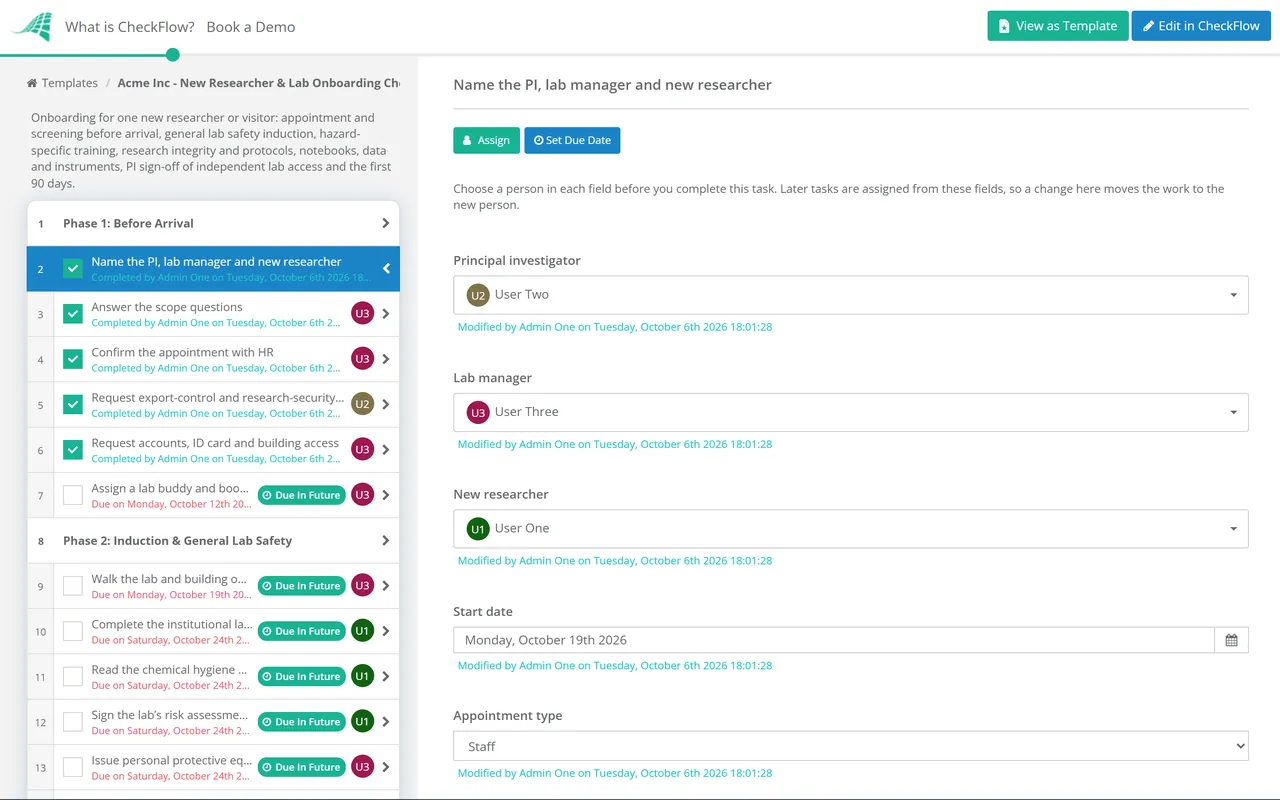
Owned by HR and the line manager
- Contract, payroll, right to work or visa and benefits
- IT account, ID card and building access
- Company or university policies and induction
- Same for every new starter in the organisation
Last reviewed: October 2026
No Credit Card Required
Printed from checkflow.io/templates/research-development/researcher-onboarding-checklist
This free researcher onboarding checklist is for lab managers, principal investigators and research administrators at universities, institutes and R&D companies bringing in postdocs, graduate students, research staff and visiting researchers. It runs from before arrival to the 90-day review: screening and access, the lab safety induction, research integrity training, data and notebook practice, IP and confidentiality, equipment sign-offs, the PI’s sign-off of independent work and a 90-day project plan. Three questions at the start show the hazard-specific training phase for work with hazardous chemicals or biological agents, and the human-participants and animal-work tasks only where the project needs them.
Every new researcher goes through two onboardings at once. HR handles the contract, payroll, right-to-work checks and benefits, and the Employee Onboarding Checklist covers that well. Nobody in HR can decide whether a new graduate student may run the ultracentrifuge alone or whether a postdoc has been added to the animal protocol. That is the lab’s job, and it tends to live in a folder of half-completed training forms.
Much of it is required by rules the lab must evidence. In the US, the OSHA Laboratory Standard (29 CFR 1910.1450) requires a written chemical hygiene plan and says employees must receive information and training at the time of their initial assignment to a work area where hazardous chemicals are present, and before assignments involving new exposure situations. In Great Britain, COSHH (the Control of Substances Hazardous to Health Regulations 2002) requires a risk assessment and suitable and sufficient information, instruction and training for anyone liable to be exposed. Funders add their own training conditions: NSF expects responsible conduct of research training for students, postdocs, faculty and other senior personnel it supports, and NIH requires it for trainees and fellows on its training and career awards.
This checklist keeps those requirements in one record per person and ends with the PI signing off that the researcher can work unsupervised. It does not replace your institution’s ethics review; if the new researcher is starting a study that needs approval, the R&D Ethics Compliance Checklist covers the application itself.
Seven phases run from the weeks before arrival to the 90-day review. Phase 3 appears only when the researcher will work with hazardous chemicals or biological agents, and the human-participants and animal-work tasks in Phase 4 appear only when the project involves them.
Answer the three scope questions first. They decide whether the hazard phase and the protocol tasks appear.
Shown only when the researcher will work with hazardous chemicals or biological agents.
The human-participants and animal tasks appear only when the scope questions say the project involves them.
The PI sign-off halts the checklist. Unescorted and out-of-hours access is not switched on until it is given.
Training requirements come from law, funders and your own institution, and they rarely line up neatly. This table maps the main frameworks behind the checklist. Your safety office and research office decide what applies in your institution.
| Framework | Who it covers | What to record |
|---|---|---|
| OSHA Laboratory Standard, 29 CFR 1910.1450 (US) | Lab employees working with hazardous chemicals | Training at initial assignment and before new exposure situations; refresher frequency set by the employer |
| COSHH Regulations 2002 (Great Britain) | Anyone liable to be exposed to a hazardous substance | Risk assessment, plus information, instruction and training on the substances and controls |
| NSF responsible and ethical conduct of research | Undergraduates, graduate students, postdocs, faculty and other senior personnel NSF supports | Completion; faculty and senior personnel, and mentor training, were added for proposals from 31 July 2023 |
| NIH responsible conduct of research (NOT-OD-22-055) | Trainees, fellows and scholars on NIH training, career development and research education awards | Instruction with face-to-face discussion, at each career stage and at least every four years |
| NIH human subjects education | Key personnel on NIH-funded human subjects research | Training described before the award is made |
| Animal Welfare Act regulations, 9 CFR 2.32 (US) | Everyone involved in animal care, treatment and use at a research facility | Training in humane handling, alternatives, anaesthesia and how to report concerns |
| Animals (Scientific Procedures) Act 1986 (UK) | Anyone carrying out regulated procedures | A personal licence, granted after accredited training modules |
| NIH Guidelines for recombinant or synthetic nucleic acids | PIs and lab staff at institutions that follow the Guidelines | Training on lab safety and the Guidelines, which the institution must ensure |
Visiting and international researchers need one more check. In the US, releasing controlled technology or source code to a foreign person inside the country is a “deemed export” under the Export Administration Regulations, so the research office reviews controlled equipment and restricted projects first. In the UK, some researchers subject to immigration control need an Academic Technology Approval Scheme (ATAS) certificate before starting work in sensitive subjects. Both checks sit in Phase 1, before the first day.
Each new arrival gets their own checklist, with every certificate, sign-off and comment in one place. When an auditor asks who trained a postdoc on the biosafety cabinet, the answer is in the checklist history.
Independent access stops at an approval step until the PI answers, so out-of-hours access is never switched on because somebody assumed the training was done. The approval and the date stay in the record.
Dropdown answers show the hazard phase and the protocol tasks only where they apply, so a computational postdoc and a wet-lab student use the same template. Reports show who is still waiting for sign-off, and the API and MCP server can start a checklist when HR confirms a start date.
Next in the research lifecycle: the Experiment Tracking Workflow Checklist builds on the notebook habits introduced here, the R&D Data Collection Checklist covers collection, and the Literature Review Checklist helps with the first weeks of reading. Joining a clinical research team instead? The Clinical Trial Site Initiation Checklist covers GCP training and the delegation log, and research nurses can also run the New Nurse Onboarding Checklist.
Onboarding researchers across several labs or departments? CheckFlow’s onboarding software runs the HR and lab sides of a new starter side by side, and compliance checklists keep the training evidence your safety office asks for.
R&D Ethics Compliance Checklist
Employee Onboarding Checklist
R&D Experiment Tracking Workflow Checklist
R&D Data Collection Process Checklist
Clinical Trial Site Initiation Checklist
Describe the process in a sentence and the AI checklist generator drafts the phases and tasks for you.
Everything the lab needs before the person works unsupervised, not just the HR steps: export-control screening and access, a lab walk-round, the general safety course and chemical hygiene plan, hazard-specific training, responsible conduct of research training, human-subjects or animal-use training where relevant, IP and confidentiality terms, notebook and data rules, instrument sign-offs, a PI decision on independent access and a 90-day plan.
Usually both. The safety office runs the general courses and maintains the institution’s chemical hygiene plan or safety policies. The PI or lab manager is responsible for the lab-specific part: the procedures, hazards and equipment in their own space. Under the OSHA Laboratory Standard the duty to train sits with the employer, and training is due at initial assignment and before new exposure situations, so a lab cannot rely on a course the person took somewhere else without checking it covers their new work.
Often, depending on who funds them and your institution’s policy. NSF requires institutions to provide training in the responsible and ethical conduct of research to the undergraduates, graduate students, postdocs, faculty and other senior personnel it supports. NIH requires it for trainees, fellows and scholars on its training, career development and research education awards, with substantial face-to-face discussion and at least once every four years. Many institutions require it of every researcher regardless of funder.
When the PI decides they are ready, based on evidence rather than time served. In this checklist that means every required course is complete, each instrument they will use has a recorded sign-off, and the lab manager or buddy has watched them carry out a full procedure. The PI’s sign-off then names the work they may do unsupervised, and your lone-working rules still apply.
The lab steps are the same, because the hazards are the same. The differences are at the start: a visiting or honorary agreement instead of an employment contract, IP and confidentiality terms that may need negotiating with their home institution, and immigration or export-control checks. In the UK some international researchers need an ATAS certificate before starting work in sensitive subjects, and in the US the research office may need to review a deemed-export question before access to controlled technology.
14-day free trial, no card required. The Business plan is $10 per user per month after the trial. Full details at checkflow.io/pricing.
14-day free trial, no credit cardFull refund in your first 30 daysUS hosting, EU on request