Six Sigma DMAIC Project Checklist Template

A DMAIC project can get the statistics right and still fail: a charter nobody agreed, a baseline measured with a gauge nobody checked, or a gain that fades once the team moves on and nobody owns the control plan.

Last reviewed: October 2026

This free Six Sigma DMAIC project checklist is for Green Belts, Black Belts and other project leads who run improvement projects, and for the champions who review them. One run is one DMAIC project, from the charter to handing the improved process back to its owner. Define writes the charter, the SIPOC and the customer requirements. Measure agrees how each measure is defined, checks the measurement system and measures the baseline and capability. Analyse maps the process and tests the possible causes with data until the root causes are verified. Improve selects solutions, runs a pilot and compares the result with the goal. Control rolls the change out, sets up the control plan and monitoring, updates the procedures and trains the people who run the process, and the project closes once the process owner accepts it and the benefits are confirmed. Each phase ends with a tollgate where the champion chooses Go, Recycle or Stop.

DMAIC, PDCA or a Kaizen Event?

DMAIC is the five-phase method behind Six Sigma projects: Define, Measure, Analyse, Improve and Control. ISO 13053-1, the international standard on the DMAIC methodology, describes those five phases, how Six Sigma projects should be managed and the roles of the people who run them. What sets DMAIC apart is the order of work: nobody chooses a solution until the measurement system has been checked, the baseline measured and the root causes verified with data. That makes it slower than other improvement methods, and the right one when the cause is unknown and the problem is worth months of a trained lead’s time.

Use this checklist for one DMAIC project at a time. Smaller problems usually need a lighter tool: a continuous improvement cycle runs PDCA as a standing programme, and a kaizen event changes one process in a few days. A problem that needs containing and fixing for a customer fits a root cause analysis (8D), and a nonconformity from an audit or a complaint belongs in CAPA.

This checklist

A DMAIC project

Use it when: a chronic problem has a cause nobody can prove, there is data to measure it, and the gain is worth several months of work.

Produces: verified root causes, a piloted solution, a control plan and confirmed benefits.

Decided at: five tollgates where the champion chooses Go, Recycle or Stop.
PDCA cycle

Plan, Do, Check, Act

Use it when: a team improves its own process in small, quick cycles, one after another.

Produces: a steady stream of tested changes and an improvement register.

Rigour: data where it helps, without formal tollgates or a measurement system study.

Kaizen event

A few days on one process

Use it when: the problem sits in one process the team can see, and changes can be tried within days.

Produces: a changed process and new standard work, followed up 30 days later.

Not for: a cause nobody can prove. Analyse it first, then fix it in an event.

What the Six Sigma DMAIC Project Checklist Covers

Six phases follow one DMAIC project: the five DMAIC phases, with Control split into running the controls and handing over. Each DMAIC phase ends with a tollgate where the champion chooses Go, Recycle or Stop. Recycle adds a rework task before the tollgate, and Stop adds a task after it to close the project properly; changing the decision hides them again. Nothing after the Improve tollgate can be completed until the champion decides. A continuous or discrete main measure adds the matching notes on the measurement system, capability and control chart tasks, and a failed measurement system study, a solution that needs change approval and claimed savings each add a task.
  1. Phase 1 — Define

    Phase 1: Define the Project

    11 tasks

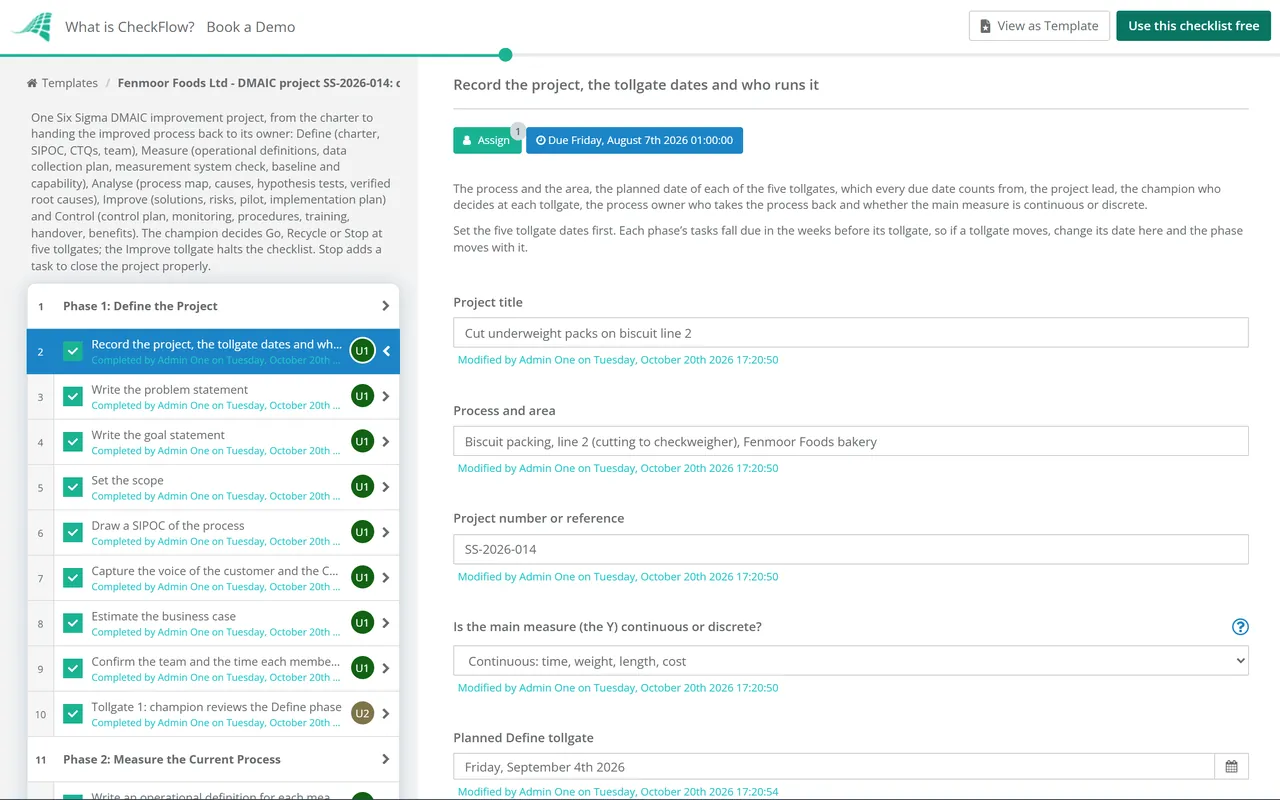
    The project lead writes the charter and agrees it with the champion. Enter the planned date of each tollgate first: every phase’s due dates count back from its own tollgate, and move when it moves. Say whether the main measure is continuous or discrete, so the later tasks show the right notes.

    • Record the project, the tollgate dates and who runs it — the process and the area, the planned date of each of the five tollgates, which every due date counts from, the project lead, the champion who decides at each tollgate, the process owner who takes the process back and whether the main measure is continuous or discrete
    • Write the problem statement — what is wrong, where, since when and how big, in measured terms, with no cause or solution written into it
    • Write the goal statement — the main measure, its baseline estimate, the target and the date, plus the measures that must not get worse
    • Set the scope — the first and last step of the process, what is in and out of scope, and the limits the team works within
    • Draw a SIPOC of the process — suppliers, inputs, the five to seven high-level process steps, outputs and customers, so everyone agrees where the process starts and ends
    • Capture the voice of the customer and the CTQs — who the customers of the process are, what they say they need, and the critical-to-quality requirements, each with a measure and a specification limit
    • Estimate the business case — why the project matters now: the cost of poor quality, the customer impact or the risk, and the estimated benefit if the goal is met
    • Confirm the team and the time each member gives — team members with their role and time commitment, agreed with their managers, and any mentor or Master Black Belt who supports the lead
    • Recycled: rework the Define deliverables and resubmit — appears when the champion chooses Recycle at the Define tollgate; rework what the champion asked for, then resubmit
    • Tollgate 1: champion reviews the Define phase — the charter, SIPOC, CTQs, business case and team; Go moves the project to Measure, Recycle sends it back for rework and Stop ends it with the reasons recorded
    • Stopped at the Define tollgate: close the project — appears when the champion chooses Stop; record the date and the reason, leave the process in a known state, keep the data and lessons where a future project can find them and tell the team
  2. Phase 2 — Measure

    Phase 2: Measure the Current Process

    11 tasks

    Measure decides whether the rest of the project rests on facts. Define each measure, check that the measurement system can be trusted, then collect enough data to show how the process performs today. A measurement system that fails its study adds a task to fix it before the baseline is collected.

    • Write an operational definition for each measure — exactly what is counted or measured, how, with what instrument and what counts as a defect, so two people measuring the same item get the same answer
    • Write the data collection plan — for each measure the source, sample size and frequency, who collects it and over what period, and the factors such as shift, product or site recorded with each value so the data can be split later
    • Check the measurement system — a gauge repeatability and reproducibility study for a continuous measure, or an attribute agreement study for pass or fail judgements, before any baseline data is trusted
    • Fix the measurement system and repeat the study — appears when the study finds the measurement system not acceptable; fix the gauge, the method or the training, repeat the study and record the new result before collecting the baseline
    • Collect the baseline data — following the plan, over a period long enough to include normal variation such as shifts, days and product mix, with gaps and unusual events noted
    • Check whether the process is stable — plot the baseline over time on a run chart or control chart, and look into points outside the limits or patterns before calculating capability
    • Calculate baseline performance and process capability — for a continuous measure the mean, the spread and capability indices such as Cp and Cpk against the specification limits; for a discrete measure the defect rate, defects per unit or yield
    • Update the charter with the measured baseline — replace the estimates in the problem and goal statements with measured figures, and check that the goal still makes sense
    • Recycled: rework the Measure deliverables and resubmit — appears when the champion chooses Recycle at the Measure tollgate; rework what the champion asked for, then resubmit
    • Tollgate 2: champion reviews the Measure phase — the operational definitions, data collection plan, measurement system result, baseline and capability; Go moves the project to Analyse
    • Stopped at the Measure tollgate: close the project — appears when the champion chooses Stop; record the date and the reason, leave the process in a known state, keep the data and lessons where a future project can find them and tell the team
  3. Phase 3 — Analyse

    Phase 3: Analyse the Root Causes

    8 tasks

    Analyse narrows many possible causes to the few the data supports. List the candidates widely, write each one as a hypothesis and test it, so the team does not spend money fixing a cause that was never proved.

    • Map the process in detail — walked where the work is done: every step, decision, handoff, wait and rework loop, with the steps that add value marked
    • List the possible causes — a cause and effect (fishbone) diagram drawn with the team and the people who do the work, grouped under people, methods, machines, materials, measurement and environment
    • Turn the likely causes into hypotheses to test — narrow the list with the process map and the team’s knowledge, and write each likely cause as a hypothesis that data can confirm or reject, with the test you will use
    • Test the hypotheses with data — split the data by the factors recorded with it, plot it and run the test that fits the data, recording the test, the result and what it means in plain words
    • Confirm the verified root causes — the causes the data supports, each with its evidence and how much of the problem it explains, and the causes ruled out with the reason
    • Recycled: rework the Analyse deliverables and resubmit — appears when the champion chooses Recycle at the Analyse tollgate; rework what the champion asked for, then resubmit
    • Tollgate 3: champion reviews the Analyse phase — the process map, the possible causes, the test results and the verified root causes; Go moves the project to Improve
    • Stopped at the Analyse tollgate: close the project — appears when the champion chooses Stop; record the date and the reason, leave the process in a known state, keep the data and lessons where a future project can find them and tell the team
  4. Phase 4 — Improve

    Phase 4: Improve & Pilot the Solution

    11 tasks

    Improve tests solutions on the verified causes, in a pilot that can be reversed. The Improve tollgate is the main gate: nothing after it can be completed until the champion records a decision, because full implementation changes the process for everyone and is the hardest step to undo. A solution that changes a safety control, a regulatory requirement or what the customer receives adds a change approval before the pilot.

    • Generate solutions for each verified cause — many options first, from the team, the people who do the work and other sites, each linked to the cause it removes
    • Select the solutions — rate each option on its effect on the main measure, cost, time and risk, using criteria agreed before anyone scores
    • Assess the risks of the solution — what could go wrong when the process changes, with a process FMEA for complex changes, and the controls added before the pilot
    • Change control: get the change approved before the pilot — appears when the solution changes a safety control, a regulatory requirement or what the customer receives; get the approval your own change or management of change procedure requires
    • Plan the pilot — where, for how long and on which shifts or products, how the results will be measured (the same way as the baseline), the success criteria and how to reverse the change if it fails
    • Run the pilot — make the change in the pilot area, train the people involved and record problems as they happen
    • Compare the pilot results with the goal — the main measure before and during the pilot, measured the same way, with a test showing whether the change is real and not normal variation
    • Plan the full implementation — the rollout steps, owners and dates, the training, equipment and documents to change, and how everyone affected will be told
    • Recycled: rework the Improve deliverables and resubmit — appears when the champion chooses Recycle at the Improve tollgate; rework the solution or repeat the pilot as the champion asked, then resubmit
    • Tollgate 4: champion approves full implementation — the pilot results against the goal, the risks and the implementation plan; nothing after this tollgate can be completed until the champion records a decision
    • Stopped at the Improve tollgate: close the project — appears when the champion chooses Stop; record the date and the reason, leave the process in a known state, keep the data and lessons where a future project can find them and tell the team
  5. Phase 5 — Control

    Phase 5: Implement & Control

    7 tasks

    Control makes the gain last after the team moves on. Roll the change out in full, write the controls into the documents people use, and watch the process long enough to show that the gain holds. Due dates count back from the Control tollgate.

    • Implement the solution in full — follow the implementation plan across every shift, site or product in scope, and record anything that differed from the pilot
    • Write the control plan — for each key input and output: what is measured, the specification or target, the method, sample size and frequency, who measures it and the reaction plan when it goes wrong
    • Set up statistical process control or monitoring — a control chart for the main measure, with limits calculated from the improved process, or a simpler monitoring check for lower-risk measures
    • Update the procedures, work instructions and forms — every document the change touches, approved and issued through your document control, with the old versions withdrawn
    • Train everyone who runs the process — every shift and role, including people who were not in the pilot, with training records kept
    • Mistake-proof where you can — design the error out with a fixture, a system check or a required field, so the control does not depend on someone remembering
    • Monitor the process and confirm the gain holds — the main measure over an agreed period after implementation, measured the same way as the baseline, with the improved capability or defect rate calculated
  6. Phase 6 — Control tollgate

    Phase 6: Hand Over & Close

    7 tasks

    The project ends when the process owner runs the controls and the benefits are confirmed, not when the solution goes live. Claimed financial savings add a check by finance. The champion’s final tollgate closes the project.

    • Hand the process over to the process owner — the control plan, charts, reaction plan and updated documents, and the process owner’s agreement to run them from now on
    • Calculate the benefits — the measured improvement turned into savings, cost avoided, capacity or customer benefit, with the method stated
    • Finance validates the savings — appears when financial savings are claimed; finance checks the method and the figures and agrees the amount the project can claim
    • Record lessons learned and the next opportunities — what worked, what to do differently next time, and the causes or ideas left out of scope that could become the next project
    • Recycled: rework the Control deliverables and resubmit — appears when the champion chooses Recycle at the Control tollgate; rework what the champion asked for, then resubmit
    • Tollgate 5: champion approves closing the project — the control plan in use, the gain sustained, the handover accepted and the benefits confirmed; Close ends the project and Recycle sends it back
    • Close the project and share the results — the final report filed with the data and analysis, the team thanked, and the result shared with the people who run the process

The Five Tollgates and What the Champion Checks

A tollgate is the review at the end of each DMAIC phase where the champion decides whether the project moves on. In this checklist the champion records one of three decisions: Go, Recycle (rework and resubmit) or Stop. The table shows what each tollgate asks and the evidence to bring. These are common practice, not the wording of a standard; agree your own criteria with whoever runs your improvement programme.

Tollgate The champion asks Bring to the review A common reason to recycle
1. DefineIs the problem real, measured and worth solving, and can one team handle the scope?The charter (problem, goal, scope, business case), the SIPOC, the CTQs and the teamA solution written into the problem statement, or a scope that covers half the business
2. MeasureCan we trust the data, and how does the process perform today?Operational definitions, the data collection plan, the measurement system result, the baseline, stability and capabilityA measurement system nobody checked, or a baseline from too few data points
3. AnalyseWhich causes does the data support?The process map, the cause and effect diagram, the test results and the verified root causes with their evidenceCauses chosen by opinion, with no test behind them
4. ImproveDid the pilot meet the goal, and is it safe to roll out?The solution selection, the risk assessment, the pilot results against the goal and the implementation planA pilot measured differently from the baseline, or no way to reverse the change
5. ControlWill the gain last without the project team?The control plan, the control chart, updated procedures, training records, the handover and the validated benefitsNo owner for the control plan, or a gain measured over too short a period

Why the Improve tollgate halts the checklist. Recycling at Define, Measure or Analyse costs analysis time. Full implementation changes the process for every shift and customer, spends the budget and is the hardest step to undo, so nothing after the Improve tollgate can be completed until the champion records a decision. The other four tollgates are decisions the champion records too, but they do not stop the checklist.

Continuous or discrete data. The main measure decides several tools. For a continuous measure such as time, weight or length, check the gauge with a repeatability and reproducibility study, express capability as Cp and Cpk, and monitor with an individuals or X-bar chart. For a discrete measure such as pass or fail, check the inspectors with an attribute agreement study, express performance as a defect rate or yield, and monitor with a p chart or a chart of defect counts. NIST’s e-Handbook of Statistical Methods defines Cp and Cpk for a stable, normally distributed process and suggests about 50 independent values as a large enough sample, so check stability before you quote capability.

The standards. ISO 13053-1:2011 covers the DMAIC methodology and ISO 13053-2:2011 the tools and techniques for each phase. iso.org lists both as first editions, last reviewed and confirmed in 2022. They are paid standards; this checklist follows common practice and does not reproduce either one.

Why Run DMAIC Projects in CheckFlow?

1

A tollgate the champion decides at every phase

The champion is chosen on the first task, and each tollgate is assigned to them alone. Go moves the project on, Recycle adds a rework task before the tollgate, and Stop adds a task to close the project properly, with the reason recorded. Nothing after the Improve tollgate can be completed until the champion decides: the approval step that protects full implementation.

2

Dates that follow your tollgate plan

Enter the planned date of each tollgate on the first task, and each phase’s tasks fall due in the weeks before its tollgate. When a tollgate moves, change its date and its tasks move with it. The Reports Grid shows every project in progress and which tasks are overdue, so whoever runs the improvement programme sees where each project stands.

3

Notes for your kind of data

Say whether the main measure is continuous or discrete, and the measurement system, capability and control chart tasks show the matching notes. A failed measurement system study adds a task to fix it, a solution that touches safety, regulation or the customer adds a change approval, and claimed savings add a finance check, all set up with conditions in the template designer.

CheckFlow does not run your statistics. Do the gauge study, the capability analysis and the hypothesis tests in your own statistics software or spreadsheet, and attach the output to the task that asked for it. CheckFlow runs the project around the analysis: who does each step, by when, with what evidence, and what the champion decided at each tollgate. CheckFlow for manufacturing shows how plants run their other quality checks the same way.

Rate the risks of a new solution with the FMEA Checklist, write the new procedures with the Process Standardization Checklist, and send a customer problem that needs containing to the Root Cause Analysis (8D) Checklist or the CAPA Checklist. For quicker improvement, use the Kaizen Event Checklist or the Continuous Improvement Cycle Process Checklist, and read the guide to continuous improvement for where DMAIC sits among the other models.

AI generator

Didn’t find what you need? Describe it.

Describe the process in a sentence and the AI checklist generator drafts the phases and tasks for you.

Frequently Asked Questions

What is DMAIC?

DMAIC stands for Define, Measure, Analyse, Improve and Control, the five phases of a Six Sigma improvement project. Define sets the problem, goal and scope. Measure checks the measurement system and measures the baseline. Analyse finds the root causes and verifies them with data. Improve tests solutions in a pilot and rolls out the one that works. Control puts the controls in place so the gain lasts, then hands the process back to its owner.

What is a tollgate review in DMAIC?

A tollgate is the review at the end of each phase where the project’s champion checks the phase’s work and decides whether the project moves on. In this checklist the decision is Go, Recycle or Stop. Recycle sends the team back to rework something specific and resubmit; Stop ends the project with the reasons recorded. A good tollgate checks evidence, not slides: the charter, the measurement system result, the test results, the pilot data.

What is the difference between DMAIC and PDCA?

Both are improvement cycles. PDCA (Plan, Do, Check, Act) is short and repeated: a team plans a small change, tries it, checks the result and adopts or drops it, then starts again. DMAIC is one longer project with tollgates, a checked measurement system and root causes verified with data before any solution is chosen. Use the continuous improvement cycle checklist for PDCA and this checklist for a DMAIC project.

When should you use DMAIC instead of a kaizen event?

Use a kaizen event when the problem sits in one process, the team can see the waste and changes can be tried within days. Use DMAIC when the cause is unknown, the problem varies in ways people argue about, and the data needs analysing before anyone can say what to fix. A DMAIC project often finds a cause that a later kaizen event then fixes in the area.

What goes in a Six Sigma project charter?

The business case; a problem statement in measured terms with no solution in it; a goal statement with the measure, baseline, target and date; the scope, with the first and last process steps and what is out of scope; the team and their time; the champion and the process owner; and the planned tollgate dates. Keep it to one page, and update it when the Measure phase replaces the estimates with measured figures.

Why check the measurement system before measuring the baseline?

Because the baseline, the capability and every test that follows are only as good as the measurements. A gauge repeatability and reproducibility study for continuous data, or an attribute agreement study for pass or fail judgements, shows how much of the variation you see comes from the measurement itself. If the measurement system is not acceptable, fix the gauge, the method or the training and repeat the study before you collect the baseline.

What is the difference between Cp and Cpk?

Both compare the spread of a stable process with its specification limits. Cp uses only the width: the distance between the limits divided by six standard deviations. Cpk also allows for where the process is centred, using the distance from the mean to the nearer limit divided by three standard deviations, so it is never higher than Cp. NIST’s e-Handbook of Statistical Methods gives both definitions and notes that they assume normally distributed data.

Is there an ISO standard for DMAIC?

Yes. ISO 13053-1:2011 describes the DMAIC methodology, including how Six Sigma projects should be managed and the roles and training of the people involved, and ISO 13053-2:2011 describes the tools and techniques for each phase. iso.org lists both as first editions, last reviewed and confirmed in 2022. This checklist follows common practice and does not reproduce either standard.

Is CheckFlow free for this template?

14-day free trial, no card required. The Business plan is $10 per user per month after the trial. Full details at checkflow.io/pricing.

Take Every DMAIC Project Through Its Tollgates

Free trial — no credit card required.

14-day free trial, no credit cardFull refund in your first 30 daysUS hosting, EU on request