Review that cannot be skipped
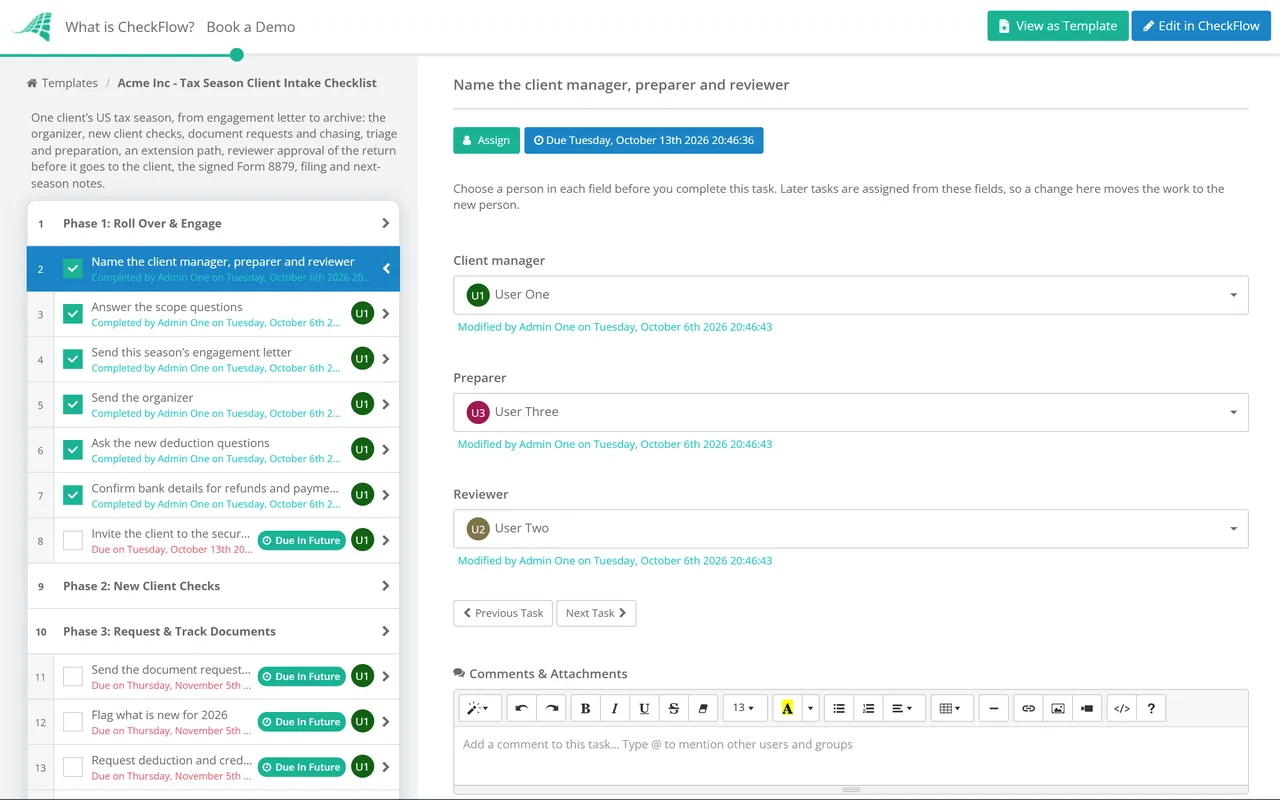
The preparer and reviewer are separate role fields, and the reviewer’s approval halts the checklist. A return cannot reach the client for signature until someone other than its preparer has approved it.
Last reviewed: October 2026
No Credit Card Required
Printed from checkflow.io/templates/professional-services/tax-season-client-intake-checklist
This free tax season client intake checklist is for US accounting and tax practices preparing individual returns, with business returns handled the same way. Start one run per client per season. It covers the engagement letter and organizer, the document request built from last year’s return, the IP PIN, chasing missing documents, triage and preparation, an extension when one is needed, an independent review, the client’s Form 8879 signature, e-file acknowledgement and delivery. It is set up for 2026 returns filed in 2027.
The organizer and document request you sent last year will miss things this year. The One Big Beautiful Bill Act, signed in July 2025, added deductions that depend on documents and facts clients rarely volunteer, and broker reporting for digital assets moves into its second stage. The table lists the changes that affect what you ask clients for. Check the final IRS forms and instructions before the season opens; this is a starting point, not tax advice.
| Change | What it means for intake | Phase |
|---|---|---|
| Schedule 1-A deductions (2025 to 2028) | Ask every client about qualified tips, overtime, interest on a loan for a new personal vehicle, and whether anyone on the return is 65 or over | 1 |
| 2026 Form W-2 codes | New Box 12 codes report qualified tips (TP) and qualified overtime (TT), with a tipped occupation code in Box 14b; check them against what the client tells you | 3 |
| Form 1099-DA cost basis | Brokers reported gross proceeds only for 2025; for 2026 they also report basis for covered digital assets bought on or after 1 January 2026 and held in the same account | 3 |
| Form 1099-K threshold | Back to more than $20,000 and more than 200 transactions, so many sellers get no form; the income is still taxable | 3 |
| Paper refund checks | The IRS began phasing them out on 30 September 2025, so collect current bank details for refunds and payments | 1 |
| Data security | The PTIN application asks preparers to confirm they know a written information security plan is required; review yours before clients start uploading | Timeline |
This page is about the firm’s workflow for each client. If you want a checklist for a business owner organising their own records before handing them to an accountant, use the Tax Preparation Checklist. Clients new to the firm should go through the Accounting Firm Client Onboarding Checklist as well, which covers acceptance and authority to act.
Seven phases follow one client from the engagement letter to the filed return. Phase 2 appears only for a new client, the business, rental and K-1 task appears only when that income exists, and Phase 5 appears only when the triage decides to extend. The reviewer’s approval halts the checklist before anything goes to the client.
Owned by the client manager. Scope DropDowns: Is this a new client? (Yes / No) and Does the client have business, rental or K-1 income? (Yes / No). Firm-wide readiness runs once, not per client; see the timeline below.
Shown only when “Is this a new client?” is Yes. Owned by the client manager.
The business, rental and K-1 task shows only when the Phase 1 answer is Yes.
The triage task records Will the return be extended? (Yes / No); Yes shows Phase 5. Preparation tasks are assigned to the preparer.
Shown only when “Will the return be extended?” is Yes in Phase 4.
The approval is assigned from the reviewer field and halts the checklist until it is Approved.
Dates are for calendar-year 2026 returns filed in 2027. When a deadline falls on a weekend or legal holiday it moves to the next business day, so confirm each date against the IRS calendar before you print it in an engagement letter.
PTIN renewal usually opens in mid-October and every PTIN expires on 31 December. Update the IRS e-file application within 30 days of any change to principals, addresses or contacts. Review the written information security plan, update software and the portal, set this season’s fees, then send engagement letters and organizers.
W-2s and Forms 1099-NEC are due to recipients by 1 February 2027, because 31 January falls on a Sunday. Clients can retrieve this year’s IP PIN online from mid-January. The IRS usually opens the filing season in late January; in 2026 it opened on 26 January.
Brokerage statements and corrected 1099s keep arriving, and K-1s often arrive late. Work the queue by completeness, not by arrival date, and make extension decisions early for anyone still waiting on a K-1.
Calendar-year Forms 1065 and 1120-S are due, or Form 7004 extends them to 15 September 2027. Partners and shareholders need their K-1s to finish their own returns.
Form 1040 returns and payments are due, along with Form 4868 for anyone extending. C corporation returns are due the same day. Tax owed is still due today even when the return is extended.
Extended individual returns are due by 15 October 2027. Hold a season debrief in May while it is fresh: which clients were late, which questions were missing from the organizer, and where review queued up.
The preparer and reviewer are separate role fields, and the reviewer’s approval halts the checklist. A return cannot reach the client for signature until someone other than its preparer has approved it.
Start a run for every client from your client list through the API or Zapier, and schedule next season’s runs with recurrence. Due dates on each task show which clients are waiting on documents and which are waiting on you.
DropDowns show the new-client checks, the business and K-1 request and the extension phase only where they apply. The audit trail records when the engagement letter, the review and the Form 8879 were completed.
CheckFlow is not tax preparation software or a client portal for tax documents. It runs the intake and review workflow around those tools so nothing depends on someone’s memory in March. Firms that repeat the same work every season use it as recurring checklist software, and the same approach covers client onboarding for new clients.
If you file information returns for business clients, the 1099 Year-End Filing Checklist runs alongside January intake, and the Year-End Close Checklist gets the books ready first.
Describe the process in a sentence and the AI checklist generator drafts the phases and tasks for you.
An engagement letter for the season, an organizer or questionnaire, a document request built from last year’s return, identity checks and the IP PIN, a way to track and chase missing documents, a triage and extension decision, preparation, an independent review, the client’s Form 8879 signature, transmission and acknowledgement, and delivery and archiving. New clients also need authority to act and prior-year returns.
Most firms send them in December or early January, after the firm’s own readiness work and before W-2s and 1099s arrive. Sending them early gives clients time to collect documents, and a signed engagement letter with a document deadline gives you something to point to when papers arrive in April.
No. Form 4868 gives an automatic six months to file, moving the 2026 individual deadline from 15 April to 15 October 2027, but tax owed is still due on 15 April. Interest and the late-payment penalty run on anything unpaid after that date, so estimate the liability and tell the client what to pay when you file the extension.
The electronic return originator keeps the signed Form 8879 for three years from the return due date or the date the IRS received the return, whichever is later. Do not send it to the IRS unless asked, and do not transmit the return until the signed form is in hand.
Fix the cause, often a missing IP PIN or a wrong prior-year figure, and retransmit. A timely filed return or extension that is rejected can be corrected and resent within a five-day perfection period and still count as on time. If it cannot be fixed electronically, tell the client within 24 hours and explain the paper filing option.
The workflow carries over, but the forms and dates do not. Online returns for the 2025/26 tax year are due by 31 January 2027, so UK firms run intake from the summer. Replace the IRS tasks with your own and keep the review approval.
14-day free trial, no card required. The Business plan is $10 per user per month after the trial. Full details at checkflow.io/pricing.
14-day free trial, no credit cardFull refund in your first 30 daysUS hosting, EU on request