Part of vendor onboarding and payment
- Form W-9 before the first payment
- Vendor records coded as reportable or not
- Backup withholding where no TIN is provided
- Responding to IRS CP2100 notices
US businesses must report many payments to contractors, landlords, attorneys and other vendors to the IRS on Forms 1099-NEC and 1099-MISC, and send each payee a copy. The forms themselves are simple. The difficulty is the data behind them: a year of vendor payments, some made by card, some to corporations, some to people who never returned a Form W-9. This free 1099 year-end checklist gives accounts payable teams, controllers and small business owners a repeatable annual process. It starts two months before the year ends with vendor tax data and IRS TIN Matching, classifies each payment by form and box, applies the $2,000 threshold that now applies to most payments made after 2025, gets the list approved and then files through the IRS’s IRIS system. If the IRS sent a CP2100 notice during the year, a B-notice and backup withholding phase appears automatically. It covers the 2026 tax year, filed in early 2027.
Forms 1099-NEC and 1099-MISC are information returns: they tell the IRS what you paid people who are not your employees, so the payees’ own returns can be matched against them. Wages paid to employees go on Form W-2 through payroll, which the Payroll Year-End Checklist covers. Your own business tax return is a separate job again, covered by the Tax Preparation Checklist.
A clean 1099 season depends on work done long before January. Vendor tax data collected at onboarding is far easier to fix than data chased in the last week of the year, and the IRS’s TIN Matching program only helps if you run it early enough to act on the results.
Six phases run from planning in November to corrections after filing. Phase 3 appears only when the IRS sent a CP2100 or CP2100A notice during the year.
Shown only when the IRS sent a CP2100 or CP2100A notice this year listing missing or mismatched TINs.
31 January 2027 is a Sunday, so the January deadlines move to Monday 1 February 2027.
The table covers the payments most businesses report. Thresholds apply per payee for the calendar year, and dates reflect the rule that a deadline falling on a weekend or legal holiday moves to the next business day. Check the IRS instructions for anything outside these boxes.
| Payment | Form and box | Threshold | Furnish / file with IRS |
|---|---|---|---|
| Services by non-employees, including attorneys’ fees | 1099-NEC, box 1a | $2,000 | 1 February 2027 / 1 February 2027 |
| Rents, other income, medical and health care payments | 1099-MISC, boxes 1, 3 and 6 | $2,000 | 1 February 2027 / 31 March 2027 (e-file) |
| Royalties | 1099-MISC, box 2 | $10 | 1 February 2027 / 31 March 2027 (e-file) |
| Gross proceeds paid to an attorney | 1099-MISC, box 10 | $600 | 16 February 2027 / 31 March 2027 (e-file) |
| Card and payment app payments | 1099-K, filed by the processor | Not on your 1099-NEC or 1099-MISC | Not your filing |
What changed for 2026. The 2025 tax law raised the threshold for most 1099-NEC and 1099-MISC payments from $600 to $2,000 for payments made after 31 December 2025, with inflation adjustments from 2027. It did not change the $600 threshold for gross proceeds paid to attorneys. Form 1099-NEC has a new box 1b for cash tips included in box 1a. The IRS’s FIRE system takes its last filings on 19 November 2026, so every tax year 2026 information return is e-filed through IRIS, either in the free IRIS Taxpayer Portal (up to 100 returns at a time, keyed in or uploaded as a CSV) or through software that files by IRIS Application to Application. You must e-file if you file 10 or more information returns in total, counting every type of form together, including Forms W-2.
Penalties for tax year 2026 returns. The IRS charges a penalty for each return filed late or incorrectly, and a separate one for each payee statement: $60 per form if corrected within 30 days of the due date, $130 if corrected after that but by 1 August, and $340 after 1 August or if never filed. Annual caps apply, lower for businesses with average gross receipts of $5 million or less. Intentional disregard costs at least $690 per form, with no cap.
State filing. Many states want their own copy of the 1099s you file. Under the Combined Federal/State Filing Program, which is available through IRIS, the IRS forwards your electronic 1099-NEC and 1099-MISC returns to the states that take part, at no cost. Some participating states still require separate notification or a direct filing, and states outside the program set their own deadlines and formats. List each state you pay vendors in during Phase 1 and give each one an owner and a due date.
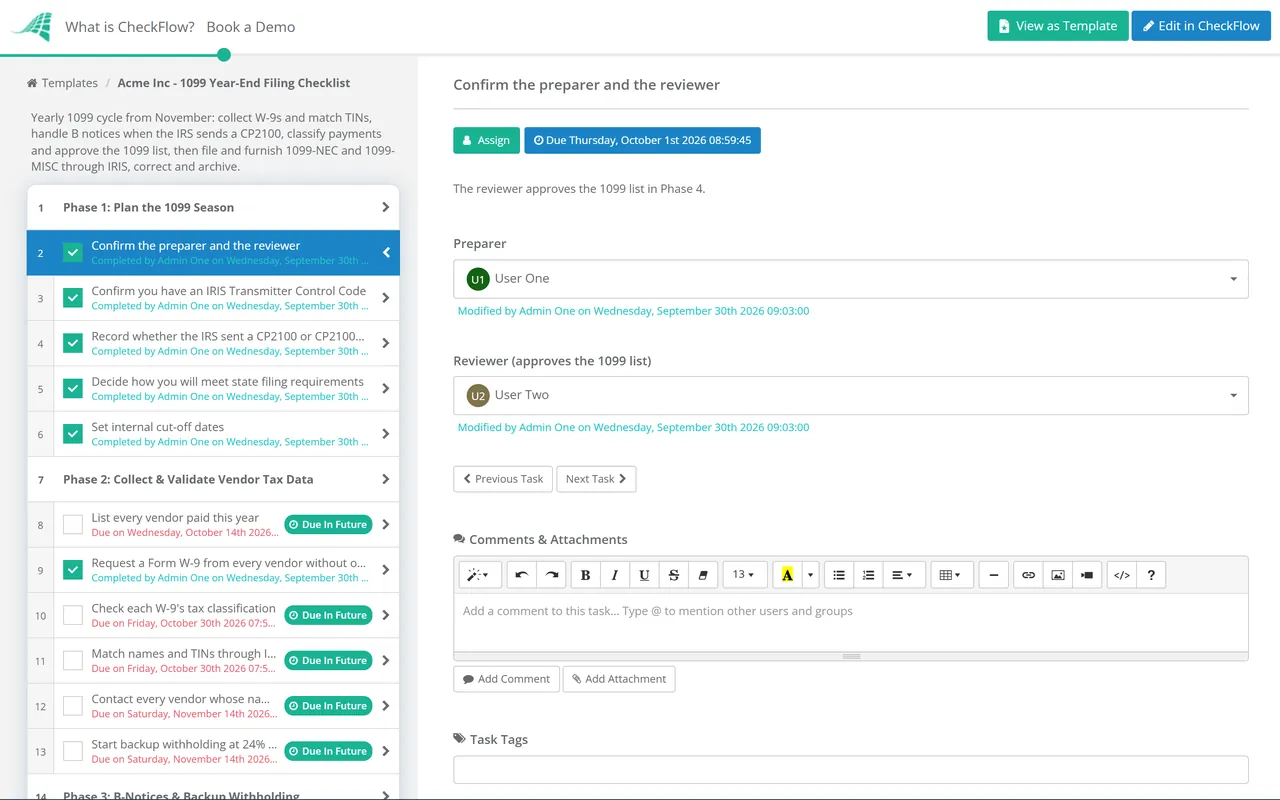
A yearly schedule starts the checklist two months before the year ends, with the vendor list, W-9 requests and TIN Matching already assigned. Mismatches are fixed while there is still time to hear back from vendors.
Answer one question about CP2100 notices and the B-notice phase appears with its 15- and 30-business-day steps. Businesses without a notice never see it.
The 1099 list goes to the reviewer you chose at the start, and the checklist stops until it is approved. W-9s, matching results and IRIS acknowledgements are attached to the tasks, with a record of who did what and when.
Most 1099 problems start at vendor onboarding. The Accounts Payable Process Checklist and the Invoice Approval Workflow Checklist are the places to require a W-9 before the first payment, so the year-end starts with clean data.
Employees are reported on Form W-2, not Form 1099. The Payroll Year-End Checklist covers Forms W-2 and W-3, the fourth-quarter Form 941 and Form 940, on the same 1 February 2027 deadline.
Describe the process in a sentence and the AI checklist generator drafts the phases and tasks for you.
Generally, any non-employee you paid $2,000 or more during 2026 for services in the course of your business, such as an independent contractor, a sole proprietor or a partnership. Payments to corporations are usually exempt, but payments to attorneys for legal services are reportable whatever the entity type. For payments made before 2026 the threshold was $600.
Form 1099-NEC must be furnished to recipients and filed with the IRS by 1 February 2027, because 31 January is a Sunday. Form 1099-MISC goes to recipients by the same date, or by 16 February 2027 if it reports amounts in box 8 or 10, and is filed with the IRS by 31 March 2027 electronically.
No. Payments made by credit card, debit card or through a third-party payment network are reported by the payment processor on Form 1099-K, so you leave them off your 1099-NEC and 1099-MISC. Payments to the same vendor by check, ACH or wire are still yours to report.
If a payee does not give you a taxpayer identification number, you must withhold 24% from reportable payments to them as backup withholding, deposit it and report it on Form 945. You still file the 1099, showing the amount withheld. Asking for the W-9 before the first payment avoids the problem.
It is a free IRS e-Services tool that checks whether a payee’s name and taxpayer identification number match IRS records before you file. You can check up to 25 combinations on screen or up to 100,000 in a bulk file. It is open to payers of reportable income, including Forms 1099-NEC and 1099-MISC, and catching mismatches before filing avoids most CP2100 notices.
Through the IRS Information Returns Intake System (IRIS). Small filers can use the free IRIS Taxpayer Portal, which accepts up to 100 returns at a time, keyed in or uploaded as a CSV. You need an IRIS Transmitter Control Code, which can take up to 45 days, so apply well before January. E-filing is required if you file 10 or more information returns in total.
14-day free trial, no card required. The Business plan is $10 per user per month after the trial. Full details at checkflow.io/pricing.
14-day free trial, no credit cardFull refund in your first 30 daysUS hosting, EU on request