
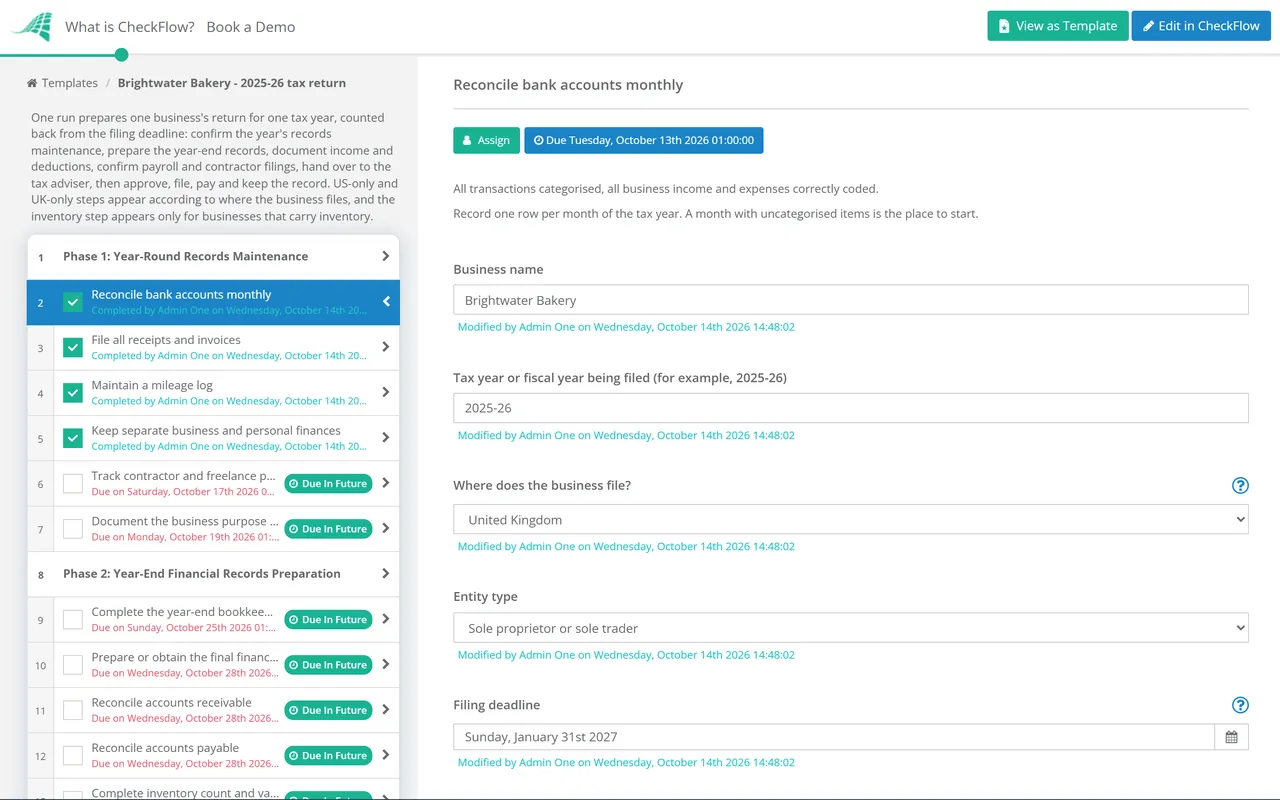
A structured annual tax preparation process — so tax season is a manageable three-week exercise rather than a panicked two-month scramble for records that should have been organised all year.
Most small business tax preparation problems are not tax problems — they are records problems. The receipts that were not kept. The mileage log that was never started. The contractor payments for which a 1099 needs to be filed but the amounts were never tracked separately. The year’s worth of bank statements that need to be categorised from scratch because the bookkeeping never quite happened. Tax preparation is not primarily an accounting exercise — it is a records organisation exercise that happens to culminate in an accounting exercise. The businesses that find tax season manageable are the businesses that treated it as a year-round process: keeping records current, organising documents as they arose, and entering the final quarter with their books already substantially in order. This free tax preparation checklist gives business owners, finance managers, and accountants a structured process for the full tax preparation cycle — from year-round records hygiene through to the adviser handover and final filing review.
This checklist covers the organisational process of tax preparation. It does not constitute tax advice. Tax laws change regularly and vary significantly by jurisdiction and entity type. Always consult a qualified tax professional for advice specific to your situation.
Why Tax Season Is Hard — and Why It Doesn’t Have to Be
Tax season is hard when the underlying records are not in order. Every hour spent in January or March reconstructing the prior year’s transactions from bank statements, chasing suppliers for invoices that were lost in email, or estimating expense amounts because receipts were not kept is an hour that represents the cost of not having a year-round records process. The preparation that feels burdensome in tax season is preparation that could have been distributed across twelve months — fifteen minutes per week rather than forty hours in a single sprint.
The second problem is missed deductions. Business owners who are not tracking expenses systematically throughout the year will not accurately capture every deductible expense at year-end — not because they would not have been entitled to the deduction, but because the supporting documentation no longer exists. A structured tax preparation checklist that runs monthly (keeping records current) and annually (preparing for the filing) addresses both problems systematically.
What the Tax Preparation Checklist Covers
This checklist covers seven phases of the tax preparation cycle — from year-round monthly records maintenance through to post-filing. The early phases are designed to run throughout the year; the later phases are the annual sprint that tax season requires.
Monthly
Phase 1: Year-Round Records Maintenance
The best tax preparation starts in January — of the year being filed, not the year the return is due. Monthly records maintenance turns a 40-hour tax season into a 10-hour one.
Reconcile bank accounts monthly — all transactions categorised, all business income and expenses correctly coded
File all receipts and invoices — physical or digital; categorised by expense type; retained for the required minimum period (IRS typically 3 years from filing date; 7 years recommended; HMRC 6 years)
Maintain a mileage log — for business vehicle use; date, destination, business purpose, and miles/kilometres for every business journey
Keep separate business and personal finances — a dedicated business bank account and credit card; commingled finances are one of the primary sources of tax preparation complexity
Track contractor and freelance payments — all payments to non-employees who may require a 1099 (US) or CIS deduction (UK) tracked separately throughout the year
Review estimated quarterly tax payments — US: if self-employed or expecting a tax liability over $1,000, quarterly estimated payments are due in April, June, September, and January
Document the business purpose for entertainment and meal expenses — at the time of the expense; documentation added retrospectively is far less credible in an audit
Year-End
Phase 2: Year-End Financial Records Preparation
Complete the year-end bookkeeping — all transactions for the fiscal year recorded, categorised, and reconciled; the trial balance balances
Prepare or obtain the final financial statements — income statement, balance sheet, and cash flow statement for the full fiscal year
Reconcile accounts receivable — confirm outstanding debtors; identify any bad debts that may be deductible as a bad debt expense
Reconcile accounts payable — confirm outstanding creditors; ensure all deductible expenses are accrued in the correct fiscal year
Complete inventory count and valuation — if the business carries inventory; year-end inventory value required for cost of goods sold calculation
Reconcile fixed assets — additions, disposals, and depreciation for the year; fixed asset schedule updated and reconciled to the balance sheet
Confirm the payroll year-end is complete — all W-2s (US) or P60s (UK) prepared and issued; payroll tax filings up to date
Phase 3
Income Documentation & Verification
Compile all income sources — sales revenue, service income, rental income, investment income, and any other business income
Obtain bank and payment processor statements — confirming all deposits are accounted for in the bookkeeping; unexplained deposits should be identified and classified
Compile any 1099 forms received (US) — 1099-NEC for non-employee compensation, 1099-MISC, 1099-INT, 1099-DIV, and any other 1099 forms received
Confirm government grants or COVID-related support received — taxability varies by programme; confirm with your tax adviser
Confirm any intercompany income — for businesses with related party transactions; intercompany pricing should be at arm’s length
Phase 4
Deduction Documentation & Identification
This phase describes common deduction categories that many businesses track. Whether any specific deduction applies to your business depends on your circumstances, entity type, and jurisdiction. Consult your tax adviser.
Compile business operating expense documentation — rent, utilities, office supplies, software, insurance, professional services, and any other deductible operating costs
Compile vehicle and mileage documentation — mileage log (if using standard mileage rate) or actual vehicle expense records (if using actual cost method)
Compile employee compensation documentation — total wages, salaries, bonuses, and employer-provided benefits; payroll summary from the payroll system
Compile contractor payments — all payments to contractors above the 1099 threshold ($600 in the US); confirm W-9 forms on file for all contractors
Compile home office documentation — if the business operates from a home office; square footage of the home office as a percentage of total home area; eligible home costs
Compile depreciation schedule — capital assets placed in service during the year; existing asset depreciation schedule updated for any disposals
Compile retirement plan contributions — employer contributions to qualified retirement plans; contribution limits confirmed with your adviser
Compile any research and development expenditure — if the business conducts qualifying R&D; documentation organised for R&D tax credit review by your adviser
Phase 5
Payroll & Contractor Tax Compliance
Confirm all W-2s are filed (US) — with the SSA by 31 January; confirm copies distributed to all employees by the same deadline
File all 1099-NECs (US) — for all contractors paid $600 or more in the calendar year; filed with IRS and sent to contractors by 31 January
Confirm P60s issued (UK) — to all employees by 31 May following the tax year end
Confirm P11D filed (UK) — for benefits in kind provided to employees or directors; filed with HMRC by 6 July
Confirm all payroll tax returns are filed — Form 941 (US quarterly) and annual Form 940 (FUTA); or employer PAYE accounts reconciled to HMRC
Confirm CIS returns filed (UK, if applicable) — for businesses in the construction industry making payments to subcontractors
Phase 6
Tax Adviser Engagement & Document Handover
Engage your tax adviser early — before the peak filing season; advisers with capacity constraints produce better work under less time pressure
Prepare the document handover pack — all financial statements, supporting schedules, payroll summaries, contractor payment records, deduction documentation, and prior year return; organised and indexed
Confirm the adviser has all information required — respond to any requests for additional documentation promptly; slow responses delay filing and may compromise advice quality
Review the draft return with your adviser — confirm your understanding of the key figures and any significant items before signing
Confirm extension requirements — if the return cannot be filed by the original deadline; an extension extends the filing date but not the payment date for any taxes owed
Confirm estimated quarterly payments are on schedule for the new tax year
Phase 7
Filing, Payment & Post-Filing
Review and approve the final return before filing — confirm all figures are accurate; the taxpayer (business owner or authorised signatory) is legally responsible for the accuracy of the return regardless of who prepared it
File the return by the deadline — or by the extended deadline if an extension was filed
Pay any balance due — by the payment deadline (which may differ from the filing deadline even if an extension was obtained)
Retain a copy of the filed return — and all supporting documentation; IRS recommends minimum three years; HMRC minimum five to six years
Note any adviser recommendations for next year — structural changes, planning opportunities, or areas where better records would have made the process easier
Set a reminder to begin the next year’s records maintenance process from the first month
S-Corporations and Partnerships: 15 March (15th day of the third month after fiscal year end)
Extension available: 15 September (6-month extension with Form 7004)
Tax is paid at the individual level by partners/shareholders on their personal returns
C-Corporations and Individual Filers
Sole proprietors, single-member LLCs, and C-Corporations: 15 April (15th day of the fourth month after fiscal year end)
Extension available: 15 October (6-month extension with Form 7004 or 4868)
Extension moves filing deadline only — not the tax payment deadline
Quarterly Estimated Tax Payments
Q1: 15 April
Q2: 15 June
Q3: 15 September
Q4: 15 January (following year)
Information Returns
W-2 (to employees and SSA): 31 January
1099-NEC (to contractors and IRS): 31 January
Form 940 (FUTA): 31 January
Form 941 (Quarterly): Last day of the month following each quarter end
Deadlines listed are for calendar year filers. Fiscal year filers should adjust accordingly. Always verify current deadlines with the IRS or a qualified tax professional — deadlines can change and late filing penalties apply. This is not tax advice.
Why Run Tax Preparation in CheckFlow?
1
Turn tax preparation into a year-round process
CheckFlow’s recurring checklist feature can run a lightweight monthly records maintenance checklist throughout the year — keeping the bookkeeping current, the receipts filed, and the mileage log up to date — so that when the annual filing deadline approaches, the preparation that remains is the adviser engagement and return review, not the reconstruction of a year’s worth of records.

2
A structured, consistent document preparation process
The annual tax preparation handover — organising all financial statements, supporting schedules, payroll records, and deduction documentation into a package for the tax adviser — is itself a structured process. CheckFlow’s tax preparation checklist ensures every category of documentation is confirmed before the adviser handover, so the adviser is working with a complete pack rather than requesting additional documents in batches.
3
A compliance record for the filing year
Every step in CheckFlow’s tax preparation checklist is timestamped and documented. When HMRC or the IRS asks about a specific element of the return years after filing, the record of what documents were gathered, what was reviewed, and when the filing was approved is preserved — not dependent on reconstructing what happened from email records.
Accurate tax returns depend on accurate books. If the month-end close has been running consistently throughout the year, the year-end books are already substantially in order. CheckFlow’s Month-End Close Checklist is the recurring process that makes tax season manageable. See the Month-End Close Checklist →
For businesses with employees, payroll tax compliance — W-2s, 1099s, quarterly 941s — is a critical component of annual tax preparation. CheckFlow’s Payroll Processing SOP ensures all payroll compliance filings are captured as part of the recurring payroll process. See the Payroll Processing SOP →
What documents are needed for business tax preparation?
+
Business tax preparation typically requires six categories of documents. Financial records: finalised income statement, balance sheet, and cash flow statement for the fiscal year, along with the supporting trial balance. Income documentation: bank statements, payment processor reports, and any 1099 forms received. Expense documentation: receipts and invoices for deductible business expenses, organised by category, with supporting mileage logs and home office records if applicable. Payroll records: W-2 or P60 filings, payroll tax returns (Form 941 or RTI submissions), and total employer costs. Contractor records: 1099-NEC forms issued, W-9 forms on file, and total contractor payments. Prior year return: the previous year’s filed return as a reference for the current year’s preparation.
What is the difference between a tax filing deadline and a tax payment deadline?
+
The filing deadline is the date by which the return must be submitted to the IRS or HMRC. The payment deadline is the date by which any tax owed must be paid. For most US businesses, these deadlines are the same date. However, when a filing extension is granted (Form 7004 for business entities), the extension moves the filing deadline by six months — but does not move the payment deadline. Tax owed must still be estimated and paid by the original deadline, or interest and underpayment penalties will accrue on the outstanding amount.
What is the IRS record retention requirement for business taxes?
+
The IRS generally requires businesses to keep records that support items on their tax return for as long as they may be assessed — typically three years from the date the return was filed or the due date of the return (whichever is later). The period is six years if the IRS suspects a significant understatement of income. Employment tax records must be kept for at least four years after the tax is due or paid. Most practitioners recommend retaining all records for seven years as a conservative standard. HMRC (UK) requires business records to be kept for five years after the 31 January submission deadline for the relevant tax year.
What are quarterly estimated tax payments and who needs to make them?
+
In the US, businesses and self-employed individuals who expect to owe more than $1,000 in federal income tax for the year are generally required to make quarterly estimated tax payments. This is because self-employed individuals and business owners do not have tax automatically withheld from income as W-2 employees do. Estimated payments are due four times a year: April 15, June 15, September 15, and January 15 of the following year. Underpayment of estimated taxes results in an underpayment penalty. Consult a tax professional for guidance specific to your situation.
Is CheckFlow free for this template?
+
14-day free trial, no card required. The Business plan is $10 per user per month after the trial. Full details at checkflow.io/pricing.
Make Tax Season a Process, Not a Panic
Free trial — no credit card required.
Do you like cookies? 🍪 We use cookies to ensure you get the best experience on our website. Learn more