
Acceptance
Covers: conflicts, capacity, due diligence, the risk rating and the partner’s decision.
Evidence: identity and ownership records, screening results and a dated approval.
Last reviewed: October 2026
No Credit Card Required
Printed from checkflow.io/templates/professional-services/accounting-firm-client-onboarding-checklist
This free accounting firm client onboarding checklist is for accounting, bookkeeping and tax practices in the UK and the US. One run takes a new client from enquiry to the first working month: conflict check, due diligence and a risk rating, the partner’s decision to accept, the engagement letter, authority to act with HMRC or the IRS, professional clearance and handover, systems setup, kickoff and sign-off. A jurisdiction question shows the UK or US tasks, and two more add handover and payroll work only when they apply.
A generic onboarding checklist is about a good first impression. An accounting practice also has to answer three questions a software vendor never faces. Should we act for this client at all? May we act for them with the tax authority? Are we ready to work without inheriting someone else’s mistakes? Each answer needs evidence a supervisor or insurer may ask to see.
The checklist follows that order. Nothing is promised until the firm accepts the client, and nothing is filed until authority and prior-year records are in place. For a returning client who only needs a return, the Tax Season Client Intake Checklist is enough.
Covers: conflicts, capacity, due diligence, the risk rating and the partner’s decision.
Evidence: identity and ownership records, screening results and a dated approval.
Covers: the engagement letter, HMRC agent authorisation or IRS Forms 8821 and 2848, and payroll authority.
Evidence: the signed letter and each authorisation showing as active.
Covers: clearance, the prior-year handover, systems, the deadlines calendar and kickoff.
Evidence: the handover file, inherited deadlines with owners, and sign-off.
Seven phases run from enquiry to a signed-off client. The jurisdiction answer shows the UK or US tasks, Phase 5 appears only for a client switching accountants, and the payroll tasks appear only when payroll is in scope. Acceptance and final sign-off are approvals that halt the checklist.
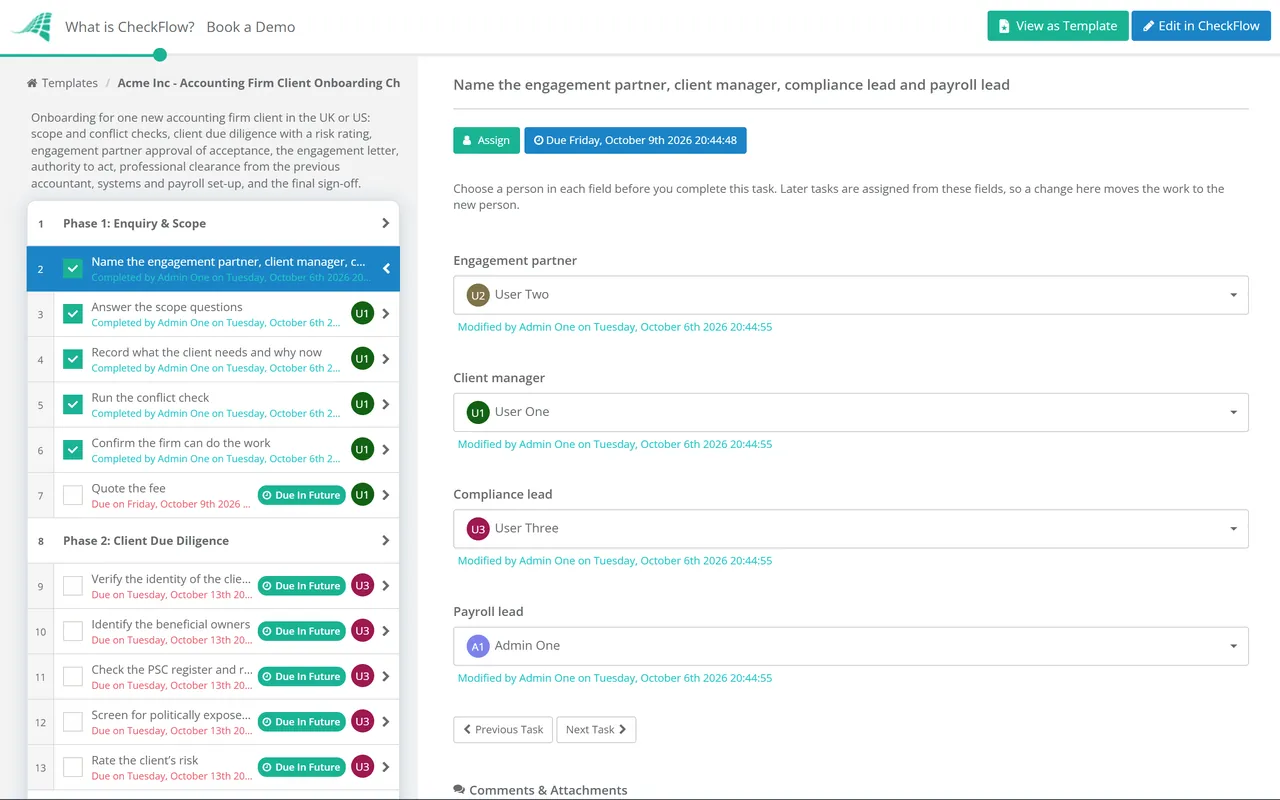
Owned by the client manager. Scope DropDowns: Jurisdiction (UK / US), Is the client switching from another accountant? (Yes / No), Does the engagement include payroll? (Yes / No).
Assigned to the compliance lead. The register and screening tasks show for UK clients and the OFAC task for US clients. The risk rating is a DropDown (Low / Medium / High); High shows the enhanced due diligence task.
The acceptance approval goes to the engagement partner and halts the checklist until it is Approved, so no engagement letter goes out first. The section 7216 task shows for US clients.
The first four tasks show for UK clients and the last three for US clients, from the Jurisdiction answer in Phase 1.
Shown only when “Is the client switching from another accountant?” is Yes. Owned by the client manager.
The last three tasks show only when “Does the engagement include payroll?” is Yes, and are assigned to the payroll lead.
The final sign-off is an approval for the engagement partner and halts the checklist until it is Approved.
The biggest difference is anti-money laundering. UK accountants and tax advisers are in the regulated sector, so client due diligence is a legal duty. US accountants are generally not covered by the Bank Secrecy Act’s AML programme rules, though sanctions law applies to everyone. Rules change, so check the current guidance from HMRC, the IRS and your professional body; this is a starting point, not legal advice.
| Area | UK | US | Phase |
|---|---|---|---|
| Client due diligence | Required under the Money Laundering Regulations 2017, as amended; verify identity before the relationship is established | No general AML programme duty; e-file rules still expect you to confirm who your clients are | 2 |
| Beneficial owners | Identify and verify them; report material discrepancies with the PSC register | No onboarding duty for accountants; good practice to know who controls the client | 2 |
| PEPs and sanctions | Enhanced due diligence and senior management approval for politically exposed persons | OFAC sanctions apply to all US persons and businesses | 2 |
| Who supervises | Your professional body (such as ICAEW, ACCA, AAT or ICAS) or HMRC; the government plans to move this to the FCA | No AML supervisor; practice before the IRS is governed by Circular 230 | – |
| Authority to act | Agent authorisation per tax through the agent services account; the firm must register with HMRC as a tax adviser | Form 8821 or 2848 on the Centralized Authorization File; Form 8655 for payroll; state forms | 4, 6 |
| Change of accountant | Professional enquiry to the existing accountant with the client’s permission (ICAEW Code section 320 and equivalents) | Client consent before the predecessor shares information; Circular 230 requires client records returned on request | 5 |
| Records and data | Keep due diligence records five years after the relationship ends; UK GDPR applies | A written information security plan under the FTC Safeguards Rule; IRS Publication 5708 is a template | 2, 6 |
Several of these changed recently. HMRC began phasing in mandatory registration for paid tax advisers on 18 May 2026; firms with an agent services account do not register again but may be contacted. Amendments to the Money Laundering Regulations largely took effect on 30 June 2026. Companies House identity verification began on 18 November 2025, and Making Tax Digital for Income Tax started in April 2026 for sole traders and landlords with qualifying income over £50,000.
In the US, the FTC Safeguards Rule treats tax preparers as financial institutions and, since May 2024, requires notice to the FTC within 30 days of discovering a breach of unencrypted information about 500 or more people.
Client acceptance is an approval assigned from the engagement partner field. The checklist halts until it is Approved, so the letter and authorisation requests cannot run ahead of due diligence.
The jurisdiction DropDown shows HMRC or IRS tasks, a High risk rating adds enhanced due diligence, and handover and payroll tasks appear only when they apply.
Identity documents, screening results and the signed letter sit on the tasks that required them, and the audit trail records who approved what and when. Due diligence reviews can run as a recurring checklist.
CheckFlow is not practice management, accounting or tax software, and it does not perform identity checks. It runs the process around those tools so every new client goes through the same steps. See how firms use it for client onboarding and across professional services.
After onboarding, the Monthly Bookkeeping Checklist runs the monthly close, and clients can keep their own records in order with the Tax Preparation Checklist. When a relationship ends, the Client Offboarding Checklist covers the handover in the other direction.
Not an accounting practice? The new client onboarding checklist template is a general version for any business, and the client onboarding checklist guide explains each step in detail.
Describe the process in a sentence and the AI checklist generator drafts the phases and tasks for you.
A conflict check, due diligence with a risk rating, a recorded acceptance decision, a signed engagement letter, authority to act with the tax authority, professional clearance and handover when the client is switching firms, systems setup, a deadlines calendar and a kickoff. Payroll setup and enhanced due diligence are added when they apply.
In the UK, yes. Accountants, bookkeepers and tax advisers are in the regulated sector under the Money Laundering Regulations 2017 and must carry out customer due diligence, assess risk and keep records for five years after the relationship ends. US accountants are generally not subject to the Bank Secrecy Act’s AML programme rules, but OFAC sanctions apply to every US business.
In the UK the default is no: identity must be verified before the business relationship is established. Regulation 30 allows verification during establishment only where that is necessary not to interrupt the normal conduct of business, the risk is low, and verification is finished as soon as practicable. Record the reason if you rely on it.
It is the common name for the enquiry an incoming UK accountant sends the existing one, asking whether there is any professional reason not to accept the appointment. ICAEW points out that no firm can give or withhold clearance as such. The existing accountant needs the client’s permission to reply; if none comes in a reasonable time, write again saying you will accept unless you hear by a set date.
For HMRC, most authorisations are requested from the agent services account: the client gets a link to accept within 21 days, one tax at a time. For the IRS, Form 8821 lets you receive a client’s information and Form 2848 lets you represent them. Tax Pro Account sends the request to the client’s IRS online account, and it shows as soon as they approve it.
14-day free trial, no card required. The Business plan is $10 per user per month after the trial. Full details at checkflow.io/pricing.
14-day free trial, no credit cardFull refund in your first 30 daysUS hosting, EU on request