
Sales and proposal
Ends with: an accepted proposal, a fee and a start date.
Owned by: the partner or business development lead.
Hands over: what was promised, who decides and what worries the buyer.
Last reviewed: October 2026
No Credit Card Required
Printed from checkflow.io/templates/professional-services/consulting-client-onboarding-checklist
Winning the work is a sales job. Getting from a signed proposal to a team that is actually working is an operations job, and it rarely has an owner. This free consulting client onboarding checklist is for management, strategy, IT and specialist consultancies. It runs from the sales handover to day 30: conflict and credit checks, a partner’s acceptance decision, the MSA and statement of work, supplier set-up, clearance and access for consultants on site, the stakeholder map and data requests, governance, and a check-in with the sponsor.
A consulting firm onboards a client by making two organisations ready to work together. The firm decides it can take the work, both sides sign the right paper, the client sets the firm up as a supplier so invoices get paid, and the consultants are cleared, equipped and let into the building. None of that is analysis, and all of it can stop the analysis starting.
Each piece usually belongs to someone different: the partner, legal, finance, the engagement manager, and the client’s procurement and IT teams. This checklist puts them in one run with named owners, so the engagement manager sees on day three that the PO is missing, not when the first invoice bounces.
Ends with: an accepted proposal, a fee and a start date.
Owned by: the partner or business development lead.
Hands over: what was promised, who decides and what worries the buyer.
Covers: acceptance, contracting, supplier set-up, access and the set-up for discovery.
Owned by: the engagement manager, with the partner, finance and legal.
Ends with: a working team, a valid PO and a sponsor happy at 30 days.
Covers: hypotheses, discovery, analysis, recommendations, quality review and close.
Owned by: the engagement manager and the delivery team.
Runs in: the Consulting Engagement Delivery Checklist.
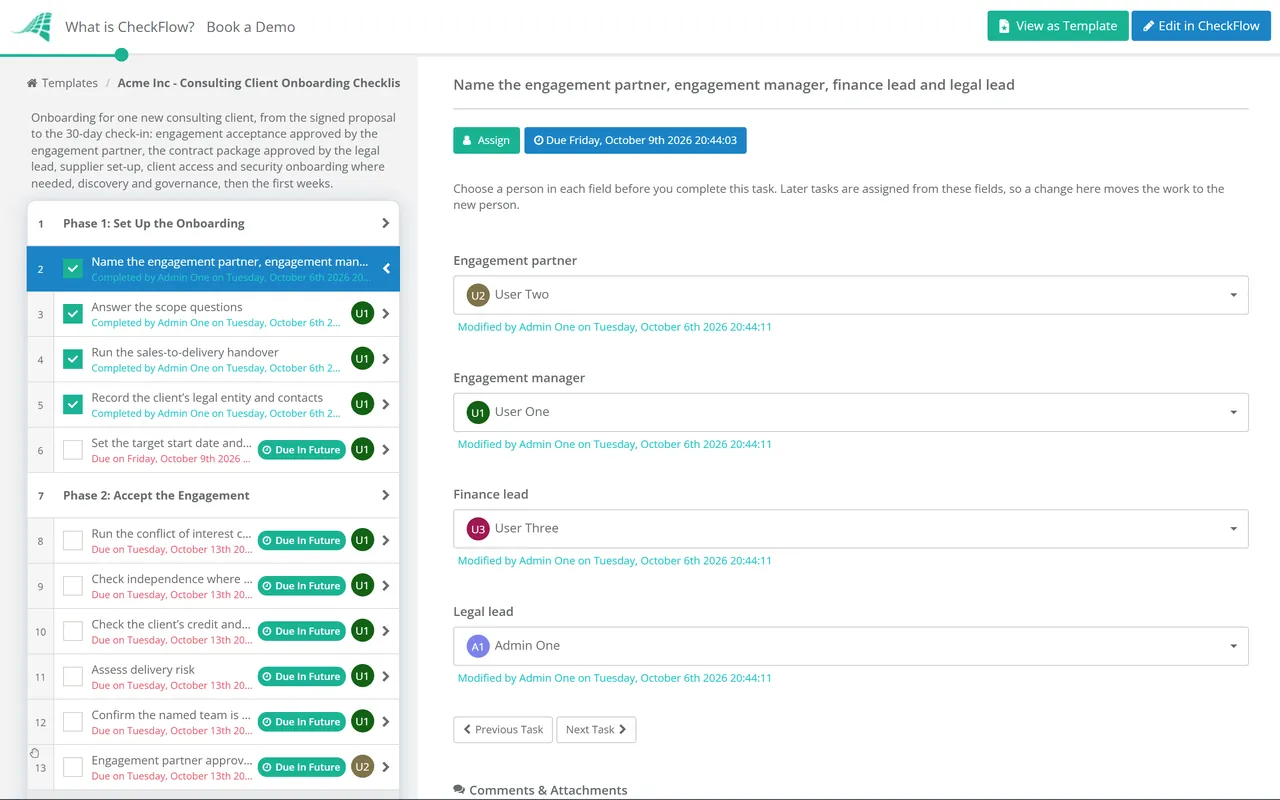
Seven phases run from the sales handover to the 30-day check-in. Two approvals halt the checklist: the partner accepts the engagement before contracting, and the legal lead approves the contract package before signature.
Owned by the engagement manager. The three Yes/No scope questions show or hide Phase 5’s tasks, the portal tasks in Phase 4 and the data processing task in Phase 3.
Ends with an approval for the engagement partner (Approved / Not approved). The checklist halts until it is Approved.
The data processing task is shown only when we will process personal data on the client’s behalf. The legal lead’s approval halts the checklist until it is Approved.
Assigned to the finance lead. The two procurement portal tasks are shown only when the client requires registration in a portal.
The phase heading always shows; its tasks are shown only when consultants will work on the client’s site or systems.
Due dates fall at the end of week one, week two and day 30 from the start date set in Phase 1.
An engagement is usually governed by several documents at once, and onboarding goes wrong when people assume one covers what another should. This is a general guide; your contract’s order of precedence clause decides which wins, so take legal advice on anything unusual.
| Document | What it does | Common gap |
|---|---|---|
| Proposal | Sets out the approach, team and fee the client chose | Promises in it never make it into the SOW |
| Master services agreement | Legal terms for all work with this client: liability, IP, confidentiality, termination | Signed once, years ago, on terms the firm no longer accepts |
| Statement of work | Scope, deliverables, acceptance criteria, team, fees and milestones for one engagement | No acceptance criteria, so “done” becomes a negotiation |
| Change order | Changes scope, fee or dates under the SOW’s change clause | Work starts on a verbal yes and is never billed |
| Purchase order | The client’s internal authority to pay, quoting an amount and often a date range | PO value or dates run out before the work does |
| Data processing agreement | Processor terms when the firm handles personal data for the client | Missing because nobody noticed the work involves personal data |
| NDA | Confidentiality, sometimes signed before the proposal | Superseded by the MSA without anyone checking |
| Insurance certificate | Evidence the firm holds the cover the contract requires | Cover limit lower than the contract requires |
The statement of work is where scope disputes start, so Phase 3 makes acceptance criteria and a change clause part of the task. The data processing agreement is the one most often forgotten. Under UK and EU GDPR, a processor works under a written contract with the terms Article 28(3) lists, including deleting or returning the data when the service ends. Interview notes, staff surveys and HR extracts are personal data, so a strategy engagement can need one as much as an IT project. For UK public-sector work, suppliers bidding under the Procurement Act 2023 have registered on the Central Digital Platform since 24 February 2025, though most Scottish bodies follow Scottish rules.
The engagement acceptance and the contract package are approval steps assigned from the partner and legal lead fields. The checklist halts until each is Approved, and the conflict check and credit report stay attached as the record of why.
Three dropdowns show the on-site access tasks, the procurement portal tasks and the data processing task only when they apply, so a remote strategy review and an on-site IT programme run from one template.
Supplier set-up goes to the finance lead, contracts to the legal lead and access to the engagement manager, each with a due date. The audit trail shows who did what, and when.
CheckFlow is not a CRM, contract system or PSA tool. It runs the human process around them: who checks, who approves and what is waiting. CheckFlow’s client onboarding software shows how firms run one onboarding per client from a template, and CheckFlow for professional services covers the wider practice. The client onboarding checklist guide covers the general principles.
Onboarding ends where delivery begins: the Consulting Engagement Delivery Checklist takes the engagement from hypotheses to final acceptance. When the relationship ends, the Client Offboarding Checklist uses the access table from Phase 5 to remove everything you were given.
Need a version that is not specific to consulting? The new client onboarding checklist template is a general version for any business.
Consulting Engagement Delivery Checklist
Client Offboarding Checklist

Business Case Checklist

Contract Review & Approval Checklist

NDA Processing Workflow Checklist
Describe the process in a sentence and the AI checklist generator drafts the phases and tasks for you.
Everything between the client saying yes and the team doing useful work: a sales handover, conflict and credit checks, a recorded acceptance decision, the MSA and statement of work with a change clause, data processing terms where needed, supplier set-up and a purchase order, clearance and access for anyone on site, a stakeholder map, data requests, governance, a kickoff and a 30-day check-in with the sponsor.
The master services agreement holds the legal terms that apply to all work with a client: liability, indemnities, intellectual property, confidentiality, payment terms and termination. A statement of work sits under it and describes one engagement: objectives, scope and exclusions, deliverables, acceptance criteria, team, fees and milestones. With an MSA in place, each new engagement needs only a new SOW.
Because finding a conflict after the team has started does far more damage than declining at the start. Consultants see confidential strategy, pricing and deal information, so advising two competitors on the same question, or both sides of a deal, puts that information and the firm’s reputation at risk. If the firm audits the client, auditor independence rules may restrict the work altogether.
If the firm processes personal data on the client’s behalf, usually yes. Under UK and EU GDPR, a processor must work under a written contract with the terms set out in Article 28(3), such as acting only on documented instructions, keeping the data secure and deleting or returning it at the end. US state privacy laws have their own contract requirements; California’s CCPA regulations list the terms a service provider contract must contain. Take advice on the facts.
Expect a supplier form with your legal entity, bank details and tax status, evidence of insurance and sometimes your security and anti-bribery policies. US clients ask a US firm for Form W-9 so they can report payments; a non-US firm gives a W-8BEN-E. UK clients usually ask for company and VAT numbers. Larger clients may require registration in a procurement portal before they issue a purchase order.
For a small client and a remote engagement, a few days. For a large organisation with a procurement portal, security vetting and client-issued devices, several weeks is common. Start supplier set-up and background checks as soon as the engagement is accepted, in parallel with contracting, and set the start date from the slowest of them.
14-day free trial, no card required. The Business plan is $10 per user per month after the trial. Full details at checkflow.io/pricing.
14-day free trial, no credit cardFull refund in your first 30 daysUS hosting, EU on request