
One rep, one buyer, one call
What is sold: a product the buyer can see working.
Who prepares: the account executive, with some help.
Use: the Sales Pitch Checklist.
Last reviewed: October 2026
No Credit Card Required
Printed from checkflow.io/templates/professional-services/new-business-pitch-checklist
This free agency new business pitch checklist is for creative, media, PR, digital and marketing agencies invited into a client’s agency review. It runs one pitch from invitation to handover: a scored go/no-go the managing director signs off, credentials and chemistry, brief questions and strategy, creative where asked, a priced proposal approved before it leaves the building, rehearsal, pitch day, the debrief and a clean handover to onboarding when you win. Three questions at the start add the tasks for pitch consultants and procurement, speculative creative and a defending incumbent only when they apply.
A salesperson pitching software has one buyer, one call and a product that already exists. An agency in a review is selling a team and a way of thinking the client cannot try first, against other agencies, often through stages run by a pitch consultant or procurement. It takes weeks, involves strategy, creative, account and finance people, and costs real money whether you win or not. That is why the decision to pitch at all, and the terms you pitch on, matter as much as the presentation.
The trade bodies on both sides of the Atlantic have said much the same thing to clients. In the UK, the IPA and ISBA launched the Pitch Positive Pledge in May 2022, built on three commitments: be sure a pitch is really necessary, run it in a way that takes people’s wellbeing into account, and close it with a proper resolution, including feedback to the agencies. In the US, the ANA and the 4As published ten Positive Pitch Principles in May 2026, covering budget transparency, limiting the number of agencies invited, paying for speculative work and not ghosting the agencies that took part. Neither binds a client, but both justify asking questions before you commit.
What is sold: a product the buyer can see working.
Who prepares: the account executive, with some help.
Use: the Sales Pitch Checklist.
What is sold: a team, a strategy and often an idea, before any work is paid for.
Who prepares: new business, strategy, creative, account and finance, over several weeks.
Use: this checklist.
Signs: no budget, a long list of agencies, no access to the decision-maker, finished creative with no fee.
Answer: score it honestly and let the managing director decide before anyone starts work.
Seven phases take one pitch from invitation to outcome. The managing director approves the decision to pitch and the commercial proposal, and the checklist stops at each until they answer. Tasks for intermediaries, speculative creative and a defending incumbent appear only when the scope questions say they apply.
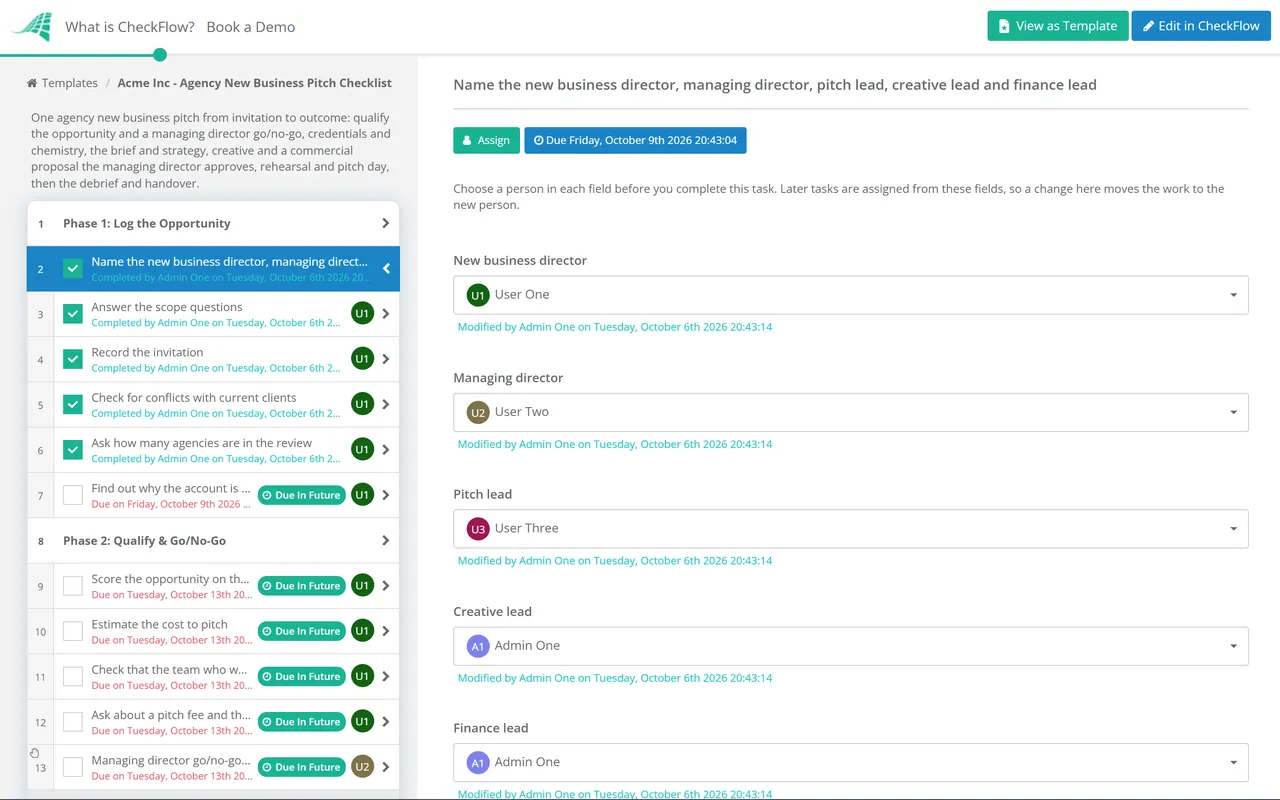
Owned by the new business director. Answer the three scope questions here: is a pitch consultant or procurement running the process, is speculative creative work requested, and is there an incumbent agency on the account.
The go/no-go is an approval task for the managing director. The checklist halts until it is Approved, so no time is booked to the pitch before the decision.
The questionnaire and procurement terms tasks are shown only when a pitch consultant or procurement is running the process.
The incumbent task is shown only when an incumbent agency holds the account.
The two creative tasks are shown only when speculative creative work is requested; the procurement template task only when an intermediary or procurement runs the process. The managing director’s approval of the commercial proposal halts the checklist.
Score each criterion green, amber or red in the Phase 2 table. There is no magic total: one red on budget or access can sink a pitch that looks good elsewhere, and strong fit can justify an amber or two. What matters is that the same criteria are used every time, by someone who can say no, and that the scores are kept.
| Criterion | Green | Amber | Red |
|---|---|---|---|
| Fit | Category, problem and scale you have done well before | Adjacent category or a bigger account than usual | Work you would need to hire for, or do not want |
| Budget | Stated, and enough for the scope asked | A range, or a hint on request | Not disclosed, or clearly too small for the brief |
| Access | The decision-maker attends chemistry and the final pitch | Access through a pitch consultant only | Procurement-only contact until the final stage |
| Competition | A short, named list of agencies | A longer list, cut down after credentials | A long list taken straight to full creative |
| Incumbent | None, or not pitching | Pitching, with a known reason for the review | Pitching, and the review looks like a fee benchmark |
| Chemistry | Clear rapport and good questions from the client | Polite and hard to read | Disengaged, or senior people absent |
| Cost to pitch | Covered or mostly covered by a pitch fee | Affordable against the first-year margin | Spec creative at full finish with no fee |
| Conflicts and capacity | No conflict, team free | Conflict manageable with consent, team stretched | Exclusivity breach, or no team to run it |
Record the reason for a no as carefully as a yes, and decline quickly and politely. A client you turn down this year may be a better fit next year.
The scored go/no-go and the commercial proposal are approval steps assigned from the managing director field. The checklist halts until they answer, so strategy work cannot start on an unqualified pitch and pricing cannot leave without sign-off.
Dropdown answers in Phase 1 show the intermediary questionnaire, the procurement template, the speculative creative tasks and the incumbent research only when they apply. A direct, credentials-only review stays short.
The scorecard, the cost-to-pitch estimate, the client’s feedback and the win/loss notes stay with each run, with an audit trail of who decided what. After a year you can see which scores predicted a win.
CheckFlow is not a CRM or a new business database. It runs the pitch process around them: the decision, the stages, the approvals and the debrief. Agencies and consultancies use it across the whole client lifecycle, as the professional services overview shows, and a won pitch moves straight into the Marketing Agency Client Onboarding Checklist with the pitch promises attached.
Once the account is live, the Monthly Retainer Delivery Checklist holds the team to the scope and hours you priced in Phase 5, and the Creative Brief Intake Checklist makes sure the first real briefs are as clear as the pitch brief should have been.
Describe the process in a sentence and the AI checklist generator drafts the phases and tasks for you.
Start before the pitch: log the invitation, check conflicts, ask how many agencies are pitching and why the account is moving, then make a scored go/no-go decision. Then credentials and chemistry, brief questions, strategy, creative where requested, the team plan and pricing, rehearsal and pitch day. Finish with the outcome, a feedback session, a win/loss review and a handover to onboarding if you win.
Score the opportunity on the same criteria every time: fit with what you do well, a stated budget that matches the scope, access to the person who decides, the number of agencies, the incumbent’s position, chemistry and the cost to pitch against the likely margin. Check conflicts and whether the account team is actually free. Then have one senior person, usually the managing director, make the call and record why.
That is a commercial decision for each agency, but make it deliberately. Ask what the client wants to see and at what finish, whether a fee is offered, and what happens to unused ideas. The ANA and 4As Positive Pitch Principles, published in May 2026, encourage clients to pay for speculative work. If the client wants finished creative with no fee and no clarity on ownership, that should show as a red on your scorecard.
Whatever the pitch terms say, so read them before you start. Industry guidance favours the agency: the ANA and 4As consider it best practice for the agency to keep ownership of work presented in a review unless the client pays an agreed fee for it and gets the rights by agreement. Some pitch documents claim rights to everything submitted, so raise it early and take legal advice if it matters.
It is an early, informal meeting where the client meets the people who would work on the account, usually before or alongside the credentials stage and before the full brief. The client is judging whether they want to work with you; you are judging the same thing. Bring the actual team rather than the pitch stars, ask good questions about the business, and do not present a deck. Write up what you learned straight afterwards.
Treat them as part of the client, not a gatekeeper. Answer their questionnaires in the format asked, with figures finance has checked, ask for the timetable, criteria and budget range, and read the draft contract early. Procurement will usually compare agencies on a common rate card, so reconcile your own pricing to their template rather than sending two inconsistent numbers.
14-day free trial, no card required. The Business plan is $10 per user per month after the trial. Full details at checkflow.io/pricing.
14-day free trial, no credit cardFull refund in your first 30 daysUS hosting, EU on request