A business case that lists benefits without quantifying them, presents one option without comparing it to alternatives, and shows no sensitivity analysis for its financial projections is not a business case — it is a project advocate’s wish list with a financial appendix.
Most business cases are written by people who already know what they want to do and are working backwards to justify it. The result is a document that presents benefits generously, underestimates costs and risks, ignores viable alternatives, and treats its financial projections as a baseline rather than a point estimate in a range of possible outcomes. Decision-makers who approve these cases discover the problems after commitment — when the cost overrun, the benefit shortfall, and the implementation delay that the business case’s sensitivity analysis would have predicted are presented as surprises. A structured business case process forces intellectual rigour at every stage: a problem statement that is not the same as the proposed solution, an options analysis that genuinely considers alternatives, a financial analysis that uses NPV rather than undiscounted cash flows, a risk assessment that is stress-tested rather than optimistic, and sensitivity analysis that shows decision-makers what happens if the key assumptions are wrong. This free checklist gives project sponsors, programme managers, and anyone seeking investment approval a structured framework for the full business case development process.
The Five Case Model — the Framework That Separates Robust Business Cases from Advocacy Documents
Developed by HM Treasury and codified in the Green Book, the Five Case Model is the most comprehensive business case framework in use. It requires that a business case addresses five distinct dimensions: the Strategic Case (why is this necessary?), the Economic Case (what are the options and which produces the best value for money?), the Commercial Case (what is the procurement strategy and has it been tested?), the Financial Case (what are the financial flows and is it affordable?), and the Management Case (can the organisation actually deliver this?). A business case that is strong on strategic and economic justification but weak on management case — no credible implementation plan, no realistic resource assessment — is an investment the organisation cannot execute.
Strategic
Why is this the right thing to do?
Alignment with strategy. Problem statement. Scope.
Economic
What produces the best value?
Shortlisted options. Comparative analysis. Recommended option with rationale.
This checklist covers the full business case development process in six phases — from problem statement through to executive summary and stakeholder presentation.
Phase 1
Phase 1: Problem Statement & Strategic Alignment
The most common business case weakness is a problem statement that is written as the solution. “We need a new ERP system” is not a problem statement — it is a predetermined conclusion. “Our finance team spends 40% of month-end close on manual reconciliations due to the absence of an integrated financial system” is a problem statement.
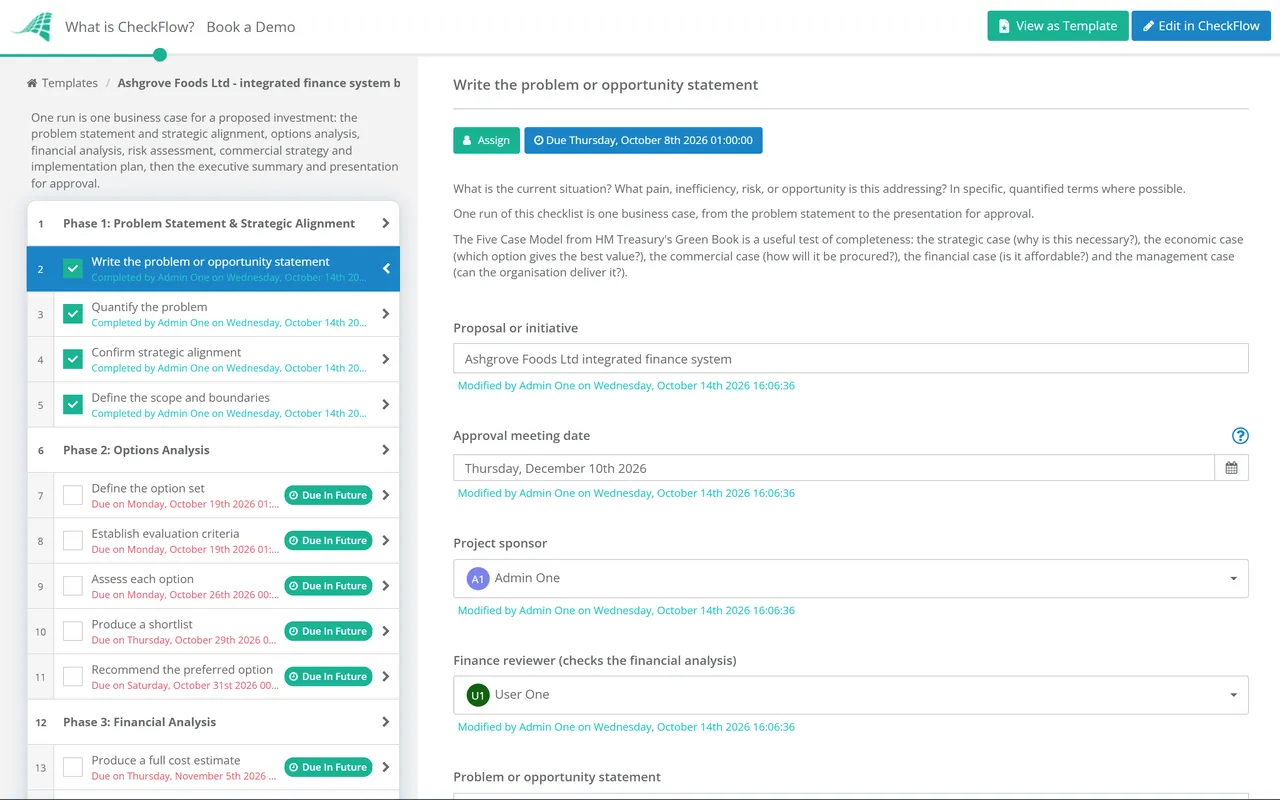
Write the problem or opportunity statement — what is the current situation? What pain, inefficiency, risk, or opportunity is this addressing? In specific, quantified terms where possible
Quantify the problem — what does the current situation cost? In direct cost, lost revenue, risk exposure, or other measurable impact
Confirm strategic alignment — which strategic objective does this address? Why is this the right time?
Define the scope and boundaries — what is in scope and what is explicitly out of scope; this prevents scope creep in the case itself
Phase 2
Phase 2: Options Analysis
An options analysis that presents only the preferred option is not analysis — it is a presentation. A genuine options analysis includes “do nothing” as one option, considers at least 2–3 viable alternatives, and uses a consistent evaluation framework that makes the comparison fair.
Define the option set — including “do nothing” (the base case), and at least 2–3 realistic alternatives at varying scale and approach
Establish evaluation criteria — against which all options will be assessed; aligned with the strategic objectives; weighted by importance; agreed before options are assessed
Assess each option — consistently against all criteria; by people with relevant expertise; avoid assessing to a predetermined conclusion
Produce a shortlist — the 2–3 options that best meet the criteria; with a clear explanation of why others were eliminated
Recommend the preferred option — with the rationale; the recommendation should follow from the analysis
Phase 3
Phase 3: Financial Analysis
A financial case that uses undiscounted cash flows rather than NPV, presents a single scenario without sensitivity analysis, or shows a payback period calculated on gross rather than net benefits is a financial case built to impress, not to inform.
Produce a full cost estimate — capital costs (one-off), operating costs (ongoing), and transition costs (implementation, change management, training); at appropriate confidence level with appropriate contingency
Quantify and evidence the benefits — financial benefits (revenue increase, cost reduction, cost avoidance) and non-financial benefits (risk reduction, customer experience, compliance); stated conservatively with evidence
Produce the NPV calculation — discounted cash flow model over the asset life or project period; using the organisation’s discount rate; NPV > 0 is the primary investment criterion
Calculate the IRR — the discount rate at which the investment breaks even; compared to the organisation’s hurdle rate
Calculate the payback period — how many years until cumulative benefits exceed cumulative costs; on a net (not gross) basis
Run sensitivity analysis — what happens to NPV and payback if the most uncertain assumptions are varied by ±20%? This is the most important section for decision-makers
Confirm funding sources and affordability — is this in the approved capital budget? If not, what is the funding strategy?
Phase 4
Phase 4: Risk Assessment
Identify all material risks — to cost (budget overrun), schedule (delay), benefits (not delivered as projected), operations (disruption during implementation), and strategy (external change that affects the case)
Rate each risk — likelihood and impact; produce a risk register with RAG-rated risks
Define mitigation actions — for each high-rated risk; specific, assigned, and planned
Assess the residual risk after mitigation — is the risk profile acceptable? Are there show-stopper risks that require further option development?
Stress-test the financial case against downside risks — if 2–3 key risks materialise, what is the revised NPV?
Phase 5
Phase 5: Commercial Strategy & Implementation Plan
Procurement strategy — how will the investment be procured? In-house, outsourced, or hybrid? Contract type? Have suppliers been market-tested?
Implementation plan — key phases, milestones, and dependencies; realistic timeline with milestones; resourcing plan (who will deliver this?)
Change management approach — how will the organisation be prepared for the change? Training, communications, and stakeholder engagement planned
Benefits realisation plan — which benefits are claimed? When will they be measured? Who is accountable for delivering them? How will they be tracked?
Project governance — who is the project sponsor? What is the governance structure? Who is the project manager?
Decision-makers approve or reject business cases based on the executive summary and the financial summary table. The executive summary that does not clearly state the problem, the recommended option, the cost, the key benefit, and the decision required — on one page — is an executive summary that has not been written for its audience.
Write the executive summary last — after all analysis is complete; it should reflect the actual conclusions, not the hoped-for conclusions
Include on one page: the problem, the recommended option, the investment required, the key financial metric (NPV/payback), the top 2–3 risks, and the decision being requested
Tailor the presentation to the audience — CFO: financial analysis and risk; operations: implementation plan and change impact; board: strategic fit and downside scenario
Anticipate the key questions — what will the decision-makers ask? Prepare evidence-based answers
Confirm the approval process — who approves, at what stage, in what forum; and what documentation is required for formal approval

NPV, IRR, and Payback Period — What Each Measures and Why All Three Are Needed
NPV (Net Present Value)
What it measures
The total value of an investment in today’s money — the sum of all discounted future cash flows minus the initial investment.
Decision rule
NPV > 0 means the investment creates value; higher NPV is better when comparing options.
Why it matters
The only metric that accounts for the time value of money across the full investment period.
IRR (Internal Rate of Return)
What it measures
The discount rate at which the investment breaks even (NPV = 0).
Decision rule
Compare to the organisation’s hurdle rate (minimum required return). If IRR > hurdle rate, invest.
Why it matters
Provides a percentage return figure that is intuitive for comparison with alternative investments.
Payback Period
What it measures
The number of years until cumulative net benefits equal the initial investment.
Decision rule
Compare to the organisation’s maximum acceptable payback period (typically 3–7 years for capital investments).
Why it matters
The most intuitive liquidity and risk metric; short payback investments are less exposed to long-term uncertainty.
Use all three: NPV for the value creation decision, IRR for comparison with other investments, and payback for risk and liquidity assessment. A business case that uses only payback period ignores long-term value. One that uses only NPV ignores liquidity risk.
Why Use CheckFlow for Business Case Development?
1
A structured process that forces the hard questions
The business case written in a single weekend by a committed project advocate is a business case that has avoided the hard questions. CheckFlow’s business case process requires each section to be completed in sequence — the options analysis genuinely considers alternatives, the financial model includes sensitivity analysis, and the recommendation follows from the evidence, not from the starting assumption.
2
A benefits realisation plan that survives approval
The benefits that justified the investment are most valuable not at approval but at post-project review, when the question is “did we achieve what we promised?” CheckFlow’s business case process requires a benefits realisation plan — named benefit owner, measurement method, and review date — created at business case stage and linked to the post-project review.
3
A consistent business case standard across the organisation
Organisations that approve capital investment based on inconsistently structured, variably rigorous business cases cannot compare competing investment options fairly. CheckFlow’s business case checklist produces a consistent structure and a consistent analytical standard — making capital allocation decisions genuinely comparable.
An approved business case initiates a project. CheckFlow’s Project Management Documentation Checklist covers the structured documentation framework for managing the project that follows approval. See the Project Management Documentation Checklist →
Capital project business cases are among the most complex to build. CheckFlow’s Capital Project Checklist covers the full project lifecycle that follows capital approval. See the Capital Project Checklist →
A comprehensive business case covers six phases: problem statement and strategic alignment (quantified problem, strategic objective link, scope definition), options analysis (minimum three options including “do nothing,” consistent evaluation criteria, shortlist and recommendation), financial analysis (full cost estimate, quantified benefits, NPV and IRR calculation, payback period, sensitivity analysis, funding confirmation), risk assessment (risk register, mitigation actions, residual risk rating, financial case stress-tested against downside), commercial strategy and implementation plan (procurement approach, milestone plan, change management, benefits realisation plan, project governance), and executive summary and presentation (one-page summary with problem, recommendation, investment, key metrics, risks, and decision required; audience-tailored presentation).
What is the difference between NPV and payback period?
+
Net Present Value (NPV) measures the total value created by an investment over its full life, expressed in today’s money — it discounts all future cash flows at the organisation’s cost of capital and sums them. Payback period measures how quickly the investment recoups its initial cost — the number of years until cumulative net benefits equal the initial outlay. NPV is the theoretically correct investment decision metric: a positive NPV means the investment creates value. Payback period is a risk and liquidity metric: a shorter payback period means less exposure to future uncertainty. Both are needed — NPV alone can justify investments whose benefits only materialise in 15 years; payback alone ignores value created after the payback date.
What is sensitivity analysis in a business case?
+
Sensitivity analysis tests what happens to the financial outcome (typically NPV) when key assumptions in the business case are changed — individually and in combination. For example: what is the NPV if costs are 20% higher than projected? What if benefits are 20% lower? What if both occur simultaneously? Sensitivity analysis answers the question decision-makers should always ask: “What has to be true for this investment to be worthwhile, and how confident are we that those things are true?” A business case whose NPV turns negative if costs are 10% over budget is a business case with thin margins; one that remains positive under a range of pessimistic scenarios is more robust.
What is the Five Case Model?
+
The Five Case Model is a business case framework developed by HM Treasury (UK) and codified in the Green Book, used across UK public sector and widely adopted in private sector organisations. It requires a business case to address five dimensions: the Strategic Case (why is this investment necessary and how does it align with strategy?), the Economic Case (what are the options and which produces best value for money?), the Commercial Case (what is the procurement strategy and has it been tested in the market?), the Financial Case (what are the detailed financial flows, how is it funded, and is it affordable?), and the Management Case (does the organisation have the capability to deliver this, and is the governance robust?).
Is CheckFlow free for this template?
+
14-day free trial, no card required. The Business plan is $10 per user per month after the trial. Full details at checkflow.io/pricing.
Build a Business Case That Informs the Decision — Not Just Advocates for the Answer
Free trial — no credit card required.
Do you like cookies? 🍪 We use cookies to ensure you get the best experience on our website. Learn more