
Accept, contract and set up
Covers: conflict checks, MSA and SOW, supplier set-up, access, governance and kickoff.
Runs in: the Consulting Client Onboarding Checklist.
Last reviewed: October 2026
No Credit Card Required
Printed from checkflow.io/templates/professional-services/consulting-engagement-delivery-checklist
Firms sell their method in the proposal and then deliver it from memory. This free consulting engagement delivery checklist turns that method into a run every engagement follows, whoever leads it: frame the client’s question and the starting hypotheses, run discovery, analyse options against agreed criteria, validate the recommendation with stakeholders, pass an independent quality review before anything reaches the client, record the sponsor’s acceptance, then capture what the firm learned. It is for management, strategy, operations and specialist consultancies, and it starts where the Consulting Client Onboarding Checklist ends.
ISO 20700:2017, the international guideline for management consultancy services, describes an engagement in three stages: contracting, execution and closure. It is written as guidance for both clients and consultants rather than a certifiable requirement, and its aim is clearer expectations on both sides. The three stages are a useful way to divide the work into checklists, because each has a different owner and a different failure.
Most delivery problems are not analytical. The team answers a slightly different question from the one the sponsor asked, a key stakeholder sees the recommendation for the first time in the final meeting, or a spreadsheet error reaches the board pack because the reviewer was on another engagement. A methodology that lives in a slide deck does not prevent any of that. A checklist with owners, approvals and due dates does.
Covers: conflict checks, MSA and SOW, supplier set-up, access, governance and kickoff.
Runs in: the Consulting Client Onboarding Checklist.
Covers: hypotheses, discovery, options, recommendations, quality review and acceptance.
Runs in: Phases 1 to 6 of this checklist.
Covers: lessons, method updates, feedback, case study permission and the engagement file.
Runs in: Phase 7, then the Client Offboarding Checklist if the relationship ends.
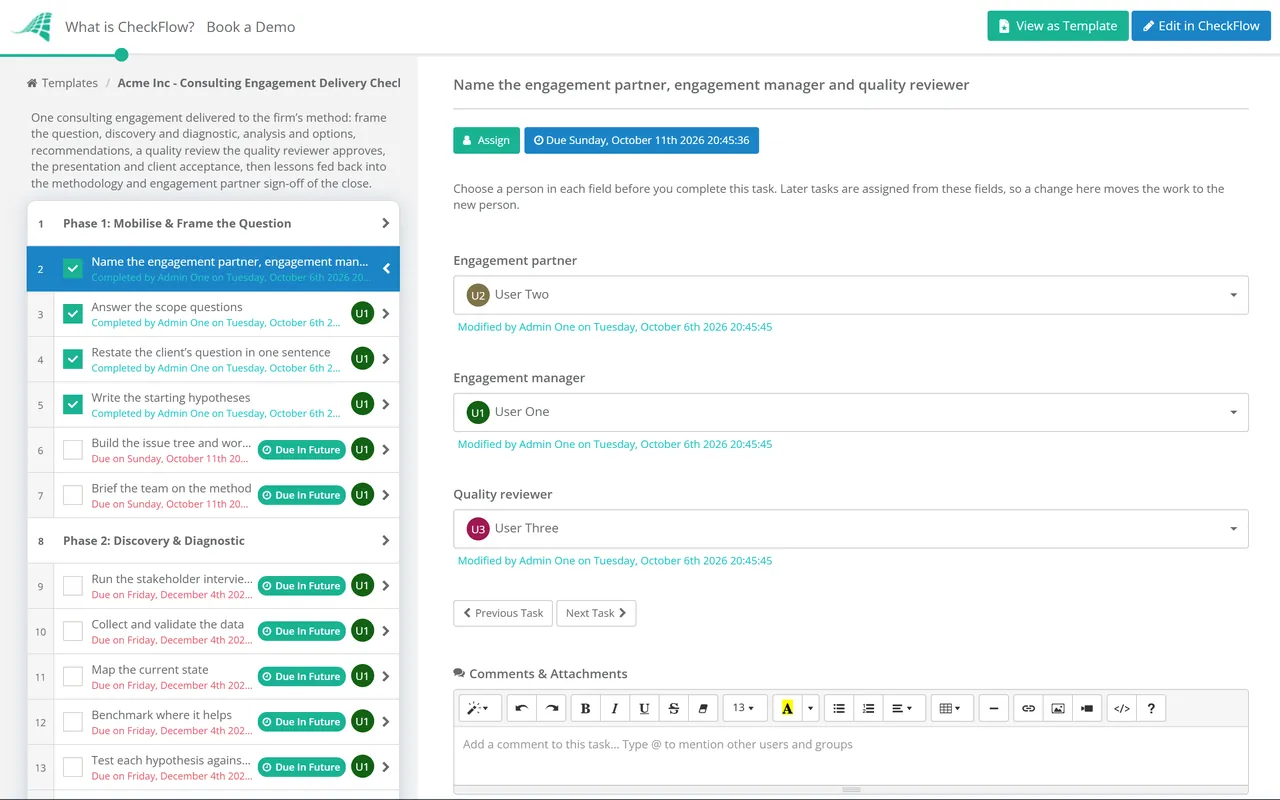
Seven phases take an engagement from framing the question to closing the file. The quality reviewer’s approval halts the checklist before any deliverable goes to the client, and the engagement partner approves the close. Three scope questions show the steering committee, reliance and implementation tasks only where they apply.
Owned by the engagement manager. The three Yes/No scope questions show or hide the steering committee tasks in Phases 3 and 6, the reliance tasks in Phase 5 and the implementation task in Phase 6.
The steering committee task is shown only when a steering committee is in place.
The two reliance tasks are shown only when someone other than the client will rely on the deliverables. The quality reviewer’s approval (Approved / Not approved) halts the checklist; nothing goes to the client until it is Approved.
The steering committee task is shown only when a steering committee is in place; the implementation task only when the engagement includes implementation support. The client’s acceptance is a recorded task, not a CheckFlow approval, because the sponsor is outside the firm.
Closure is an approval for the engagement partner, and the checklist halts until it is Approved.
The checklist above is a starting point. Your firm’s method is what clients pay for, so replace the generic steps with your own. This is the order that works.
Use the stage names your proposals already use, so the client recognises the method they bought. Five to eight phases is usually enough.
Write each task as an action with a reason. Attach your interview guides, analysis templates and report formats to the task where they are used.
Partner, manager and reviewer are fields filled in when each engagement starts, and tasks are assigned from them, so the template never names a person.
Instead of three versions of the method, ask a few dropdown questions at the start and show the extra tasks only where they apply.
Put an approval wherever your method says a senior person must review before the work moves on. The checklist halts until they approve.
Share a read-only link to the run with your own logo, so the sponsor follows progress through your method without a login. See white label checklists.
Phase 7 sends lessons to the template owner. Changing the template is how the firm’s learning reaches the next team.
Status reporting cadence. Agree it at kickoff and keep it in the template: a short weekly status note to the sponsor (progress, risks, decisions needed), a fortnightly or monthly steering committee where one exists, and a playback at the end of each phase. Put the status note on a recurring schedule so it does not depend on the engagement manager remembering. The guide to choosing and pricing white-label software explains how firms deliver their methodology to clients as a branded product.
Every engagement starts from the same template, with tasks assigned from the partner, manager and reviewer fields. Dropdowns add the steering, reliance and implementation steps only where they apply, so a senior manager and a first-time lead follow the same method.
The quality review is an approval step assigned to a named reviewer. The checklist halts until they approve, and their comments, the team’s responses and the client’s acceptance stay in the audit trail.
A read-only share link carries your logo, not ours, so the sponsor watches your methodology at work. The method looks like the firm’s own product, because it is.
CheckFlow is not a PSA, project accounting or document management system. It runs the steps, roles and approvals of your method around those tools. CheckFlow’s white label checklist software covers the branding options for client-facing runs, and CheckFlow for professional services shows how consultancies use it across a practice.
Start each client with the Consulting Client Onboarding Checklist, which ends by starting this one. If the recommendation needs funding, the Business Case Checklist helps the client make the case internally.
Consulting Client Onboarding Checklist
Client Offboarding Checklist
Project Management Documentation Checklist

Business Case Checklist
Design Review & Approval Checklist
Describe the process in a sentence and the AI checklist generator drafts the phases and tasks for you.
ISO 20700:2017, the guideline for management consultancy services, uses three: contracting, execution and closure. Within execution, most firms work through the same sequence under their own names: frame the question and hypotheses, discover and diagnose, analyse options, recommend and validate, review quality, then present and secure acceptance. Closure covers lessons learned, the client’s feedback, the engagement file and any handover to implementation.
Starting with a view of what the answer might be and then trying to prove it wrong, instead of collecting every piece of data first. Each hypothesis tells the team which interviews and analyses matter, which keeps discovery focused. The discipline is in dropping or revising a hypothesis when the evidence goes against it, which is why Phase 2 records keep, revise or drop for each one.
Someone senior who did not do the work. The engagement partner reviews too, but they are close to the answer and to the client. An independent reviewer catches numbers that do not reconcile, claims the evidence does not support and confidential material from other clients. Name the reviewer when the engagement starts and book their time for the review week, or it will be skipped.
A letter in which the firm agrees that a named third party, such as a lender or buyer, may rely on a report written for the client. Without one, that third party usually has no contract with the firm. With one, it may have a claim if the report is wrong, so the letter normally sets the purpose, any liability cap and the terms that apply. Treat reliance letters as contracts: legal reviews them and the partner signs.
Weekly to the sponsor is the common rhythm for an engagement of a few weeks or months: a one-page note with progress, risks, issues and the decisions needed. Steering committees usually meet less often, at the end of each phase or every few weeks. Agree the cadence at kickoff, schedule it so it recurs automatically, and never let the first sight of bad news be the steering committee pack.
Yes. Share a read-only link to the run and the sponsor sees which phases are done and what is next, under your firm’s logo. Decide which tasks belong in the client-facing template and keep internal ones, such as margin or staffing notes, in a separate checklist.
14-day free trial, no card required. The Business plan is $10 per user per month after the trial. Full details at checkflow.io/pricing.
14-day free trial, no credit cardFull refund in your first 30 daysUS hosting, EU on request