Simple Customer Onboarding Checklist Template

A consistent, repeatable onboarding process for any business — without overcomplicating it.

Most businesses know their first impressions with new customers matter. Fewer have a structured process that makes good first impressions consistent — not just when everything is going smoothly and you have time, but for every new customer, every time. This free simple customer onboarding checklist gives any business — consultants, coaches, accountants, IT providers, healthcare practices, tradespeople, retailers, and more — a clean, repeatable framework for welcoming new customers, collecting what you need, setting clear expectations, confirming they are getting value, and following up at the right moments to build a lasting relationship.

Use This Template Free See Live Example
No Credit Card Required

Why a Simple, Consistent Onboarding Process Makes a Real Difference

The first few interactions a new customer has with your business set the tone for everything that follows. Not in a vague, general sense — in a specific, measurable one. Customers who reach their first meaningful win with a product or service quickly are significantly more likely to stay, spend more, and refer others. Customers who have a slow, confusing, or inconsistent start are more likely to disengage quietly — often before saying a word to you about it.

You do not need an elaborate customer success function to deliver a good onboarding experience. You need a process: a defined sequence of steps that ensures every new customer gets a warm welcome, understands what happens next, receives the right information at the right time, and hears from you before they need to chase you. A simple checklist — run consistently for every customer — is enough to make this happen.

The Simple Customer Onboarding Checklist

This checklist is structured across five phases covering the first 90 days of a new customer relationship. It is designed to be simple enough to run for any business — adapt it to your specific context by adding or removing tasks as needed.

Phase 1

Before They Arrive — Internal Preparation

What happens before the customer first hears from you directly shapes what they experience when they do. Five minutes of preparation saves twenty minutes of follow-up.

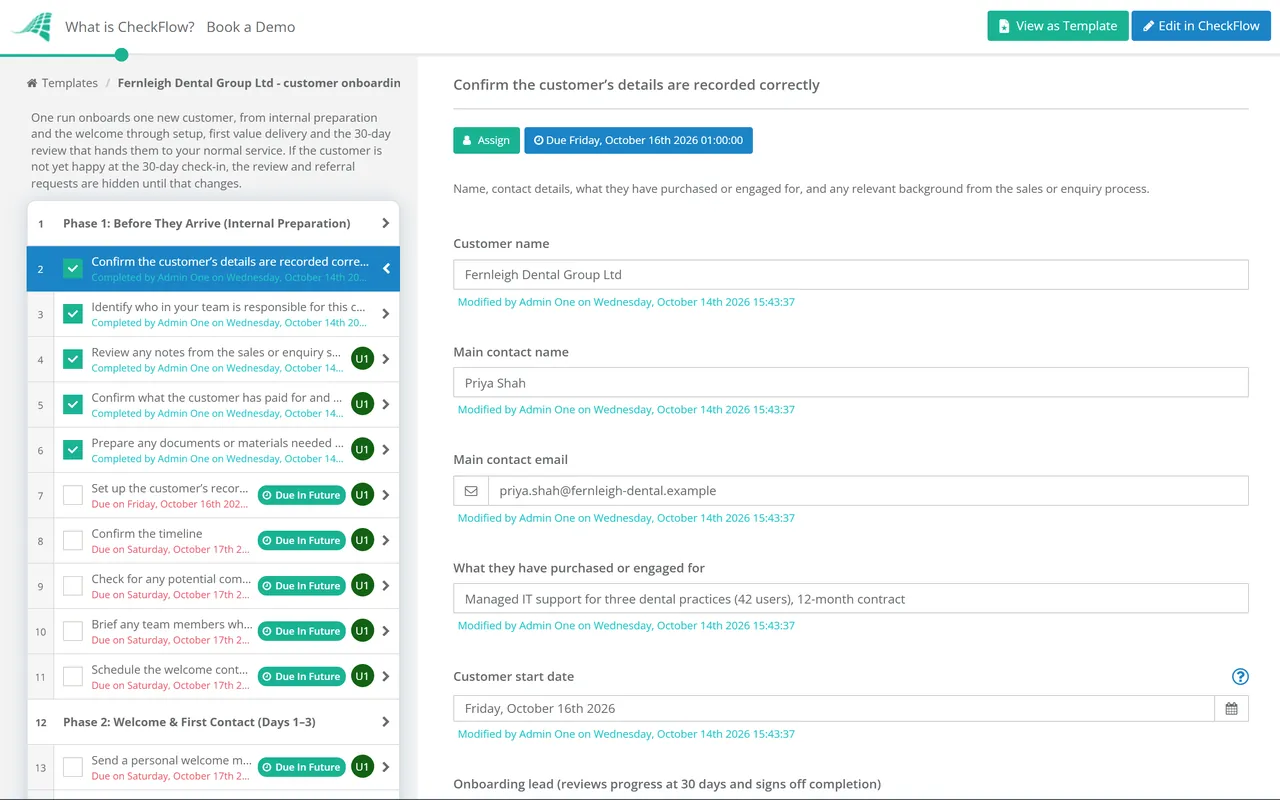
  • Confirm the customer’s details are recorded correctly — name, contact details, what they have purchased or engaged for, and any relevant background from the sales or enquiry process
  • Identify who in your team is responsible for this customer — assign a named owner for the onboarding process
  • Review any notes from the sales or enquiry stage — understand what the customer said they needed and why they chose you
  • Confirm what the customer has paid for and what they will receive — make sure the delivery team knows what was sold before the customer hears from them
  • Prepare any documents or materials needed for the welcome — contract, service agreement, welcome pack, questionnaire, or any information the customer needs to start
  • Set up the customer’s record in your CRM, project management tool, or equivalent system
  • Confirm the timeline — what needs to happen in the first week, first month, and first 90 days
  • Check for any potential complications — is there anything you know about this customer’s situation that needs extra attention?
  • Brief any team members who will interact with the customer
  • Schedule the welcome contact — confirm exactly when and how you will reach out
Phase 2

Welcome & First Contact (Days 1–3)

  • Send a personal welcome message within 24 hours of the customer starting — email, call, or message depending on your relationship style; make it warm and specific, not a generic auto-response
  • Introduce yourself and anyone else the customer will be working with — names, roles, and how to reach each person
  • Confirm what the customer has signed up for and what happens next — in plain terms, without assuming they have read everything
  • Set clear expectations for the first phase — what they will receive, when, and what you need from them
  • Send or present any documents that need to be reviewed or signed — service agreement, terms, privacy notice, or intake forms
  • Collect any information you need to deliver your service — a questionnaire, briefing form, or intake call; keep it focused and explain why each question matters
  • Confirm their preferred communication style — how often they want to hear from you, through which channel, and how quickly they typically need responses
  • Give them one clear next step — not a list of things to do, just the most important one thing you need from them right now
  • Confirm receipt and answer any immediate questions — do not leave an opening message unanswered
  • Record the welcome contact in the customer record — note the date, what was sent, and any response
Phase 3

Setup & Getting Started (Days 1–14)

  • Complete whatever internal setup is needed to begin delivering for this customer — account creation, file setup, project board, or whatever your business requires
  • Deliver any materials or resources the customer needs to get started — login details, guides, reference documents, or introductory materials
  • Walk the customer through anything that needs explaining — a short call, video, or written guide depending on the complexity
  • Complete the intake or information collection — confirm you have everything you need to deliver well
  • Confirm the customer knows how to contact you and what your response time is — remove the uncertainty of not knowing who to call or how quickly to expect a reply
  • Address any initial questions or concerns promptly — first interactions after welcome set the tone for responsiveness
  • Confirm any third-party introductions that need to happen — colleagues, suppliers, or other contacts the customer will interact with
  • Confirm the customer is set up and ready to start receiving your service — do not assume; ask directly
  • Send a brief check-in at the end of the first week — confirm everything is on track and invite any questions
  • Update the customer record with setup completion status
Phase 4

First Value Delivery (Days 7–30)

The most important milestone in any onboarding process is the moment the customer receives their first meaningful value. Identify what that moment is for your business and make sure it happens as early as possible.

  • Deliver the first meaningful output, outcome, or result for the customer — whatever the first real value looks like for your specific service
  • Communicate what has been delivered and why it matters — do not let good work go unnoticed; point to it explicitly
  • Check the customer is happy with what they have received — ask directly rather than assuming
  • Address any concerns or gaps identified early — a problem acknowledged and resolved in week two is far less damaging than one that festers to week eight
  • Confirm the customer understands what is coming next — the second phase of delivery, the next meeting, or the next milestone
  • Send a mid-month progress update — brief and proactive; do not wait for the customer to ask how things are going
  • Confirm any tasks or actions outstanding from the setup phase have been completed
  • Note any feedback, preferences, or requests raised by the customer — and confirm how you will respond to them
  • Internally review the onboarding progress at 30 days — is this customer on track for a good long-term relationship?
  • Document first value delivery in the customer record — note the date and what was achieved
Phase 5

30-Day Review & Ongoing Relationship (Days 30–90)

  • Conduct a 30-day check-in — a short, structured conversation reviewing what has been delivered, how the customer is finding the service, and what comes next
  • Ask directly how happy the customer is — not in a vague way, but specifically: is there anything that could be better?
  • Address any feedback from the check-in promptly — act on it before the next interaction
  • Confirm the customer’s goals are still the same — things sometimes change in the first month; confirm your delivery plan is still aligned
  • Mark onboarding as formally complete — confirm the customer is fully set up and receiving your service as intended
  • Transition to your normal service cadence — confirm the customer knows what ongoing communication looks like from here
  • Identify any expansion or upsell opportunities — is the customer getting value in one area that suggests they might benefit from something else you offer?
  • Request a review or testimonial if the customer is happy — this is the best time to ask, while the positive experience is fresh
  • Ask for referrals directly — a happy customer at 30 days is more likely to refer you than a happy customer at 12 months
  • Archive the onboarding record — document the complete journey for future reference

This checklist is available as a free, runnable template in CheckFlow — with tasks assigned to team members, customer-facing tasks shareable via a secure link, and every step logged so nothing falls through the cracks.

Use This Template Free

Who This Template Is For

This checklist works for any business that onboards customers — not just the industries covered by more specific templates in this library. Here are some of the business types that use it most.

Consultants & coaches

A consistent way to collect client information, set expectations, and confirm goals before the first session — so the engagement starts with clarity, not confusion.

Accountants & bookkeepers

A structured intake process for new clients — collecting authorisations, prior year records, and software access in the right order rather than through a scattered series of email requests.

IT support providers

A repeatable setup and onboarding process for new business clients — from system access and documentation through to first support ticket resolution and relationship establishment.

Healthcare & wellness practices

A patient or client intake process that collects the right information, sets expectations about the service, and follows up to confirm satisfaction — without the administrative overhead of doing it manually each time.

Tradespeople & service businesses

A professional client management process that confirms requirements, collects necessary information, and follows up after delivery — distinguishing the business from competitors who never follow up at all.

Any growing small business

A repeatable framework that ensures every new customer gets the same quality of start — regardless of which team member handles the relationship or how busy the business is that week.

Need something more specific for your industry? We have dedicated onboarding templates for SaaS companies, marketing agencies, financial planners, and real estate agents — see the full list below.

Why Run Customer Onboarding in CheckFlow?

1

The same experience for every customer, every time

Without a checklist, onboarding quality depends on who is available, how busy the business is, and whether anyone remembers to follow up. CheckFlow runs the same structured process for every new customer — the same welcome, the same information collection, the same check-ins — regardless of who is handling the relationship or what else is going on that week.
2

Share tasks directly with customers

Some onboarding tasks belong to the customer — completing an intake form, signing a document, providing information, or confirming a detail. CheckFlow lets you assign those tasks to the customer directly via a shared checklist link — no account required on their side. They see exactly what they need to do; you see when they have done it. No more chasing by email.

3

Never miss a follow-up

The most common onboarding failure is not a bad first impression — it is no second impression. Forgetting to check in at week two, missing the 30-day review, or losing track of a customer’s outstanding task are what turn a good start into a lost relationship. CheckFlow assigns every follow-up to a named person with a due date and sends automatic reminders — so nothing slips through.

If your business runs the same onboarding process on a recurring schedule — weekly new client intakes, monthly cohort starts, or any regular pattern — CheckFlow can schedule and start the checklist automatically. No one needs to remember to kick it off. Learn more about recurring checklists in CheckFlow →

The simple customer onboarding checklist gives every business a solid foundation. Once you have that foundation, CheckFlow’s SOP software lets you build out every other recurring process in your business — from the same platform, with the same structure. Learn more about SOP software in CheckFlow →

Frequently Asked Questions

What should a simple customer onboarding checklist include?

+

A simple customer onboarding checklist should cover five core phases: internal preparation before the customer first hears from you (reviewing what they have signed up for, assigning an owner, preparing documents), welcome and first contact (a warm, specific welcome within 24 hours of starting, with clear next steps), setup and getting started (delivering what the customer needs to begin receiving the service and collecting what you need from them), first value delivery (confirming the customer has received something meaningful and checking they are happy), and a 30-day review (a structured check-in that marks the end of onboarding and the start of the ongoing relationship). The checklist should be simple enough to run consistently for every new customer — not so detailed that it only gets used when there is plenty of time.

How long should a customer onboarding process take?

+

For most service businesses, the active onboarding process runs for 30 days, with a natural progression through three sub-phases: activation in the first week (welcome, setup, and first contact), the foundation phase from days 8–30 (information collection, first delivery, and early check-ins), and a transition to the ongoing relationship at 30 days. The most important milestone is not the end of the 30 days — it is the customer’s first meaningful win with your service. That moment should happen as early as possible in the process, ideally within the first week for simpler services and within the first two weeks for more complex ones.

What is the most common reason customers disengage during onboarding?

+

The most common reason customers disengage early is not a bad first impression — it is a good first impression followed by silence. A warm welcome email goes unanswered for three days. A follow-up call is not made when expected. A 14-day check-in never happens. The customer begins to feel like a number rather than a person, and starts to question their decision. A structured onboarding checklist with assigned follow-up tasks and automatic reminders prevents this — not by being more sophisticated, but by being more consistent.

Do I need a customer success team to run a good onboarding process?

+

No. The principles of good onboarding — a warm welcome, clear expectations, proactive communication, and a check-in at the right moments — apply to any business regardless of size. A sole trader with five clients can deliver better onboarding than a company with a dedicated CS team, simply by following a consistent process for every client. The checklist is the process — the tool that ensures the right thing happens for every customer, even when you are busy, distracted, or managing ten things at once.

How do I make onboarding consistent when I am busy?

+

The only reliable way to make onboarding consistent is to run it from a checklist — not from memory or a to-do list. When the process is documented and the tasks are assigned, the right things happen regardless of how busy you are. CheckFlow runs the same checklist for every new customer, assigns each task to the right person with a deadline, and sends automatic reminders before and after each due date. The onboarding process runs itself — you just complete the tasks when they arrive.

Is CheckFlow free to use for this template?

+

You can start a free 14-day trial with no credit card required, giving you full access to all features including this template. The Business plan is $10 per user per month after the trial. Full details at checkflow.io/pricing.

Start Running Consistent Customer Onboarding Today

Free trial — no credit card required.