
Run by a supervisor or EHS officer on the floor
Asks: are guards fitted, exits clear, PPE worn and chemicals labelled today?
Cadence: daily, weekly or monthly, area by area.
Output: a list of defects and quick fixes.
Last reviewed: September 2026
No Credit Card Required
ISO 45001 does not set a calendar, but most organisations run it as a yearly cycle. This free ISO 45001 checklist gives health and safety managers, EHS leads and management system coordinators that cycle, built on ISO 45001:2018 and its 2024 climate change amendment. It covers context and policy, worker consultation and participation under clause 5.4, hazards and risk, the legal register, objectives, contractors and management of change, emergencies, incident investigation, internal audit and management review. It produces a dated, clause-by-clause record that the system runs, and that the people doing the work helped run it.
ISO 45001 is the international standard for occupational health and safety management systems, now maintained by ISO/TC 283. It replaced the British standard OHSAS 18001 and shares its clause structure with ISO 9001 and ISO 14001. It is voluntary: your health and safety law applies either way, and certification is a choice.
What sets it apart is who it involves. Clause 5.4 requires consultation of non-managerial workers before decisions are made, and their participation in hazard identification, the choice of controls and incident investigation. Clause 8.1.2 makes the hierarchy of controls a requirement rather than a textbook diagram. Clause 6.1.2.1 counts workload, harassment and culture as hazards.
A safety inspection finds the blocked fire exit. The management system asks why it was blocked, whether anyone had reported it and whether the risk assessment changed.
Asks: are guards fitted, exits clear, PPE worn and chemicals labelled today?
Cadence: daily, weekly or monthly, area by area.
Output: a list of defects and quick fixes.
Asks: are hazards found early, are workers involved, and does the organisation learn?
Cadence: an annual cycle, with meetings, drills and audits inside it.
Output: evidence for each clause, a management review and an improvement plan.
Six phases take the management system through one year, from context to management review. A seventh switches on for organisations holding an accredited certificate.
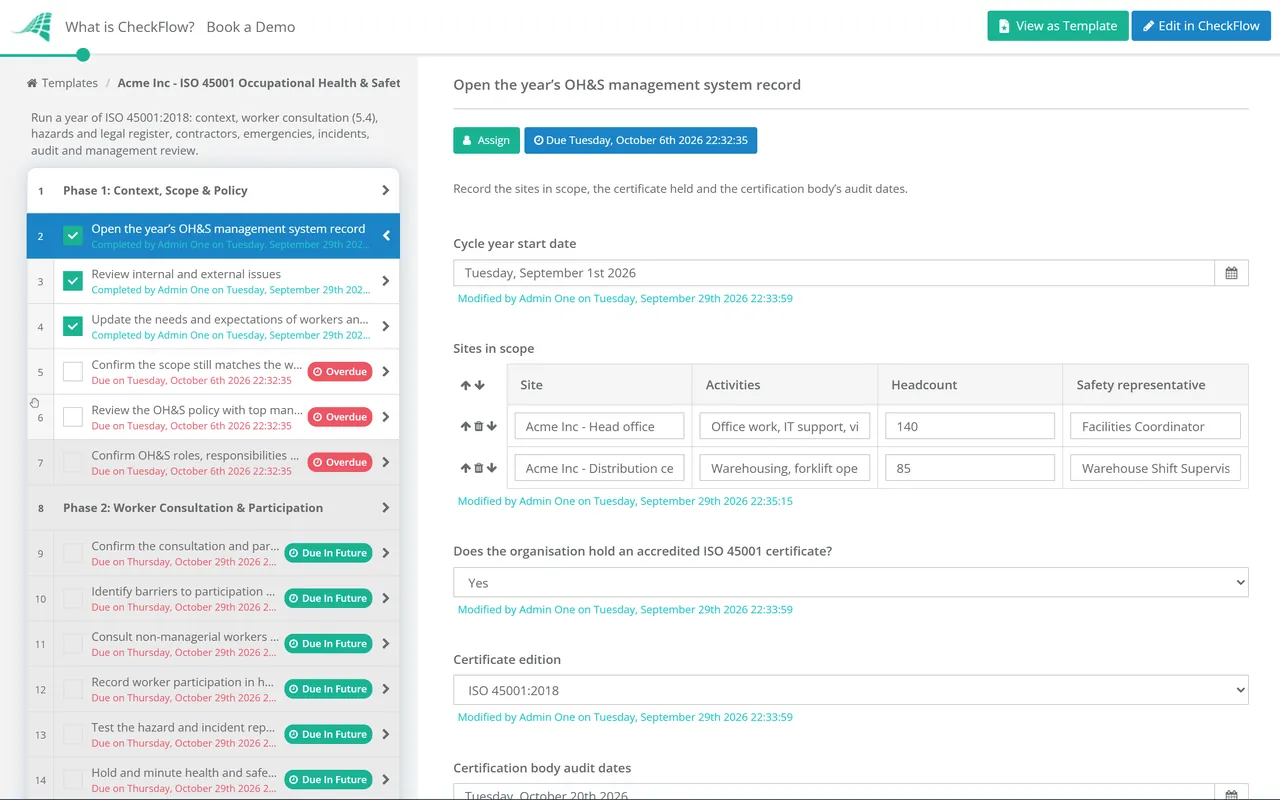
The first task asks the scope questions. Its answers switch on the contractor tasks in Phase 4 and the certification phase.
Clause 5.4 names non-managerial workers in both consultation and participation. Keep evidence of each.
The contractor and outsourcing tasks appear only when Phase 1 records that contractors or outsourced processes operate within scope.
The first task asks whether any incident this year had to be reported to a regulator. If Yes, the notification check appears.
The OH&S lead prepares the inputs. Top management holds and signs off the review.
Shown only when Phase 1 records an accredited ISO 45001 certificate.
The table maps the main requirements of ISO 45001:2018, as amended in 2024, to the phase that produces the evidence. ISO 45001 sits on top of your health and safety law rather than replacing it, and your certification body applies its own audit rules, so treat the table as a starting point, not legal advice.
| Requirement | ISO 45001:2018 | Evidenced in |
|---|---|---|
| Context, interested parties and climate change | 4.1, 4.2 (Amd 1:2024) | Phase 1 |
| Scope | 4.3 | Phase 1 |
| Leadership, policy and roles | 5.1–5.3 | Phases 1 and 2 |
| Consultation and participation of workers | 5.4 | Phase 2 |
| Hazard identification and risk assessment | 6.1.2 | Phase 3 |
| Legal and other requirements | 6.1.3 | Phase 3 |
| OH&S objectives | 6.2 | Phase 4 |
| Competence | 7.2 | Phase 4 |
| Hierarchy of controls | 8.1.2 | Phases 4 and 5 |
| Management of change | 8.1.3 | Phase 4 |
| Contractors and outsourcing | 8.1.4 | Phase 4 |
| Emergency preparedness and response | 8.2 | Phase 5 |
| Evaluation of compliance | 9.1.2 | Phase 6 |
| Internal audit | 9.2 | Phases 6 and 7 |
| Management review | 9.3 | Phase 6 |
| Incidents, nonconformity and corrective action | 10.2 | Phases 5 and 6 |
ISO 45001:2018 with Amendment 1:2024 is the current edition, and this checklist uses its clause numbers. The amendment, published in February 2024, added one sentence to clause 4.1 requiring you to determine whether climate change is a relevant issue, and a note to clause 4.2. Unlike ISO 9001 and ISO 14001, ISO 45001 has not yet moved to a new edition. The revision is at draft stage: ISO/DIS 45001 went to ballot among ISO members in June 2026, and voting closed on 9 September 2026. At the time of review the result had not been published, and ISO expects the new edition to replace the 2018 edition in the first half of 2027. Certification bodies such as LRQA and NQA expect more weight on psychosocial health and wellbeing, but a draft can still change, so keep auditing against 2018. Global Accreditation Cooperation Incorporated (Global ACI) will set transition rules after publication. It gave ISO 9001:2026 and ISO 14001:2026 three years, and certification bodies expect similar here. Certificates to ISO 45001:2018 remain valid in the meantime.
An annual recurring schedule opens the cycle and assigns each phase to its owner, with dynamic due dates across the year. A data set of sites and safety representatives fills Phase 1, so each site runs its own copy of one template.
Assign consultation and investigation tasks to safety representatives or a committee group, not only to managers. Minutes and risk assessments attach to their task, and the activity trail shows who did each step and when.
Conditional logic hides contractor tasks and the certification phase where they do not apply. Enforced step order holds the management review until the audits are done, and an approval records top management’s sign-off. Template versioning keeps each finished year on the edition it was run against.
CheckFlow is not a certification body and cannot certify you to ISO 45001. It runs the management system work and keeps the evidence. Day-to-day checks belong in their own checklists: the Safety Audit Checklist for a workplace walk-round and the Manufacturing Safety Inspection Checklist for plant, guarding and lockout. For implementing any ISO standard from gap analysis to certification, use the ISO Compliance Checklist.
CheckFlow’s compliance checklist software shows how recurring reviews and evidence fit across your compliance calendar, and CheckFlow for manufacturing covers the shift and inspection checklists that run alongside it on the factory floor.

ISO 14001 Environmental Management Checklist
Health & Safety Risk Assessment Checklist
Safety Audit Checklist

Manufacturing Safety Inspection Checklist

ISO Management Review Checklist
Describe the process in a sentence and the AI checklist generator drafts the phases and tasks for you.
No. ISO 45001 is a voluntary standard, and certification to it is optional. Your legal duties come from health and safety law in each country where you operate. The standard makes you identify those duties (clause 6.1.3) and check you meet them (clause 9.1.2), but holding a certificate does not show legal compliance on its own. Many adopt it because customers or tenders ask for it.
Consultation means asking workers for their views before a decision is made. Participation means involving them in making it. Clause 5.4 lists topics for each: non-managerial workers are consulted on matters such as the policy, objectives, contractor controls and the audit programme, and take part in identifying hazards, choosing controls and investigating incidents. Time, training and resources must be provided, and barriers such as language or fear of reprisal removed.
Clause 8.1.2 sets five levels, in order: eliminate the hazard; substitute less hazardous processes, operations, materials or equipment; use engineering controls and reorganise work; use administrative controls, including training; and use adequate personal protective equipment. Controls are often combined, but an auditor will expect higher levels to have been considered before procedures and PPE.
Yes. The hazard identification clause, 6.1.2.1, includes how work is organised and social factors such as workload, work hours, victimisation, harassment and bullying, along with leadership and culture. ISO 45003, published in 2021, gives guidance on managing psychosocial risk within an ISO 45001 system. Phase 3 asks for psychosocial hazards explicitly, because a walk-round never finds them.
Yes. A draft revision, ISO/DIS 45001, was balloted from June to September 2026, and ISO expects the new edition to replace ISO 45001:2018 in the first half of 2027. Once the new edition is published, the accreditation bodies will set a transition period, and you will move to it at a surveillance, recertification or separate transition audit agreed with your certification body.
Yes. All three share the same high-level clause structure, from context in clause 4 to improvement in clause 10, so many organisations run one management review and audit programme. Keep worker participation, the hierarchy of controls and incident investigation visible: ISO 9001 has no equivalent.
14-day free trial, no card required. The Business plan is $10 per user per month after the trial. Full details at checkflow.io/pricing.
14-day free trial, no credit cardFull refund in your first 30 daysUS hosting, EU on request