A new sales assistant can be on a till by their second shift, taking cash, giving refunds and deciding who is old enough to buy alcohol or tobacco. Most of what they learn comes from whoever is working the next register.
This free retail employee onboarding checklist is for store managers, area managers and owners of shops, supermarkets, convenience stores and off-licences. It covers what happens behind the counter and on the shop floor: till and cash handling, cash-up with a second count, refund authority, card terminal checks, age-restricted sales, loss prevention that never puts staff at risk, safe stockroom work, service standards, a buddy shift and a till sign-off. Two answers shape it: whether the store sells age-restricted products and whether the starter will hold keys. Retail is the shop-floor training. If you are hiring a peak-season intake or bringing back last year’s team, start each person on the Seasonal Employee Onboarding Checklist and run this one alongside it. A café counter needs the Restaurant Employee Training Checklist, and the contract and payroll steps live in the Employee Onboarding Checklist.
Retail training often starts with where the stock lives and how to fold the knitwear. The mistakes that cost a store money or its licence happen at the till: a refund processed without a receipt, a drawer left open, a card terminal swapped by someone claiming to be an engineer, a bottle of wine sold to a teenager. A new starter needs those rules before they serve a customer alone, and the store needs a record that they were taught.
The second variable is responsibility. Every assistant needs the till, the age checks and the loss prevention rules. A key-holder also opens and closes the building, handles the safe and answers the alarm at night, which brings a different set of risks. Asking on the first day whether the starter will hold keys keeps the opening and closing training away from people who will never need it.
Every starter
Sales assistants and cashiers
Till: sales, voids, refunds within their limit, card terminal checks and a counted cash-up.
Age checks: the store’s products, legal ages, accepted ID and how to refuse.
Loss prevention: observe, record and report.
Signed off when: they have run a till through a busy period and balanced it.
Key-holders
Supervisors and shift leads
Everything an assistant learns, plus refund overrides and approving under-18 sellers where that applies.
Building: opening and closing routines, the safe, banking and the alarm.
Records: key and code register, signed by the manager.
Signed off when: they have opened and closed the store with a manager present.
What the Retail Employee Onboarding Checklist Covers
Training moves from the starter’s set-up to a till they may run alone. The age-restricted sales phase appears only in stores that sell those products, and the opening and closing phase only for key-holders.
Phase 1
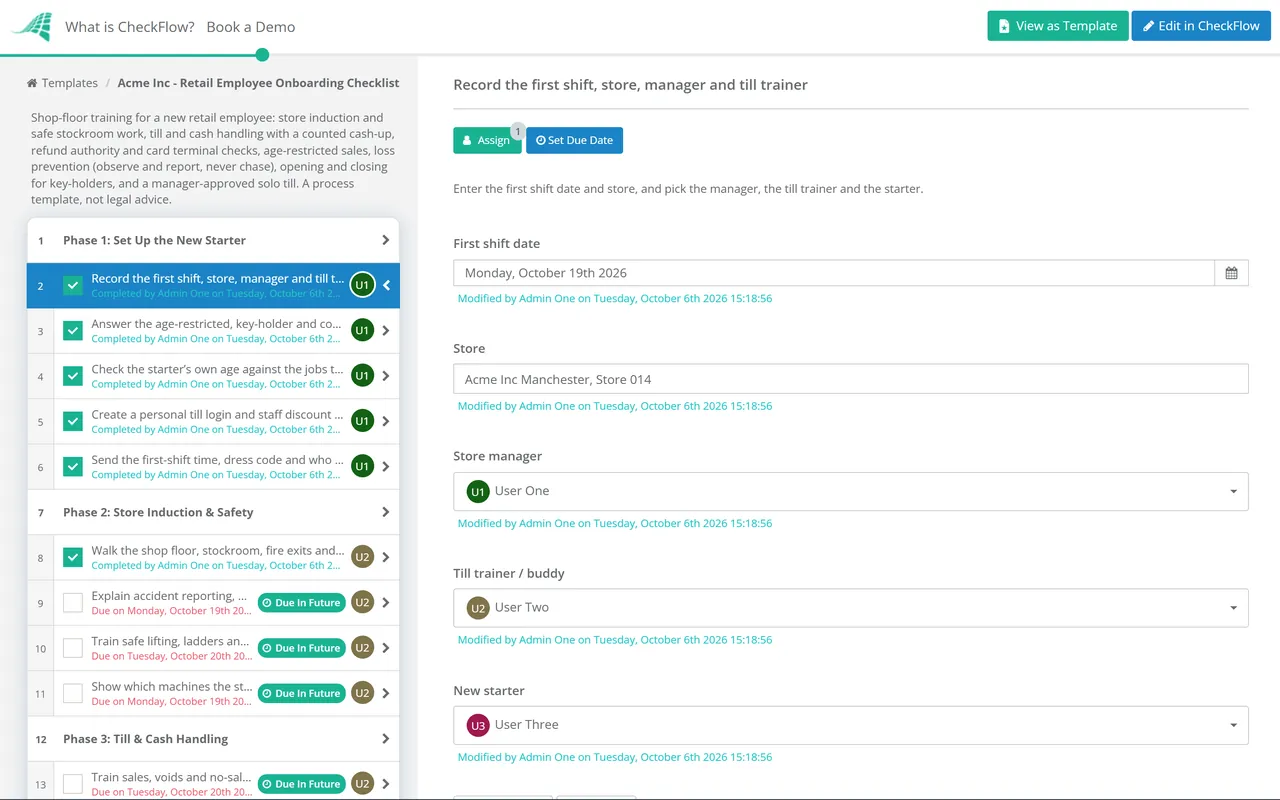
Phase 1: Set Up the New Starter
Record the first shift, store, manager and till trainer
Answer the age-restricted, key-holder and country questions — does the store sell restricted products, will they hold keys, and is the store in the US or the UK?
Check the starter’s own age against the jobs they will do — under-18s have limits on selling alcohol and using stockroom machinery
Create a personal till login and staff discount record — operator codes are never shared
Send the first-shift time, dress code and who to ask for
Phase 2
Phase 2: Store Induction & Safety
Walk the shop floor, stockroom, fire exits and assembly point
Explain accident reporting, first aid and spill clean-up
Train safe lifting, ladders and roll cages in the stockroom — and when to ask for help instead of lifting
Show which machines the starter may not use — balers, compactors and anything the risk assessment rules out
Phase 3
Phase 3: Till & Cash Handling
Train sales, voids and no-sales on the till in training mode
Teach cash handling and how to check notes — count change back, notes stay on the drawer until the change is given, drawer closed between sales
Explain refund and exchange authority — which refunds need a supervisor, receipts and refunds to the original payment method
Train card terminal use and tamper checks — inspect the device, verify anyone who says they have come to repair it, report anything odd
Practise a cash-up with a second person counting — variances recorded, never covered
Phase 4 — If Age-Restricted
Phase 4: Age-Restricted Sales
Shown only in stores that sell alcohol, tobacco, vapes, knives, lottery or other restricted products. A process step, not legal advice.
Teach the restricted products and legal ages for this store
Train the store’s age verification policy and accepted ID — Challenge 21 or 25, what a valid document looks like, digital ID only if the store accepts it
Practise refusing a sale and spotting proxy purchases — role-play the polite refusal and the adult buying for a teenager outside
Show how to record a refusal in the refusals log
Book the state alcohol seller course where required — US stores
Explain the tobacco date-of-birth rule from 1 January 2027 — UK stores
Phase 5
Phase 5: Loss Prevention
Follow company policy. No item of stock is worth a member of staff getting hurt.
Explain how stock and cash go missing in this store — shoplifting, refund fraud, distraction at the till, internal theft and admin errors
Teach observe, record and report, never chase — what to write down and who to tell, including on a quiet late shift
Show the tags, CCTV, alarms and high-value displays — how to remove tags at the till and what to do when a door alarm sounds
Explain the staff purchase and bag check policy — another member of staff rings up their purchases
Phase 6 — If Key-Holder
Phase 6: Opening, Closing & Alarm
Shown only for starters who will hold keys. The last task is an approval, and keys are not issued for solo use until it is given.
Train the opening routine — look for signs of entry before going in and do not enter alone if anything is wrong
Train the closing routine, safe and banking
Issue keys and a personal alarm code and log them
Walk through the alarm call-out procedure
Manager approves the starter as a key-holder
Phase 7
Phase 7: Shop Floor Service & Till Sign-Off
Train service standards and product knowledge — greeting, finding stock, click and collect, returns at the desk
Practise handling a complaint and calling for help
Age checks are where a new cashier can personally break the law on their first day. The table lists the rules that shape the training. Treat it as the brief for your training rather than legal advice: alcohol licensing in the US is set state by state, and in the UK the rules differ between England and Wales, Scotland and Northern Ireland.
Topic
United States
United Kingdom
Alcohol
21 to buy in every state. Seller training is set by the state: Texas does not require it by law, but sellers and their managers certified within 30 days of hire is part of its safe harbour; Utah requires training for store staff who sell beer
18 to buy. In England and Wales every licensed shop must have an age verification policy, ID must show a photo, date of birth and a holographic mark or ultraviolet feature, and staff must know the policy. In Scotland the policy covers anyone who looks under 25
Tobacco and vapes
21 for all tobacco products, including e-cigarettes, since 20 December 2019. Retailers must check photo ID for anyone under 30
18 today, and 18 for all consumer nicotine products from 29 October 2026. Under the Tobacco and Vapes Act 2026, from 1 January 2027 tobacco may never be sold to anyone born on or after 1 January 2009
Digital ID
Set by state law and store policy
Since 15 September 2026, licensed premises in England and Wales may accept digital proof of age through a registered digital verification service. It is optional, and physical ID remains valid
Other products
Set by state and local law, so list what your state restricts
Knives (16 for some domestic knives in Scotland), corrosive products, lottery tickets and scratchcards, and adult fireworks are 18; aerosol paint is 16. A ban on high-caffeine energy drinks for under-16s in England is expected from April 2027
Under-18 staff
May not operate or unload balers and compactors; 16 and 17-year-olds may only load compliant machines. State rules on young clerks selling alcohol vary
In England and Wales, a person under 18 may sell alcohol in a shop only if each sale is specifically approved by a responsible person
Loss prevention is the other area where a checklist should not give legal advice. The safe rule for new staff is the same everywhere: watch, note what you saw, tell the manager or security, and never chase or physically stop anyone. In England and Wales the Crime and Policing Act 2026 creates a specific offence of assaulting a retail worker, with its measures being brought in over time, which is one more reason for staff to report rather than intervene. Primary sources: the FDA on Tobacco 21, the mandatory licensing conditions, the Tobacco and Vapes Act 2026 and Business Companion on underage sales.
Why Run Retail Onboarding in CheckFlow?
1
Each store gets its own version
Three answers on the second task shape the checklist. A store without restricted products skips the age checks, a non-key-holder never sees the alarm codes, and the country answer shows either the state seller course or the UK tobacco change.
2
Approvals guard the till and the keys
The solo till sign-off and the key-holder approval are approval tasks assigned to the manager picked on the first task. The checklist stops at each one until it is approved, so nobody runs a till alone or holds keys on a trainer’s say-so.
3
A record for a licensing visit
Trading standards guidance says a business defending an underage sale must show it took all reasonable precautions, and training records are part of that. Every task carries a name and a timestamp, and the refusal training and policy sign-off sit on one checklist per starter.
Stores rarely hire one person at a time. CheckFlow’s onboarding software runs this checklist next to your seasonal and permanent onboarding templates, with due dates set from each start date and reports showing which starters across your stores still need a till sign-off.
What ID can a shop accept for alcohol sales in the UK?
+
In England and Wales, the mandatory age verification policy requires ID that shows the customer’s photograph and date of birth and carries a holographic mark or an ultraviolet feature, such as a photocard driving licence, a passport or a proof of age card with the PASS hologram. Since 15 September 2026 a store may also accept digital proof of age through a registered digital verification service, but only if it chooses to and meets the safeguards. Train staff on the documents your own policy lists.
What is the legal age to buy tobacco and vapes?
+
In the US it is 21 for every tobacco product, including e-cigarettes, and retailers must check photo ID for anyone under 30. In the UK it is 18 today, but the Tobacco and Vapes Act 2026 changes tobacco from 1 January 2027: anyone born on or after 1 January 2009 can never legally be sold it. From that date, cashiers need to read the date of birth on the ID rather than just confirm the customer is over 18. Vapes and other consumer nicotine products stay at 18, with that age extended to all of them from 29 October 2026.
Can a 16 or 17-year-old sell alcohol in a shop?
+
In England and Wales, yes, but each sale must be specifically approved by a responsible person such as the licence holder, the designated premises supervisor or an adult authorised to approve it. In practice that means a supervisor approves the sale at the till every time. In the US the minimum age for staff who sell alcohol is set by each state, so check your state regulator before rota planning.
Should retail staff try to stop a shoplifter?
+
Follow your company’s policy, and for new staff that policy should be simple: do not chase, block or touch anyone. Note the description, time and what was taken, tell the manager or security, and let them decide whether to call the police. The rules on detaining someone differ by country and state and carry real risk for the employee, so the checklist teaches reporting, not intervention.
What should card terminal training cover for new cashiers?
+
Beyond taking payments, cashiers should know how to spot a terminal that has been tampered with or swapped. The card industry’s PCI DSS standard expects staff who use terminals to be trained to check the identity of anyone claiming to be a repair engineer before letting them touch a device, never to install, replace or hand back a terminal without verification, to watch for suspicious behaviour around devices and to report it. Show them what your own terminals should look like, including seals and serial numbers, so a change stands out.
How soon can a new retail employee work a till alone?
+
There is no legal minimum. A sensible bar is that they have balanced a cash-up with a second person counting, handled a refund within their limit, refused an age-restricted sale in role-play if the store sells those products, and worked a busy period with a buddy beside them. For many starters that is two or three shifts. The manager’s approval in Phase 7 is the point where the decision gets recorded.
Is CheckFlow free for this template?
+
14-day free trial, no card required. The Business plan is $10 per user per month after the trial. Full details at checkflow.io/pricing.
Every New Cashier Trained Before They Serve Alone
Free trial — no credit card required.
Do you like cookies? 🍪 We use cookies to ensure you get the best experience on our website. Learn more