HVAC Service Call Checklist Template

A reactive HVAC call goes well when the fault is found before anything is priced, the work waits for an approved estimate, and the refrigerant records are done before the van leaves.

Last reviewed: October 2026

Printed from checkflow.io/templates/operations-facilities-management/hvac-service-call-checklist

This free HVAC service call checklist runs one reactive call, from the customer’s first report to the signed-off service record. It is for facilities teams who send their own technicians or call in a contractor, and for HVAC contractors running service calls for their customers. One run covers booking and triage, safety on arrival, the HVAC diagnostic, a written estimate with a repair and a like-for-like change-out priced, the approval, the repair or the change-out with the old unit removed, commissioning, clean-up and sign-off. Refrigerant recovery and records appear only when the work involves refrigerant, with short notes for the UK or the US, and a follow-up visit appears when one is needed.

One Breakdown, From the First Call to the Service Record

An HVAC service call starts with a fault: no heating, no cooling, water dripping from a ceiling unit, a noise or an error code on the controller. Someone has to find the cause, price the fix, get it approved and put it right, and when the refrigerant circuit is opened, keep the records the law asks for. A call that skips the estimate, or starts work before anyone has approved it, can end in a dispute about what was agreed.

This checklist runs one reactive call from the first report to the signed-off service record, for a facilities team or an HVAC contractor. Planned work belongs elsewhere: seasonal servicing follows the HVAC Maintenance Checklist, and the building-wide condition check follows the Facility Inspection Checklist. Two checklists sit closest to this one.

This checklist

One reactive HVAC service call

Covers: triage and booking, safety on arrival, the HVAC diagnostic, a written estimate with a repair and a like-for-like change-out priced, the approval, the repair or change-out, refrigerant recovery and records where they apply, commissioning, clean-up and sign-off.

Owned by: the service coordinator, with the technician doing the work and the approver deciding on the estimate.

Output: a unit back in service, an approved estimate, and a service record with the readings before and after.

Planned service

The HVAC Maintenance Checklist

Covers: one planned service visit: the air side, spring cooling and autumn heating start-ups, refrigerant leak checks that are due, controls and ventilation, and remedial work approved.

Use it: for the quarterly and seasonal visits that try to stop breakdowns. Defects it finds can become service calls here. HVAC Maintenance Checklist.

All equipment

The Equipment Servicing Workflow Checklist

Covers: the equipment register, service agreements, planned and reactive servicing for every kind of equipment, and contract reviews.

Use it: to run servicing across a building’s lifts, generators, fire systems and HVAC together. This checklist is the detail of one HVAC call. Equipment Servicing Workflow Checklist.

What the HVAC Service Call Checklist Covers

Nine phases take one HVAC service call from the first report to the closed work order. The first task records the date of the first site visit, which sets every due date, and the country, which shows short notes on refrigerant and gas work for the UK or the US. The diagnosis asks whether the work involves refrigerant, which adds the refrigerant tasks. The estimate approval is the gate: nothing after it can be completed until the approver decides, and the decision shows the repair tasks or the change-out tasks, or a task to make the unit safe and close the call or re-quote. A follow-up visit appears when one is needed.

  1. Phase 1

    Phase 1: Booking & Triage

    7 tasks

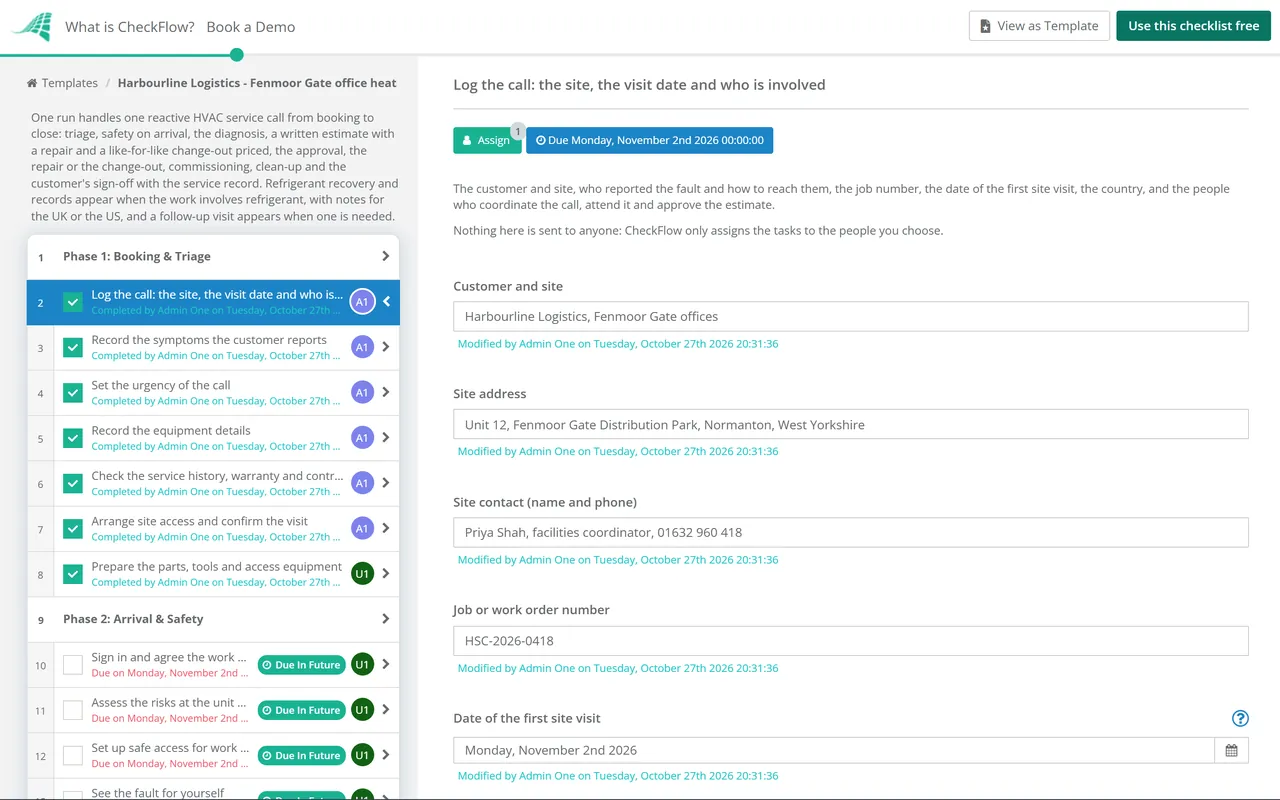
    Log the call, find out what the customer is seeing and how urgent it is, and record the equipment before anyone travels. Enter the date of the first site visit on the first task: every due date counts from it in business days. Choosing the country shows short notes on refrigerant and gas work for the UK or the US.

    • Log the call: the site, the visit date and who is involved — the customer and site, who reported the fault and how to reach them, the job number, the date of the first site visit, the country, and the people who coordinate the call, attend it and approve the estimate
    • Record the symptoms the customer reports — what is happening, when it started, which rooms or areas are affected, any error code on the controller, and anything already tried, such as a reset
    • Set the urgency of the call — emergency, urgent or routine, on the scale your organisation uses; record what is at risk, such as vulnerable occupants without heating, an overheating server room, stock that needs cooling or water leaking near electrics
    • Record the equipment details — the type of unit, make, model and serial number, the refrigerant type and charge from the nameplate, where it is (roof, plant room, ceiling void, outside wall) and the year it was installed if known
    • Check the service history, warranty and contract cover — earlier visits and repeat faults on this unit, whether it is still under the manufacturer’s or installer’s warranty, and whether a service contract covers the call-out, parts or labour
    • Arrange site access and confirm the visit — access times, keys and escorts, the site’s induction or permit rules, roof or plant room access, parking, and the visit time confirmed with the site contact
    • Prepare the parts, tools and access equipment — likely parts for the reported fault, test instruments, access equipment, and recovery equipment and empty cylinders if refrigerant work is possible, with a technician whose refrigerant certification covers the equipment
  2. Phase 2

    Phase 2: Arrival & Safety

    5 tasks

    Before any panel comes off, the technician signs in, looks at the risks at the unit, sets up safe access and sees the fault for themselves. The checks here are this template’s practice: follow your employer’s risk assessments, the site’s rules and the manufacturer’s instructions.

    • Sign in and agree the work area with the site contact — follow the site’s sign-in, induction and permit rules, ask for the site’s information on known hazards in the area, such as asbestos, and agree where you can work and leave equipment
    • Assess the risks at the unit before starting — roof edges and fragile roofs, ladders and access, plant room hazards, hot and moving parts, electrical supplies, confined spaces and working alone; record the controls you will use
    • Set up safe access for work at height — use the access equipment the risk assessment calls for, and do not work near an unprotected edge or on a fragile roof without protection agreed with the site; mark this task not applicable when the unit is at ground level
    • See the fault for yourself — with the site contact, run the unit if it is safe to, check the controller’s settings and error log, and compare what you see with the symptoms reported
    • Isolate the unit before opening it — isolate the electrical supply at the local isolator, lock it off and tag it, and prove it dead before touching terminals; isolate the gas supply on gas-fired units; restore power only for live tests your risk assessment allows
  3. Phase 3

    Phase 3: HVAC Diagnosis

    5 tasks

    The HVAC diagnostic works from the simple causes to the failed component, with readings recorded so they can be compared after the work. The last question here, whether either option would involve refrigerant, adds the refrigerant tasks in Phases 6 and 8.

    • Check the controls, settings and power supply — thermostat or controller settings, time schedules and building management system commands, fuses, breakers and the isolator, before looking for a failed component
    • Inspect the filters, coils, fans and condensate drain — blocked filters, dirty or iced coils, a failed or slow fan, a blocked drain or a full condensate pump, and loose or burnt wiring
    • Take and record the readings — temperatures, refrigerant pressures, electrical current and voltage and any fault codes, against the manufacturer’s data; only a technician certified for refrigerant work fits refrigerant gauges
    • Record the diagnosis and the cause of the fault — what failed and why, the condition of the rest of the unit, and whether it can be repaired or needs a like-for-like change-out; add photos
    • Leave the unit safe until the work is done — if the unit cannot run safely, keep it isolated, label it out of use and tell the site contact; agree any temporary heating or cooling
  4. Phase 4

    Phase 4: HVAC Estimate & Approval

    6 tasks

    The HVAC estimate prices a repair and, where it makes sense, a like-for-like change-out, so the approver can choose. Nothing after the approval can be completed until the approver records a decision, and the decision shows the repair tasks or the change-out tasks. Not approved adds a task to make the unit safe and close the call or re-quote.

    • Price the repair and the like-for-like change-out — parts, labour, access equipment, refrigerant work, removal and disposal of the old unit and the lead time for each option; price a change-out when the unit cannot be repaired or a repair looks poor value, and record why
    • Check a change-out unit is a like-for-like match — capacity, electrical supply, refrigerant type, size and mounting, condensate route and controls, so the new unit fits without other work; mark this task not applicable if no change-out is offered
    • Write the HVAC estimate — the fault found, each option with its price and lead time, what is not included, how long the price stands, and what happens if nothing is done
    • Send the estimate and agree when a decision is needed — send it to the approver chosen on the first task, or to the customer, explain the options and agree the date a decision is needed
    • Approve the estimate before any work starts — the approver chooses the repair or the change-out, or does not approve; record any conditions and the purchase order, and attach the customer’s written approval where you have it
    • Make the unit safe and close the call or re-quote — the estimate was not approved: leave the unit isolated and labelled if it is not safe to run, tell the customer in writing, and either close the call or revise the estimate
  5. Phase 5

    Phase 5: Parts & Planning

    4 tasks

    Order what the approved option needs, book the work and tell the site about the downtime. If parts or a new unit will arrive later than the due dates here, agree a new date with the customer and move the remaining due dates.

    • Order the parts or the replacement unit — against the approved option and purchase order; record the supplier, order number and promised delivery date, and if it is later than the due dates here, agree a new date with the customer and change the remaining tasks’ due dates
    • Book the work and the access equipment — the date and time, the technicians needed, access equipment, any crane or lifting for a rooftop change-out, permits, and an isolation window the site can accept
    • Tell the site about the downtime — when the unit will be off, which areas lose heating or cooling, temporary arrangements, and any noise or access disruption
    • Check the parts or the new unit on delivery — against the order: model, capacity, refrigerant type, electrical supply and any damage in transit
  6. Phase 6

    Phase 6: Refrigerant Recovery

    3 tasks

    Applies only when the diagnosis says the work involves refrigerant. If the approved option does not touch refrigerant, mark these tasks and the recharge and refrigerant record in Phase 8 not applicable. A technician certified for the equipment recovers the refrigerant before a circuit is opened or a unit is removed. The country chosen on the first task shows short notes from gov.uk or EPA; this template gives no handling instructions beyond them.

    • Confirm the technician holds the right refrigerant certification — for the type of equipment and the work; record the certificate type and number. Only a certified technician opens a refrigerant circuit, adds refrigerant or recovers it
    • Check the recovery equipment and cylinders — a working recovery machine, enough empty recovery cylinders for the refrigerant type, labelled, and scales to weigh what is recovered
    • Recover the refrigerant before opening the circuit or removing the unit — into recovery cylinders, weighed and recorded, before any part of the circuit is opened or the old unit is disconnected; refrigerant is never released to the air
  7. Phase 7

    Phase 7: Repair or Change-Out

    5 tasks

    The approved option is carried out. Approved: repair shows the repair task; Approved: change-out shows the removal of the old unit, the installation of the new one and the disposal of the old one. Anything else found during the work is priced separately.

    • Carry out the repair — replace or repair the failed part as approved, following the manufacturer’s instructions, and record the parts fitted
    • Disconnect and remove the old unit — once it is isolated and any refrigerant has been recovered: disconnect the power, pipework, condensate and controls, and remove the unit safely from the roof, plant room or wall
    • Install the new unit — in the agreed position with the agreed connections, condensate route and controls, following the manufacturer’s installation instructions; record the make, model and serial number
    • Send the old unit for disposal — through a waste route that accepts it, with the waste paperwork kept on this task
    • Record anything else found during the work — other defects, damage or wear outside the approved scope; price extra work separately and do not start it without approval
  8. Phase 8

    Phase 8: Commissioning & Checks

    6 tasks

    The unit is brought back into service and checked against the readings taken at diagnosis, so the record shows the fault is gone. When refrigerant was involved, the circuit is recharged and the refrigerant records are completed. The last task asks whether a follow-up visit is needed.

    • Recharge and leak test the circuit — by the certified technician, following the manufacturer’s instructions for the refrigerant type and charge; record the type and amount added
    • Restore power and commission the unit — remove the isolation, start the unit and check it runs through its modes with the controls, following the manufacturer’s commissioning steps
    • Record the readings after the work — the same readings as at diagnosis, so the before and after can be compared
    • Check the controls and settings with the site contact — setpoints, time schedules and building management system points back as they were or as agreed, and the symptoms reported at the start gone; if they are not, record why and ask for a follow-up visit in the last task of this phase
    • Record the refrigerant recovered and added — the refrigerant type, the amounts recovered and added, the cylinders, the technician, and where recovered refrigerant went; give the owner a copy
    • Decide whether a follow-up visit is needed — for example a part still on order, a temporary fix, a re-test after a leak repair, or the customer’s request
  9. Phase 9

    Phase 9: Clean-Up, Sign-Off & Close

    7 tasks

    Leave the site as you found it, take the customer through the work, and finish the service record so the next visit starts from facts. A follow-up visit appears here when one is needed.

    • Clean up the work area — remove packaging, old parts and debris, clean any marks, and put back ceiling tiles, panels and access covers
    • Get the customer’s sign-off — walk the site contact through the work, the readings and anything still open, and record who signed off
    • Complete the service record — the fault, the diagnosis, the work done, parts fitted, readings, refrigerant records where they apply, the technician and any recommendations; send a copy to the customer
    • Update the asset record and service history — the unit’s details (the new unit’s make, model and serial number after a change-out), the warranty start, and the next planned service, so the planned maintenance schedule picks it up
    • Book the follow-up visit — the date, what the visit is for, the parts or access needed, and the site contact told
    • Invoice the call and close the work order — against the approved estimate and purchase order, with any agreed extras; if a follow-up visit is booked, keep this checklist open until it is done
    • Carry out the follow-up visit and record the result — do what the visit was for, record any readings or re-test result, and update the service record

HVAC Service Call Rules and Timing at a Glance

Refrigerant and gas rules on a service call, GB and US

What the rules say about who may do the work, recovery, disposal and records when a call opens a refrigerant circuit or touches a gas-fired unit. The country chosen on the first task shows the matching notes in the checklist.

Point Great Britain United States Where in the checklist
Who may work on refrigerantYour own F gas qualification: category 1 for all activities, category 2 for systems under 3kg (6kg hermetically sealed), category 4 for leak checks that do not break into the circuitSection 608 certification: Type I small appliances, Type II medium-, high- and very high-pressure, Type III low-pressure, or Universal (40 CFR 82.161); it does not expirePhases 3 and 6
Company certificationA company servicing stationary air conditioning, refrigeration or heat pumps operated by others is certified by an approved body, renewed every 3 years; not needed to service only your own equipmentNot covered by this templatePhase 6
Recovery and releaseA qualified technician recovers F gas from stationary air conditioning and heat pumps; releasing F gas into the atmosphere on purpose unnecessarily is against the lawEvacuate to the levels in 40 CFR 82.156 Table 1 with certified recovery equipment before opening, with exceptions for minor repairs and leaking components; intentional venting is prohibited, with limited exceptionsPhase 6
Disposal of the old unitRecovered F gas, or the whole unit, goes to a licensed waste facility by a registered waste carrierEquipment dismantled on site has its refrigerant recovered first; technicians keep disposal recovery records for 5 to 50 lb appliances for three years (82.156(a)(3))Phase 7
RecordsEquipment with 5 tonnes CO2 equivalent or more: gas installed and added, leak checks, recovery and disposal, and the service companies used, kept for 5 yearsAppliances with 50 lb or more of an ozone-depleting refrigerant (82.157(l)) or, since 1 January 2026, 15 lb or more of an HFC or a substitute with a GWP above 53 (84.106(l)): a service record to the owner, kept for at least three yearsPhase 8
Leaks foundRepair as soon as possible and repeat the test within a monthOzone-depleting appliances of 50 lb or more (82.157) and, since 1 January 2026, HFC appliances of 15 lb or more (84.106): repair within 30 days of the refrigerant addition that shows a leak rate over 10% for comfort cooling; initial and follow-up verification testsPhase 8
Gas-fired unitsA gas engineering business must be on the Gas Safe Register for gas work within the Gas Safety (Installation and Use) Regulations 1998 (HSE)Not covered by this template: check your state and local licensingPhase 2

Check the rules before a change-out. The US leak repair rule in 40 CFR 82.157 has applied only to appliances with ozone-depleting refrigerants since April 2020. Since 1 January 2026 a separate AIM Act rule, 40 CFR 84.106, applies leak repair at the same rates to appliances with 15 lb or more of an HFC or a substitute with a GWP above 53, except residential and light commercial air conditioning and heat pumps (the HVAC Maintenance Checklist covers leak checks in more depth). The Great Britain column follows gov.uk’s F gas guidance; gov.uk says Northern Ireland is in the EU F gas system, so check the EU rules there, and gov.uk’s company certification page was last updated in August 2019. Check the current position for your equipment before you rely on this table.

How the call’s timeline fits together

Every due date counts in business days from the date of the first site visit entered on the first task. Public holidays are not skipped, and parts with a long lead time move the later dates: change them on the checklist when they do.

Stage What happens Due, in business days from the first site visit Phase
Booking and triageSymptoms, urgency, equipment, history, accessOn or before the visitPhase 1
Arrival and diagnosisSafety, isolation, readings, cause of the faultVisit dayPhases 2 and 3
EstimateOptions priced, estimate written and sent1 to 2 afterPhase 4
Approval (the gate)Repair, change-out or not approved3 afterPhase 4
Parts and planningOrder, book the work, tell the site, check the delivery4 to 6 afterPhase 5
Refrigerant and the workCertification, recovery, repair or change-out6 to 8 afterPhases 6 and 7
CommissioningRecharge, readings after, settings, refrigerant records8 to 9 afterPhase 8
CloseClean-up, sign-off, service record, invoice8 to 10 afterPhase 9
Follow-up visit (if needed)Booked, carried out and recorded9 to 15 afterPhase 9

Sources. gov.uk: Qualifications to work with F gas, Company certification to work with F gas, Recovering, reclaiming and recycling F gas, Record F gas in equipment you own or service, Checking F gas equipment for leaks and Moving F gas between Great Britain and Northern Ireland; HSE: Gas Safe Register; EPA: Section 608, technician certification requirements, prohibition on venting, service practice requirements, recordkeeping and safe disposal; eCFR: 40 CFR Part 82, Subpart F (sections 82.156, 82.157 and 82.161) and 40 CFR 84.106. The timings in the second table are this template’s choices: change the offsets to fit your service levels. This table is not legal advice.

Why Run HVAC Service Calls in CheckFlow?

1

No work before the estimate is approved

The approver chosen on the first task is the only person who can record the decision on the HVAC estimate, and no task after it can be completed until they do. Approved: repair shows the repair task, Approved: change-out shows the removal, installation and disposal tasks, and Not approved adds a task to make the unit safe and close the call or re-quote.

2

Refrigerant tasks only when they apply

One answer at the diagnosis adds the certification check, recovery before the circuit is opened, recharging and the refrigerant record. The country chosen on the first task shows short notes from gov.uk or EPA on the tasks they affect, so the technician sees the rule where the work happens. Calls that never touch refrigerant stay short.

3

A service record you can show

Readings before and after, photos, the estimate, the approval, the parts fitted and the refrigerant amounts are kept on the tasks that produced them. Every task has a due date counted from the first visit, and overdue alerts go to the people assigned. The Reports Grid lists every call with its answers, and Analytics shows where calls are waiting.

CheckFlow does not diagnose faults, price parts or replace a refrigerant log your regulator expects in another form. It runs the call around the work: who owns each step, by when, with what evidence, and who approved the spend. See how a running checklist works.

Keep units from breaking down with the HVAC Maintenance Checklist and the Preventive Maintenance Checklist, and run servicing for every kind of equipment with the Equipment Servicing Workflow Checklist. Tenants’ repair requests follow the Property Management Maintenance Checklist, sites that issue permits for plant work use the Permit to Work Checklist, and the Facility Inspection Checklist checks the whole building.

AI generator

Didn’t find what you need? Describe it.

Describe the process in a sentence and the AI checklist generator drafts the phases and tasks for you.

Frequently Asked Questions

What should an HVAC service call checklist include?

Booking and triage (the symptoms, urgency, equipment details and history, site access), safety on arrival, the diagnosis with readings, a written estimate, the customer’s or facilities manager’s approval, the repair or change-out, refrigerant recovery and records where a circuit is opened, commissioning with readings after the work, clean-up, the customer’s sign-off and the service record. This template adds a follow-up visit when one is needed.

What is on an HVAC diagnostic checklist?

This template works from the simple causes to the failed part: the controller settings, time schedules and power supply first, then filters, coils, fans and the condensate drain, then readings of temperatures, pressures and electrical current against the manufacturer’s data. It records the cause, the condition of the rest of the unit, photos, and whether a repair will fix it or a like-for-like change-out should be offered.

What should an HVAC estimate include?

The fault found, each option with its price and lead time, what is included and what is not, how long the price stands, and what happens if nothing is done. This template prices a repair and, where it makes sense, a like-for-like change-out, including access equipment, refrigerant work and disposal of the old unit, and checks that the replacement matches before the estimate is sent.

What is an HVAC change-out?

A change-out replaces a unit that cannot be repaired, or is poor value to repair, with a new one in the same position. This template treats it as like for like: the same capacity, electrical supply and refrigerant type, a unit that fits the same mounting, condensate route and controls. It covers recovering the refrigerant, removing and disposing of the old unit, installing and commissioning the new one, and updating the asset record.

Should you repair or replace an HVAC unit?

It is the customer’s decision, and this template makes sure they can make it with the facts: the diagnosis, the condition of the rest of the unit, the price and lead time of each option, and what is not included. It records why a change-out was offered. The approver then chooses the repair or the change-out, and only the tasks for that option appear.

Who can work on refrigerant in the UK?

In Great Britain, gov.uk says you must have your own F gas qualification to work on equipment containing F gas, even if you work for someone else. A category 1 certificate covers all activities, and narrower categories cover smaller systems, recovery or leak checks. A company that services stationary air conditioning, refrigeration or heat pumps operated by others must also be certified by an approved body. Northern Ireland is in the EU F gas system.

Does an HVAC technician need EPA certification?

In the US, EPA’s section 608 rules require technicians who could release refrigerant while maintaining, servicing, repairing or disposing of equipment to be certified: Type I to maintain, service or repair small appliances, Type II for medium-, high- and very high-pressure appliances, Type III for low-pressure appliances, or Universal. Attaching gauges to measure pressure counts as technician work. Certification does not expire, and apprentices are exempt only while closely and continually supervised by a certified technician.

What refrigerant records should a service call keep?

In Great Britain, equipment holding F gas equal to 5 tonnes of carbon dioxide or more needs records of gas added and recovered, leak checks and disposal, kept for 5 years. In the US, whoever services an appliance with 50 pounds or more of an ozone-depleting refrigerant, or since 2026 15 pounds or more of an HFC (outside residential and light commercial air conditioning), gives the owner a record of the work and refrigerant added. This template records the amounts, cylinders and technician on every call that touches refrigerant.

Is CheckFlow free for this template?

14-day free trial, no card required. The Business plan is $10 per user per month after the trial. Full details at checkflow.io/pricing.

Run Every HVAC Service Call the Same Way

Free trial — no credit card required.

14-day free trial, no credit cardFull refund in your first 30 daysUS hosting, EU on request