An office that is consistently well-maintained is not just aesthetically better — it produces fewer unexpected failures, lowers repair costs, and tells staff and visitors that the organisation takes care of what it owns.
The office environment is an operational asset. When it functions well — clean common areas, working light fixtures, functioning HVAC, reliable technology — it is invisible to the people who work in it. When it does not — when the printer is always broken, the lighting in half the meeting rooms is poor, the kitchen is a persistent complaint, and the restrooms need attention — it is a constant, low-level friction that affects morale, productivity, and how the space presents to clients and candidates. A structured office maintenance schedule converts ad hoc reactive maintenance into a proactive programme: daily tasks that keep the space in consistent condition, weekly tasks that catch developing issues, monthly tasks that address the maintenance needs that accumulate over time, and annual tasks that protect major systems. The result is an office that works — reliably, consistently, and without the surprises that come from deferred maintenance. This free checklist gives office managers, facilities coordinators, and building managers a structured recurring framework for the full office maintenance cycle.
The Five Frequencies of Office Maintenance — What Belongs at Each Level
Daily
Cleaning and presentation (common areas, restrooms, kitchen, entrances), immediate hazard response (spills, broken items that create a trip or safety risk), mail and deliveries, building security check at open and close.
Weekly
Deeper cleaning, restroom and kitchen consumables restock, lighting check and spot replacements, HVAC visual check, outdoor area check, minor repairs and touch-ups.
Monthly
HVAC filter inspection, fire extinguisher visual check, emergency lighting test, pest control inspection, deep clean of communal appliances, furniture and equipment condition review.
Quarterly
HVAC filter change (or as per manufacturer), battery replacement in smoke/CO detectors and emergency exit signage, deep clean of ventilation grilles, carpet deep clean, building maintenance review.
Annual
HVAC annual service (by contractor), fire safety system annual inspection and certification, electrical installation check, water heater and plumbing review, pest control annual treatment, window and external cleaning, full facility inspection.
The Office Maintenance Schedule Checklist
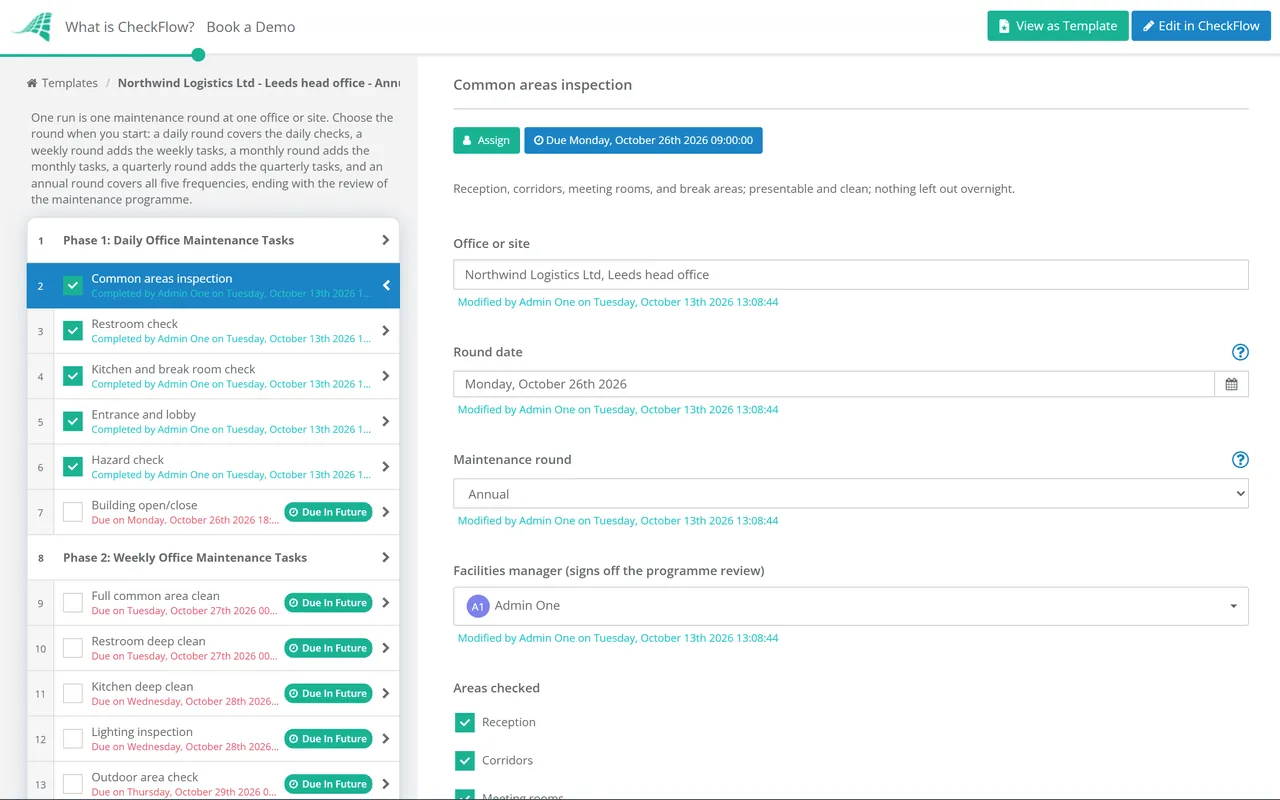
Five phases covering every maintenance frequency — from daily presentation checks through weekly deep cleans, monthly safety tasks, quarterly filter and battery replacements, and the annual contractor services.
Phase 1
Daily Office Maintenance Tasks
Common areas inspection — reception, corridors, meeting rooms, and break areas; presentable and clean; nothing left out overnight
Restroom check — soap, paper towels, and toilet tissue stocked; no obvious cleaning issues; cleaning record signed
Kitchen and break room check — surfaces clean; dishwasher run and emptied; communal appliances clean and functioning; nothing left on worktops
Entrance and lobby — clean and presentable; no clutter; signage correct; entry system functioning
Hazard check — any spills, trip hazards, broken furniture, or unsafe conditions noted and addressed immediately
Building open/close — at start and end of each day; security system armed/disarmed; all areas confirmed empty at close
Phase 2
Weekly Office Maintenance Tasks
Full common area clean — vacuum, mop, wipe surfaces, sanitise high-touch points (door handles, light switches, lift buttons)
Restroom deep clean — toilets, sinks, mirrors, floors; stock count and reorder as needed
Kitchen deep clean — fridge cleared and cleaned (weekly on a defined day); microwave and other communal appliances; coffee machine descaled if needed
Lighting inspection — walk every area; replace any failed bulbs immediately; log persistent failures for electrical investigation
Outdoor area check — car park, entrances, and smoking areas; litter removed; no hazards
Furniture and equipment condition check — any broken chairs, desks, or equipment reported for repair or replacement
Phase 3
Monthly Office Maintenance Tasks
HVAC visual check — accessible filters and grilles visually inspected; unusual noises or temperature complaints investigated
Fire extinguisher visual check — in correct location; pin and seal intact; pressure gauge in green; no visible damage
Emergency lighting function test — press and hold the test button on each unit; any non-functioning units replaced or reported for repair
Pest control inspection — check bait stations if in use; any signs of activity (droppings, damage, tracks) reported to pest control contractor
Consumables inventory — cleaning supplies, restroom consumables, kitchen consumables, stationery; reorder where at or below reorder point
Meeting room equipment check — screens, video conferencing systems, whiteboards, and markers; any defects raised for repair
Phase 4
Quarterly Office Maintenance Tasks
HVAC filter change — per manufacturer recommendation; log filter type and date in the equipment register; use correct MERV rating for the system
Smoke and CO detector battery replacement — for any units not on hardwired power; or test and service date of hardwired units
Emergency exit signage battery check — any sign not illuminating replaced or reported
Ventilation grille and diffuser cleaning — dust buildup on grilles affects air quality and HVAC efficiency
Carpet and upholstery deep clean — high-traffic areas; or as per maintenance contract
Plumbing check — run all infrequently used outlets to prevent Legionella risk; check under sinks for slow leaks
Phase 5
Annual Office Maintenance Tasks
HVAC annual service — by contracted HVAC engineer; comprehensive service and certification; service report filed in equipment register
Fire safety annual inspection — fire alarm, sprinklers, emergency lighting, and extinguishers by certified fire safety contractor; certificates on file
Electrical installation review — any concerns from the facility inspection referred to a qualified electrician; EICR on schedule
Window cleaning — external and internal; by contractor if windows are at height
Annual pest control treatment — full treatment of the building by contractor; not just bait station replenishment
Maintenance programme review — review the full maintenance schedule for the year; what changed? Any new equipment or areas to add? Any tasks that proved unnecessary?
Why Deferred Maintenance Costs More Than the Maintenance It Deferred
The HVAC filter that is not changed on schedule makes the system work harder, consuming more energy and placing more stress on the compressor. The compressor that is under stress fails sooner. The compressor replacement costs ten times the filter change that was deferred. The same logic applies to every maintained asset in a building: the small, low-cost maintenance task that is deferred compounds into a larger, higher-cost repair or replacement.
Research on commercial property maintenance consistently shows that for every £1 deferred in maintenance, £4 to £8 is eventually spent in corrective repairs. The structured maintenance schedule is not a cost — it is the mechanism by which the larger costs are prevented.
Why Run Your Office Maintenance Schedule in CheckFlow?
1
Every maintenance frequency running automatically, simultaneously
An office maintenance programme operates at five simultaneous frequencies — daily, weekly, monthly, quarterly, and annual — all running in parallel. CheckFlow’s recurring feature manages all five: the daily cleaning checklist starts every morning, the weekly deep clean generates every Monday, the monthly HVAC check appears on the first of the month, and the annual fire safety inspection runs on the date set at the start of the year. One platform manages the full maintenance calendar.

2
Maintenance tasks documented before any issue can be disputed
When a landlord disputes a maintenance claim, when an insurer queries the condition of a damaged system, or when a regulator asks how often the fire extinguishers were checked, the maintenance record answers the question. Every task completed through CheckFlow is timestamped, attributed to a named person, and archived — creating the maintenance record that makes these conversations straightforward rather than adversarial.
3
Consistent standards across multiple locations
An organisation with multiple offices needs the same maintenance standards applied consistently across all of them — not dependent on the diligence of each site’s office manager. CheckFlow deploys the same maintenance schedule to all sites, with completion tracked centrally, and reports the compliance rate across the portfolio.
The annual maintenance tasks in the maintenance schedule connect directly to the comprehensive facility inspection. CheckFlow’s Facility Inspection Checklist covers the full systematic inspection process. See the Facility Inspection Checklist →
Office maintenance requires a consistent supply of cleaning products, replacement parts, and consumables. CheckFlow’s Supply Ordering & Inventory Restock Checklist covers the structured procurement process for these supplies. See the Supply Ordering & Restock Checklist →
Other Operations & Facilities Management Checklist Templates
An office maintenance schedule covers five frequencies: daily (common area inspection, restroom checks, kitchen check, hazard response, building open/close), weekly (full common area clean, restroom and kitchen deep clean, lighting inspection, outdoor area check), monthly (HVAC visual, fire extinguisher check, emergency lighting test, pest inspection, consumables reorder), quarterly (HVAC filter change, battery replacements, ventilation cleaning, carpet deep clean, plumbing check), and annual (HVAC and fire safety contractor services, full facility inspection, window cleaning, pest treatment, and maintenance programme review).
How often should HVAC filters be changed in an office?
+
HVAC filter change frequency depends on the filter type, the system design, and occupancy conditions. As a general guideline for commercial office HVAC: basic pre-filters every 1–3 months; medium efficiency filters (MERV 8–13) every 3 months; high efficiency filters (MERV 14+) every 6–12 months. In an environment with high occupancy, nearby construction, or poor outdoor air quality, more frequent changes are required. Following the manufacturer’s recommendations for the specific system is the primary guide. Filters changed less frequently than required reduce air quality, increase energy consumption, and accelerate HVAC wear.
What maintenance records should an office keep?
+
Office maintenance records that should be retained include: fire extinguisher inspection records (monthly visual and annual service), emergency lighting test records (monthly and annual), HVAC service records (all services and filter changes), fire alarm and sprinkler system service certificates, pest control visit records and treatment logs, electrical installation reports, Legionella risk assessment and monitoring records (where applicable), and any reactive maintenance work orders and completion records. These records support insurance claims, regulatory inspections, lease disputes, and liability defence.
How does office maintenance affect employee productivity?
+
Research on workplace environment and productivity consistently shows that physical environment quality has a measurable impact on performance. Poor lighting reduces accuracy and increases fatigue. Temperature extremes from poorly maintained HVAC reduce concentration and output. Poor air quality from blocked HVAC filters is associated with increased sick days. And studies on the “broken window effect” suggest that a poorly maintained environment signals low standards, which normalises careless behaviour — while a well-maintained environment signals that the organisation values quality. The economic return from maintaining a well-functioning office environment consistently exceeds the maintenance cost.
Is CheckFlow free for this template?
+
You can start a free 14-day trial with no credit card required, giving you full access to all features including this template. The Business plan is $10 per user per month after the trial. Full details at checkflow.io/pricing.
Keep Every Office Maintenance Task on Schedule — Automatically
Free trial — no credit card required.
Do you like cookies? 🍪 We use cookies to ensure you get the best experience on our website. Learn more